
INSIDE BOOK 10
NEON: The Flying Carriage — Where Ash Town Held Its Breath — Book 10
Leonardo stood between the cage and the table with the Blue Spark Machine ready on its wheeled frame. The machine was ugly, crooked, and extremely offended by every sensible principle of furniture-making. Copper coils climbed round her body. Blue glass lungs pulsed under a brass guard. A row of little shard-sockets glowed with light as cold as winter stars.
Varric looked at her with professional disgust.
“You have given it wheels of different sizes,” he said.
“Correct,” said Leonardo.
“Why?”
“So enemies will underestimate her.”
“The enemy is a machine intelligence from another world.”
“All the more reason to be stylish.”
No one laughed.
Even Leonardo did not laugh for long.
In the next room, behind a half-open door, Madam Crumbolina slept in a small cot beside Brother Luc. The little mouse had one blanket over her body, one copper thread round her crystal paw, and one basin of blessed water beneath the bed, because Brother Luc had insisted on it and Ysabet had not had the strength to argue.
Madam Crumbolina’s blue paw ticked softly.
Not like a clock.
Like something pretending to be a clock in order to be invited indoors.
Brother Luc held one tiny mouse paw between his fingers and murmured the old prayers under his breath.
In the main room, the guild masters had drawn a chalk circle around the Patch Hunter’s table. Each guild had placed its own sign at one point of the circle.
Engineers: cog and compass.
Armourers: closed helm.
Weapons: crossed blades.
Mind Handlers: silver eye.
Alchemistry: blue drop.
Leonardo had placed nothing.
Varric had noticed.
“You do not mark your craft?” he asked.
“My craft is not foolish enough to stand in chalk and call itself safe.”
Hélène’s ears twitched. “That from the cat who brought a lightning machine indoors.”
“She likes rooms.”
The Blue Spark Machine gave a low hum, as if accepting the compliment.
Across the room, the assistants stood in a row pretending not to tremble. Perrin Cogwhisker clutched a slate. Mirelle Ironpaw held a roll of emergency straps. Marcel Knifelet had three knives and no idea which one would help. Tavin Blueglass carried salts, phials, and the expression of a young cat regretting every promotion he had ever desired. Seline Whisperbell, Oriel’s assistant, stood nearest the copper line that ran into the next room. Her whiskers quivered with every tick from Madam Crumbolina’s paw.
There was fear in the room.
There was also hunger.
Leonardo could smell both.
The guild masters had not come only to prevent disaster. That was what they said. That was what they had written in the report. That was what they would tell the king, the treasury, the ministers, and any elderly aunt with a purse and a taste for patriotic advancement.
But their eyes said more.
If the repair worked, they would not merely have fixed a rare machine. They would have identified, restored, awakened, and controlled a thing no guild of Paris-Neon had ever mastered. Apprentices could become masters from such work. Masters could become grandmasters. Grandmasters could become legends carved over stone gates.
And one Sentinel was never only one Sentinel.
One restored Patch Hunter could become a pattern.
A pattern could become a workshop.
A workshop could become an army.
Varric had said it once too carelessly over cold coffee.
“Imagine twenty of them guarding the city wall.”
Tarian had answered, “Imagine fifty on campaign.”
Hélène had said nothing, but Leonardo had seen her paw moving over armour thickness in the margin of her notes.
Oriel had smiled.
That smile had worried Leonardo most.
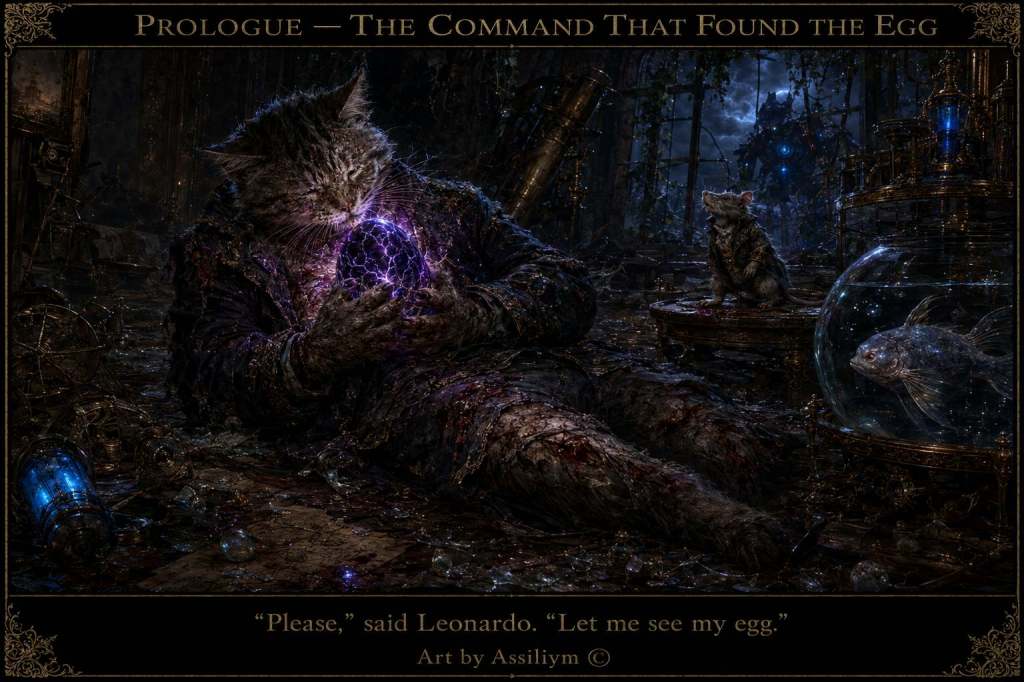
Leonardo looked at them both.
“A rat, a fish, and an engineer,” he murmured, “all attempted to save a stone egg from a murder-machine. I keep the finest mad household in Paris-Neon.”
“I heard that,” said a small voice above him.
Leonardo froze.
Lord Nibblewick froze.
Duchess sank lower in the basin.
A tiny spark fell through the air.
Zip.
It struck the floor near Leonardo’s paw.
Another followed.
Zip-zip.
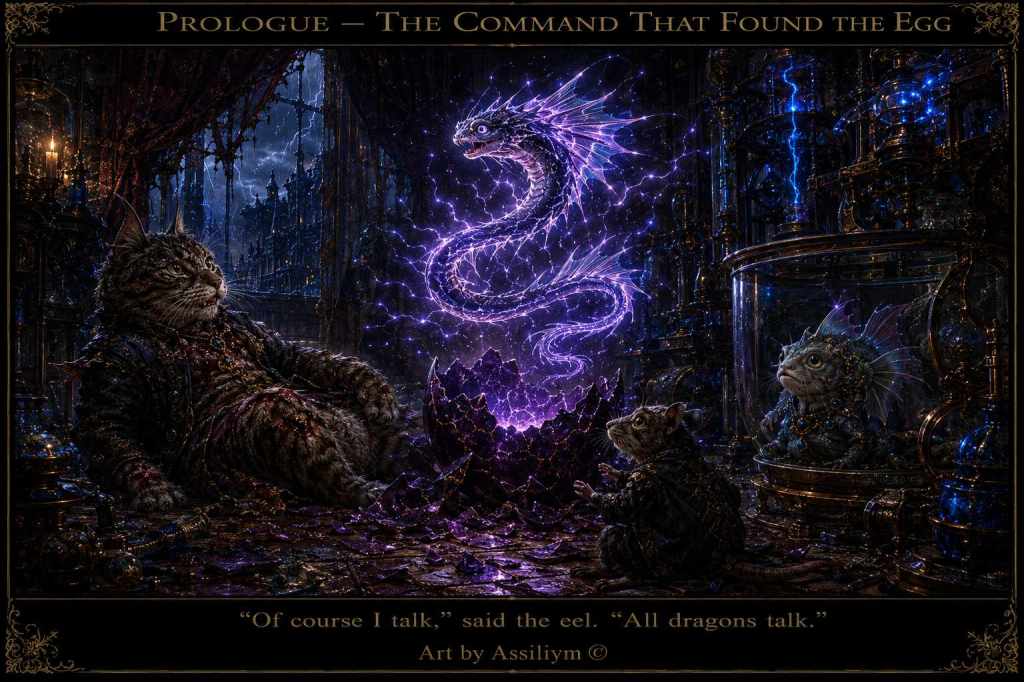
Then something long, silver-blue, and impossible curled out of the shadow above the broken curtain rail.
It was no larger than a scarf and considerably more offended. Its body shimmered like wet moonlight over storm-clouds. Little fin-wings trembled along its sides. Two absurdly long moustaches floated from its snout, each tipped with a bead of blue fire. Its belly glowed faintly violet, and tiny sparks dripped from its tail to the floor.
Leonardo closed his eyes.
He opened them again.
The flying eel was still there.
“Well?” said the flying eel.
Leonardo stared.
“Are you going to say something?” asked the eel.
“He talks,” whispered Leonardo.
Lord Nibblewick made a faint, suspicious “Hrr?”
“Of course I talk,” said the eel, with a tiny chuckle. “All dragons talk.”
Leonardo pushed himself into a sitting position with great care.
“You are not a dragon,” he said.
The little creature drew himself up to his full length, which was not impressive but was done with splendid arrogance.
“I am a dragon-eel.”
“You are a flying scarf with sparks.”
“I saved you.”
Leonardo’s face softened.
“Yes,” he said quietly. “You did.”
“You saved me first.”
For a moment neither of them spoke.
Then Leonardo sniffed, wiped his eyes with the back of his paw, and pointed at the little creature with as much dignity as a half-ruined inventor on a wet floor could gather.
“Very well,” he said. “Mr Sparky.”
The baby dragon-eel recoiled.
“Mr Sparky?”
“It is accurate.”
“It is not my name.”
“It is now.”
The creature lifted his head, his moustaches sparking with outrage.
“I am Thundraziel Voltrazimir, Last Coil of the Violet Sky, Keeper of the Purple Shell, Lord of the Blue Crackle, High Lord of the Nine-Storm Rivers.”
Leonardo blinked.
Lord Nibblewick sneezed.
Duchess made a bubble.
“Excellent,” said Leonardo. “Mr Fishy.”
The dragon-eel stared.
“Mr Fishy?”
“You are flying. You are slippery. You possess fins. Look at yourself in the mirror.”
“I am not a fish.”
“No,” said Leonardo, studying him. “Not exactly. More eel. A flying electric eel. With ancestral pretensions.”
“I am not Mr Fishy.”
“Very well,” said Leonardo. “I shall be generous. You may choose. Mr Fishy or Mr Sparky.”
The baby dragon-eel hovered in wounded silence.
A spark dropped from his tail.
Zip.
It landed on Lord Nibblewick.
The rat leapt straight up. His moustaches burst in every direction like frightened broom-bristles.
“Hrrr-CHK!”
Leonardo looked at him.
Then at the eel.
Then back at Lord Nibblewick.
A slow smile spread over Leonardo’s bruised face.
“Well,” he said. “If anyone owes me money, I now know precisely what to do.”
The dragon-eel tried not to look pleased.
“Sparky, then,” he said at last. “But I am not happy.”
“Mister Sparky,” said Leonardo.
“Not Mister,” said the eel-drake at once. “Lord Sparky.”
“No.”
“Prince Sparky, then.” The eel-drake’s eyes glittered. “You may choose. Prince or Lord.”
“Mister Sparky,” said Leonardo.
The little creature looked wounded to the end of his tail.
“It sounds better,” said Leonardo. “Also, I already have one lord in the house, and he chews boots.”
Lord Nibblewick, still smoking slightly at the moustaches, gave a deeply insulted “Hrr-chk.”
Mister Sparky drifted down until he hovered level with Leonardo’s nose.
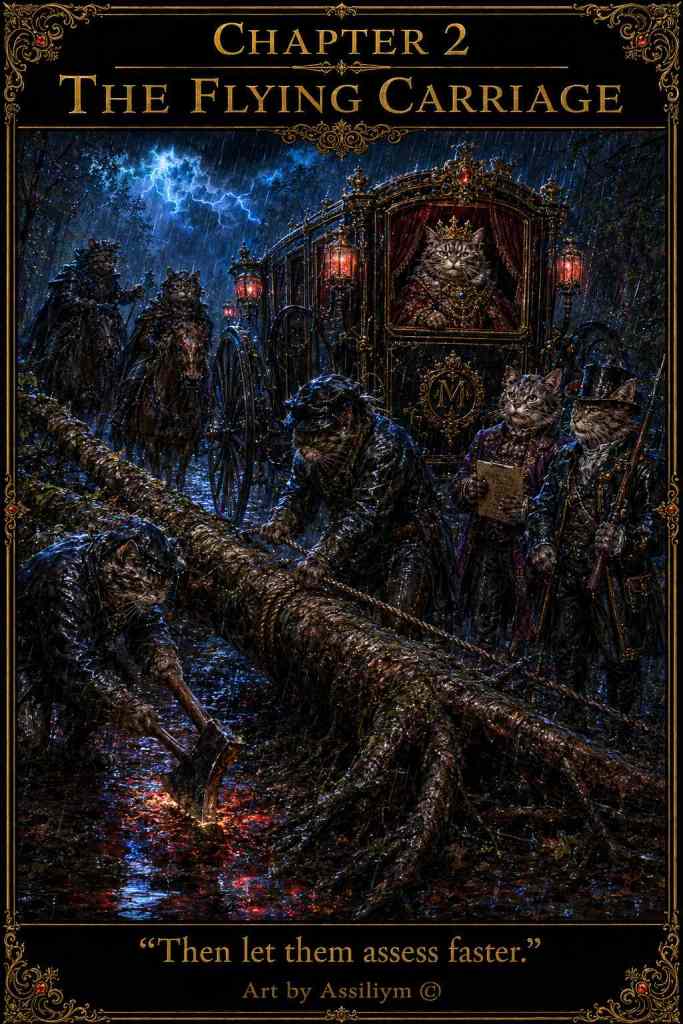
The old Queen Mother did not deceive herself. She knew very well that Paris-Neon had not turned northward in longing. The city had not suddenly remembered filial tenderness. Her son had not sent fresh apologies galloping south. Leonardo had not come for her. Eleonora had not yet returned. The capital had simply resumed its old appetite and had begun swallowing all that mattered without her. That, more than loneliness, had set her on the road.
And so the first two days passed under a strained, deceptive grace.
On the third morning the sky lowered.
It did not become ugly at once. First it merely thickened. The pale spring light dimmed as if a hand had gone slowly over the world’s lantern. The distant hills lost their edges. White cloud gathered in broad silent banks and then, by degrees, turned the colour of old pewter. The air became heavier. The horses tossed their heads more often. Birds dropped low over the hedges and vanished. In the fields, labouring cats looked upward more than once and then bent to their work with the sullen haste of creatures who know the sky has already decided against them.
Something else moved under that thickening, too small for the Queen Mother to name and too old for the servants to discuss honestly while royal ears were inside the carriage.
The first sign was not thunder. It was the horses. They had taken rain before. They had taken bad roads, steep pulls, shouted orders, worse drivers, and the peculiar burden of royal importance without once believing themselves consulted. But that morning, before the rain properly fell, the lead mare threw her head up and stared north-east, past hedges, fields, and hills, toward a distance no beast could have seen with ordinary eyes. The second horse stamped once, hard enough to splash mud against the traces though the road was still mostly dry.
Old Hervé Morel felt the ribbons tremble in his paws.
He did not look back into the carriage. He had served long enough to know that some things should not be explained to queens until they had already become history.
Above the road, a flock of small brown birds crossed from one hedge to the other, then broke in the middle as if an invisible paw had passed through them. For a breath they scattered upward, not away from the carriage but away from the sky itself. One struck a branch, recovered, and vanished into the wet leaves with a furious little cry.
One of the younger grooms crossed himself.
Hervé said, without turning his head, “Hands on your work.”
The groom obeyed.
But he muttered what his grandmother had muttered over winter fires when storm came without lightning and dogs would not leave the doorstep.
“Stone eggs dream before the old sky wakes.”
Hervé heard him.
He pretended not to.
By midday rain had begun.
Hervé drew the carriage up.
The sergeant stepped forward and saluted, though his face suggested he would have preferred to salute a thunderbolt from a safer distance.
“Road closed ahead,” he called above the weather. “By royal order and in the interest of safety. I’m afraid you cannot continue.”
The carriage window opened.
Marguarite looked out.
Rain blew at once through the opening and freckled the dark silk at her sleeve. The sergeant saw who she was, and whatever prepared speech he had been nursing under his hood went visibly to pieces.
“Madam,” he said, bowing lower. “Your Majesty. I beg pardon. The river has taken part of the bridge. The stones are under water. Another section may go at any time. It is most dangerous.”
Marguarite’s mouth moved in the faintest hint of amusement.
“Do I look frightened, Sergeant?”
“No, Madam. But the bridge—”
“Is it gone?”
The sergeant hesitated.
“No, Madam, but—”
“Then the road is not closed. It is merely inconvenient.”
The wind gusted so hard that one of the barrier ropes snapped loose and cracked against the turned cart.
“Madam,” said the sergeant, lowering his voice into the special pleading register by which minor officials attempt to save superiors from their own grandeur, “I know who you are. I would not answer for the crossing. The water’s washing over the stones. One parapet is gone. A section in the middle has dropped. We’ve turned back three carts and a grain wagon already.”
Marguarite leaned a fraction nearer the opening.
“Almost impossible is not impossible, Sergeant. Move aside.”
The sergeant closed his eyes once, very briefly, as if offering up his career to whatever saint concerned himself with doomed obedience.
“As you wish, Madam,” he said. “But I have warned you.”
He gave the order. The barrier was dragged clear. The turned cart hauled enough aside for the carriage to pass. One of the younger blue guards, seeing the old royal crest move through the rain toward the drowned approach, made the sign of the fish before Saint Celestine without realising he had done it.
Then he blinked.
For one breath — only one — he thought he saw the black carriage already on the far side of the river, its lamps blurred in the rain beside the inn roof beyond the rise.
He turned his head sharply.
There was nothing there.
Only flood, bridge, rain, and fear.
He looked back. The old royal carriage was still before him, still rolling towards the drowned stones.
The young guard said nothing. He was old enough to fear being laughed at, and young enough to fear being believed.
The bridge came into full view only when they were almost upon it.
The sergeant had not exaggerated.
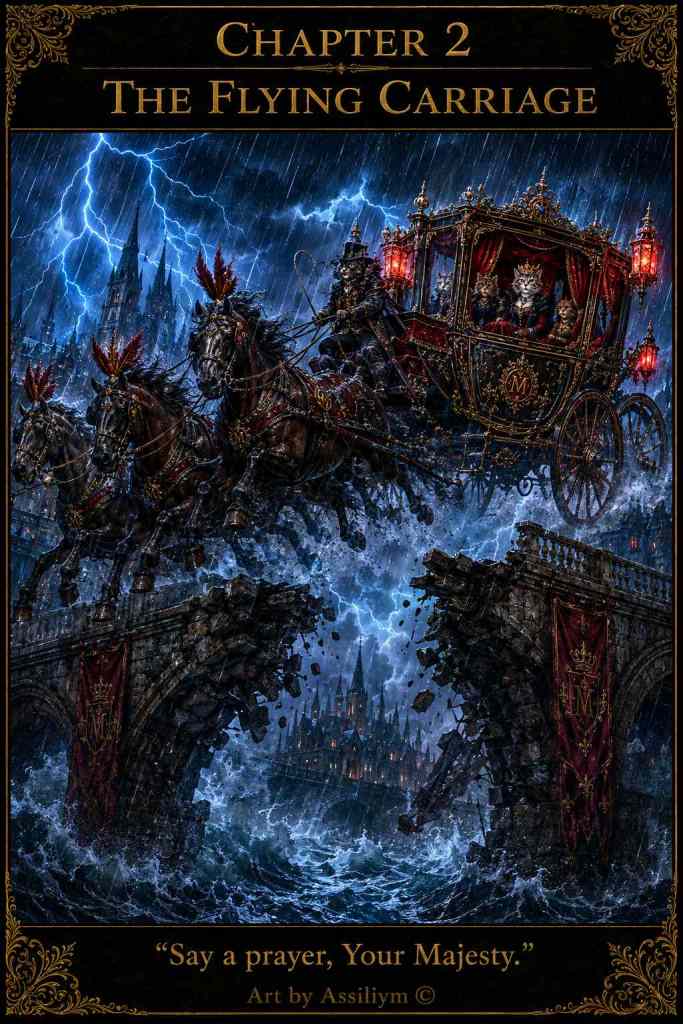
The river had burst every courtesy it had ever owed to its banks. It boiled brown and swollen beneath the bridge, carrying branches, fence rails, and whole spinning patches of uprooted reed in its violent body. Water washed over the first stretch of stone in broad racing sheets. The left parapet had been bitten away for several yards, leaving only a slick edge above the churning drop. Midway across, where the current struck hardest, one section of the roadway had collapsed inward, not into total ruin but into a broken jagged gap large enough to swallow a wheel and perhaps, if fortune took offence, half the carriage after it.
Hervé stared.
Rain streamed from the brim of his hat and ran down his whiskers. He measured the stones, the water, the horses, the angle, the weight, the gap, and the fact that there was no turning the carriage here without risking a slide backward into the flooded ditch behind them.
Marguarite’s voice came from within.
“Well?”
Hervé did not turn.
“If we are to cross, Madam, it must be now.”
“Can you do it?”
He looked once at the bridge, then once at the team.
“I can attempt it.”
It was the sort of answer royal households live on and rarely reward properly.
Marguarite said only, “Then attempt it.”
Hervé drew breath. “Say a prayer, Your Majesty.”
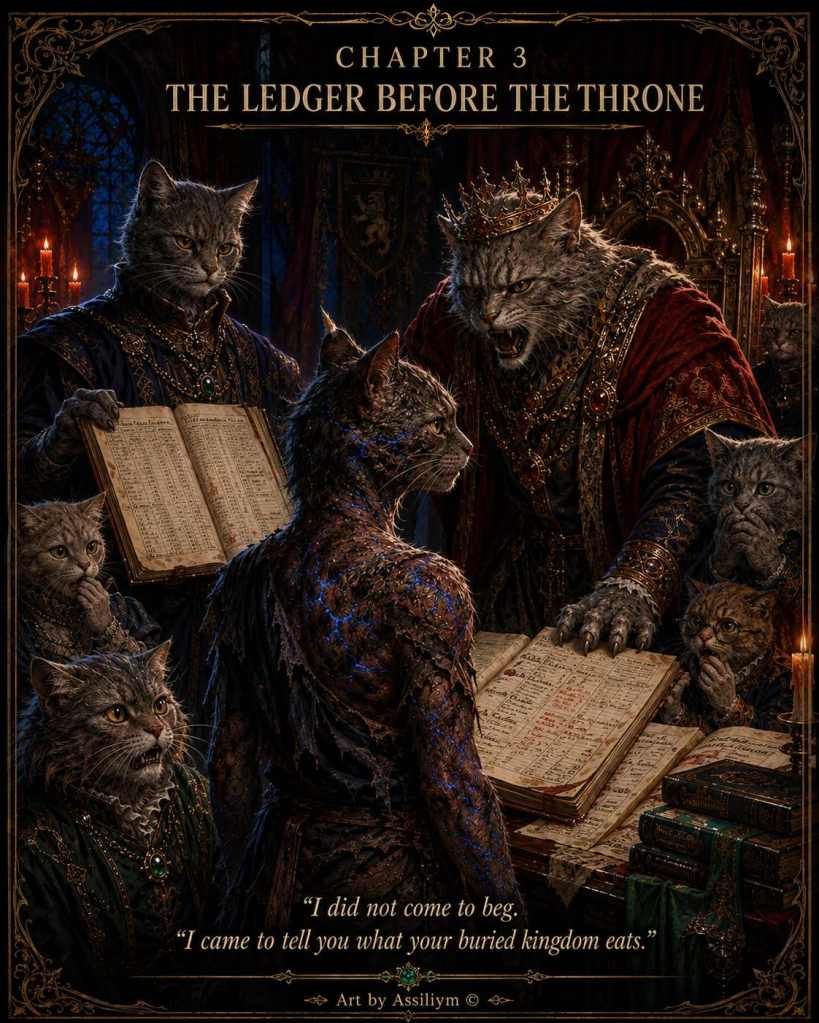
Henry’s gaze fixed upon him like a hooked blade.
“Speak.”
So Basti spoke.
He did not pour out misery in one wild broken flood. That would have gratified the room too cheaply. He spoke the way the worst truths are spoken: clearly, piece by piece, until each one had time to lodge.
He told them how the king’s food, which on paper descended whole, arrived already light. How baskets reached the wells with their bottoms half-empty and barrels with their bellies thinned. How dried fish meant for the tunnels often came down as skin and bone. How grain turned to sweepings by the time it reached the buried. How the weak waited while the strong pressed first to the drop points, because starvation teaches its own law and law below the city has little patience for sermons from above.
Then he spoke of the water.
That changed the room.
Food may be imagined in absence by full-bellied cats. Water cannot. It is too immediate, too old in the blood. Even Bellombre, who would have gambled on almost anything except genuine discomfort to himself, lowered his eyes at that part.
“The wells above are dry,” Basti said. “Or near enough. So what the guards and carriers do is pour casks down through the old mouths and hope it reaches. Some days it does. Some days it runs over the stone and down the cracks and into the dark faster than a thirsty paw can catch it. Cats wait below with broken pots, with old cups, with cans, with rags. The strongest get nearest. The weak hold cloth against the rock and suck the wet from it. Some lick the stone where the drips run. Some wait beneath bad water, stale water, green water, and thank it because it is wet.”
Henry’s face had gone to stone indeed.
Basti did not spare him.
“And yes, Majesty,” he said, “some guards have made sport of it. They laugh while the buried scramble. They pour from too high to watch the splash. They waste what they would not give a kennel beast. Once, one of them pissed after the water to hear the cats below curse and cry.”
Bellombre made a tiny sound of disgust.
Valmire shut his eyes for one heartbeat only.
Henry did not move.
The old king’s body seemed to have entered that dangerous stillness by which fury ceases to be merely an emotion and becomes judgement in formation. Basti saw it and did not step back.
“We are below because you sent us below,” he said. “That is true. But we are not dead. We have to fight every day for scraps that were meant to be ours before they were stolen. We have to drink from rock and runoff while your books say we were supplied. I came to tell you that the theft was not only of food. It was of your word.”
That landed.
One could see it land.
The old king’s nostrils flared. The scar at the side of his jaw, faint and usually hidden in fur, showed a shade whiter.
“My word,” he said.
“Yes, Majesty.”
Henry turned slowly and looked down at the opened ledger on the table.
The pages seemed now less paper than insult.
He drew in breath.
When he spoke, the room shook with it.
“I want them all here.”
The chamberlain started as though clawed.
“Every one,” Henry roared. “Pell, Sorn, Vale, and if Baron Oriel de Vaugren is in bed, in prayer, at table, or in a mistress’s lap, drag him from it. I want them before me while the ink is still wet enough to drown them in. Move!”
The chamberlain vanished.
Henry pointed one shaking claw at Vale, who had already begun trying to melt into the furniture.
“You. Stay.”
Vale collapsed to his knees.
“Sire, mercy—”
“Be silent until I have leisure to despise you properly.”
Vale obeyed at once, because royal contempt has one virtue over philosophy: it clarifies.
Henry turned back to Montreuil.
“You are certain of the route?”
“Every stage, Sire.”
“You have the original books?”
“I do.”
“And witnesses below?”
“I have one here,” said Montreuil, glancing at Basti. “And more, if Your Majesty wishes to hear them one by one until dawn grows old and ashamed of us.”
Henry gave a short, savage nod.
“We may yet.”
Then he looked again at Basti.
The young tom had not moved. The lamp showed every scar upon him and made no attempt to flatter any of them. Yet the king’s gaze now contained something besides astonishment. It contained recognition, though of what exact kind even Henry himself may not have known: perhaps courage, perhaps fury, perhaps the simple brutal respect of one kingdom confronted by another that had survived without permission.
“What would you have me do?” he asked.
It was not a tender question. Kings do not suddenly become parish priests because the truth has bruised them. Yet it was a real one.
Basti bowed once more.
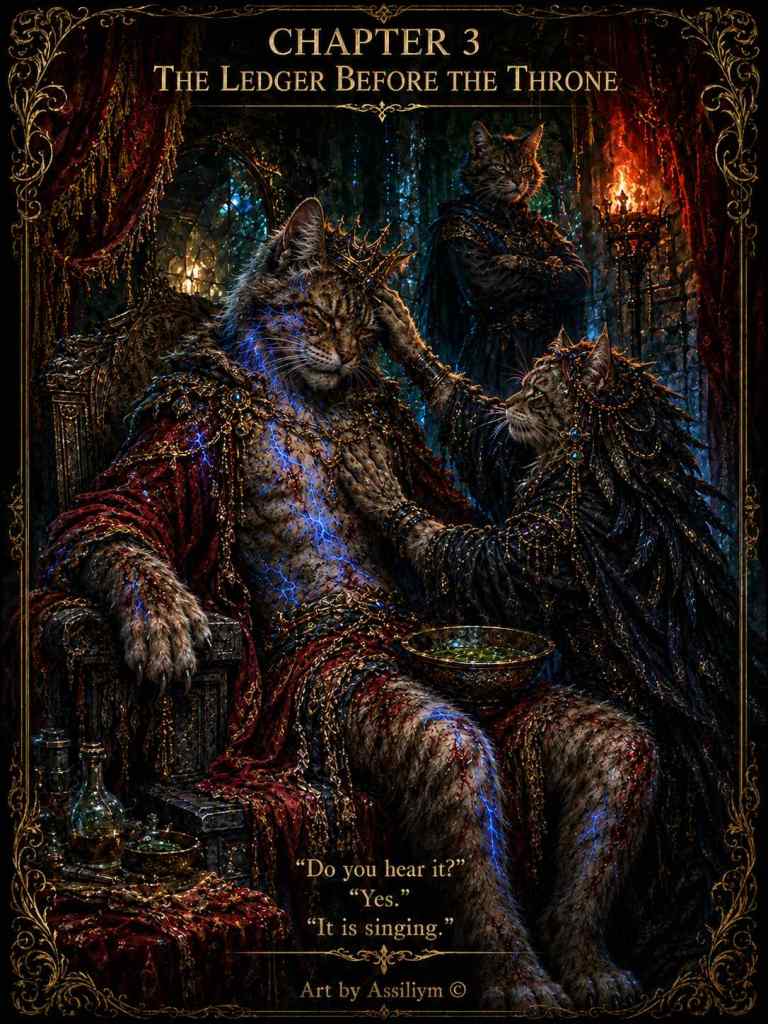
Below, another kingdom reorganised itself around the possibility of fairness.
And as the first properly counted provisions began at last to descend into the lower court under royal order, the buried watched Basti move among the carts and casks with the hood back and the scars plain to see, and they understood that something had changed which no thief, clerk, or noble now hauled away in secret could easily undo.
He had gone up alone.
He had returned with the king.
Basti woke with a sound caught in his throat.
The underground throne room returned badly.
First the damp. Then the torch-smoke. Then the weight of the chair beneath him. Then the blue ache moving through his scars like cold insects under the skin.
Little Crow was still beside him.
Her paw held the wet cloth against his brow. Her face was pale beneath the black feathers of her cloak.
“You were dreaming,” she said.
Basti swallowed.
The Root-Voice hummed once more.
Low.
Almost pleased.
“I went up once,” he whispered.
Little Crow did not ask where. She knew. Perhaps not the whole of it, not every chamber, every page, every word King Henry had spoken, but enough. Little Crow always knew enough to frighten mercy into honesty.
“For the hungry,” Basti said.
Little Crow’s eyes softened.
“And now?”
He looked past her to the throne room: to the patched chair, the damp walls, the guards in the shadows, the cats waiting beyond the curtains for orders, favours, punishments, bread, protection, fear.
The blue marks in his old scars brightened.
The demon-flower hummed again, but now, beneath its song, there was another rhythm.
Tik.
Tok.
Basti closed one paw over the arm of the throne.
“Now,” he said, “the hungry come to me.”
 Vuk Stribog