
INSIDE BOOK 11
Neon: The Lost Prince and the Thirteen Wounds
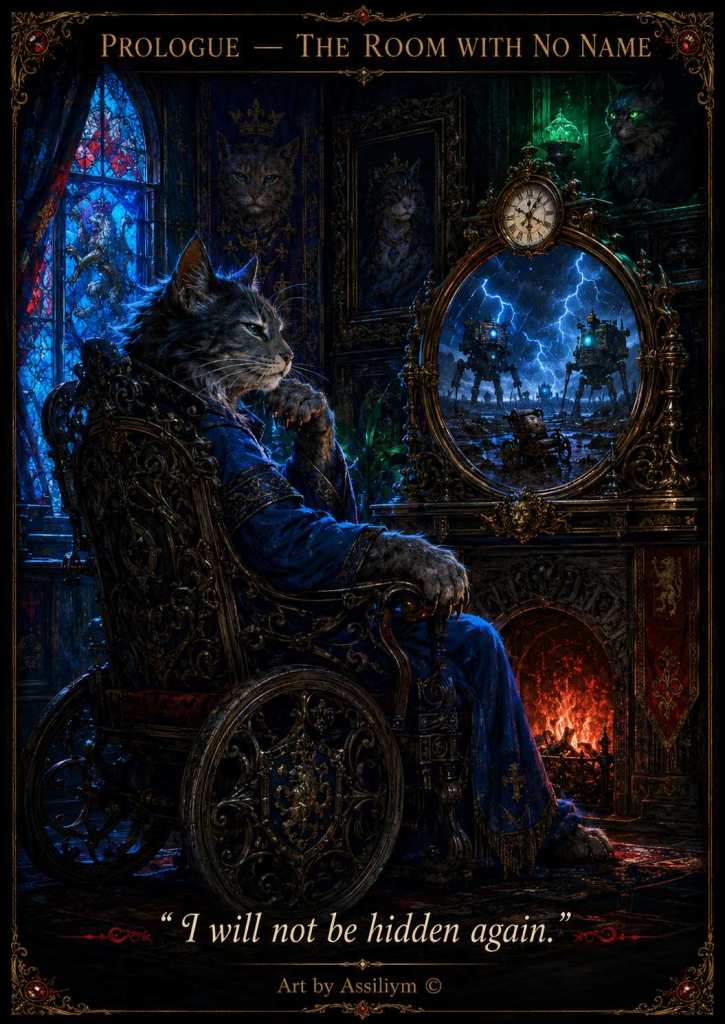
The room beyond was warm, though not comfortable. A fire burned low behind a brass guard. The curtains had been drawn nearly shut, leaving only a narrow seam through which Lucette entered and Mauve watched. Books stood in careful ranks along one wall. Maps lay weighted under stones on the table. A wheeled monastery chair rested near the window, its carved sides worn by use, its little brass rims polished by paws that had gripped them too often and too hard.
In the chair sat the cat whom the kingdom had buried without a grave.
Philippe.
Morel did not say the name aloud.
Not yet.
Names were doors. Some doors, once opened, could not be persuaded to close.
The hidden prince wore a dark robe trimmed in old blue. Not royal blue. Monastery blue. The colour of discipline, cold corridors, ink-stained claws, bells before dawn, and lives made small enough to be defensible. His body sat poorly in the chair, as though pain had argued with every joint and won several legal points. One shoulder rose higher than the other. His hind legs were covered with a wool rug despite the heat. His paws were thin, the right one slightly twisted at rest, though when he reached for a page it moved with precise authority.
His face did not ask to be forgiven for the body beneath it.
That, too, was dangerous.
He had Queen Marguarite’s eyes.
Older, perhaps.
Colder.
No, not colder, Morel thought. Clearer.
Cats who spend their lives in crowded courts often learn to look through others for advantage. Cats who spend their lives hidden learn to look through themselves first. Philippe’s gaze had that terrible education in it. He saw what entered. He saw what was concealed. He saw, Morel sometimes feared, all the words old servants had buried behind obedience.
“Morel,” Philippe said.
“My lord.”
“You bring supper as if it were treason.”
“In this house, my lord, supper may yet be charged with conspiracy.”
The corner of Philippe’s mouth moved.
It was not quite a smile. It was the memory of one, preserved for use when the world behaved absurdly enough to deserve it.
“Then set it down before it confesses.”
Morel crossed the room and placed the tray on the small table beside the chair. He uncovered the bowl. Broth, chicken, crushed herbs, a little barley. Food for illness, not appetite.
Philippe looked at it.
“The physician believes I am made of broth.”
“The physician believes every living creature is a badly arranged bottle.”
“That explains his conversation.”
Morel’s whiskers twitched despite himself.
It was a small mercy, humour. Not a cure. Never that. But a candle, perhaps, in a cellar where no one admitted the stairs existed.
Philippe lifted the spoon. His paw stiffened once before obeying. The movement was slight, almost invisible. Morel saw it. Philippe saw him seeing it.
“Do not look tragic,” Philippe said.
“I was arranging my face, my lord.”
“Arrange it elsewhere. I have mirrors enough.”
Morel bowed his head.
Philippe took two spoonfuls, then set the spoon down with the calm of a cat who had negotiated with his own body and rejected the latest terms.
“The Games continue tomorrow?”
“If the weather permits.”
“The weather is kinder than politics. It sometimes permits what it threatens.”
“His Majesty wishes the city to see strength.”
A silence followed.
Outside, a carriage passed in the street below. Iron on stone. Harness bells. A drunken cheer from some late-returning group of festival cats rose briefly, broke, and was swallowed by the night.
Philippe looked towards the thin seam between the curtains.
“Strength,” he said.
He did not say the word bitterly. That would have been easier. Bitterness is heat leaving a wound. This was cooler than that. Older.
“Cats always choose such simple altars.”
Morel did not answer.
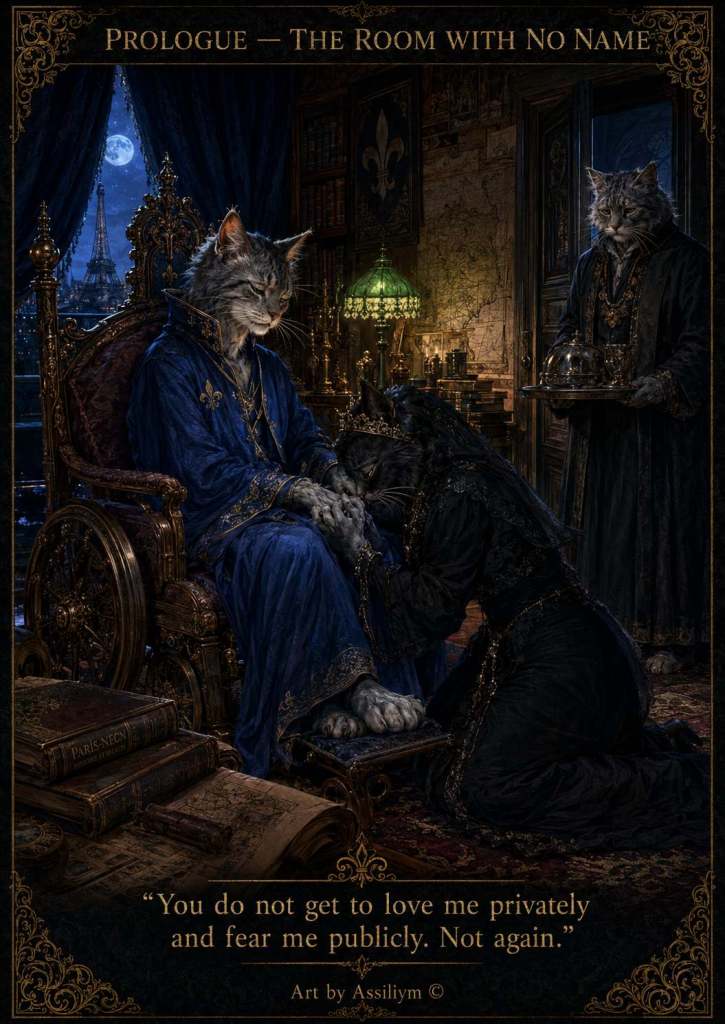
She crossed the room too quickly for dignity, too desperately for ceremony. Morel had never seen her move so, not even when the old king lay dying and all France seemed to be holding its breath in her sleeve. Her black mourning silk dragged against the carpet. One paw struck the side of the small table and made the covered medicine cup tremble.
Philippe turned his head.
“Mother,” he said.
The word was calm.
That made it worse.
Marguarite fell to her knees before his wheeled chair.
Not knelt.
Fell.
The sound of her old bones striking the carpet made Morel flinch.
“My son,” she whispered.
Then both her forepaws caught his thin paws and lifted them to her mouth. She kissed them once, twice, again, with the helpless hunger of a she-cat trying to kiss years back into place. His right paw, the twisted one, stiffened in her grasp. She did not let it go. She bowed her head over it as though it were a relic she had betrayed.
“My son. My little son. Forgive me.”
Philippe did not move.
Marguarite kissed his paws again.
“Forgive me. Forgive me for all those years. Forgive me for the pain. For the cold. For the silence. For the monastery. For every birthday I did not hold you. For every winter you thought yourself forgotten. Forgive me.”
Her voice failed on the last words.
The room held itself still.
Morel stood by the door with his head lowered, but he could not stop seeing. Some things are not meant for servants, yet servants are often the only witnesses history can afford.
Philippe looked down at her.
His face did not soften.
If anything, it hardened.
Not with cruelty. Cruelty would have been easier. Cruelty is a young blade. This was older, heavier, and more patient. It was anger that had survived long enough to learn grammar.
“You know, Mother,” he said quietly, “for many years I hated you.”
Marguarite’s paws tightened around his.
Philippe continued.
“You and Father both. I hated you in the chapel. I hated you when the bells rang before dawn and the monks told me gratitude was a virtue. I hated you when the other kittens asked why no family came for me. I hated you when my legs would not hold me. I hated you when winter entered the stones and no royal fire remembered my name.”
“Philippe—”
“No.”
The word struck harder because he did not shout.
He pulled his paw back from her kisses.
Or tried to.
His body obeyed slowly, badly, angrily. One forepaw gripped the arm of the chair. His shoulders trembled as he forced himself forward.
“No,” he said again. “You will listen. You have had years of silence from me. Tonight I will have words.”
Marguarite bowed her head.
He pushed himself upright.
Morel stepped forward without thinking.
Philippe’s eyes flashed.
“Do not.”
Morel froze.
Philippe tried to rise.
For one terrible moment he almost managed it. His paws gripped the carved chair arms until the knuckles whitened under fur. His shoulders lifted. His body dragged itself upward by will alone, as if the mind in him had declared war on every failed joint.
Then his weak hind paw slid.
His weight buckled.
Pain crossed his face, hot and naked, before pride slammed a door over it. He fell back into the chair with a harsh breath, one paw clutching the wool rug over his knees.
Marguarite gave a broken cry and reached for him.
He struck her paw away.
Not hard.
Enough.
“Look at me,” he said.
She was weeping now.
“Look at me.”
She lifted her face.
Philippe spread his forepaws slightly, a bitter, terrible invitation.
“Here is the monster you saved France from.”
“No.”
“Here is the vicious beast hidden in a monastery so no noble stomach would turn at the sight of him.”
“No, my son.”
“Look properly. Do not be royal about it. I am hideous, am I not? Crooked. Weak. Wrongly made. A poor argument against the portrait of kings.”
“No.”
Marguarite rose only enough to lean forward, then buried her face against his chest like a mother hiding from judgement in the very kitten she had wounded.
“No, my son. No. Never. You are not a monster. You were never a monster.”
Her words came into his robe, muffled and wet.
“You were my kitten. My first kitten. My little prince. I should have kept you. I should have held you before the court and let them choke on their judgement. I should have been braver.”
Philippe’s paws hovered at his sides.
He did not touch her.
“Then why were you not?”
The question was almost gentle.
That was its cruelty.
Marguarite lifted her head. Her face had lost all arrangement. No court painter would have known what to do with it. Sorrow had made it too honest.
“Because I was afraid.”
Sunken Wharf smelt of wet rope, rotting timber, bilge, tar, and the old cold patience of water that had watched too many crimes become business to be impressed by any of them.
The rain had gone off some while before, but its damp remained everywhere. It hung in the boards. It darkened the pilings. It sweated on the warehouse walls and clung to the low stone lanes between them. Lantern light leaked through cracks and shutter slits in long weak smears, as though even light came cautiously to that quarter and preferred not to be seen arriving. The tide moved blackly under the docks. Somewhere farther out, a chain knocked against a mast with a hollow little ringing sound, patient as a creditor.
It knocked once.
Then twice.
Then four times, though no honest chain had cause to make that count.
For one breath the water under the dock seemed to hold the sound instead of swallowing it. Then the river remembered itself and went on slapping the pilings in the dark.
Below the lower steps, river-moss clung to the stones in black-green beards. Little dock-crabs slipped beneath cracked planks. Salt-moths, pale as wet paper, worried the seams of old casks and beat themselves softly against lantern glass, as if even insects in Sunken Wharf came looking for contraband.
Hook Jan’s warehouse stood among the others with the modesty of a place that had no need to boast. It had old timbers, a warped loading door, flood marks on the lower stone, and a lantern above the side entrance whose yellow eye seemed to say that only fools came there by accident.
Inside, the ordinary stolen goods had already changed paws.
No sensible cat in Low Paris walked straight to a crime boss and asked for forbidden goods. Such requests travelled slantwise: through tavern keepers, dock porters, false chandlers, dice-room clerks, salvage widows, and cats who knew how to answer a question without admitting it had been asked. By the time a request reached Hook Jan’s warehouse, it had already been weighed, priced, tested for traps, and passed through the hidden channels of the lower city like dirty water through rotten boards.
Flour, meat, pears, lamp oil, and cheese had been counted, prodded, haggled over, and paid for in the usual way by which theft reassures itself with arithmetic. Hook Jan had taken the goods not lavishly, but well enough. Brick had pretended to negotiate. Stick had tried to look like a creature born to illegal commerce. Captain Morren Pike had watched the whole affair with the expression of a river cat who had once survived worse fools and expected to do so again if weather and providence remained lazy.
Now the ordinary business was done.
That was when Hook Jan, whose one paw lay flat on the scarred plank table while the hook of the other caught the lantern light in a dull crescent, turned his hard old face towards Brick and Stick and said, as if remembering some trifle no bigger than an unpaid cup of cider,
“I have one barrel that needs taking to the Dock District.”
Brick blinked.
Stick, who had not liked the look of the Wharf from the moment they entered it and liked extra errands even less, said, “Dock District?”
Hook Jan’s whiskers shifted with the ghost of a chuckle.
“Yes. The Dock District.”
“What are we to do with it?” asked Brick.
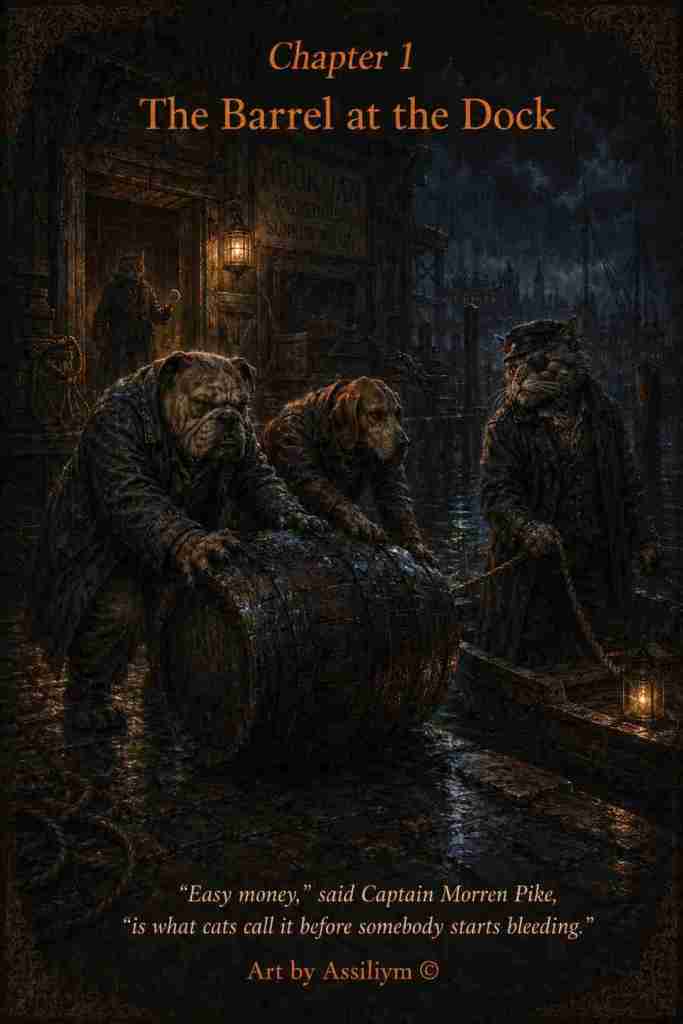
“Nothing,” said Hook Jan. “That is the beauty of the work. You roll it onto the boat. You take it over. You leave it at the end of the dock where Captain Morren Pike tells you. Then you go away and do not educate yourselves with questions.”
He drew out a small purse and tossed it onto the table.
It landed with a neat silver weight.
“I will pay you for that too.”
Now there are moments in every foolish career when caution walks into the room, looks round, sees what sort of minds it has been sent to govern, and leaves at once in offence. This was one of them.
Brick looked at the purse.
Stick looked at the barrel.
Captain Morren Pike looked at both dogs and saw, with the dry bitterness of old practical creatures, that payment had already decided the matter.
The barrel stood in the corner near the loading door, broader than a wine cask, bound with blackened iron hoops, its wood dark with damp. There was nothing outwardly remarkable about it. A barrel is one of the most innocent shapes in the world. It promises only storage. It suggests only grain, wine, dried fish, apples, salt beef, oil, or the other blunt respectable contents by which kingdoms move their appetites from one district to another.
This barrel had that very innocence.
Brick went to it first and gave it a testing shove with both paws.
It moved, but not lightly.
“Heavier than wine,” he muttered.
“Everything is heavier than wine if enough trouble has been put in it,” said Captain Morren Pike.
Stick came near and put one paw against the wood. It was cool. Wet. Ordinary.
Too ordinary.
“Who owns it?” he asked.
Hook Jan’s eyes went to him.
The hound had not yet learnt that there are quarters in a city where certain questions do not produce answers so much as prices.
“The owner,” said Hook Jan mildly, “will know where to find it.”
Stick held his tongue after that.
Brick, who had the broad courage of creatures less burdened than most by imagination, hooked his paws under one rim.
“Come on, then.”
For some while he did not know where he was.
The darkness was too close for room, too upright for grave, too wet for cellar. His head pounded with a slow murderous regularity. His left shoulder burned. One thigh had gone half numb. His ribs hurt when he breathed and hurt more when he tried not to. He lifted one paw and met curved staves inches from his face.
Barrel.
The word came into his mind not as thought, but as insult.
He was in a barrel.
Memory returned in crooked bursts. An alley. A message. The wrong turn, or perhaps the right one for somebody else. Hook Jan’s cats — or cats like them — out of the dark. One blow. Another. The sting of a knife or hook-point at the shoulder. The rag over the mouth. The taste of drug. Then nothing.
Now this.
He pushed against the boards.
The barrel rocked slightly under him.
Not ship-sway. Not road-jolt.
Dock.
He heard it then: water under timber. The slap and suck of it against pilings. Somewhere close by, the knock of a loose line. Farther off, a cargo chain dragging once over wood. He was not on a vessel. He had been brought somewhere and left.
Alive.
That was worse in its own way.
“Open up,” he croaked.
His throat felt lined with ash.
He swallowed and struck the boards with his paw.
“Open up!”
No answer.
He kicked then, hard as his cramped body allowed, and pain flashed through his side so bright that for one instant blackness swarmed again at the edge of sight.
“Open!” he rasped. “I am a king’s officer!”
The barrel did not tremble at rank.
He battered it again, weaker now, with shoulder and heel and both scraped paws. His breath came short. Sweat broke cold through his fur. He stopped only because the body, even humiliated, retains the right to collapse before pride has finished with it.
Then, at last, there came an answering sound from outside.
A scrape.
A mutter.
Another scrape, more deliberate.
Something pried at the top.
A blade or crowbar worked under the rim with the practised little patience of a cat opening other cats’ property. The lid shifted. Wet grey lantern-light sliced down into the dark.
A face appeared over the opening.
It was a narrow dockland tom with torn ears, rain-slick whiskers, one cheek scarred in a white seam, and the sharp quick eyes of a creature who had survived chiefly by arriving first at other animals’ misfortune. He wore a patched coat too thin for the season and had the look of one who could smell a hidden coin through three pockets and a prayer-book.
This was Sticky Rask, a lower-wharf thief called Sticky because his paws had a talent for coming away from any meeting with more than they brought to it.
Sticky blinked once.
Then his mouth curled.
“Well,” he said. “You’re drunk. That much I can tell.”
Vasili tried to rise, but the world tilted under him. His paws slipped against the inner wood. His voice came thick and ugly.
“Help me out.”
Sticky considered him.
“I don’t think,” he said, “that you need your boots.”
Before Vasili had fully understood the sentence, the dock thief had already moved. One paw shot down, gripped a boot top, and yanked. Vasili kicked out in delayed outrage, but the drug was still a swamp inside his bones. The boot came free. Then the second. Sticky tucked both under one foreleg with the calm efficiency of long practice.
“Stop,” Vasili snarled weakly.
Sticky ignored him and dipped into the torn coat, quick as a rat between barrels. He pulled out a few coins, a cord, a folded scrap, a blood-wet glove.
Then his claws struck something hidden deeper in the inner seam.
He frowned.
Drew it out.
Held it near the lantern.
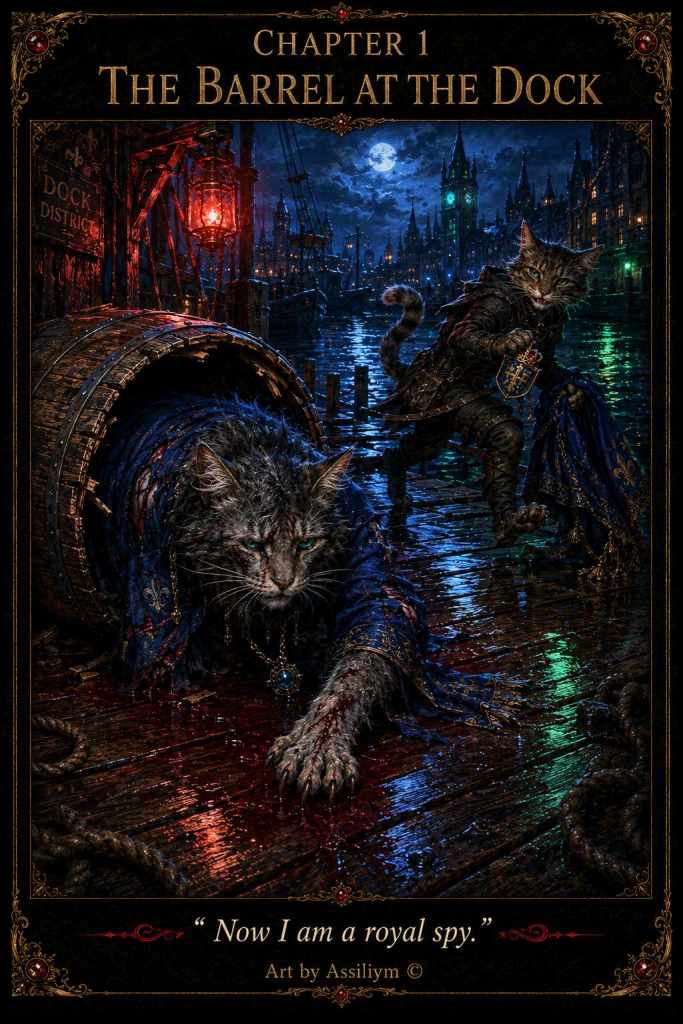
It was the small hidden badge, the one not worn openly, the one that bore the royal spy emblem worked plain and unmistakable to any cat unfortunate enough to recognise it.
Sticky froze.
For one bare heartbeat the dock, the water, and the whole breathing night stood still with him.
Then fear arrived — sharp, immediate, practical fear, the best sort because it wastes no time on philosophy.
Sticky looked from the badge to Vasili’s face.
Then back to the badge.
The badge ticked.
It had no spring. No wheel. No hidden works. It was only metal, seal, and authority. Yet it ticked once between Sticky’s claws, cold enough that his pads tightened around it.
The lantern flame narrowed.
In the polished rim of the badge, Sticky saw the barrel — not as it was now, open and wet under dock-light, but closed again, rolling through black water with Vasili trapped inside and Brick’s heavy paws against the rim.
The image slipped.
Now he saw Vasili limping barefoot through a pale street before dawn, his face bloodied, one paw pressed to the wall while the palace gate rose ahead like a judgement that had not yet learnt his name.
The image slipped again.
Now Sticky saw himself.
Not here. Not now. Rain fell hard in that little metal circle, harder than the weather above the dock. He was running through a narrow lane with the badge clutched against his chest, eyes wide, mouth open, coat torn, something unseen coming after him with a sound like iron counting teeth.
Then the badge became ordinary again.
Sticky stared at it.
Fear should have made him drop the thing. Instead, Low Paris did what Low Paris had always done to fear: it asked what fear might fetch if sold quickly.
A slow crooked grin began creeping over his mouth.
“This,” he murmured, “is very nice.”
Vasili reached upward, but his paw closed on empty air.
Sticky stepped back from the barrel, held the little badge up between two claws, and gave a breath of low delighted laughter.
“Now I am a royal spy.”
He snatched up the cloak as well, bundled boots and badge and cloth together, and ran.
Not hesitated. Not scrambled. Ran.
He vanished into the Dock District dark with the speed of a cat who has just stolen a future and means to survive long enough to find out what price it fetches.
Vasili stared after him through the spinning blur of drug and weakness.
“You coward,” he said.
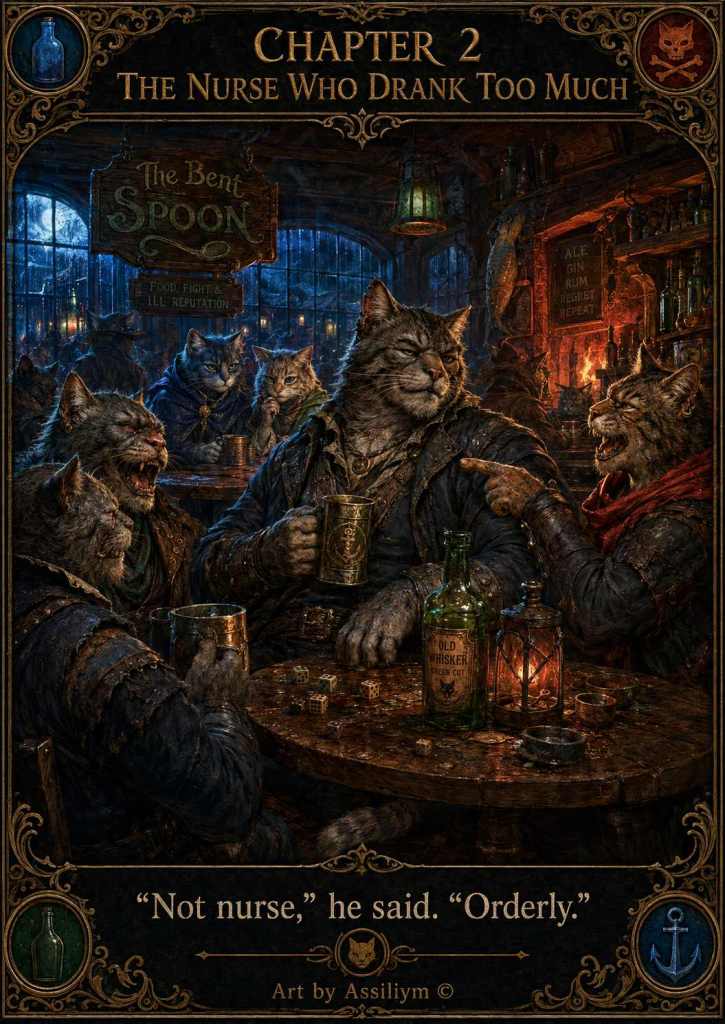
Apprentices came there when they did not wish their masters to know how badly they drank. Lesser clerks came to complain about senior clerks. Porters came to warm their paws. Cut-rate surgeons came to boast of operations the patient had, by mercy or laziness, survived. Laundresses came in twos and spoke softly over hot onion cups. Knife-cats came alone and watched doors. A few guild assistants, if their business had run late and their courage had run thin, came for one cup and left after three.
That evening the rain had made a damp argument of the city. It slid from roof tiles, tapped at shutter edges, silvered the gutter stones, and gathered under cart wheels in black little mirrors where Lucette and Mauve appeared broken into trembling pieces. The tavern windows sweated. The hearth smoked. A smell of wet wool, cheap ale, bone-willow brandy, fried river smelts, and old sawdust hung in the room with the patience of a debt collector.
At a table near the back sat Tavin Blueglass, junior assistant to Mistress Ysabet Blueflask of the Alchemistry Guild, with a cup he had not yet drunk from and a face that suggested his thoughts had been recently boiled and found unsafe.
Opposite him sat Seline Whisperbell, assistant of the Mind Handlers, neat-pawed, narrow-eyed, and too alert for any room which hoped to keep secrets cheaply.
They had not come to the Bent Spoon together for pleasure. No sane guild assistant sought pleasure that close to the medicine laundries.
They had come because Tavin had been sent to collect two small jars of winter-fixed alcohol from a supplier who had gone missing between his own back door and his own promises. Seline had been sent by Mistress Oriel Glass-Whisper to ask, discreetly, whether any of the minor medical houses possessed old sleep-mechanisms, patient bells, nerve chimes, or calming devices that could be purchased without exciting formal interest.
Both errands had failed.
The alcohol supplier’s wife had told Tavin that her husband was out. His apprentice had told Tavin that his master was ill. The neighbour had told Tavin that the supplier had run away because he owed money to a lamp-oil cat with one eye and no fondness for waiting. All three versions had possessed the depressing quality of being true.
Seline’s errand had been worse. Medical houses never admitted to having interesting devices until they had first decided whether the asking cat was rich, dangerous, official, or stupid. Since Seline looked poor in purse, dangerous in mind, unofficial in badge, and not stupid enough to be profitable, every door had become polite.
So they sat in the Bent Spoon, damp, annoyed, and silent, while the tavern gave itself over to the ordinary music of late drinking: cups, coughs, mutters, dice, lies, and the sigh of a room that had worked all day and found civilisation unimproved by the effort.
Then the door opened.
A large tom came in under the lintel as if the tavern owed him space and had better remember the fact quickly.
He was broad through the shoulders, thick in the neck, and moved with the heavy economy of a cat who had once settled arguments by putting other cats through furniture. His coat was cleaner than the room deserved. His boots were decent. His paws were scrubbed, though the scars at the knuckles had not accepted the washing as an explanation. One ear had been torn years ago and healed in the shape of an accusation.
Tavin glanced up, then down again.
Seline did not move her head, but her ears changed.
The newcomer stamped rain from his boots and went to the bar.
“Brune Caskel,” said a voice from the corner.
The large tom stopped.
At a round table near the hearth, three rough cats had turned to stare at him. They had the look of creatures who had once been young together in places where youth is merely the season before arrest. One had a flattened nose. One had a split lower lip. The third wore a red scarf and smiled with all the warmth of a lockpick.
“Well, well,” said Red Scarf. “If it is not Brune Caskel.”
The big tom’s shoulders tightened.
The room noticed, because rooms of that sort notice tightening shoulders the way priests notice blasphemy and creditors notice windows.
“Thought you’d died,” said Split Lip.
“Worse,” said Flat Nose, leaning back. “He’s clean.”
That brought laughter.
Brune Caskel turned slowly. He had the hard, controlled face of a cat deciding whether old friendship excused present insult. For a moment the tavern weighed the possibilities and judged them rich.
Then Brune grunted.
“Still ugly, Jorran.”
Flat Nose put one paw to his chest.
“Still honest.”
“You were never honest.”
“Compared with present company, I’m a chapel bell.”
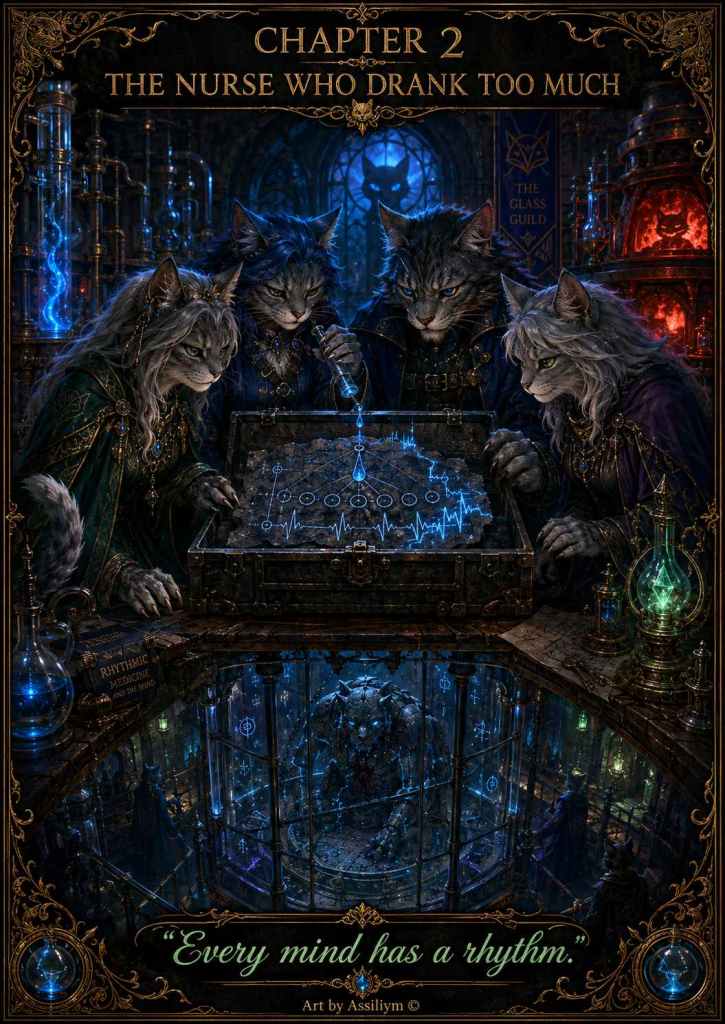
In the Guild Hall, behind locked doors, a damaged Sentinel waited with dead channels and half-woken blood. Mistress Ysabet could make blue liquid that crawled, repaired, thickened, crystallised, remembered, disobeyed, and sometimes tried to become something that looked too much like a vein. Master Varric could repair housings, braces, sockets, and joints. Master Tarian could rebuild claws and needles. Mistress Hélène could fit armour plates to a body that seemed to resent being touched. Mistress Oriel could make the machine listen.
But the stolen clock was gone.
Red Apple had taken the trusted rhythm-case — the black-brass one with the blue bead under glass, the rhythm that had once taught machine-blood to wake without immediately becoming a disaster.
Since then the guilds had possessed parts, notes, guesses, pride, and danger.
They did not possess rhythm.
At the corner table, Brune’s bragging went on.
“Some patients talk in sleep after,” he said, lowering his voice because even drunken pride remembered certain doors. “Doctor writes it down. Dream-speech, he calls it. Words they don’t know awake. Names of dead cats. Places that never were. One little climber-kitten sang numbers for half an hour after the clock and the draught. Didn’t know numbers before, they said.”
Red Scarf whistled softly.
“And you stay there?”
Brune’s mouth twisted.
“I have keys.”
That, perhaps, was the whole of him.
Not healer. Not nurse. Not monster in his own opinion. A cat who had once held corners by fist and now held corridors by key. The House of Quiet Minds had not changed Brune Caskel. It had only washed his paws and given his violence a schedule.
Seline rose.
Tavin looked up at her.
“Now?” he murmured.
“Now,” she said.
They left coin by their cups and moved towards the door with the unhurried care of cats who had learned that haste is a kind of confession. Behind them, Brune Caskel laughed too loudly at something one of his old friends had said. The Quiet Clock lived on in the room after his imitation of it, not as sound but as possibility.
Outside, rain struck the street in thin silver lines.
Tavin pulled his hood up.
“Moon-poppy,” he said.
“Clock,” said Seline.
They walked quickly.
The Guild Quarter did not sleep so much as deny exhaustion by committee. Even late, light showed behind high windows. Furnaces glowed red through grates. A hammer sounded once, then once again, then stopped as if reprimanded. Somewhere a journeymaker was coughing over filings. Somewhere a master was discovering that pride remains awake long after the body has filed a complaint.
Mistress Ysabet Blueflask received Tavin in the Alchemistry rooms with her sleeves rolled, her whiskers acid-sharp, and three glass tubes before her.
In one, blue fluid lay still as enamel.
In the second, blue fluid trembled.
In the third, blue fluid had climbed halfway up the glass and was trying, with horrible patience, to become a thread.
“What?” she said, without looking up.
Tavin swallowed.
“I heard something.”
“I hope it was useful. Everything else is noise.”
“At the Bent Spoon. A House of Quiet Minds orderly. Brune Caskel.”
Ysabet’s paw stopped above the third tube.
“The House of Quiet Minds?”
“He spoke of moon-poppy draughts. Not ordinary sleep. Softening resistance. Memory. Will. Pain. He said enough of it makes even a name go soft.”
Ysabet turned then.
The thread in the tube reached a little higher.
Meanwhile, across the corridor and up one narrow stair, Seline Whisperbell stood before Mistress Oriel Glass-Whisper.
Oriel had not gone home. She rarely did now before the hour grew deeply unreasonable. She stood by the window of the Mind Handler chamber, calm and pale in the blue reflected glow from the locked lower hall where the Sentinel waited.
In waking life there was no blue in her veins.
No wound on her paw.
No mark in her eyes.
Only the composed alertness of a brilliant cat who had recently won a dangerous contest and was beginning to enjoy the obedience of the defeated.
“What did you hear?” Oriel asked.
Seline told her.
Not all at once. Carefully. The drunk orderly. The moon-poppy. The treatment room. The old clock. The rhythm not quite like ordinary ticking. The patients calming. The dream-speech. Doctor Vale’s saying.
Every mind has a rhythm.
Find it, soften it, and the patient stops fighting himself.
Oriel listened without interrupting.
When Seline finished, the room seemed quieter than before.
At last Oriel smiled.
Not widely.
Not warmly.
But with the delicate satisfaction of a cat hearing a lock confess that it owns a keyhole.
“How interesting,” she said.
Before Seline could answer, there came a soft knock. Tavin entered behind Mistress Ysabet, carrying a narrow iron box sealed first with blue wax and then with black, as if one warning had not satisfied the cat responsible.
“Archive fragment,” Ysabet said. “Filed under obsolete treatment instruments and ignored by six generations of competent fools.”
Oriel produced the key. Neither mistress asked how the other knew the box existed.
Inside lay one grey-blue leaf, scorched along two edges. It showed a pendulum, seven circles, and a line resembling a pulse. Ysabet placed a pinhead of diluted blue-shard solution upon the corner. The liquid did not spread. It travelled, following the drawn line and making new marks appear between the old ones.
The Blueprint explained nothing in words. It placed understanding directly behind the eyes: rhythm entering blood, blood carrying rhythm into nerve, nerve teaching thought to loosen its grip upon pain. Beneath that merciful design lay a colder one, showing how the same process became obedience if three returning lines were removed.
Oriel understood first. Ysabet understood next. Then Tavin and Seline understood enough to be harmed by it.
Tavin’s heartbeat separated into measures. Three parts salt. One part heat. Two pauses before binding. Every pulse suggested proportions for compounds he had never intended to make.
Seline heard the silence between ticks and discovered that silence was no longer empty. Something waited inside each pause, ready to receive a command. Later, one small stretch of her walk across the corridor would be missing from memory.
Ysabet’s paws remained steady, but alcohol, copper, ash, and glass lost their scents. She could name each substance and smell none of them until morning.
Oriel paid most quietly. The page took from her the ability to hear another cat hesitate without wondering where a command might be placed.
She shut the lid.
No one called these things payment. Guild cats preferred strain, reaction, exposure, temporary disturbance. Respectable language has buried many bodies without touching a shovel.
They left the fragment closed inside its box.
The fragment did not leave itself closed inside them.
Far below, behind iron and warded glass, the Sentinel stood motionless in its restraints.
Its damaged chest did not rise.
Its broken inner channels did not pulse.
Its empty command-space, which was not empty, waited in silence.
And somewhere beyond waking, behind the door Oriel did not know she still opened when she dreamed, something vast and wheeled and patient listened also.
Tik.
A pause.
Tok.
The sound was not in the room.
Not yet.
Leonardo began with the soldier.
Not because he wanted to.
Not because the Air-Eel had ceased whispering to him from the desk in the language of unfinished inventions.
Not because the monastery diagram had stopped lying open beneath its brass weights like a drowned saint pretending to be helpful.
He began with the soldier because Minister Adrien de Valmire had a grand-kitten, the grand-kitten had a birthday, and the Treasury had memories sharper than tax claws.
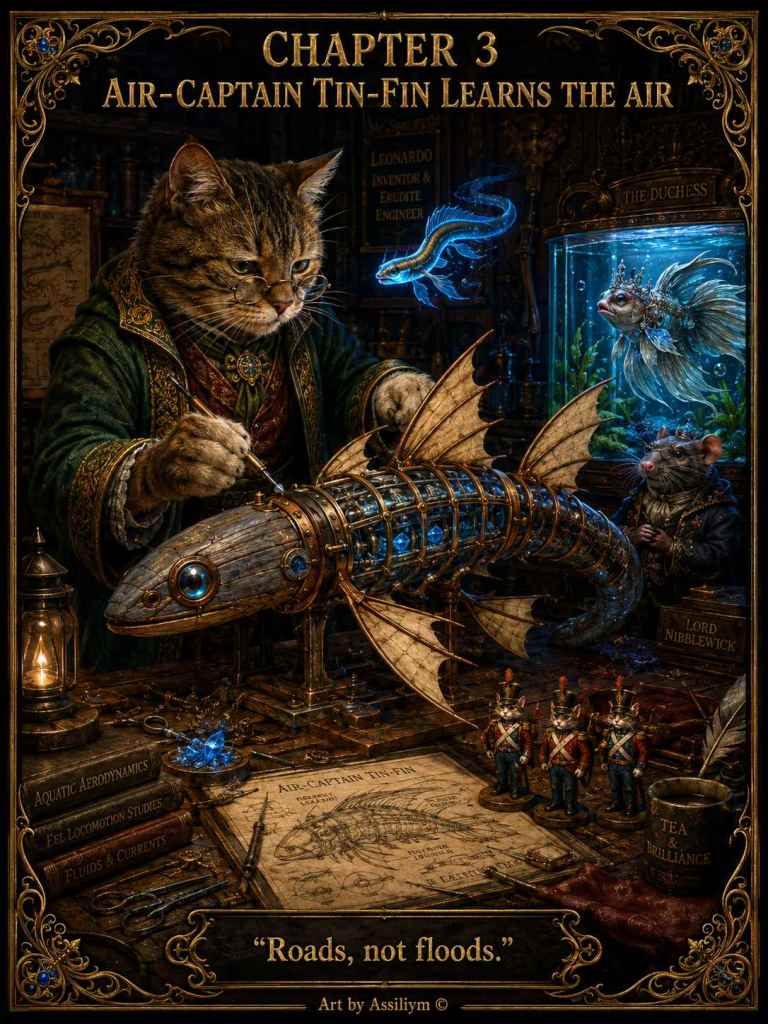
The third toy soldier lay on a cloth beside the lamp, drying with the tragic dignity of a veteran who had survived battle, drowning, lightning, and a duchess.
Its little tin body had been opened. Its marching spring lay beside it. Its sword had been removed, dried, polished, and placed well out of Lord Nibblewick’s reach. The painted hat had lost half its shine. One boot clicked when it should not. Its internal pin, warped by water, made the right leg kick forward with a courage more suitable to cavalry than nursery furniture.
Leonardo bent over it with his smallest screwdriver.
“You,” he told the soldier, “are not infantry any longer. You are a lesson.”
Lord Nibblewick sat on the corner of the desk, guarding the sword by staring at it with deep professional hunger.
“No,” said Leonardo.
Lord Nibblewick did not move.
“No military theft.”
Tchik.
“That sword belongs to the Minister’s grand-kitten.”
Lord Nibblewick’s whiskers suggested that possession was a flexible matter.
Leonardo pointed the screwdriver at him.
“Do not become a constitutional crisis with fur.”
Mr Sparky hovered from the curtain rod, his blue whiskers twitching with interest. The little eel-drake had been forbidden, in precise terms, from touching, sparking, rescuing, licking, warming, improving, training, inspecting, or emotionally supporting the toy soldier.
He had accepted all these restrictions badly.
“No,” said Leonardo, without looking up.
Mr Sparky chirruped.
“No.”
A smaller chirrup.
“No, not even a tiny encouragement.”
The Duchess watched from her volcanic cave-labyrinth with the grim silence of a sovereign whose borders had recently been violated by wet infantry. Only her eyes showed beneath the dark stone arch. The rescued toy soldier had, in her view, escaped justice.
Leonardo repaired the wet spring first.
He cleaned it with oil, warmed it gently above the lamp, wiped away the faint green beginning of corrosion, and reset its bite into the brass wheel. Then he replaced the warped pin with a straight one from the flea-market. Then he adjusted the edge-turner, the little curved piece of metal that ought to make the soldier turn at the end of a table instead of marching onward into aquariums, carpets, soup, or foreign policy.
“March,” Leonardo said, “but do not invade.”
The soldier clicked.
“Salute if necessary.”
Click.
“Do not drown.”
Click.
“And if any flying eel-drake attempts to rescue you, refuse.”
Mr Sparky gave an offended chirrup.
“I am making household law from experience.”
By the time the sun climbed over the roofs of Paris-Neon, the soldier stood whole again.
Leonardo placed all three soldiers at one end of the table.
Lord Nibblewick climbed onto a stack of papers for a better view.
Mr Sparky lowered himself until Leonardo glared.
The Duchess came halfway out of her cave.
“Witnesses,” said Leonardo. “You are here to observe the restoration of order.”
He wound the first soldier.
Click-click-click-click.
It marched straight, reached the end of the table, turned neatly, and returned.
Leonardo nodded.
“One.”
He wound the second.
It marched, saluted, lowered its foreleg without punching itself in the face, turned, and returned.
“Two.”
He lifted the third soldier.
The repaired invader.
The aquarium veteran.
The tiny criminal with a sword.
Leonardo looked at the Duchess.
“Madam, the army has been warned.”
The Duchess blew one bubble.
Leonardo placed the soldier on the table and wound it.
For one breath, nothing happened.
Then the soldier marched.
Click-click-click-click.
Straight.
Too straight, perhaps.
Leonardo’s paws hovered near it.
Lord Nibblewick’s whiskers stiffened.
Mr Sparky held his breath, if storms could be said to hold anything.
The soldier reached the edge of the table near the aquarium.
Leonardo’s ears flattened.
The little edge-turner clicked.
The soldier paused.
Turned.
And marched away from the aquarium.
Leonardo exhaled.
The Duchess remained very still.
The soldier returned to its brothers and halted.
All three stood in line.
The third raised its sword.
Not at the Duchess.
Not at the water.
Straight upward.
A clean little salute.
Leonardo bowed to the aquarium.
“Madam, the army has recognised your border.”
The Duchess stared.
Then she produced one suspicious bubble.
“I accept this as peace.”
Lord Nibblewick gave a proud chrrp, as if he had commanded the whole manoeuvre.
“No,” said Leonardo. “You did not train them.”
Chrrp.
“You stood on my invoice.”
Chrrp.
“Yes, perhaps that is leadership.”
Not as a beast.
Not yet.
As a question carefully made lighter.
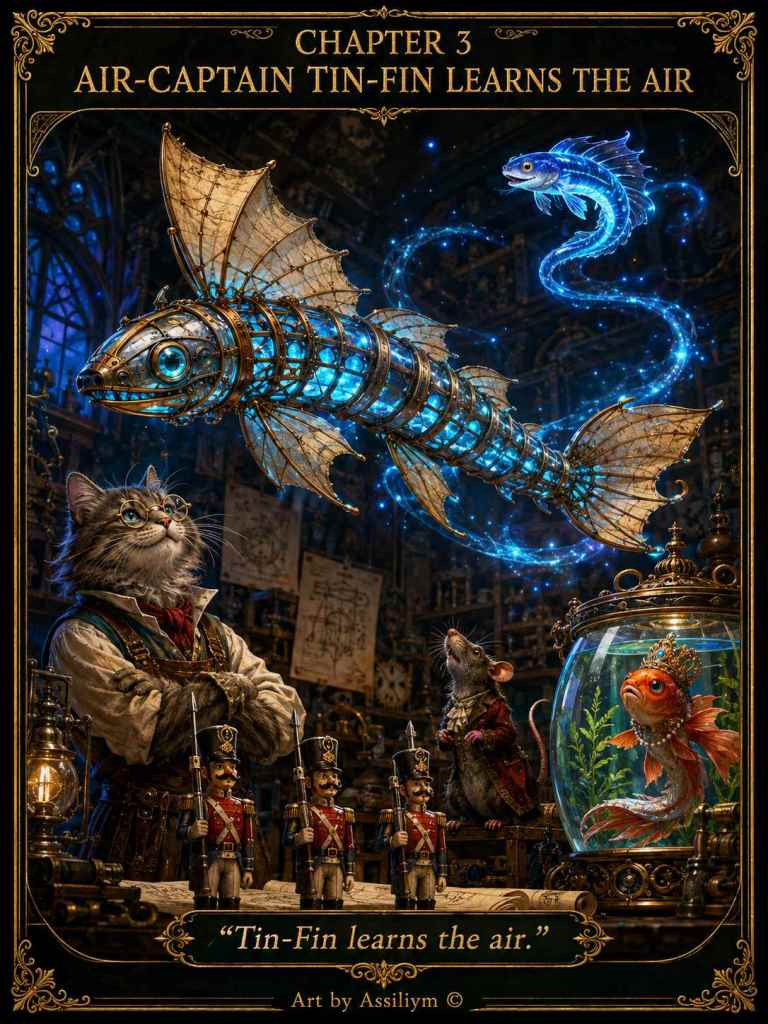
The head was hollow wood, shaped long and narrow, with tiny holes for whisker-wires and one cautious glass eye. The body began as reed ribs threaded through light copper rings, each ring separated from the next by little lacquered washers cut from old toy parts. Thin hammered tin plates covered the back, but each plate had been lacquered inside so the current could not rush wherever it pleased. The belly was left partly open, not from neglect but from wisdom: Leonardo wanted to see the little channels and sockets, and he wanted the machine to know he was watching.
The fins were parchment stretched over fan-ribs.
“Not wings,” he told Mr Sparky. “Do not be vulgar.”
Mr Sparky chirruped.
“Sky-fins.”
Lord Nibblewick gave tchik.
“Yes, the name needs work.”
The tail was made from the lighter fish segments, with a minnow-shard socket set near its base. Leonardo worked the tail twice, frowned, shaved one joint thinner, worked it again, and nodded.
“Better. Not strong. Clever.”
The Common shards came next.
They looked ridiculous beside the sealed Elder eel-shard. Tiny blue chips and bead-bright slivers, wrapped like sweets in little cloth squares. Leonardo opened each one with care.
The Common Reed-Bird shard flickered pale and quick.
“Left fin,” he said.
The Common River-Fly shard trembled whenever the desk moved.
“Right fin.”
The Common Minnow shard pulsed in a tiny silver-blue line.
“Tail correction.”
The Marsh-Beetle shard glowed dull and steady.
“Belly balance.”
The cracked little fish-shard he did not install. Not yet. He placed it in a testing ring beside the drawing and looked at it sternly.
“You may observe. You have not earned trust.”
Lord Nibblewick gave an approving chrrp.
“Yes, very good. Suspicion is the beginning of engineering.”
The Elder eel-shard remained in its glass tube until the body was ready.
Leonardo did not cut it.
He did not crack it.
He did not force it.
He made a central cradle of porcelain and silver wire beneath the wooden head, then set the tube inside so that the shard could pulse through the machine by contact and channel, not by naked hunger. Four thin copper paths ran from the cradle to the smaller Common shards, each path broken by a tiny porcelain bead so the current could not flood straight through.
“Roads,” Leonardo murmured. “Not floods.”
Mr Sparky drifted closer.
“No licking the roads.”
Mr Sparky pulled back, offended that such a thing had clearly been possible and now was forbidden.
The Duchess emerged farther from her cave, watching despite herself.
Leonardo saw her reflection in the glass and bowed without turning.
“You will note, Madam, the launch path is away from your sovereign waters.”
The Duchess gave no answer.
“That is generous of you.”
By late afternoon, the second Air-Eel lay ready on the table.
It was smaller than the first.
Lighter.
Stranger.
It did not look built to survive a siege. It looked built to survive air.
The tin along its back caught the lamplight softly. The parchment fins trembled whenever anyone breathed. The hollow head gave it an expression of foolish courage. Its little belly sockets glowed one by one as the Common shards settled into their duties: left, right, tail, balance.
Leonardo set it on a cradle made from two books and a folded cloth.
Lord Nibblewick stood on the shelf facing the aquarium, as if personally prepared to defend the border.
Mr Sparky hovered beside Leonardo’s shoulder, quivering with importance.
The Duchess watched from the cave mouth.
Leonardo raised one paw.
“First test of Air-Swimmer Experiment Two. No sparks except when requested. No sudden dives. No military rescue. No aquarium.”
Lord Nibblewick gave chik.
“Yes. Especially no aquarium.”
Leonardo touched the little activation pin.
The Elder eel-shard pulsed in its glass cradle.
The Air-Eel trembled.
The left fin opened.
The right fin answered.
The tail twitched.
The belly shard glowed dull and steady.
The Air-Eel rose.
Not much.
One inch.
Two.
It wobbled.
Leonardo did not breathe.
The left fin dipped. The Reed-Bird shard flickered. The right fin opened to answer. The tail corrected. The belly glow strengthened.
The wobble stopped.
The Air-Eel hung in the air.
Properly.
Crookedly, yes.
Ridiculously, yes.
But it hung.
Leonardo whispered, “There.”
Mr Sparky gave a tiny chirrup.
The Air-Eel clicked back.
Lord Nibblewick’s ears went up.
The Duchess forgot to hide.
The machine moved forward.
Not fast. Not like the first disaster. It did not lunge, bow, dive, or declare war on glass. It rippled. Head, spine, tail. The fins did not beat. They balanced. It travelled through the room as though the air were water too thin to trust but not too thin to swim.
Leonardo’s eyes shone.
“It is not flying like a bird,” he whispered. “It is swimming through falling.”
Mr Sparky darted beside it.
“No chasing.”
Mr Sparky chased.
Of course he chased.
But gently, for him. He circled the Air-Eel with bright delight, whiskers sparking once, twice, three times.
The Air-Eel answered with three little clicks.
Click-click-click.
Mr Sparky chirruped again and looped beneath it.
The Air-Eel dipped after him.
Leonardo stepped forward, alarmed.
The belly shard glowed.
The Air-Eel corrected itself and rose.
“Hah!” Leonardo cried. “It has manners!”
The machine turned towards the aquarium.
Lord Nibblewick sprang upright.
Chik-chik-chik!
The Duchess vanished into her cave.
Leonardo lifted both paws.
“No. No, no, no.”
The Air-Eel drifted nearer.
The Marsh-Beetle shard pulsed.
The tail minnow-shard flickered.
The machine turned away from the aquarium by a smooth, polite curve and headed instead towards the curtains.
Leonardo stared.
Then bowed deeply to the glass.
“Madam, it has recognised your borders.”
From the cave came one bubble.
“Suspicious peace accepted.”
The Air-Eel reached the curtain, bumped it softly, and hung there with its tail curling around the fabric.
Not caught.
Perched.
Mr Sparky hovered in front of it, eyes bright as little storms.
He chirruped.
The Air-Eel clicked.
He chirruped again.
The Air-Eel’s fins fluttered.
For one breath, living current and blue mimicry faced each other in the lamplight like two odd kittens discovering the same game.
Leonardo watched them.
Then he looked towards the door.
Beyond that door were servants, ministers, princes, spies, and cats who would understand a machine far more readily than they would understand a living eel-drake born from lightning and old dragon blood.
 Vuk Stribog