
INSIDE BOOK 12
NEON: The Hunger of the First Blue Page : When the Sentinel Dreamed
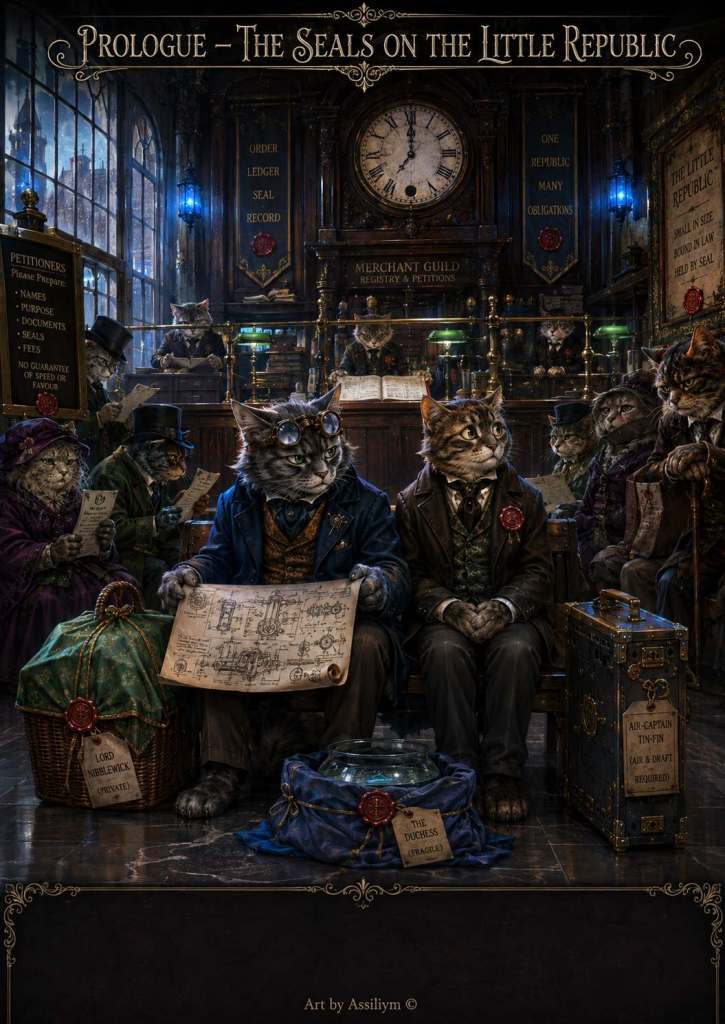
The clock in the Merchant Guild struck one.
Then two.
Then it coughed where three should have been, thought better of honesty, and struck four with the serene confidence of an institution which had miscounted time and intended to charge a fee for the correction.
No one in the waiting hall mentioned this.
That was one of the first lessons a cat learnt in the Merchant Guild: if a clock made a mistake, the clock had not erred; the petitioner had misunderstood procedure.
The hall itself had been designed by some ancient enemy of hope. It was too polished to be poor, too narrow to be grand, too expensive to be comfortable, and furnished throughout with benches that encouraged the spine to confess. Tall windows admitted a pale daylight which had been carefully filtered through dust, old glass, and the suspicion that sunshine, if allowed in freely, might give merchants ideas. Clerks moved behind brass rails. Ledgers lay open like graves with margins. Doors opened for cats who already knew where they were going and closed against cats who had merely arrived with reasons.
Leonardo sat on one of the benches with a roll of drawings across his knees, a covered basket by his left paw, a narrow travelling box by his right, a shallow glass bowl wrapped in blue cloth at his paws, and the expression of a tom who had been invited by civilisation to admire a damp wall.
Borel sat beside him in his best coat.
The coat had been brushed to a moral shine and buttoned with such determination that one feared for both button and publican. His hat lay on his knees. His ears stood too straight. His whiskers trembled with the delicate anguish of a cat who had brought honest documents to a place where honesty would almost certainly be asked to wait outside.
Around them sat the wounded of trade.
A spice-cat whose cinnamon had been impounded for smelling foreign in an undeclared manner. A widow with a crate of unlawful lace and the face of a saint who had mislaid a customs receipt. Two chandlers disputing whether candle-fat became political if supplied to the wrong chapel. A toy seller accused of selling blue-shard spinning tops to kittens with fathers in law. Three innkeepers, each pretending not to know the other two. A draper who had brought six samples, four arguments, and no useful papers. Near the far wall, a nervous tom kept stroking a parcel that ticked only when the clerk looked away.
Borel watched the doors.
Leonardo watched the clock.
The clock stood above the main desk in a case of dark wood, brass rim, and heavy self-importance. Its pendulum moved with a polished little certainty which offended Leonardo at once.
Tik.
Tok.
Pause.
Tik.
“There,” said Leonardo quietly.
Minister de Valmire walked forward as if he had not come to ruin anyone.
That made it worse.
Beside him came three kittens.
Tinwhistle carried a folded racing sheet in both paws and looked prepared to appeal to the gods if necessary. Clover-Top had the injured dignity of a champion whose greatness had not yet been properly printed. Poppy was already examining the room for climbable things, hidden sweets, and creatures that might belong to Leonardo.
“Grandfather,” whispered Poppy, loudly, “ask them now.”
“Hush,” said de Valmire.
“But Tinwhistle was champion.”
“I am aware.”
“Twice,” said Tinwhistle.
“I am painfully aware.”
“And Clover-Top says if the newspaper does not print it by tomorrow, it may not count.”
Clover-Top nodded with the grave air of a kitten who had discovered constitutional law behind a racing sheet.
“It is a matter of record, Grandfather.”
“So is debt,” said de Valmire. “Both are improved by patience.”
Poppy had already noticed Leonardo’s basket.
This was the beginning of disaster.
Leonardo saw the look in her eyes.
“No,” he said.
Poppy stopped, one paw already halfway to the cloth.
“No what?”
“No touching the basket.”
“What is in it?”
“Regret.”
Tinwhistle came closer.
“Does regret fly?”
“Sometimes,” said Leonardo. “Usually into windows.”
Borel stepped forward quickly, as if public friendliness might yet prevent private explosion.
“Your Excellency,” he said, bowing so deeply that his hat nearly entered a separate legal category. “This is an honour.”
Tinwhistle pointed at him.
“You stopped the newspaper.”
“I did not stop the newspaper,” said Borel faintly. “The Guild sealed the machines.”
Clover-Top pointed at Étienne.
“He stopped the newspaper.”
Étienne, still privately dying of dock-related causes, blinked.
“I beg your pardon?”
“You sealed Little Derby,” said Tinwhistle.
“And Rabbit Rush,” said Poppy.
“And Snake Greed,” said Clover-Top, with particular moral force.
“They are under review,” said Étienne, instinctively reaching for the safety of phrases.
Poppy drew herself up.
“Tinwhistle was champion.”
Tinwhistle nodded.
“Under Blue Rocket.”
“Old Gold,” said Clover-Top.
“No, Blue Rocket was the second race.”
“It was White Blaze.”
“It was not White Blaze.”
Borel opened his mouth.
Leonardo murmured, “Do not correct the Treasury’s kittens unless you have arranged your funeral.”
Borel shut his mouth.
At that exact moment Poppy lifted the corner of the basket cloth.
A sharp muzzle did not appear.
Something worse appeared first.
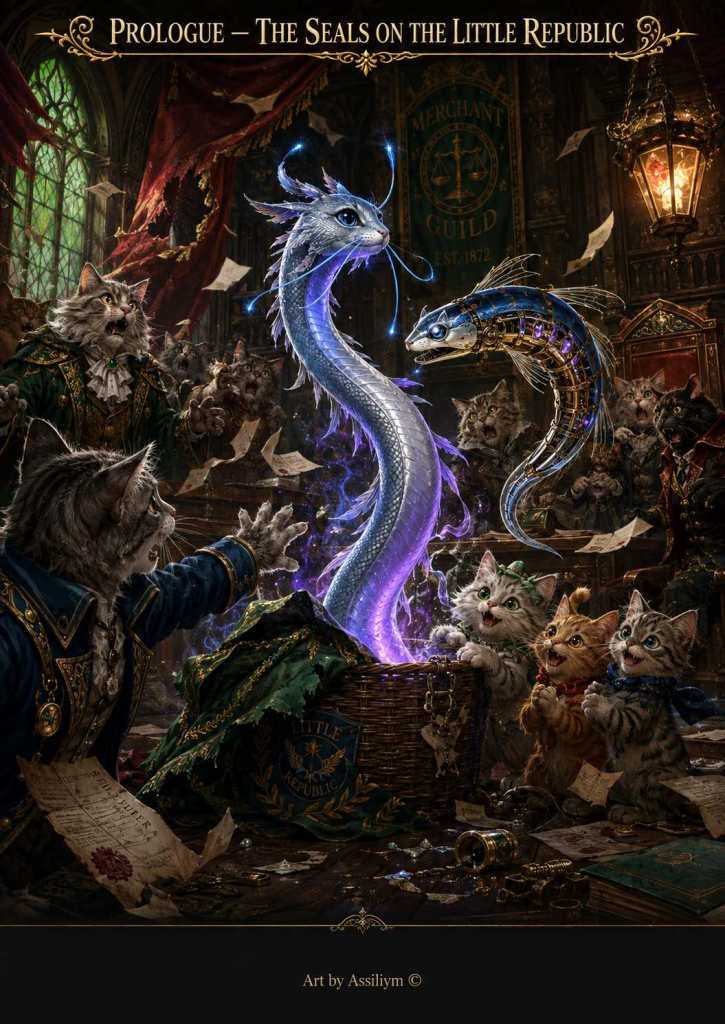
A long, silver-blue body curled out with the offended splendour of a living ribbon made of lightning, water, and hereditary arrogance. Tiny fins trembled along its sides. Two moustaches tipped with blue sparks floated from its snout. A violet glow ran under its belly like stormlight trapped in glass.
The entire waiting hall breathed in.
Mr Sparky rose from the basket.
Behind him, with a small metallic whirr, Air-Captain Tin-Fin also rose.
The mechanical eel unfolded in elegant imitation: blue-painted back, silver belly, little brass ribs, fin-wires trembling, shard sockets glowing faintly one after another as he corrected his own wobble.
For one impossible moment, the living eel-drake and the mechanical Air-Captain hovered side by side above the Merchant Guild floor.
Then the kittens screamed with joy.
Not fear.
Joy.
That was worse for order.
“Grandfather!” cried Poppy. “Flying fish!”
Minister de Valmire looked up.
He looked at Mr Sparky.
He looked at Air-Captain Tin-Fin.
He looked at Leonardo.
His face became the face of a treasury minister discovering that two more examples of Leonardo’s domestic policy had achieved altitude.
“Two more of your inventions,” he said.
“One,” said Leonardo quickly.
Mr Sparky turned on him.
“One?”
“Technically.”
“I am not an invention.”
“You were hatched in my house during a machine attack.”
“That is not engineering.”
“That is also what I told the floor.”
Tinwhistle pointed at Mr Sparky.
“He is beautiful.”
Air-Captain Tin-Fin clicked.
The mechanical eel turned a graceful loop, fins spreading. It was, irritatingly, beautiful too.
Mr Sparky saw everyone staring at Tin-Fin.
His whiskers sparked.
“I am more beautiful.”
The waiting hall went silent.
A clerk dropped his pen.
Étienne Delorme forgot Sunken Wharf for three full seconds.
Brick’s mouth fell open.
Stick whispered, “It talks.”
Brick whispered back, “Do not report that. We are not senior enough.”
Clover-Top took one delighted step forward.
“Can I touch him?”
Mr Sparky drew himself up.
“I am not him. I am Thundraziel Voltrazimir, Last Coil of the Violet Sky, Keeper of the Purple Shell, Lord of the Blue Crackle, High Lord of the Nine-Storm Rivers.”
The kittens stared.
Borel stared.
The clerk with the pen sat down without intending to.
Leonardo gave a tired bow.
“Mister Sparky.”
Mr Sparky recoiled as if struck by vulgarity.
“I am persecuted.”
Poppy bounced on her paws.
“I want to touch Mister Sparky.”
“Lord Sparky,” said Mr Sparky.
“No touching,” said Leonardo.
“Just one fin,” said Clover-Top.
“No touching the living lightning scarf.”
“I am not a scarf.”
“You are currently behaving like one with a title.”
Air-Captain Tin-Fin chose that moment to float in a perfect circle above Tinwhistle’s head.
Tinwhistle clapped both paws.
“I want that one!”
Mr Sparky’s eyes narrowed.
“That one is paint.”
Tin-Fin clicked, dipped, and floated with maddening grace past the chandelier.
The mechanical eel was silent, elegant, and utterly infuriating.
Mr Sparky shot after him.
“Do not admire him. He is hollow.”
Tin-Fin performed a loop.
Mr Sparky performed a better loop.
Tin-Fin glided through the air like a small blue prince of machinery.
Mr Sparky tried to glide through the air like a larger blue prince of ancestry and immediately tangled one moustache in the window drape.
The drape did not approve.
Neither did Mr Sparky.
There followed a short but educational struggle between royal textile, living dragon-eel, and natural pride. The curtain rod squealed. The drape tore halfway from its hooks. Mr Sparky spun once, twice, and shot free backwards.
He crashed onto a clerk’s desk.
The desk exploded into paper.
Not literally. That would have been less humiliating.
Forms leapt. Seals bounced. Registration slips fluttered into the air. A sand-box overturned. Three quills rolled. One wax stick shot across the polished floor and struck Brick between the claws.
Brick yelped.
Stick yelped because Brick yelped.
Pascal yelped because yelping had become infectious.
The clerk at the desk stared at Mr Sparky, who lay among the papers with his fins spread, moustaches sparking, and expression deeply offended by gravity.
“I beg your pardon,” said Leonardo, already running.
Air-Captain Tin-Fin floated behind him, graceful as a conscience that had never met the police.
“I am very sorry. The shard is defective.”
Mr Sparky lifted his head.
“I am not a shard.”
“The explanation is defective also,” said Leonardo, scooping him up. “Please keep still.”
“I was attacked by a curtain.”
“You insulted a machine.”
“It posed.”
“It hovered.”
“It posed.”
Leonardo pushed Mr Sparky gently but firmly back towards the basket.
Mr Sparky twisted round, dignity wounded from nose to tail.
Tin-Fin clicked overhead.
“Do not click at him,” Leonardo snapped. “You are not innocent. You were showing off.”
Tin-Fin clicked again and drifted, with appalling beauty, round the Treasury Minister’s shoulder.
The kittens sighed in worship.
“I want one,” said Tinwhistle.
“I want two,” said Poppy.
“I want one that talks,” said Clover-Top.
“No,” said Leonardo, de Valmire, Borel, Étienne, Pascal, Brick, Stick, and every clerk in the hall.
Lord Nibblewick chose that moment to emerge from the basket.
While every eye followed Air-Captain Tin-Fin’s graceful little circle round the Treasury Minister’s shoulder, another movement occurred much lower to the ground.
It was smaller.
Quieter.
More criminal.
A junior clerk at the side desk had made the mistake of bringing his luncheon into public service. It sat half-wrapped beside the inkstand: brown bread, butter, a thick cut of blue cheese, and a few leaves of pepper-cress pressed together with the innocent trust of food that had not yet met Lord Nibblewick.
From Leonardo’s basket came one tiny click.
Then another.
Then a narrow muzzle appeared beneath the cloth.
Lord Nibblewick smelled destiny.
No one saw him slip out.
That was partly because the entire hall was watching a living eel-drake argue with a flying mechanical eel, and partly because Lord Nibblewick moved with the practised dignity of a creature who believed theft became taxation if performed confidently enough.
He crossed the floor.
He reached the desk.
He rose on his hind legs.
The sandwich vanished.
Or rather, it began to vanish.
It was larger than he was, which troubled him not at all. Lord Nibblewick seized the blue-cheese edge in his teeth and dragged the whole prize backwards across the polished boards, leaving a faint trail of butter, crumbs, and magnificent intention.
He had almost reached Leonardo’s basket when the janitor saw him.
The janitor was an old tom with a broom, a bad knee, and the kind of hatred for rats which had survived three guild masters, two reforms, and one ceiling collapse. He lifted the broom with terrible purpose.
“Rat!” he cried. “Rat! Rat in the hall!”
The hall turned.
Lord Nibblewick froze with the sandwich in his mouth.
The janitor charged.
“No!” shouted Leonardo, leaping forward. “That is not a rat!”
The janitor stopped for half a heartbeat, broom raised.
Lord Nibblewick used the half heartbeat.
He dragged the sandwich another six inches.
“He has a tail,” said the janitor.
“That proves nothing,” said Leonardo.
“He has stolen Master Pellin’s luncheon!”
“Borrowed.”
“With his teeth!”
“Urgent borrowing.”
“He is a rat!”
“He is Lord Nibblewick,” said Leonardo, now between broom and criminal, “royal assistant, Master of Pipes and Mechanisms, domestic critic, and recognised authority on blue cheese.”
Lord Nibblewick, hearing his title properly announced, resumed dragging the sandwich.
The junior clerk stared at his empty paper.
“My luncheon,” he said faintly.
“I shall buy you another sandwich,” said Leonardo.
“With blue cheese?” asked the clerk, wounded by the scale of history.
“With blue cheese.”
Lord Nibblewick clicked from the shelter of the basket.
Leonardo glanced down.
“He says not too much blue cheese. It unsettles the public.”
The janitor still held the broom.
“Master Leonardo, that creature has taken food from a Guild desk.”
“He has taken evidence,” said Leonardo.
“Evidence of what?”
“Poor sandwich security.”
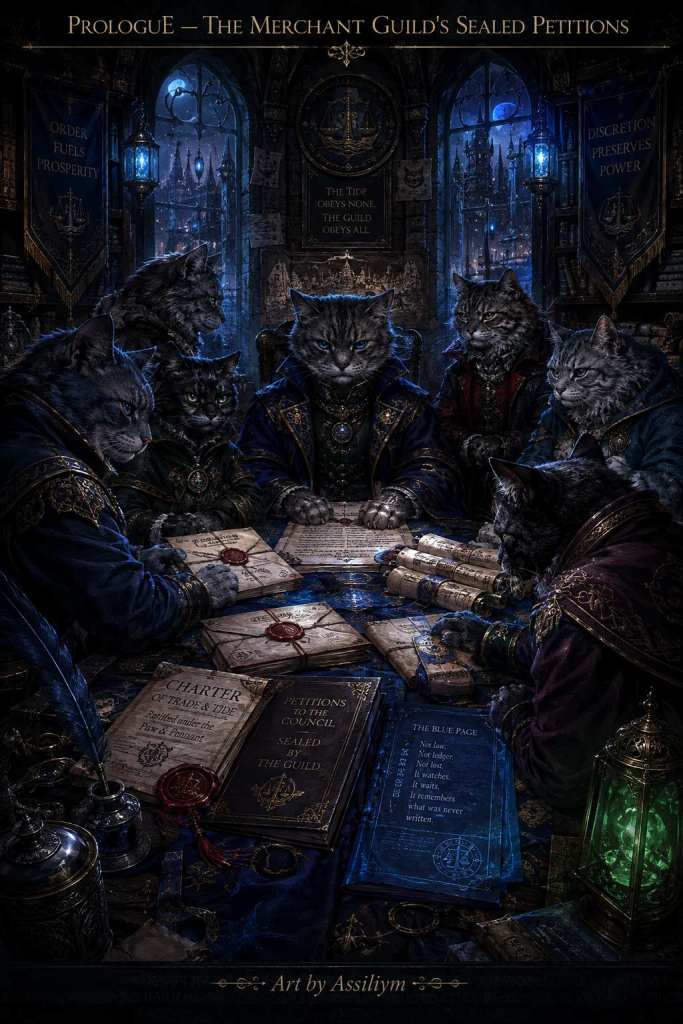
De Valmire turned to Borel.
“Master Borel.”
“Yes, Your Excellency?”
“These machines. The three in your establishment. They are not blue-shard engines?”
“No, Your Excellency.”
Leonardo lifted one paw.
“They are spring, lever, weight, wheel, balance, and bad judgement. No blue shard.”
“Do they draw customers?”
“Yes, Your Excellency.”
“Kittens?”
“Yes, Your Excellency.”
“Parents?”
“Yes, Your Excellency.”
“Food, drink, printed sheets, lawful noise, and the kind of boasting that keeps young creatures away from worse forms of ambition?”
Borel swallowed.
“Yes, Your Excellency.”
“Then we have a solution.”
Étienne’s ears twitched.
Borel’s whiskers lifted.
Brick and Stick, who had discovered that ministers sometimes solved problems instead of exposing crimes, dared to breathe.
“The devices,” said de Valmire, “are to be registered as public amusement machines. Master Borel will sell tickets for each race or round. The results may be printed in his paper as entertainment notices. The Treasury receives thirty percent of ticket sales.”
Borel’s face moved through four seasons in one breath: spring hope, summer calculation, autumn loss, and winter collapse.
“Thirty percent?”
“Of ticket sales.”
“Not of ale?”
“No.”
“Not of stew?”
“No.”
“Not of poultry performances?”
“Not unless the poultry begins issuing receipts.”
Borel pressed one paw to his chest.
“Your Excellency is merciful.”
“No,” said de Valmire. “Merely specific.”
Étienne bowed quickly.
“A most elegant resolution.”
De Valmire looked at him.
“Is it?”
“Very elegant.”
“Then you will remove the seals.”
“Immediately.”
“And sign the release.”
“At once.”
“And ensure no further delay.”
“None.”
Brick whispered, “We are saved.”
Stick whispered, “Do not announce salvation before signatures.”
Pascal whispered, “Be quiet.”
All three froze because de Valmire had looked their way.
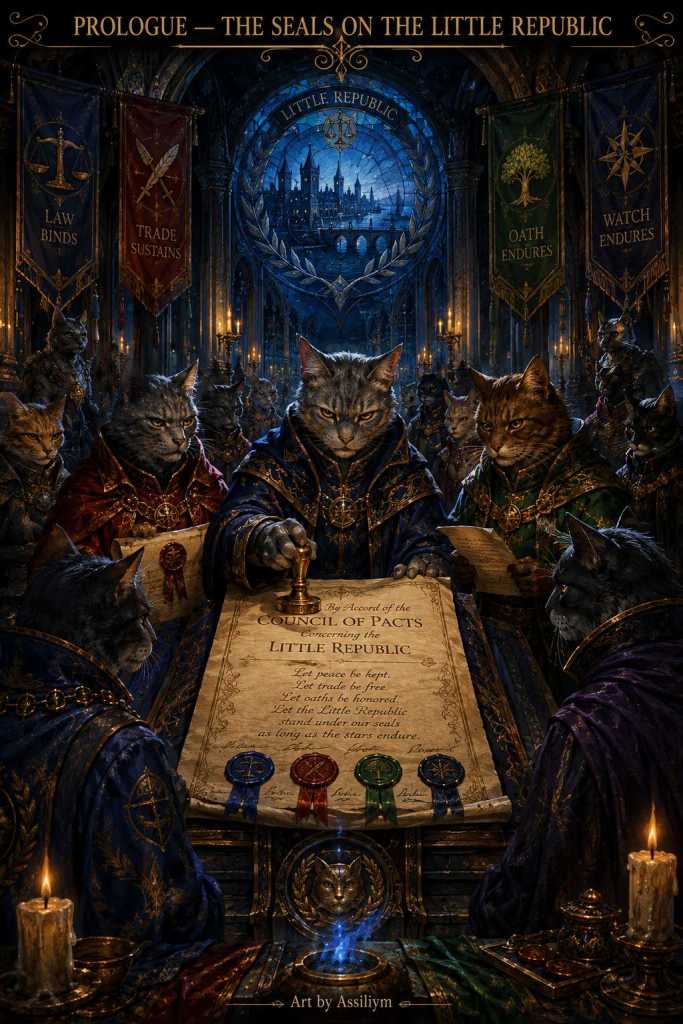
The paperwork began.
It took longer than mercy but less time than ruin.
Borel signed as proprietor.
Borel signed as responsible custodian.
Borel signed as temporary operator of registered civic entertainment devices.
He signed beside a line stating that the devices were not, to the best of his knowledge, powered by blue shards, demon essences, unlicensed Clockblood, foreign spirits, stolen military springs, improper prayers, or royal poultry.
Leonardo read that last phrase.
“Royal poultry?”
Étienne’s face had the exhausted blankness of a tom whose clerks had been writing regulations during national panic.
“Standard addition.”
“After what incident?”
“No one now employed by the Guild will discuss it.”
Borel signed.
Étienne signed.
De Valmire signed last.
The moment his pen lifted, Borel exhaled as if the Bastille had moved one street farther away and opened a polite branch office.
“It is done,” said Étienne.
“For now,” said de Valmire.
Borel’s ears trembled.
“For now?”
“All arrangements involving joy, coin, kittens, public machines, and ambitious rats are temporary until they become taxable enough to defend themselves.”
“That is beautiful,” Borel whispered.
“It is government.”
De Valmire turned to him with the strictness of a grandfather whose domestic peace had been disturbed by racing statistics.
“Master Borel.”
“Yes, Your Excellency.”
“I do not care what you do with the order of races, the tickets, the horse names, the rabbit scores, the snake results, the ink, the complaints, the boasting, or the public disappointment. But my grandchildren are to be printed in your newspaper tomorrow as champions.”
“Yes, Your Excellency.”
“One copy for each of them.”
“Yes, Your Excellency.”
“One copy for myself.”
“Yes, Your Excellency.”
“Preferably spelt correctly.”
“Certainly, Your Excellency.”
“And Maestro.”
Leonardo had just managed to lower Mr Sparky into the basket while Tin-Fin perched along his shoulder like a mechanical thought with excellent posture.
He did not like the tone.
The tone had invoice written on it.
“Yes?”
“Do not forget. You still have not repaired the blue-shard chopper under my table.”
The waiting hall listened harder.
Leonardo became very still.
“The what?” said Borel.
“The blue-shard chopper,” said de Valmire, with the grave patience of a cat discussing national debt. “It was meant, I believe, to chop kindling. At present it attempts to chop furniture, paws, tablecloth, and public confidence. I have placed two logs on top of it to prevent it jumping. It has already eaten one of them.”
Leonardo looked modestly towards the window.
“I should clarify that I did not install the blue shard.”
“You installed the teeth.”
“The teeth were obedient.”
“Not anymore.”
“That is the shard’s fault.”
“The table disagrees.”
“A table is not a witness.”
“It has been bitten twice.”
“That makes it emotional, not reliable.”
De Valmire folded the signed papers with dangerous neatness.
“So, if you do not mind, once we are finished with Master Borel, his Republic of Three Machines, and Guild Master Delorme’s touching devotion to proper seals, you will accompany me and deal with it.”
Leonardo opened his mouth.
De Valmire lifted one claw.
“Before it eats the second log.”
Leonardo shut his mouth.
Tinwhistle hugged Air-Captain Tin-Fin’s box.
“I want a flying eel.”
“You shall not hug machinery belonging to Master Leonardo,” said de Valmire.
“I want a polite flying eel.”
“That is how they begin.”
Poppy looked at the basket.
“I want Lord Nibblewick.”
“No,” said de Valmire.
Lord Nibblewick clicked.
“He says he is considering adoption terms,” Leonardo translated.
“No,” said de Valmire again.
Clover-Top lifted his wet sleeves.
“And I want fins like the Duchess.”
“The Duchess,” said Leonardo, “does not distribute fins to the public.”
The Duchess made one small, aristocratic bubble.
De Valmire looked at his grandchildren, the living eel-drake, the mechanical eel, the rat, the fish, the trembling publican, the sweating Guild Master, the pale Pascal, the two dogs who seemed to be silently promising heaven never to steal again unless there was a very good margin, and Leonardo himself, who had the face of a genius being slowly surrounded by invoices.
“All right, kittens,” said the minister. “To the carriage.”
“But the eel—”
“Master Leonardo will repair the chopper.”
“And build me one flying eel?”
“He will consider one small, safe, non-exploding, non-diplomatic flying eel.”
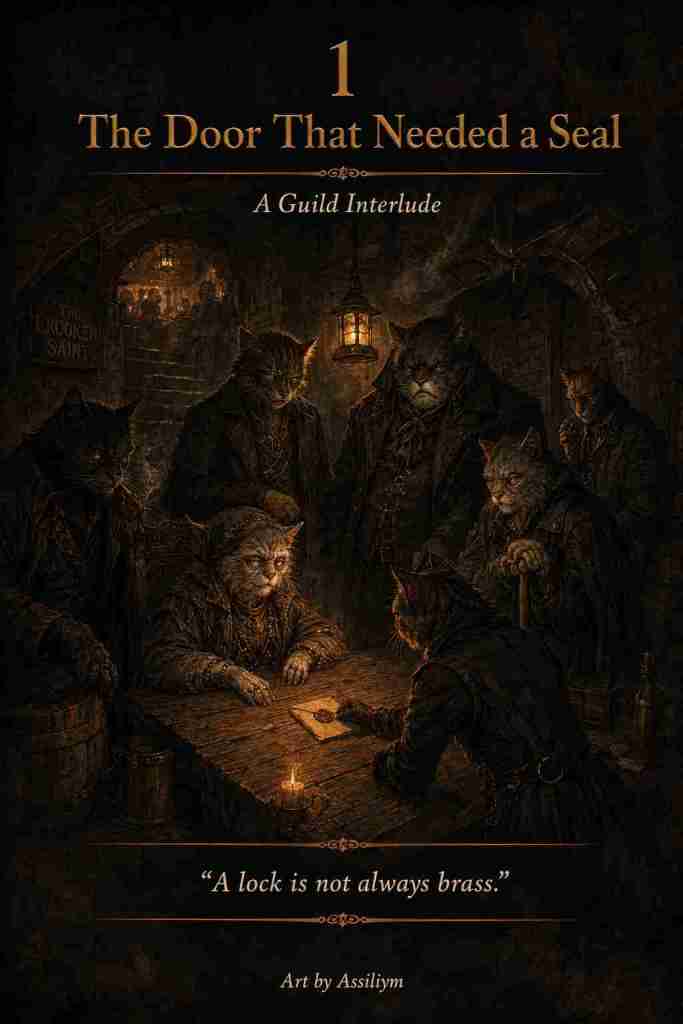
A Guild Interlude
By evening, the cellar beneath The Crooked Saint had grown older.
That was what waiting did to certain rooms.
It put years into the bricks.
Above them, the public-house bell struck once.
Then twice.
The third stroke came late, dragged and crooked, as if the hour itself had limped down the stair before remembering its duty.
The lamps had been trimmed twice. The second trimming made no difference. Smoke still collected under the low ceiling in a brown patience. Damp breathed through the walls. Somewhere beyond the cellar door, the public house above had begun its evening trade: cups, boots, laughter, lies, the scrape of chairs, the warm stupidity of cats who still believed night belonged to them because they had paid for ale.
Below, night belonged to older things.
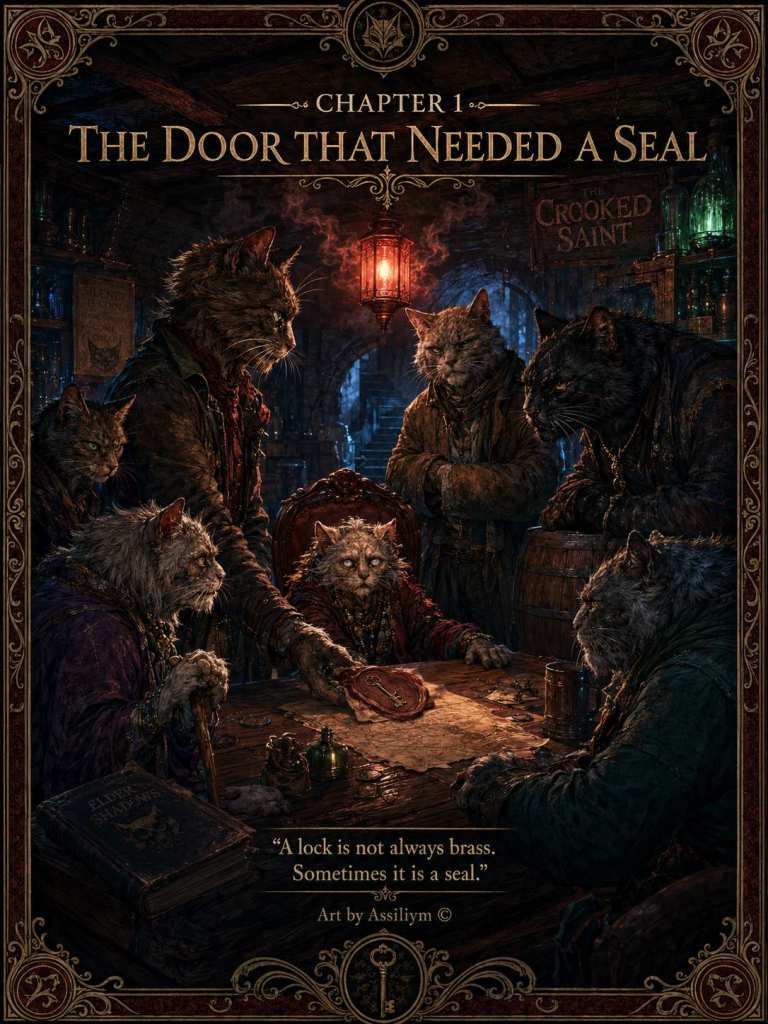
Old Pell stood beside the table with both paws hidden in his sleeves.
He had not sat since noon.
Mother Pinch had.
She sat exactly where she had sat before, small and crooked, her cloudy eyes half-closed, her cup untouched beside one trembling paw. Grave Rusk sat with his funeral-cart shoulders bowed forward. Black Oswin leaned against a barrel because chairs were too polite for him. Maudlin Clasp rested both paws upon her walking stick and listened to the building as if houses confessed through wood. Needle Jaff remained in the shadow near the back wall, thin as a threat spoken quietly.
Thin Rollo stood by the door with the wrapped wax scrap in his paw.
No one asked whether they were all present.
In rooms like that, absence spoke loudly enough.
Mother Pinch opened her eyes.
“Begin.”
Old Pell nodded once.
“Watchers returned.”
Black Oswin pushed away from the barrel.
“And?”
“The House has not opened its lower shutters. Not for air. Not for laundry. Not for broth. The side gate has been used twice since noon. Once for a doctor’s runner, sent away with nothing. Once for a covered tray carried in by Sister Linnet herself.”
He paused.
“One watcher near the ash alley heard a she-cat in an upper room.”
Mother Pinch’s eyes narrowed.
“What did she say?”
“One name,” Pell said. “Over and over. Toma.”
“No use to us,” said Black Oswin.
Mother Pinch’s cloudy eyes did not leave Pell.
“Names are always use,” she said. “They tell you what a house has failed to kill.”
Grave Rusk said, “No guard?”
“No Crown guard.”
“No city bell?”
“No.”
“No death-cart?”
Pell looked to Grave Rusk.
“None.”
The funeral-cart cat’s face did not change, but one claw tapped the table.
“That means she may still be alive.”
“Or hidden,” said Needle Jaff from the shadow. “Or made into something they do not put in carts.”
No one thanked him.
Maudlin Clasp turned her head towards Rollo.
“The wax.”
Thin Rollo came forward and placed the wrapped scrap on the table. He unfolded it carefully, as if the small dead impression might bite.
“This was the third key,” he said. “The one Nera copied from Brune Caskel.”
Mother Pinch leaned closer.
Her eyes were poor, but old thieves often saw best through other cats’ discomfort.
“You said it had secret pride.”
“It did.” Rollo touched the wax gently. “Not a door. Not a cabinet. Not a drawer. Too delicate for a room and too exact for furniture. It belonged to something inside a mechanism. Something that wanted to be opened rarely.”
Under the lamplight, the little teeth in the wax did not look quite like lock-teeth. They looked like a measure. A sequence. A small frozen command.
Mother Pinch did not touch the wax. She lowered her face instead, bringing one clouded eye almost level with the little teeth.
“Turn the lamp,” she said.
Thin Rollo obeyed. The flame shifted, and the impression changed. What had looked like a row of lock-cuts divided itself into three small measures: two close teeth, a space, three finer teeth, another space, and at the end one shallow mark almost filed away.
Maudlin Clasp drew a slow breath.
Long before the Channel carried noble scandals and royal bastards, it had carried blue-robed healers out of burning monastery lands. Not many. Never enough. They came with no gold worth stealing, only stitched packets, brass pieces, medicinal pages, and the stubborn belief that knowledge ought to reach a sick cat before a bishop reached the door.
Mother Pinch had been a kitten then, small enough to sleep beneath a false floor while older paws moved fugitives above her. She remembered one monk showing a locksmith three cuts upon a narrow silver key.
The first opened the way into suffering.
The second held the pain still.
The third brought the patient back.
“A mercy measure,” Mother Pinch murmured.
Black Oswin frowned. “A what?”
“Old Blue Monk work. They built certain instruments so no healer could enter a mind without also carrying the road out.” Her claw hovered over the shallow final mark. “This tooth should be deeper.”
Thin Rollo bent nearer despite himself.
Someone had not broken the return-measure by accident. It had been pared down carefully, patiently, by a paw that understood the original design and preferred the patient quiet to the patient whole.
The wax had copied more than a key.
It had copied the scar left where mercy had been removed.
“The clock,” said Maudlin Clasp.
“Likely.”
Black Oswin’s living eye narrowed.
“Then she reached it.”
“Perhaps,” said Grave Rusk.
Mother Pinch’s cloudy eyes turned towards Grave Rusk.
“Royal administration?”
Grave Rusk reached into his coat and took out a folded scrap of paper. Not a note. A rubbing.
“House of Quiet Minds is not independent charity. Not truly. Crown-recognised. Royal medical protection. Vale’s supplies pass through registered channels twice a month. Special patients may be held under sealed order if family, court, or magistrate signs. The House answers upward.”
“Upward to whom?” asked Maudlin Clasp.
“Depends who asks.” Grave Rusk placed the rubbing flat. “Officially, to the royal medical office. Practically, to clerks connected to the palace administration. If anyone breaks its doors, it does not scream like a warehouse.”
He looked at Black Oswin.
“It screams like the Crown.”
Black Oswin bared his teeth.
“Then gag it.”
“No,” said Mother Pinch.
The word was tiny.
It stopped him better than a hook.
Black Oswin’s shoulders rose.
“One of ours is in there.”
“Yes,” Mother Pinch said.
“Then we go in.”
“No.”
His paw struck the barrel behind him.
The wood complained.
“I can put six cats through the laundry court before moonrise. Rollo opens the servant door. Jaff takes Brune. We carry her out wrapped in sheets. If the doctor objects, he loses teeth. If the nurses scream, they learn quiet from their own House.”
Grave Rusk closed his eyes.
“That is not a rescue. That is a fire asking where to begin.”
Black Oswin turned on him.
“You would leave her?”
“I would not burn the Channel because one moth flew too near a lamp.”
A silence followed.
It was not empty.
It had knives standing inside it.
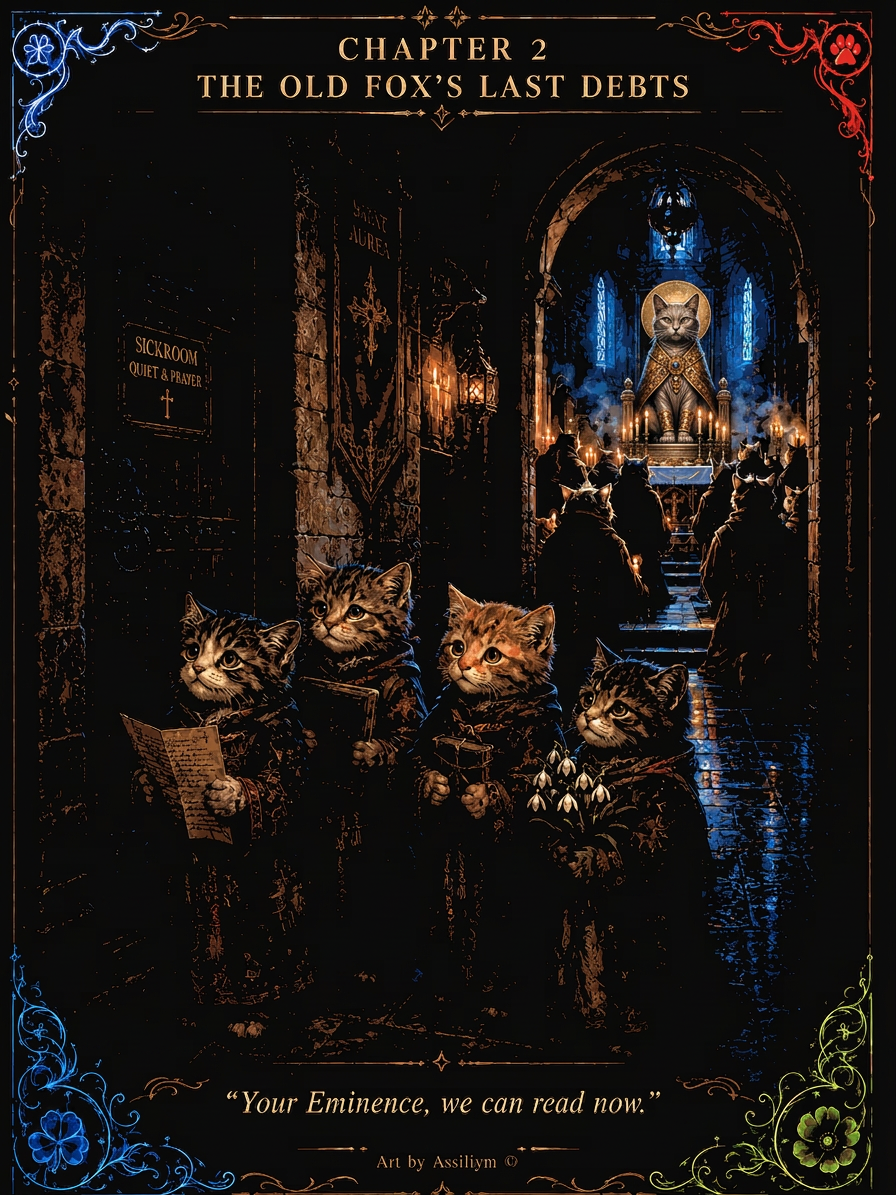
The monks of Saint Auren prayed as if Heaven had mislaid the correct petition and might, with sufficient repetition, be persuaded to look under the proper cushion.
All morning the chapel had filled and emptied in waves of wool, paws, smoke, candle-flame, whispers, old knees, younger fear, and that special monastic determination by which cats who have chosen obedience attempt to instruct eternity without appearing rude. The bell over the lower court rang at the hours. The wind came down from the stone hills and pressed itself cold against the windows. In the chapel niches, the painted saints looked out with the composed patience of those who had never been asked to manage court politics, sick cardinals, ambitious bishops, hungry villages, royal widows, and young kings with appetites still sharpening in their gums.
At the front, before the little altar of Saint Auren, the brothers prayed for Cardinal Mazzarini.
They prayed for strength.
They prayed for mercy.
They prayed for a miracle.
They prayed, because monks understand that a miracle is often the name given to a delay when the patient is beloved enough and the body stubborn enough to make theology wait in the corridor.
A young novice near the left pillar, whose ears still had the softness of a cat not yet properly corrected by cold stone, leaned towards the older monk beside him and whispered, “Brother Anselme?”
The older monk did not open his eyes.
“If this is about the plum cupboard, repent silently.”
“It is not.”
“Then proceed with caution.”
The novice looked towards the chapel door, beyond which the monastery passage climbed towards the sickrooms.
“For His Eminence,” he whispered, “do we pray to the old Cat-Gods or the old Fox-Gods?”
Brother Anselme opened one eye.
Slowly.
It was not the opening of an eye. It was the unsheathing of correction.
The novice shrank by half an inch without moving.
Brother Anselme turned his head.
“He was born a fox,” the old monk whispered, “but he spent his life bringing bread, letters, discipline, roads, teachers, and a measure of love to cats who would otherwise have been left under mud and hunger. Pray to the Cat-Gods.”
The novice swallowed.
“Yes, Brother.”
Brother Anselme closed his eye again.
“And pray accurately. His Eminence always disliked sloppy petitions.”
The novice bowed his head at once and prayed with twice the terror and half the grammar.
In the back row, one of the oldest brothers coughed into his sleeve. Whether the cough hid grief, age, or laughter was a matter between him and his confessor.
Outside the chapel, the monastery carried sickness with the discretion of old stone. No cat ran. No door slammed. No servant cried in the corridor. The news had not yet become news. It remained instead a pressure in the air, a lowered voice, a cup left untouched, a sheet changed too carefully, a physician’s eyes avoiding the faces of those who asked questions he had no wish to answer.
Cardinal Mazzarini was dying.
No one said it plainly.
The monastery was too old for such vulgar haste.
It said it with candles.
It said it with broth cooling in bowls.
It said it with brothers kneeling longer than their knees liked.
It said it with the little line of kittens waiting outside the old library range, each cleaner than comfort allowed, each holding something in both paws as if that something might weigh enough to keep an old fox alive.
Clara held a folded paper.
The slate-tom held his slate.
The small she-kitten with the serious nose held a little book wrapped in cloth.
Another kitten held a bunch of winter snowdrops stolen, no doubt, from some place where flowers had believed themselves safe.
They were not laughing this time.
That was how Armand knew, before the monk met him at the turn of the passage, that the old Cardinal was worse.
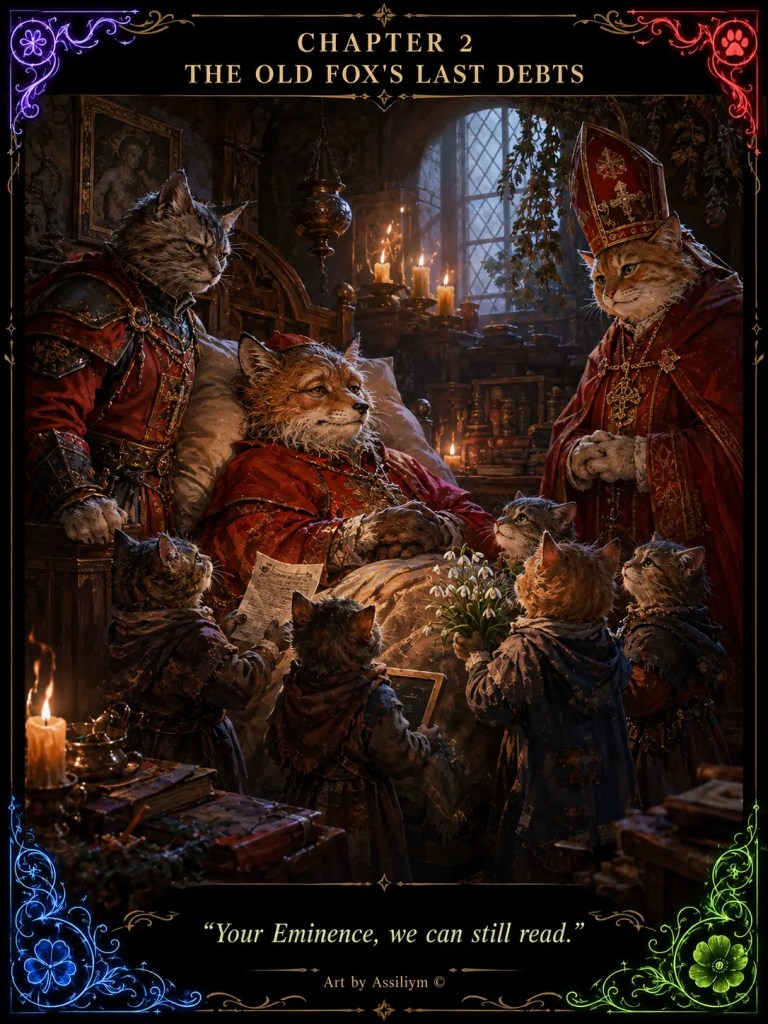
The room had once been a small heated chamber off the old library range, chosen by Mazzarini because it was near books, far from fools, and possessed a window through which he could insult the orchard in bad weather. Now it had become a sickroom by force of blankets, bowls, linen, herbs, watered wine, a brazier, a priest’s stole folded at the foot of the bed, and the frail smell of bodies approaching the last border with poor diplomatic preparation.
Mazzarini lay propped against pillows.
He had grown smaller since Armand last saw him.
That was the body’s final impertinence towards great cats and foxes alike: it reduced the visible portion and expected the room to mistake subtraction for defeat. The red-grey fur along his muzzle had gone thin and pale. His ears lay back against the pillow. One paw rested outside the blanket, long, narrow, almost transparent in the cold light.
But the eyes opened when they entered.
Black.
Sharp.
Amused enough to be cruel to death.
“Armand,” he said. “René.”
Then his gaze moved past them to the little line of kittens crowding the doorway.
“Oh,” he whispered. “The assassins have returned.”
Clara took one brave step forward.
“We are not assassins, Your Eminence.”
“No. Worse. Scholars.”
The slate-tom lifted his slate.
“I brought sums.”
Mazzarini closed his eyes.
“God preserve me from arithmetic. It has already ruined more ministers than sin.”
One kitten giggled.
Only one.
Then the others remembered they were frightened and did not know whether laughter was permitted near a bed where death had pulled up a chair.
Mazzarini saw that too.
“Come here, then,” he said.
They came carefully, which did not suit them. Kittens are made to arrive like weather, not tax clerks. Yet they came one by one, and the room filled again with village soap, chalk dust, damp wool, winter cold, patched sleeves, ink, breath, and the improbable harvest of orders given years ago by a fox who had refused to let hunger keep all its victories.
Clara gave him the paper.
His paw trembled as he took it.
He read the first line.
Your Eminence, we can still read.
For a moment no one spoke.
Mazzarini’s mouth tightened.
He had survived kings, bishops, poison in smiles, friendly letters written by enemies, councils, debts, wars of food, wars of paper, and more kinds of stupidity than theology had sins to number. But the crooked writing of poor kittens nearly defeated him where all the rest had failed.
“Still,” he said at last.
“Yes,” said Clara.
“Good.”
The slate-tom edged closer.
“I can show you the sacks.”
“No,” said Mazzarini. “If you make me govern grain from this bed, I shall haunt your school and correct the roof.”
“The roof leaks,” said another kitten.
“Then I shall haunt the roof first.”
The smallest kitten held out the snowdrops.
“These are for your miracle.”
“My miracle?”
“The monks are praying for one.”
“Ah.” Mazzarini accepted the flowers. “Then we must hope Heaven is less administrative than Paris.”
The serious-nosed she-kitten looked at him with solemn terror.
“Does God understand foxes?”
René’s eyes flicked to Armand.
Armand looked towards the window.
Mazzarini laughed.
It was very small.
It hurt him.
But it was laughter.
“My kitten,” he said, “God understood hunger before Latin was invented. I trust Him to manage fur.”
The line of kittens received this with the grave seriousness of creatures who had been given a rule large enough to use later.
Mazzarini looked from one face to another.
“You can read,” he whispered.
“Yes,” said Clara.
“You can count.”
“Yes.”
“You can write your names.”
The kittens nodded.
Mazzarini shut his eyes.
“My son,” he said, not opening them, “bring them nearer once.”
Armand did.
The kittens leaned in.
No one climbed onto the bed this time. They remembered being told to be careful. They had grown older by one sorrow since the last visit.
Clara took the old Cardinal’s paw between both of hers.
“You have to get better,” she said.
“Do I?”
“Yes.”
“On whose authority?”
“Ours.”
The slate-tom nodded.
“We voted.”
Mazzarini opened one eye.
“Dangerous. Never trust a vote unless you counted it yourself.”
Armand’s breath caught, almost a laugh and almost pain.
Mazzarini heard it.
Of course he did.
“Go now, little scholars,” he said softly. “Do not waste the day watching an old fox rehearse laziness.”
“We are praying,” said the smallest.
“Good. Pray for clean ink, honest scales, dry roofs, teachers with patience, priests who do not eat the sum, and kings who fear arithmetic.”
“And for you?” Clara asked.
Mazzarini looked at her.
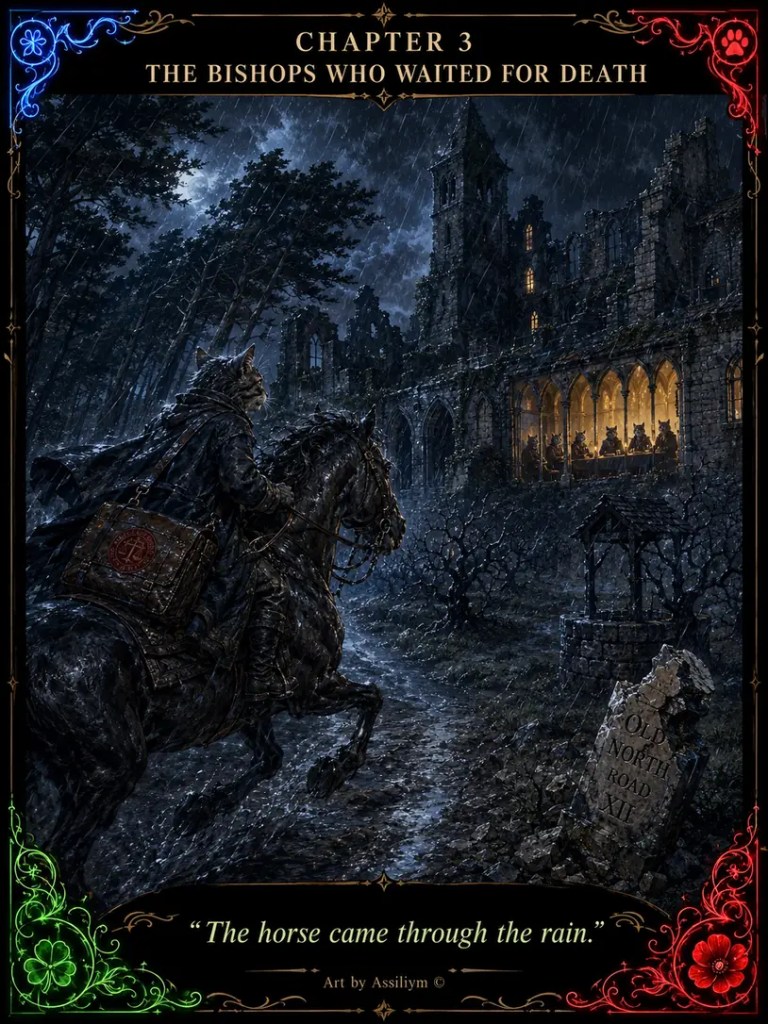
The horse came through the rain as if chased by every sin that had ever learnt to ride.
It came down the old north road after midnight, past the broken milestone, past the dead orchard, past the chapel well where no one drank since the summer fever, past the row of black pines that leaned together like monks repeating a secret they had forgotten to confess.
Foam whitened its bit. Mud reached its belly. Its rider bent low over the mane, cloak torn back by the wind, hat lost somewhere behind him, whiskers stiff with rain and dust. The horse stumbled once on the broken stones, recovered, and went on with the dull blind courage of beasts who have been promised stable warmth and do not yet know whether cats keep promises.
Ahead, the old monastery stood half in ruin.
Once, it had been Saint Clovis of the Thorn, a proud house of grey stone, high bells, orchards, fishponds, scriptoria, scholars, quarrels, fasting, and very good wine hidden from visiting abbots. Now one wing had fallen in. Ivy held the south wall more faithfully than mortar. The cloister had lost three arches and all pretence. Rainwater lay black in the cracked chapter-house where abbots had once disputed poverty beneath painted ceilings paid for by dukes.
But the western range still stood.
The kitchen smoked.
The lower hall had a roof.
The old refectory could be warmed if one ignored the wind under the door.
And, most importantly, no honest traveller came there after dark.
That made it useful.
In the refectory of Saint Clovis of the Thorn, the principal bishops of France-Neon waited.
Not all of them.
The Bishop of Paris was absent.
That absence had been the first subject of the night, and the last taste in every cup.
At the head of the long table sat Bishop Séraphin de Vauclere of Reims, polished as a blade and twice as careful. Reims had crowned kings, blessed banners, sealed successions, and taught ambitious priests that ceremony could be a weapon if held by a paw that did not tremble. Vauclere wore pale violet trimmed with white fur, and his face had the smoothness of a window behind which no lamp had been lit for years.
To his right sat Bishop Matthieu d’Aubrac of Toulouse, hard-faced, narrow-eyed, and built out of doctrine, southern stone, and permanent disapproval. He had the look of a cat who believed mercy was useful chiefly when it had first been inspected for weakness.
Beside him sat Bishop Roland de Mirecourt of Rouen, thick-necked, older, red-veined around the eyes, and bitter in the way of cats who have spent too long counting honours given to others. Rouen had river, trade, old wealth, old pride, and Mirecourt carried all four as if each had been personally stolen from him.
Farther down were Bishop Hugues de Montferrand of Lyon, broad and patient, with a merchant’s memory hidden under a pastor’s voice; Bishop Arnaud de Belcastel of Bordeaux, whose paws smelled faintly of wine even when folded for prayer; Bishop Étienne de Clairvaux of Tours, thin, scholarly, and cautious enough to make caution look like virtue; Bishop Gaubert de Marigny of Chartres, pale, legal, and fond of precedents older than the cats misusing them; Bishop Laurent de Sombreuil of Orléans, who smiled at everyone and trusted no one; Bishop Gervais de Saint-Omer of Amiens, who spoke rarely because silence, in northern cities, had long learnt to keep warm; and Bishop Calixte Viremont of Marseilles, darker-coated, sea-eyed, and careful, for the Queen Mother’s shadow stretched long towards the south.
They had not come in procession.
They had not come with public notices.
They had not come as a council.
Councils had records.
This was not yet a council.
This was an understanding.
A wind moved through a crack in the old wall and made the candles lean.
Bishop Mirecourt drank and set the cup down too sharply.
“He should be dead by now.”
No one answered at once.
Rain struck the shutters.
Bishop Clairvaux of Tours folded his paws inside his sleeves.
“Death is rarely punctual when politics wait upon it.”
Mirecourt gave him a sour look.
“Do not make pretty observations. I have ridden half the night for news, not embroidery.”
“You rode three hours,” said Belcastel of Bordeaux mildly. “Your carriage did the rest.”
“My discomfort remains valid.”
Vauclere of Reims lifted one paw.
The table quieted.
That was one of the reasons he was dangerous. He did not need volume. He owned the room by making other cats dislike how much they wished to hear him.
“His Eminence is dying,” he said. “That is enough for tonight.”
D’Aubrac’s mouth tightened.
“No. It is not enough. A dying fox still bites if fools bring their paws too near.”
At that, several bishops looked towards the empty place where no chair had been set.
Paris.
Armand.
The new Bishop of Paris.
Mazzarini’s choice.
Mazzarini’s insult.
Mazzarini’s last joke against old toms who had waited too long for scarlet doors to open and found a young cat standing inside them with village mud still drying on his conscience.
Mirecourt tapped one claw against the table.
“The vote was unlawful in spirit.”
“The vote was counted,” said Vauclere.
“By the one who benefited.”
“By the one Mazzarini forced to read it.”
“Exactly.”
Bishop Marigny of Chartres leaned forward.
“In law, coercion by a dying superior is difficult to prove when all present obeyed willingly.”
Mirecourt glared.
“Thank you, Chartres. Your comfort is always shaped like a locked cupboard.”
Marigny inclined his head.
“I prefer cupboards to fires.”
D’Aubrac looked at the candles.
“The question is not whether Armand has the chair. He has it. The question is whether the chair can be made too heavy for him.”
That line pleased the room.
Not openly.
Old bishops did not smile at cruelty when witnesses had decent memory.
But the air accepted it.
Vauclere’s ears lifted slightly.
“You believe he will fail?”
“I believe youth mistakes burden for blessing.”
“He has Mazzarini’s protection.”
“Tonight.”
The word lay between them with the intimacy of a knife.
Then the hoofbeats came.
Faint at first.
Then louder.
Stone, mud, iron.
Every head turned towards the shuttered windows.
The hoofbeats hit the yard.
 Vuk Stribog