
INSIDE BOOK 13
NEON: The Blue Page and the Hunter

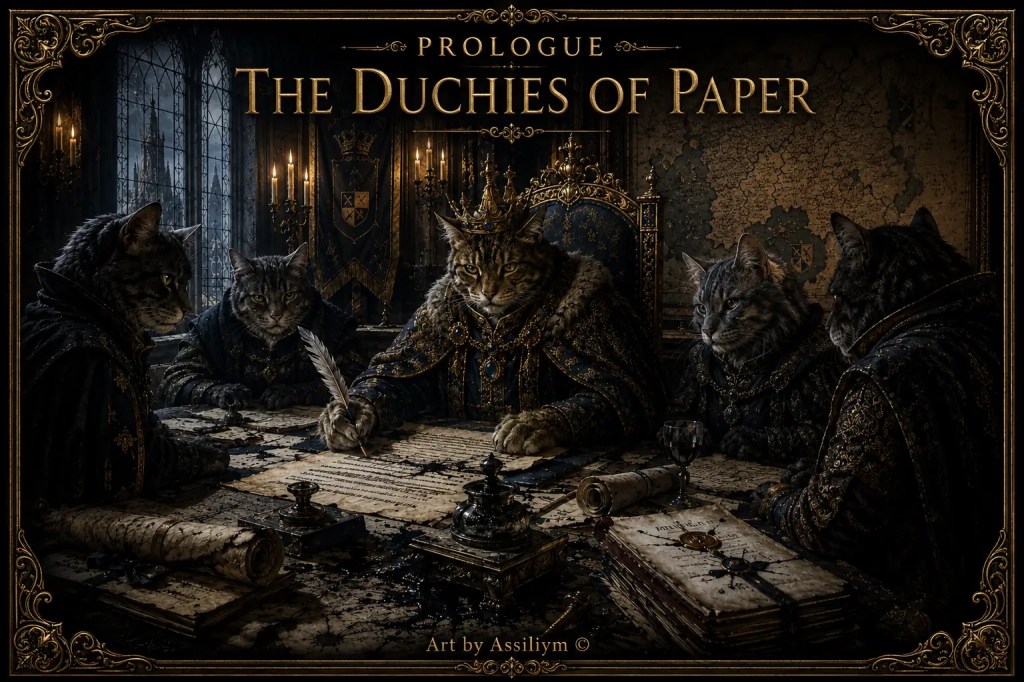
The royal ink dried slowly.
That was one of its better qualities.
Blood had the vulgar habit of declaring itself at once. It ran, steamed, stained cuffs, troubled floors, summoned laundresses, offended carpets, and gave even the dullest witness the satisfaction of understanding that something irreversible had occurred. Ink was better bred. It entered the fibres quietly. It darkened where it was told. It obeyed the paw that guided it and then, once dry, became law with the modesty of a spider becoming a web.
King Luis had come to prefer ink.
That morning, in the small council chamber behind the west gallery of the palace, there was a great deal of it.
The table had been covered in green cloth, because green cloth made theft look administrative. Upon it lay three stacks of papers, each tied with ribbon, each weighted by a seal, each prepared by clerks whose whiskers had been trimmed to the exact length at which conscience ceased to be visible. There were maps too: Aquitaine rolled open under two silver weights; Burgundy drawn in red lines, black figures, and little numbered boxes; Marseilles shown with its harbour, old royal castle, collapsed wing, sea-wall, chapel roof, cracked cisterns, and several optimistic estimates which had already lied themselves into respectability.
At the head of the table sat Luis.
He wore mourning black still, but not helplessly. There are cats who wear mourning as grief, cats who wear it as custom, and cats who discover, to their surprise, that black suits authority rather well. Luis belonged increasingly to the third order. The death of his father had first placed the crown upon him like an iron bowl over a candle. He had stumbled under it. He had sweated. He had smiled too quickly and slept too little. But time, that merciless tutor, had begun teaching him the first lesson of kingship: that mercy spoken aloud could sometimes perform the labour of cruelty if the papers were arranged beforehand.
Behind him, the palace clock ticked.
Tik.
Tok.
A small pause waited where the third beat should have stood.
No one looked at it.
In that chamber were gathered the necessary witnesses of generous exile.
Lord Justice Malvosin stood near the right side of the table, long, grey, thin in the mouth, and composed of law in the way old knives are composed of metal: not shining, perhaps, but still able to cut. His robe fell in black folds from his shoulders. He had brought three legal clerks, two lesser registrars, and an expression of such solemn obedience that one could have buried a province under it.
Treasury Minister Adrien de Valmire stood opposite him, a sheaf of account schedules tucked under one foreleg. He had the pale, cultivated exhaustion of a tom who had spent too many years persuading numbers to confess and had come to suspect that all numbers were criminals by nature. His spectacles sat low on his muzzle. His eyes moved from seal to seal, from margin to margin, with the weary precision of a cat who knew that ruin, when properly itemised, could pass through a council chamber as reform.
Senior Clerk Aubert Marcenat waited behind him with two inkstands, four sand-shakers, a locked box of wax, and the air of a cat who had personally invented the inconvenience of signatures.
Princess Sofia stood by the window.

On the central table stood Varric Steelquill’s temporary brass cradle.
It held the silver tongue of the Quiet Clock.
The little stolen piece looked harmless in the cradle, which was how dangerous things often began successful careers. A curved sliver of silvered metal, pierced with tiny holes, fixed beneath a hand-turned wheel, a weighted arm, and three adjustment screws Varric had labelled in tiny engineer’s script:
DO NOT GUESS.
Beneath that, in smaller writing:
ESPECIALLY YSABET.
Ysabet had read the note, smiled once, and written beneath it:
THEN DO NOT BUILD TEMPTATION INTO SCREWS.
Tavin had decided not to copy either line into the official record.
Beside the cradle stood the vial of White Quiet stolen from Doctor Vale’s House of Quiet Minds.
It was pale as watered moonlight.
Sleep would have looked kinder.
The White Quiet did not look kind.
It looked patient.
On the other side of the table lay three covered samples of unstable Clockblood. Each had been taken from the Guild’s stored blue liquid, refined, strained, argued with, and insulted under professional conditions.
One sample had dried into a branching thread.
One had become sluggish and glassy.
The third still trembled in its tube as if it hated the tube personally but had not yet decided on a plan.
Tavin looked at them and swallowed.
“Which sample, mistress?”
Ysabet did not look up from her measuring glass.
“The angry one.”
“They are all angry.”
“The one with ambition.”
Tavin looked again.
The trembling sample knocked softly against its glass.
Tap.
Tap.
Tap.
“Yes,” he said. “That one.”
“Good. You are learning.”
“I wish to learn less.”
“Then you chose the wrong guild.”
He carefully lifted the tube.
Around the walls, the other masters waited.
Not comfortably.
Master Varric Steelquill stood nearest the brass cradle, forelegs folded, eyes fixed on the silver tongue as if it might attempt to become poetry while his back was turned.
Mistress Hélène Coldbar stood by the restraint cabinet, because she trusted locked things more than free ones and neither very much.
Master Tarian Ashglaive leaned near the blade rack with the expression of a cat pretending not to enjoy the possibility of disaster.
Mistress Oriel Glass-Whisper stood in the shadow between two shelves of old nerve salts, calm and pale and attentive.
Behind Oriel stood Seline Whisperbell, silent as a held breath.
Perrin Cogwhisker had not been allowed near the hand-wheel.
He had asked once.
The room darkened into ordinary sorrow.
For a moment, nothing remained of the miracle except the pressure of Calix’s paws against folded cloth.
Then something cold touched the pad of his left thumb.
He looked down.
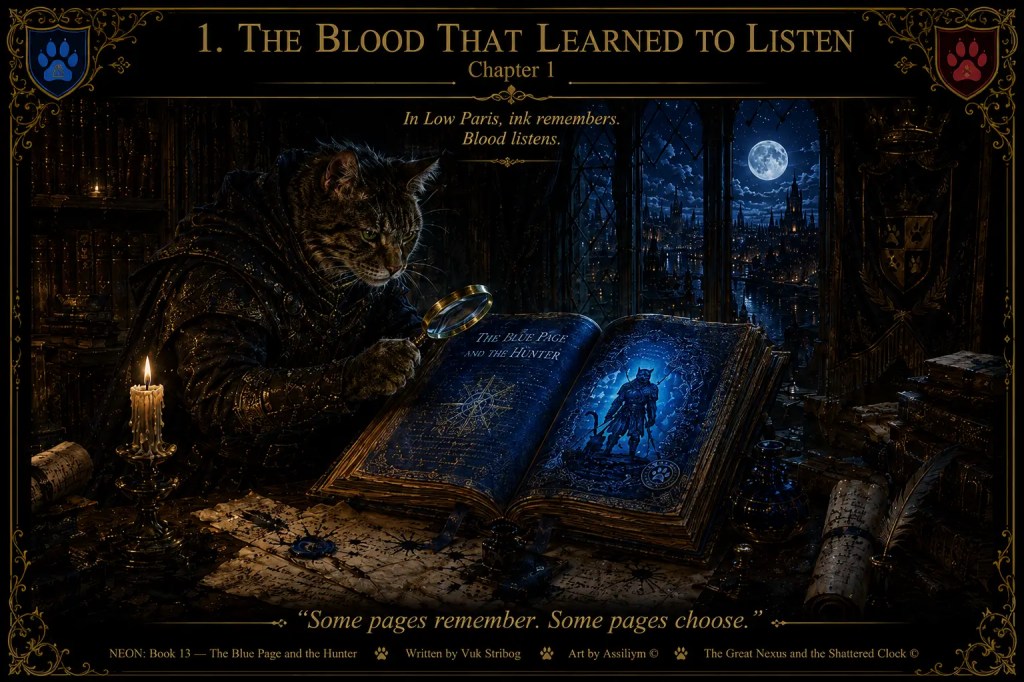
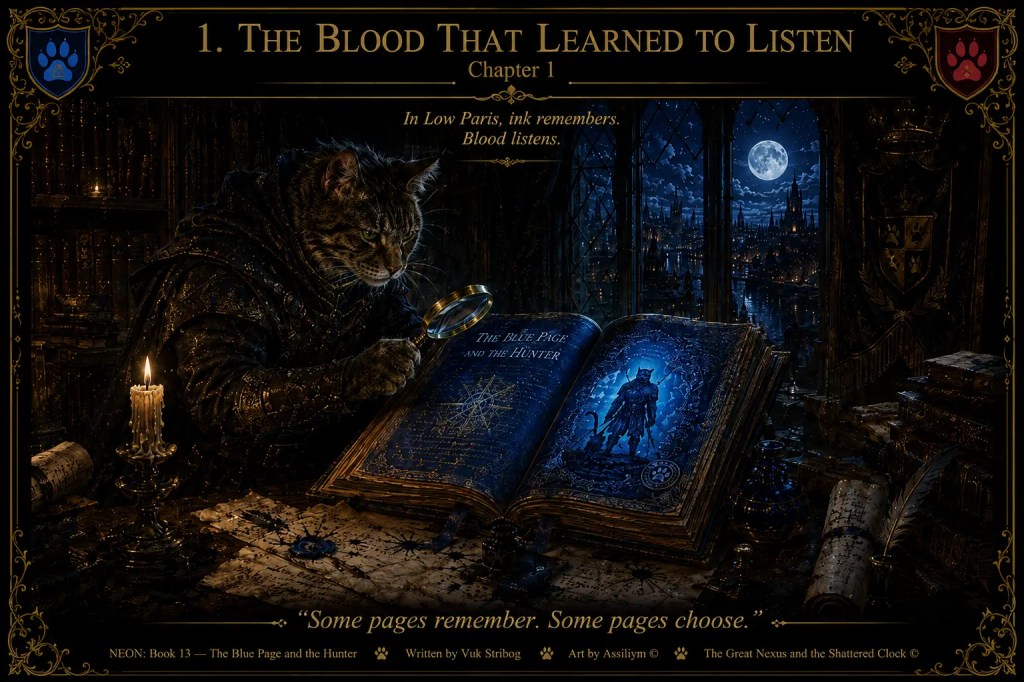
Upon the inner fold, where no ink had stood before, a small blue sign had appeared: an open circle crossed by a single returning line. Beneath it, letters formed slowly, not in the language of kings or Guild masters, but in the plain old script used by monks who expected their words to be read beside sickbeds rather than thrones.
THE FIRST DUTY OF THE KEEPER IS NOT TO OPEN THE PAGE.
Calix’s breath caught.
A second line appeared.
IT IS TO KNOW WHEN THE PAGE MUST REMAIN CLOSED.
The letters shone once and sank into the cloth.
Brother Anselme saw only a fading blue seam. Armand saw Calix staring. Mazzarini, whose eyes had already begun travelling beyond the room, seemed nevertheless to understand.
The old monks had not hidden such knowledge merely because kings were cruel, bishops afraid, or guilds hungry. They had hidden it because mercy required a guardian even when no tyrant stood near. A miracle could become murder in loving paws. A cure could become possession. The cat who knew how to begin must also know when beginning was the greater sin.
Calix pressed the folded page against his chest.
Somewhere inside his memory, Mazzarini laughed—the thin, dry laugh with which he had once dismissed three noble petitions and a badly cooked turnip in the same afternoon.
Calix reached for the sound.
He remembered the room. He remembered Brother Anselme choking on his broth. He remembered Mazzarini’s eyes, the lift at one corner of his mouth, the exact words that had caused it.
But the laugh itself had moved farther away.
Not gone.
Not yet.
Only muffled, as if heard through a wall being built one stone at a time.
The page had closed.
Its account had not.
For the first time since the Sentinel had been dragged into guild custody, the word Clockblood did not sound like a boast or a prayer.
It sounded like a recipe.
A dangerous one.
A recipe that might yet poison the cook, burn the kitchen, and teach the knives to sing.
But a recipe.
Tavin swallowed.
“What do we call it, mistress?”
Ysabet did not answer quickly.
That was unusual.
Then she said, “Near-true active sample. Quiet-sequenced. Repair-capable. One eighth-drop tolerance.”
Tavin wrote it carefully.
Then, because he was young and tired and the room had survived, he added beneath it in smaller letters:
Blood that learned to listen.
Ysabet looked over his shoulder.
Tavin went still.
“I can scratch that out.”
She read the line again.
“No.”
He blinked.
“No?”
“No,” she said. “Leave one poetic infection. It will annoy Varric.”
“I heard that,” Varric said.
“I intended you to.”
The room allowed itself something almost like breath.
Not relief.
Relief would have been premature and therefore vulgar.
But something.
A narrow bridge between terror and pride.
Then the tube pulsed again.
Once.
The black cloth over the Elder Eagle shard shifted.
Only slightly.
As if something beneath it had turned an eye.
Above the Guild Hall, three sleeping pigeons woke at once on the roof-tiles.
They did not cry.
They did not fly.
They only turned their heads towards the covered room below, as if some old bird-memory had heard a claw scratch once against the inside of the sky.
Everyone saw.
No one admitted first.
Hélène crossed the room and placed one heavy paw on the cloth.
“Not tonight.”
The covered shard went still.
Oriel smiled faintly.
“Then we are close.”
Varric looked through the open doorway, down the corridor, towards the lower chamber where the Sentinel waited.
“No,” he said.
Every cat looked at him.
He picked up a chalk stub from the workbench and placed it beside the sealed tube.
“We are closer. That is not the same as close.”
Ysabet lifted the tiny vial of near-true Clockblood and set it in the locked blue cabinet.
One tube.
One repaired tooth.
One controlled retreat.
One small success.
Not enough to wake the Sentinel.
Enough to make waking possible.
Downstairs, behind glass, chain, iron, and old chalk words, the Sentinel remained motionless.
AWAITING MATERIAL
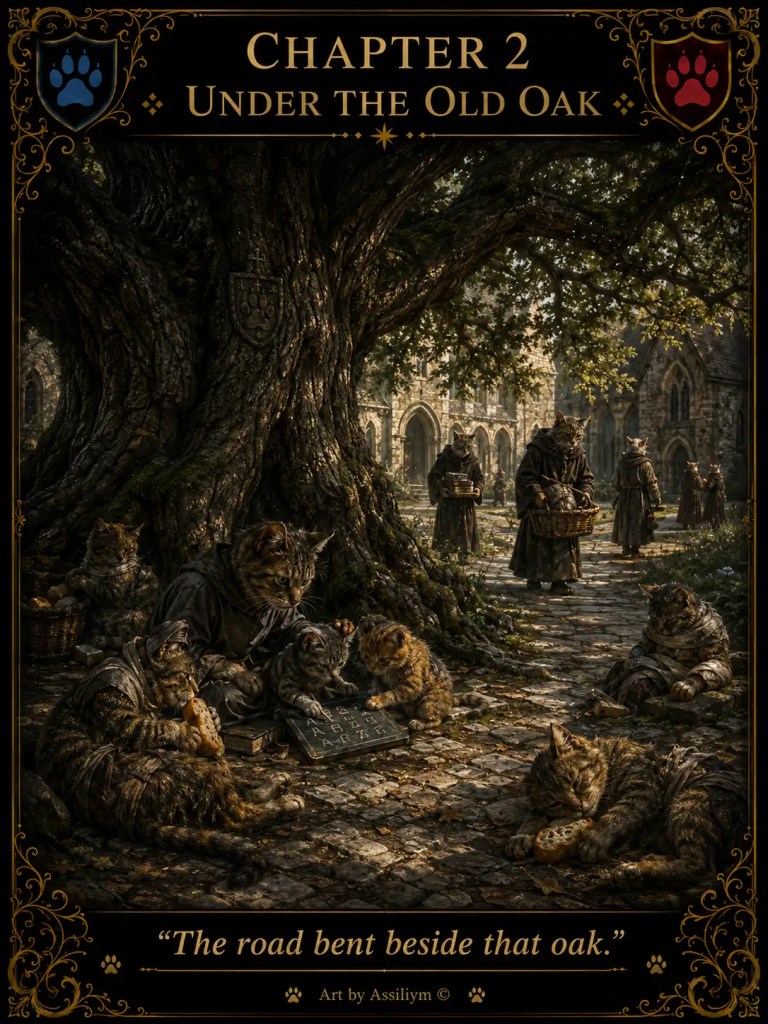
At Saint Auren, the oak was older than every argument in the kingdom.
It stood in the monastery yard with its roots under the stones and its branches over the road, broad, dark, patient, and wounded by so many winters that age had become its dignity. Kittens had learnt their first letters beneath it when the weather was kind. Poor cats had rested in its shade with bread in their paws and dust on their coats. Monks had walked past it with baskets, books, water, bandages, and the quiet stubbornness of those who mend the world badly because no better worker has arrived.
The road bent beside that oak.
Not a great road. Not a royal road with carved stones, fresh gravel, and soldiers riding before important wheels. This was an older road, narrow, patched, bitten by rain, repaired in places by paws that had not been paid enough, and loved by those who needed it because poor roads, like poor cats, become precious when they are the only way through.
Mazzarini knew that road.
He had sent grain along it.
He had sent guards along it.
He had sent books, slates, chalk, soup pots, winter cloaks, teachers, priests, doctors, and tired cats who complained the whole way and went anyway. He had argued for that road in rooms where rich cats thought mud was a provincial rumour. He had signed papers for it with a paw that had signed darker things too. He had stolen from waste, lied to arrogance, threatened indifference, and once, when a royal clerk had said the road served only poor villages, had answered that roads which serve only the poor are the first roads a kingdom should fear losing.
Now the road had brought him to its end.
The chamber above the library was small.
Mazzarini had chosen it himself. He had refused the larger guest room, the warmer room, the room with tapestries, and the room where dying cats of rank were usually placed so that visitors might admire both the sufferer and the curtains.
He wanted the little chamber with the narrow bed, the smoke-dark crucifix, the plain chair, the table scarred by old ink, and the window that looked towards the oak.
“I have seen enough curtains,” he had said.
That had been two weeks ago.
Now even that sentence seemed to belong to a stronger cat.
He lay beneath a grey blanket, thinner than illness had any right to make him. His ring had been removed because it had begun to slip from his claw. It lay now on the table beside a slate, a folded letter from the school kittens, and a little cracked cup holding snowdrops.
The snowdrops had been brought that morning.
No one had told the kittens they were too early for mourning.
Kittens know earlier than adults when a house has changed its breathing.
Armand sat beside the bed.

The chamber above the library was small.
Mazzarini had chosen it himself. He had refused the larger guest room, the warmer room, the room with tapestries, and the room where dying cats of rank were usually placed so that visitors might admire both the sufferer and the curtains.
He wanted the little chamber with the narrow bed, the smoke-dark crucifix, the plain chair, the table scarred by old ink, and the window that looked towards the oak.
“I have seen enough curtains,” he had said.
That had been two weeks ago.
Now even that sentence seemed to belong to a stronger cat.
He lay beneath a grey blanket, thinner than illness had any right to make him. His ring had been removed because it had begun to slip from his claw. It lay now on the table beside a slate, a folded letter from the school kittens, and a little cracked cup holding snowdrops.
The snowdrops had been brought that morning.
No one had told the kittens they were too early for mourning.
Kittens know earlier than adults when a house has changed its breathing.
Armand sat beside the bed.
He did not wear court robes. He did not wear splendour. His bishop’s dignity, which had looked almost unreal on him in palace rooms, seemed heavier here, in plain stone and winter light. Saint Auren stripped rank down to duty. It did not care what silk called a cat if the poor were cold.
René stood by the door, still as a guard, but not hard enough to fool any cat who loved him. His scarlet cloak was folded over one foreleg. He had not put it on. Scarlet had no business making a banner in that room.
Brother Anselme stood near the hearth, silent, severe, and red-eyed in a manner he would later deny with theological violence.
Mazzarini’s eyes opened.
They found Armand first.
“Still here,” he whispered.
“Yes.”
“A dangerous habit. Cats have built whole prisons out of staying.”
Armand bent closer.
“Then I shall risk it.”
The old voice was very weak, but the old shape of it remained. A blade worn thin is still a blade if it remembers the edge.
Mazzarini turned his head a little towards the window.
The oak filled the glass.
For a while he only looked at it.
No one spoke.
Death was in the room, but not yet in command. It stood somewhere behind the bed, waiting with the courtesy of an enemy who knows victory does not require haste.
At last Mazzarini said, “No Paris.”
Armand’s breath changed.
René looked up.
Mazzarini did not turn from the window.
“No procession through Paris-Neon. No cathedral stone. No court sermon polished until every truth has been combed out of it. No noble cats stepping on poor paws to show how well they grieve. No marble. No golden letters. No lying statue with one paw raised as if I spent my life blessing things.”
Armand’s eyes stung.
“You deserve honour.”
“I have had enough honour to know the smell.”
“You served the kingdom.”
“I also used it.”
“You saved many.”
“I failed many.”
“You built schools.”
“I closed doors too late.”
“You fed villages.”
“I signed hunger before I learnt its name properly.”
Armand lowered his head.
Mazzarini’s paw moved.
It was so small a movement that for a moment Armand did not understand. Then he placed his own paw beneath it.
The old cardinal’s claws were cold.
“My son,” Mazzarini said, and the words entered Armand like grief finally finding its door, “do not make me clean at the end. It is a cruel thing to do to an old sinner.”
Armand closed his eyes.
“I do not know how to let you go.”
“No. You are young. You still believe love has methods.”
René turned his face towards the wall.
Brother Anselme placed one paw over his mouth.
Mazzarini’s gaze remained on the oak.
“The road began here, Armand.”
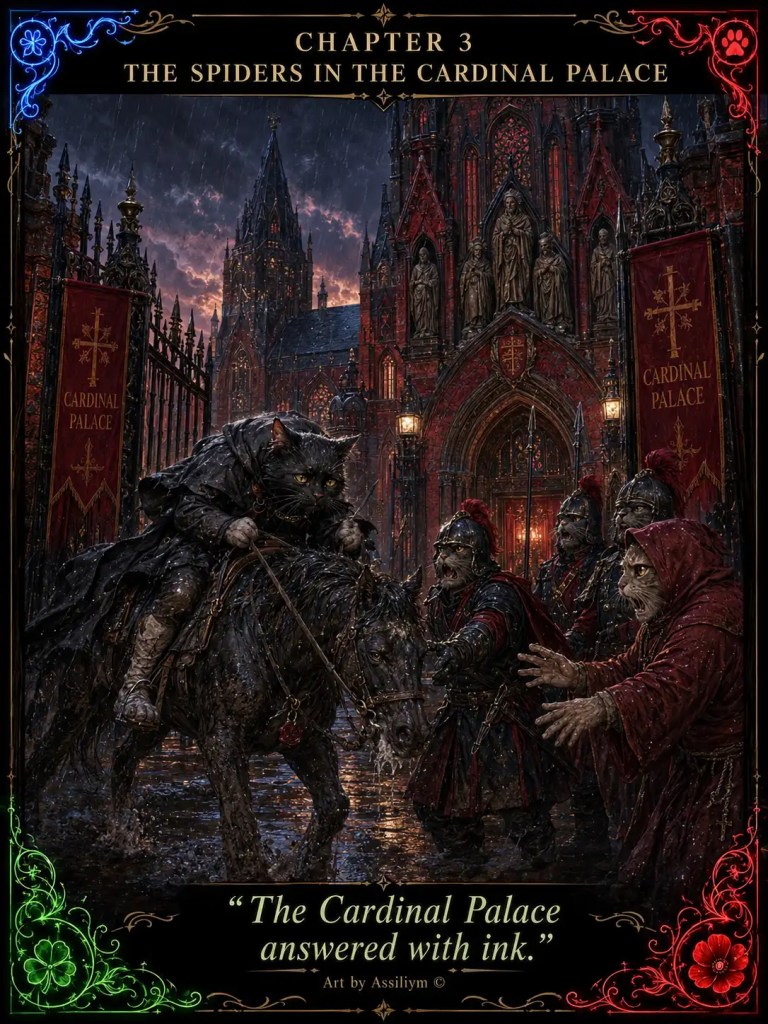
The black rider reached the Cardinal Palace at dusk.
His horse came through the western gate with foam at the bit, mud up to the knees, and the hollow-eyed obedience of a beast that had carried grief farther than mercy should ask. The rider’s cloak was dark with road-water. His boots were white with dried salt from Saint Auren’s stones. His paws shook when he drew the reins, though whether from cold, exhaustion, or the message under his coat, the guards could not say.
The palace rose before him in red stone and black glass.
It was not the royal palace. It did not need to be. There are houses in which crowns sleep, and houses in which crowns learn how to kneel. The Cardinal Palace belonged to the second kind. Its windows watched the street like old confessors. Its gates were iron. Its chapel roof pointed upward with the humility of a dagger. Above the main door, saints carved in dark stone looked down on Paris-Neon with expressions suggesting they had heard enough excuses from the living.
The rider almost fell from the saddle.
A gate monk caught him.
“From where?”
The rider swallowed.
His voice came rough.
“Saint Auren.”
The gate monk’s face changed.
No bell had rung yet in Paris-Neon.
But some news arrives before sound.
The rider drew a sealed packet from inside his coat. The wax had cracked at one edge, not from tampering, but from the hard gallop. Black thread bound it. A small mark had been pressed into the wax: the monastery seal of Saint Auren.
“Take me to the bishops,” he said.
The gate monk hesitated.
“The bishops are in council.”
The rider looked at him.
“That is why I came.”
Inside the Cardinal Palace, the bishops were already spinning.
They had gathered in the red council chamber, where the walls were hung with old portraits of cardinals who had died with better reputations than they deserved. A long table stood in the middle, polished so deeply that candlelight drowned in it. On the table lay maps, letters, account books, keys, seals, a silver inkstand, and one folded strip of yellow cloth which no one touched because it reminded them too much of paper.
Outside, Paris-Neon still believed Cardinal Mazzarini was dying.
Inside, several cats had moved on to what should happen after.
Bishop Séraphin de Vauclere sat at the head of the table, though no one had invited him to that chair. He was narrow, pale, beautiful in the cold way of saints painted by artists who have never been hungry. His paws were folded. His ring shone. His eyes smiled when his mouth did not.
Bishop Matthieu d’Aubrac sat to his right with ledgers near his elbow. He was heavy, soft-furred, careful, and carried his greed not like hunger but like a doctrine. He believed accounts were prayers if written in a holy building.
Bishop Roland de Mirecourt stood by the hearth. He did not sit when power could be looked down upon from standing. His face had discipline carved into it. He believed order was mercy, command was cleanliness, and young bishops were an unfortunate stage between useful obedience and dangerous sincerity.
Three lesser bishops sat farther down.
One old bishop near the wall had not spoken much. His paws rested on his knees. His eyes were red. He had liked Mazzarini, which made him poor company for ambitious cats.
“Bishop Armand remains at Saint Auren,” said Mirecourt. “Captain René is with him. The Scarlet Guards have their sentimental centre absent. That gives us the necessary hour.”
“Hours,” said d’Aubrac softly, touching one ledger. “Let us not impoverish opportunity.”
Vauclere looked at him.
“Opportunity becomes vulgar when counted aloud.”
D’Aubrac smiled.
“Everything is counted somewhere.”
“Then count quietly.”
A scribe sat at the side table with pen ready, pretending not to understand anything. Good scribes do this professionally. Great scribes understand even less and charge more.
Vauclere lifted one paper.
“First: the Cardinal Palace must be placed under temporary chapter custody until Bishop Armand returns and is confirmed in full administrative authority.”
“Confirmed by whom?” asked the old bishop near the wall.
Vauclere turned with gentle surprise.
“By the Church, naturally.”
“The Church already raised him.”
“The Church, my dear brother, sometimes raises a cat in hope and then steadies him in practice.”
“Steadies,” murmured d’Aubrac.
It was a beautiful word. It meant taking the keys.
Mirecourt said, “The Scarlet Guards must be reviewed.”
The old bishop’s ears flattened.
“Reviewed?”
“Reorganised,” said Mirecourt.
“By whom?”
“By a temporary military-ecclesiastical commission.”
“Meaning you.”
“Meaning order.”
The old bishop looked around the room.
“Mazzarini is not dead yet.”
The words struck the table.
Not because they were surprising.
Because they were inconveniently alive.
Vauclere lowered his eyes.
“We pray for his recovery.”
“No,” said the old bishop. “You prepare for his absence.”
No one answered.
The candles did.
They bent very slightly in a draught from under the door.
D’Aubrac turned a ledger page.
“We must also consider the rural schools.”
The old bishop stared at him.
“The kittens?”
“The funds,” said d’Aubrac. “The food routes, chalk accounts, roof grants, teacher stipends, grain security, winter cloth, monastery kitchens—”
“The kittens,” said the old bishop again.
D’Aubrac’s smile thinned.
“Charity without review becomes leakage.”
“Mazzarini called it mercy.”
“Mazzarini,” said Vauclere softly, “had a talent for making expenditure sound like theology.”
The old bishop’s paw tightened on his knee.
Before he could answer, a side door opened.
The chamber fell silent.
Vasili entered.
 Vuk Stribog