
INSIDE BOOK 14
NEON:THE KINGDOM BEYOND THE THRONE
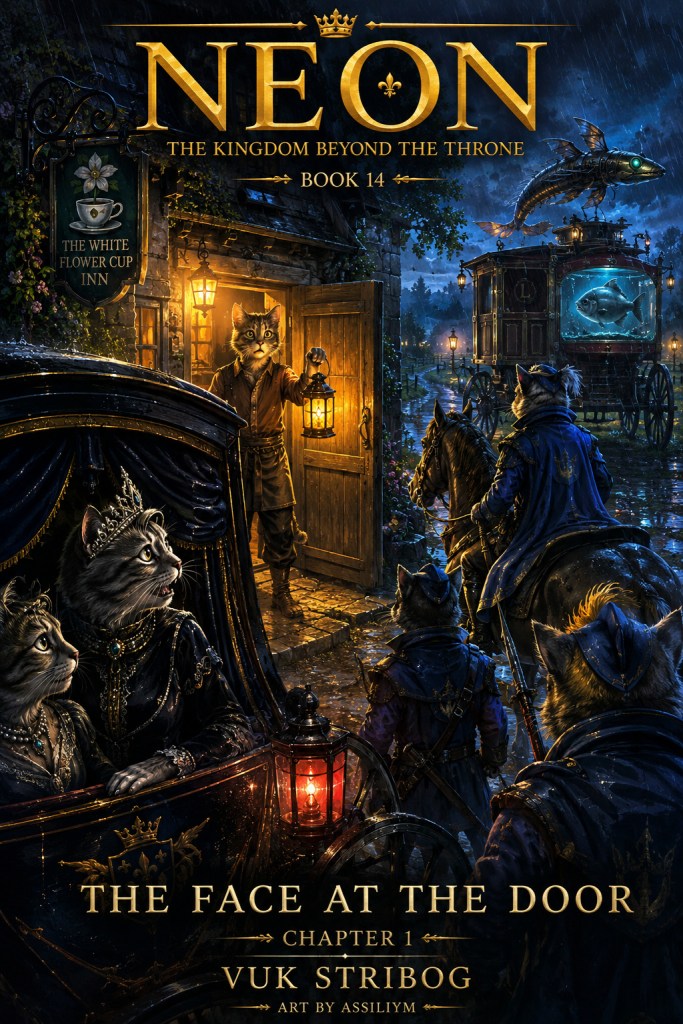
Tin-Fin circled under the eaves and offended two sleeping sparrows into waking.
Then the inn door opened.
Warm light spilled across the wet stones.
A young tom stepped out with a lantern in one paw.
He wore a plain brown working coat, damp at the cuffs, with a leather apron tied over it. His boots were muddy. His sleeves were rolled. Rain darkened the fur along his shoulders. His head-fur was uncombed in the practical manner of cats who had been carrying barrels rather than attending mirrors.
He lifted the lantern.
“Evening, travellers. We have room if you do not mind simple beds and honest soup.”
Captain Renaud opened his mouth to answer.
The Queen Mother’s carriage curtain moved.
Only a little.
Only enough for Marguarite to see the lantern-light fall across the young tom’s face.
She froze.
The rain continued.
The guards did not notice.
The horses stamped.
The young tom came closer, lantern raised, his face clear now beneath the light.
Marguarite’s paw closed around the carved handle of her cane.
Countess Eleonora, sitting opposite her, saw the change at once.
The Queen Mother did not pale.
Queens of her kind did not give blood the satisfaction.
But every line of her became still.
Outside, the young tom smiled politely.
Not courtly.
Not trained.
Not polished.
A good, tired, provincial smile, offered to wet travellers by a cat who expected no history to be staring back from behind carriage curtains.
“Shall I wake my mother?” he asked. “She handles the rooms. I can take the horses.”
Marguarite looked at him.
Luis.
No.
Not Luis.
Luis if the palace had never taught him fear.
Luis without silk. Luis without the crown. Luis without the hard brightness that court mirrors polish into princes. Luis with mud on his boots, rain in his fur, and work in his shoulders.
But the bones of the face were there.
The mouth.
The eyes.
The royal line, stripped of gold and standing in an inn yard holding a lantern.
Countess Eleonora said softly, “Madame?”
Marguarite turned her eyes to her.
Only her eyes.
That was enough.
Eleonora understood: silence.
Captain Renaud rode beside the carriage.
“Majesty, shall I—”
The curtain opened fully.
Not quickly.
Queen Mother Marguarite looked out at him with such cold force that the title died in his mouth too late.
She said, very quietly, “No titles tonight, Captain.”
Renaud blinked.
“Madame?”
“Madame Marguarite,” she said.
The correction was a blade wrapped in cloth.
Renaud bowed his head at once.
“Madame Marguarite.”
The young tom at the door heard only that.
He stepped nearer and bowed with simple respect.
He noticed Eleonora staring and lowered his eyes, embarrassed.
“Forgive the mud, Madame. I was in the stable when you arrived.”
“There is nothing to forgive,” Eleonora said.
Her voice was smooth.
Her gaze was not.
Inside the inn, the common room was low-beamed, warm, and smelled of stew, damp cloaks, woodsmoke, horse leather, onions, and the faint sharpness of cheap wine being encouraged towards respectability. A few late travellers sat by the wall. They stared as the party entered, then looked away with the speed of cats who understood that armed escorts were not decorative.
The innkeeper placed Marguarite and Eleonora near the fire.
Not the grandest table.
The warmest.
That was better.
“Hot wine?”
“Yes,” Marguarite said.
“Soup?”
“Yes.”
“Bread?”
“Please.”
The innkeeper paused.
“Please?”
Marguarite looked at her.
“Yes.”
The innkeeper’s eyes softened very slightly.
“I will bring the good loaf.”
At the other side of the room, Leonardo was attempting to persuade Duchess that the water brought in a clean white bowl was not a personal insult.
Duchess turned her back on it.
Leonardo sighed.
“She says it remembers a bucket.”
Antoine, carrying a tray, stopped.
“The water remembers a bucket?”
“Apparently.”
“Does she prefer spring water?”
Leonardo looked up.
“Yes.”
“We have a stone spring behind the yard. Cold. No iron taste.”
Duchess turned halfway in her tank.
Leonardo pointed at her.
“You heard that.”
Antoine smiled.
“I will fetch some.”
Leonardo watched him go.
“Excellent inn.”
Mr Sparky sat on a chair opposite a candle, staring at the flame.
“Is this a baby sun?”
“No,” Leonardo said.
“Can I teach it thunder?”
“No.”
“It is very small.”
“So is my remaining patience.”
Across the room, Countess Eleonora leaned slightly closer to Marguarite.
“You saw it.”
Marguarite did not look at her.
“Yes.”
“He has the king’s face.”
“No,” said Marguarite softly.
Eleonora waited.
“He has Luis’s face.”
The distinction chilled the air between them.
The innkeeper returned with wine.
Marguarite became ordinary before the tray touched the table.
“Your son is helpful.”
The innkeeper’s paw paused for less than a blink.
“My son works hard.”
“Antoine?”
“Yes.”
“A good name.”
“It was his grandmother’s choice,” the innkeeper said.
A lie.
Or not.
Lies told often enough grow relatives.
Marguarite accepted the cup.
“Have you kept this inn long?”
“Some years.”
“You bought it?”
The innkeeper looked at her more closely.
“Yes.”
“It is well kept.”
“It has to be. Roofs do not repair themselves, and guests do not praise leaks unless they are poets.”
“Where did you live before?”
The innkeeper smiled politely.
“Elsewhere.”
Eleonora’s mouth twitched.
Marguarite inclined her head, accepting the boundary.
For now.
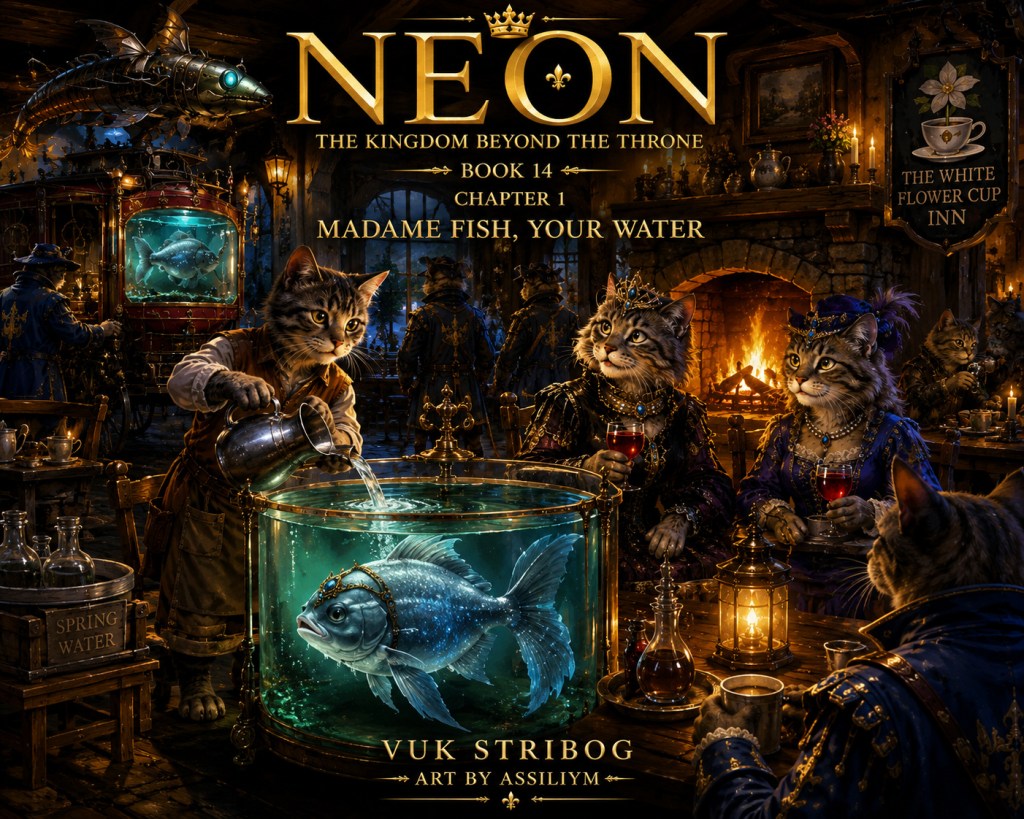
Antoine came back with spring water in a covered jug.
He carried it carefully to Duchess’s tank.
“Madame fish,” he said solemnly, “your water.”
Duchess approached the surface.
Leonardo stared.
“She has never accepted a title so quickly.”
Antoine poured the water through the little filter funnel.
Duchess circled once, then twice.
Then shimmered.
Leonardo looked impressed.
“She approves.”
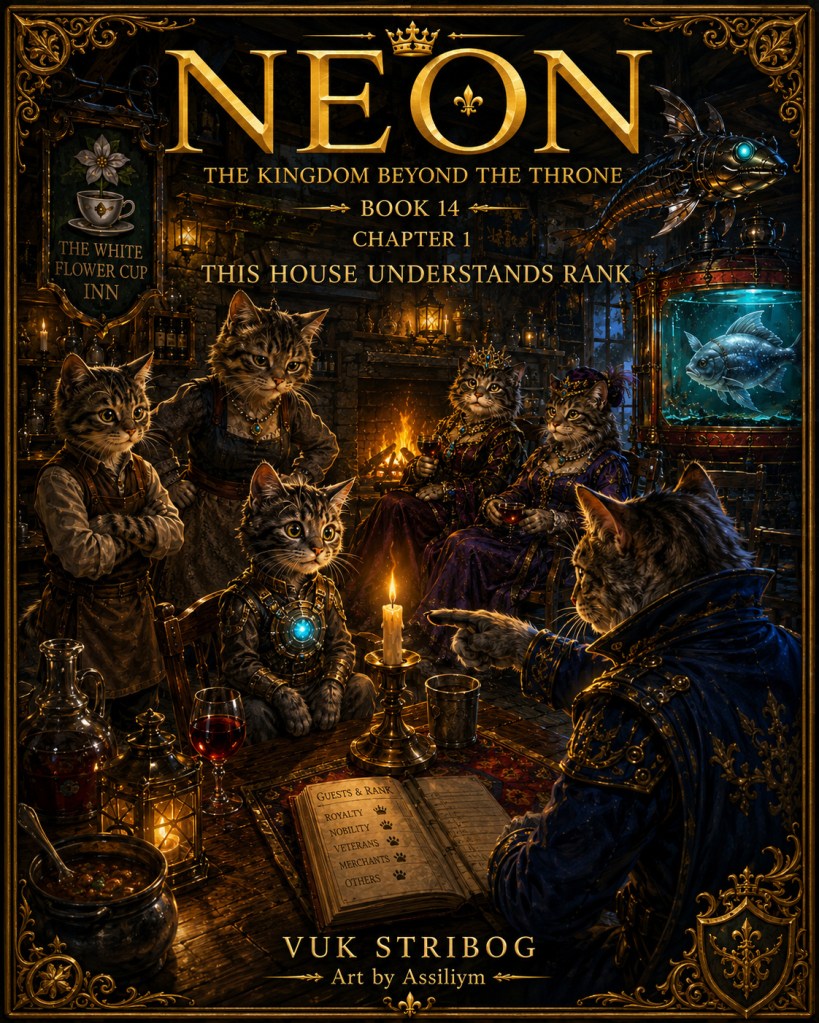
Marguarite watched them all from the firelight.
A provincial inn. A hidden son. A mad engineer grieving a rat. A storm creature demanding eggs. A countess collecting silence. Rain at the windows. Luis’s face carrying spring water to a fish.
The kingdom, she reflected, had become vulgar in its miracles.
Later, the party ate.
The guards drank carefully because Renaud watched them. Leonardo forgot to eat until Antoine placed bread beside his elbow and said, “You look like a cat who remembers food only after inventing hunger.”
Leonardo blinked.
“That is accurate.”
“Then eat before you improve the soup.”
Mr Sparky whispered, “Can soup be improved?”
“No,” said Leonardo and Antoine together.
They looked at each other.
For one strange moment, Leonardo smiled properly.
The innkeeper saw that from the doorway and was pleased. Not because Leonardo was important. She did not know how important. But because tired guests who smiled tended not to complain about sheets.
The night deepened.
Rain softened.
One by one, travellers went upstairs.
The guards took turns in the stable and yard.
Captain Renaud arranged watch without using royal titles.
Antoine noticed.
He noticed many things.
He noticed the escort never named the older lady.
He noticed the countess watched his mother whenever she thought no one saw.
He noticed the older lady’s paw had tightened on her cup when his name was spoken.
He noticed that the strange engineer touched an empty box at his belt when sad.
He noticed the blue creature was not dangerous when answered seriously, which was perhaps the strangest thing of all.
But Antoine had grown up in hiding without knowing he was hidden.
He had learnt not to ask questions that made adults stop breathing.
So he carried bowls, banked fires, fetched water, checked locks, and said goodnight.
Near midnight, Marguarite stood by the small window of her room.
The inn yard lay below, wet and silver-black. A lantern burned near the stable. Antoine crossed the yard with an armful of blankets, head bowed against the last rain.
The lantern-light caught his face once more.
Marguarite closed her eyes.
Henry, she thought.
You old, selfish ghost.
Countess Eleonora stood behind her.
“Do we wake the innkeeper?”
“No.”
“Do we question the son?”
“No.”
“Do we tell Captain Renaud?”
“Not all of it.”
Eleonora waited.
Marguarite opened her eyes.
“If Luis knows of him, the kitten dies.”
“Perhaps not.”
Marguarite turned.
Eleonora bowed her head slightly.
“Yes,” she said. “Perhaps.”
They both understood the court meaning of perhaps.
It meant already bleeding.
Before dawn, the Queen Mother’s party left.
Ashcourt understood enough about old queens to know that spider instructions were usually wiser than military ones and much harder to explain afterwards.
He left the royal party at the fork without trumpet, salute, or visible importance. One moment he rode at the rear of the escort. The next he had turned down the smaller road, cloak pulled low, sword wrapped under his saddle blanket, officer’s sash hidden in a bread sack, and his good riding posture damaged as much as discipline allowed.
By midmorning, he looked almost like an ordinary traveller.
Almost.
There are cats who can disguise rank by changing coats.
There are others whose shoulders continue saluting even when unemployed.
Ashcourt belonged to the second category.
He knew this. It annoyed him. He tried slouching.
The horse seemed offended.
“Do not judge,” Ashcourt told it.
The horse judged anyway.
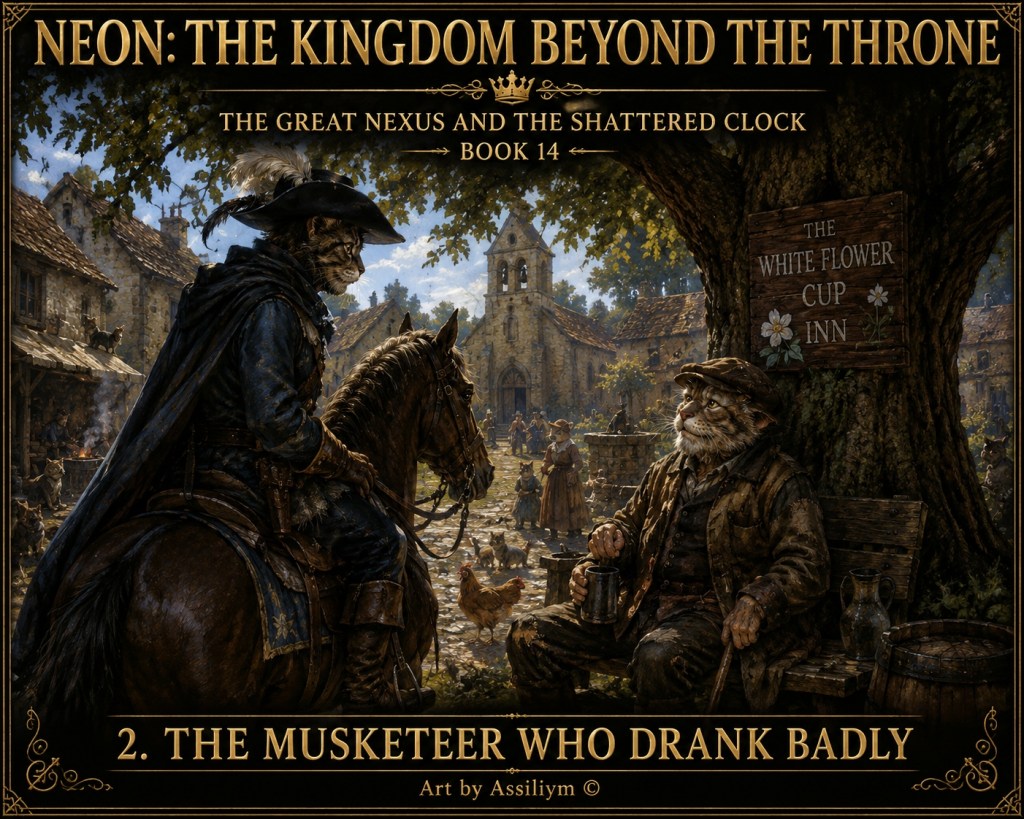
The village lay half a mile from the inn, clustered around a little square, a stone pump, a chapel with a cracked bell, two walnut trees, a smithy, a baker, a cooper’s yard, three arguing hens, six sleepy cats, and one old tom sitting under the larger walnut tree as if he had personally invented shade.
The old tom wore a cap of indeterminate age, a coat patched in several moral directions, and an expression that suggested the world had been disappointing him since before most cats had learnt to disappoint properly.
Ashcourt rode past him once.
The old tom watched.
Ashcourt rode past the baker.
The baker watched.
Ashcourt rode past the smith.
The smith watched.
Ashcourt reached the end of the square, realised the entire village had now seen him attempt innocence, and dismounted.
The old tom under the walnut tree spat one sunflower shell into the dust.
“You are lost,” he said.
Ashcourt turned.
“Am I?”
“Yes.”
“I had not noticed.”
“That is how I know.”
Ashcourt tied his horse by the pump.
“I am looking for a cup of wine.”
The old tom looked him up and down.
“At this hour?”
“I was told to drink badly.”
The old tom’s eyes brightened.
“By a doctor?”
“By a lady.”
“Worse.”
Ashcourt crossed the square and sat on the bench beneath the walnut tree.
The old tom shifted just enough to make room and not enough to imply hospitality.
“The tavern is there,” he said, pointing with his chin.
“I saw.”
“And yet you sit here.”
“I am gathering strength.”
“For the wine?”
“For the tavern.”
The old tom considered him.
“You have been in better places.”
“Not today.”
“You ride like a soldier.”
“I fell off a cart as a kitten and recovered with dignity.”
“No. You ride like a soldier trying to remember how carts work.”
Ashcourt looked at him.
The old tom looked back.
A hen walked between them and pecked at nothing with professional confidence.
Ashcourt said, “What is your name?”
“That was nearly a question.”
“A greeting, then.”
“Old Pernet.”
“I am Jules.”
“That is either true or close enough to be polite.”
Ashcourt decided he liked him.
This was dangerous. Liking old village cats led to information, but also to unnecessary honesty.
He took out two small coins.
“Will Old Pernet accept wine bought badly?”
Old Pernet looked at the coins.
Then at Ashcourt.
Then at the tavern.
“If you pay that much for village wine, the wine will be insulted by the expectation.”
“Good.”
“Good?”
“I was ordered to pay too much.”
Old Pernet’s whiskers lifted.
“Ah. Definitely a lady.”
They went into the tavern.
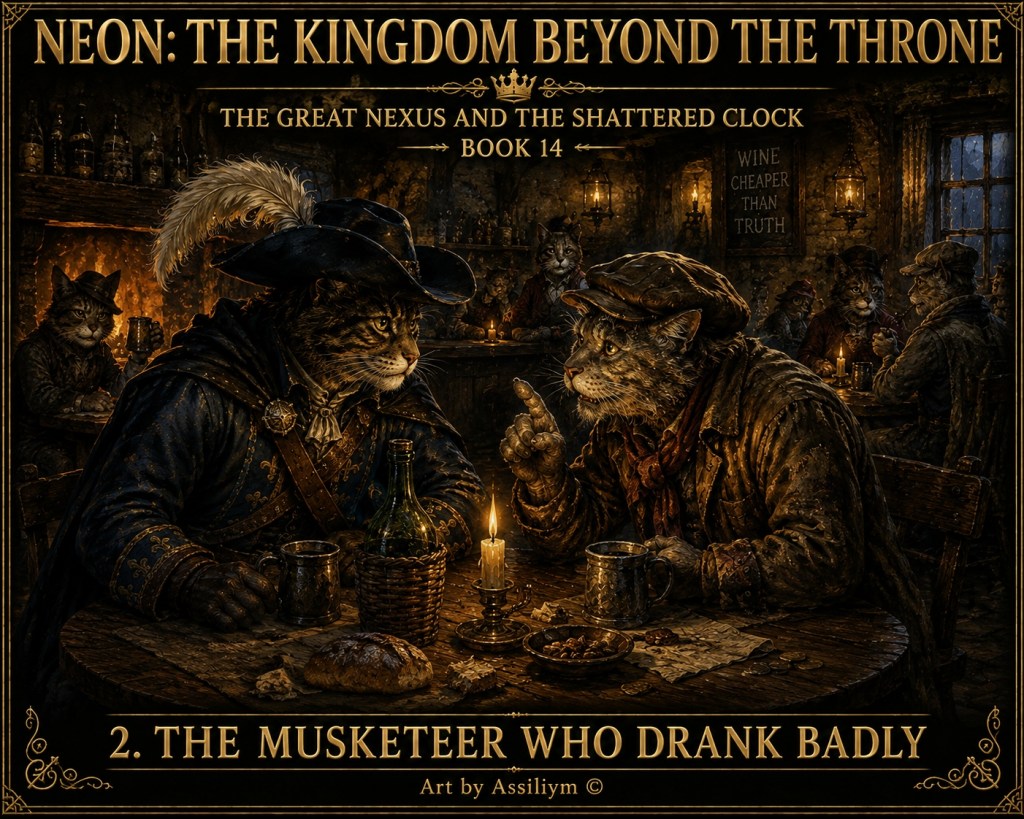
The tavern-keeper became respectful in the way merchants become respectful when coins improve their view of strangers.
Old Pernet sniffed the cup.
“This is bad.”
“I asked for bad.”
“No, you asked for wine. He chose crime.”
Ashcourt drank.
His face did not change.
Old Pernet looked disappointed.
“You swallow like a soldier.”
“I have swallowed army soup.”
“Ah. Then village wine cannot hurt you.”
“No.”
“It can still surprise you later.”
“I shall prepare a report.”
Old Pernet grinned.
They sat near the wall.
For a while, Ashcourt did not ask anything.
He let the room speak first.
The tavern-keeper complained about tolls. A cooper complained about hoops. A cat by the fire complained that the new road-guard inspected turnips with the arrogance of a bishop. Another said the Queen Mother had passed through at dawn. A third said it had not been the Queen Mother but a duchess, because queens did not travel with fish. The tavern-keeper said noble ladies could travel with anything they liked provided they paid.
Ashcourt drank badly.
Listened well.
Paid for another cup.
Old Pernet accepted his share with the grave dignity of a scholar receiving dangerous manuscripts.
At last Ashcourt said, “There is an inn near the road. White flower on the sign.”
“The White Flower Cup.”
“Good place?”
“Better than this.”
The tavern-keeper shouted from behind the counter, “I heard that.”
Old Pernet lifted his cup.
“So did the wine, and it agreed.”
Ashcourt smiled faintly.
“Who keeps it?”
“Madame Lise.”
“Lise?”
“That is what she lets cats call her.”
Ashcourt lifted the cup.
“Not her name?”
Old Pernet looked into his wine as if the answer might be hiding there and refusing to pay rent.
“Names are like boots,” he said. “Some cats wear the pair they were born in. Some change when the road gets muddy.”
Ashcourt waited.
Old Pernet drank.
Ashcourt paid for bread.
Old Pernet ate it.
Patience, Ashcourt thought, was more expensive than cavalry.
“She came years ago,” Old Pernet said at last. “Not born here. Not village stock. Too straight in the back. Too careful with silence. Bought the old inn after Widow Perraude died and her nephews tried to sell the roof twice.”
“With coin?”
“With enough coin.”
“From where?”
Old Pernet shrugged.
“Villa sale, some said.”
“What villa?”
The old tom glanced at him.
“That sounded like a question.”
Ashcourt leaned back.
“My mother used to say old houses die badly.”
“Your mother was right.”
“She knew villas.”
“Did she?”
“No.”
“Then she guessed well.”
Ashcourt waited again.
Old Pernet finished the bread.
“The old Varennes place,” he said.
Ashcourt felt the name land.
Varennes.
He did not write it down.
Writing too soon frightened truth.
“The innkeeper came from there?”
Old Pernet’s eyes narrowed.
“You ask with soft paws, Jules-who-rides-like-soldier.”
“I am curious.”
“Curiosity wears many uniforms.”
“I left mine in a saddle bag.”
Old Pernet laughed.
It was a dry little sound, but not unkind.
“Yes. From Varennes. She had been a lady once, or close enough that servants opened doors before remembering not to. Lady Élodie de Varennes.”
Ashcourt lifted the cup slowly and drank.
Lady Élodie de Varennes.
The name sat behind his teeth like a coin he dared not bite.
He said, “And now she keeps an inn.”
“And better than many born to it.”
“Alone?”
“With her son.”
“Antoine.”
Old Pernet’s expression changed.
Only slightly.
But Ashcourt had been trained to notice the exact size of fear when it dressed as fondness.
“Yes,” said the old tom. “Antoine.”
“A good worker.”
“The lad lifts barrels like taxes and complains less.”
“Local?”
Old Pernet snorted.
“He arrived with her.”
“How old?”
“When he came? Young enough to run. Old enough to remember being told not to.”
“Not to what?”
Old Pernet looked towards the window.
Outside, the village square lay in pale daylight. A she-cat crossed with a basket. The smith’s hammer rang once. A cart wheel creaked. Ordinary sounds. Useful sounds. Sounds behind which dangerous things liked to sit quietly.
“Not to stand too close to strangers,” Old Pernet said.
Ashcourt stepped out into the square.
The village had shifted into afternoon. Smoke rose from chimneys. A donkey objected to existence near the smithy. Two kittens ran past chasing a hoop. The chapel bell gave one cracked note and then seemed to lose confidence.
Ashcourt walked to the pump and washed the taste of wine from his mouth.
It did not work.
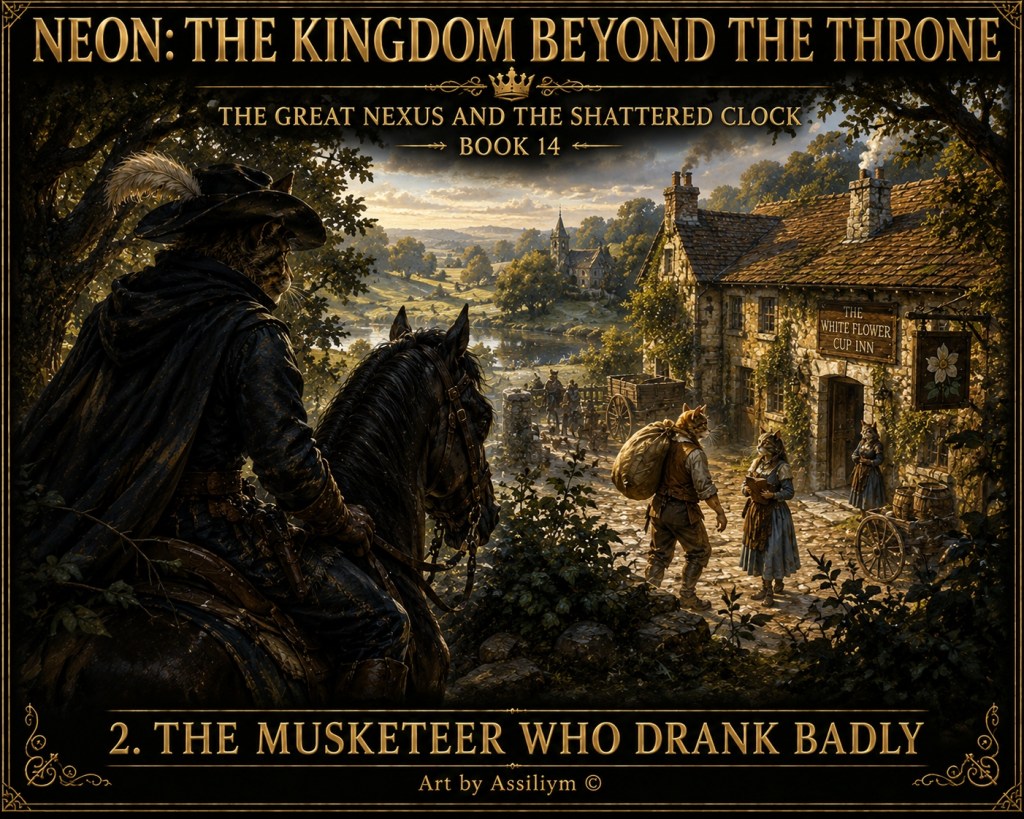
He mounted and took the smaller lane towards the inn.
He did not ride into the yard.
He stopped on the ridge above it, half-hidden by hawthorn, and looked down.
The White Flower Cup stood quiet in the pale light.
Laundry hung near the side wall. A stable cat swept straw. The roof did indeed need work. A shutter on the west side had been mended with two different woods.
In the yard, Antoine lifted a flour sack from a cart and carried it inside.
Plain coat.
Working shoulders.
Mud on boots.
Luis’s face.
Not exactly.
No crown. No fear-polish. No soft cruelty taught by rooms full of mirrors. But the same line of jaw. The same eyes. The same royal bones, made provincial by labour and almost saved by ignorance.
Lady Élodie came out after him, carrying a ledger.
She said something.
Antoine laughed.
The sound travelled up faintly.
Ashcourt looked away.
He had served kings. He had guarded queens. He had seen claimants, bastards, cousins, titles, sealed papers, and the ways royal blood could make a knife nervous.
This young tom did not look like ambition.
He looked like a roof bill.
That might make him more dangerous.
Ashcourt rode on before anyone at the inn could see him watching.
At a little shrine by the road, he dismounted and took out his field notebook.
He did not write everything.
A report that carried too much truth could become evidence in the wrong paw.
Instead, he wrote in the private cipher used by officers who had once needed to report troop numbers past enemy priests.
Madame Lise = Lady Élodie de Varennes.
Former Varennes villa sold after death of King Henry.
Son: Antoine. Arrived with her. Believed ignorant of parentage.
Village memory: fine visitor under plain cloak, called “Uncle Philippe” by the young one.
Face: resemblance to His Majesty King Luis too strong for accident.
Local loyalty: favourable. Mother guarded. Son hardworking.
Risk: extreme if court learns before Her Majesty decides.
He paused.
Then scratched out Her Majesty.
Rook Slipwhisker had survived because he understood the difference between fear and panic.
Fear was useful.
Fear sharpened the ears, dried the paws, measured the distance between doors, counted windows, weighed footsteps, and asked, very sensibly, why a friendly smile had arrived before breakfast.
Panic ran.
Rook did not run unless he had already chosen where.
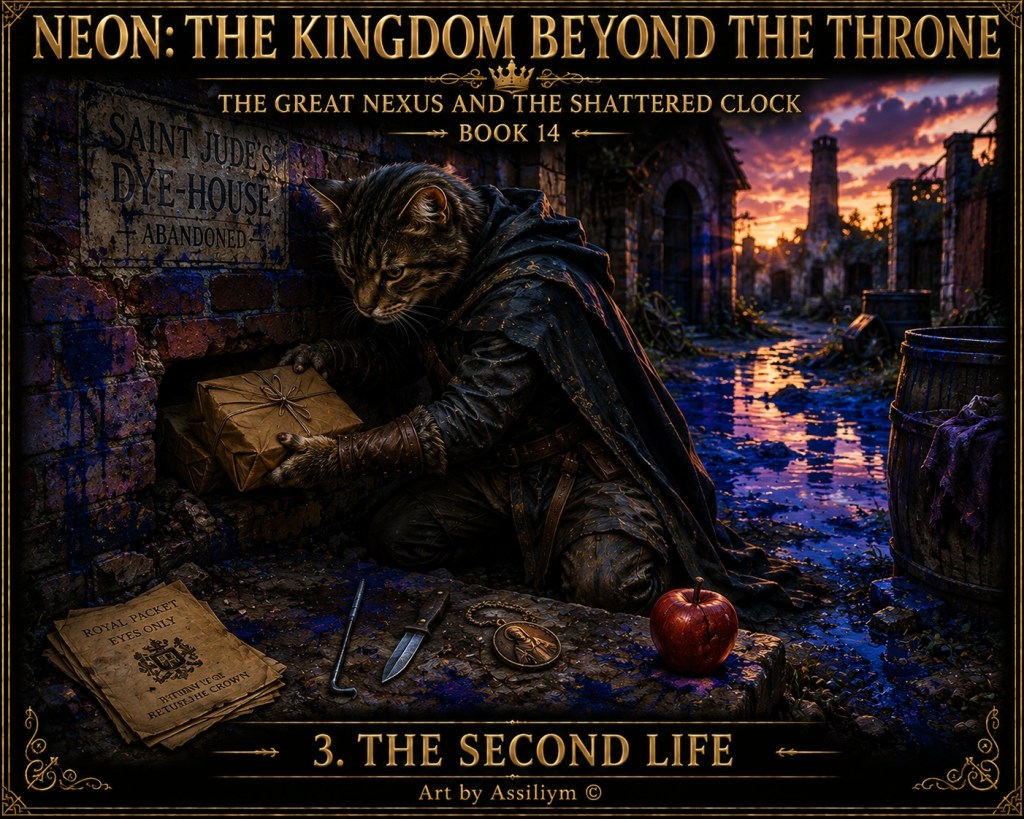
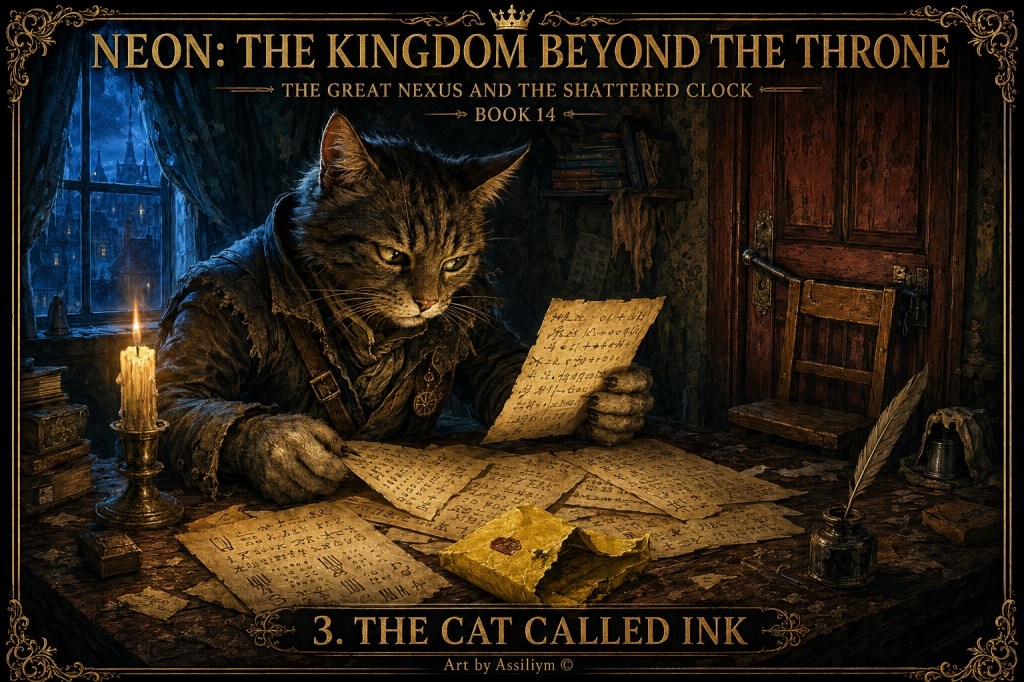
That morning, in a little rented upper room above a shuttered comb-maker’s shop, he locked the door, wedged a chair under the handle, pulled the curtain across the cracked window, placed a cup upside down over the mouse-hole because one never knew who employed mice, and took the yellow packet from beneath his shirt.
It lay on the table in the candlelight.
Yellowed paper. Old folds. Dry wax. A seal broken once and pressed flat again. The packet smelled of dust, locked drawers, old noble rooms, and trouble with money.
Rook did not touch it at once.
He listened.
Below, a cart passed.
Somewhere in the wall, a pipe clicked.
A tom coughed in the street.
No boots on the stair.
No paw on the latch.
No polite royal silence outside the door.
Good.
He opened the packet.
The first sheet unfolded with a faint crackle.
Rook expected names.
Names could be sold.
Names could be traded.
Names could be whispered to the right cat in the wrong tavern and turned into coin, protection, or a clean way out of a filthy alley.
He expected payments. Orders. Bishops. Mazzarini. King Henry. Maybe the old Cardinal Palace. Maybe proof that certain holy cats had once licked the royal bowl and later pretended they had been fasting.
He expected danger.
He did not expect soup made by spiders.
The page was covered in marks.
Not ordinary writing.
Not merchant shorthand.
Not thieves’ cant.
Not even the private scratch-code used by bookkeepers who wished arithmetic to look innocent after murdering a widow.
Lines of cramped letters crawled between little dots, hooks, church marks, number-groups, short dashes, old court abbreviations, and strange margin signs like half-finished claws. Some words looked almost readable, then fell apart when stared at. Others seemed to repeat with small changes, as if the paper were lying differently each time.
Rook stared.
Then turned the page upside down.
It did not improve.
He held it near the candle.
Nothing appeared except the alarming possibility of fire.
He sniffed it.
The paper smelled old, expensive, and unhelpful.
“Well,” he said softly, “that is rude.”
He unfolded the next sheet.
The same.
The third.
The same.
The fourth had a seal mark and a set of symbols down the side that looked like church counting, but wrong. The fifth had a name, or almost a name, cut into pieces and hidden among numbers.
Rook’s mouth tightened.
He could not read it.
That was bad.
But he could read the fact that he could not read it.
That was worse.
Common paper wanted to be understood. Even lying paper wanted the right cat to understand the lie. This paper had been written for cats who knew how to bury meaning alive and leave a little breathing hole for friends.
Rook folded the sheet again.
Slowly.
Carefully.
He was many things: thief, listener, occasional coward, useful liar, unofficial rat of three alleys, and, under one red name, Red Apple.
He was not stupid.
Vasili had seen enough.
That was the first bad fact.
The second bad fact was that royal clerks, bishops, or both might already be looking.
The third bad fact was that a paper no one could read might be worth more than jewels, and a thief who sold what he did not understand was only a corpse waiting for a buyer.
Rook leaned back.
“Copy first,” he whispered.
The candle trembled.
“Understand later.”
He put the sheets back into the packet, wrapped it in cloth, tied it under his coat, and left by the window.
Rook leaned closer.
“Royal paper.”
The two guards changed.
Not much.
But enough.
The sweet one stopped smiling.
“Wait.”
Rook waited in the alley with his paws visible, his shoulders loose, and three exits measured.
A minute later, the sweet one came back.
“Down.”
Rook went down.
Barrel Tom’s cellar was long, low, warm, and full of the comfortable misery of illegal drink. Barrels lined the far wall. Dice clicked in one corner. Two cats argued over a debt in whispers because shouting cost extra. A lantern smoked above the main table.
Barrel Tom sat beneath it.
He was broad, heavy, and dressed in a coat that made no attempt to hide the fact that he had shoulders like furniture. His eyes were small, patient, and unpleasantly good at counting.
He looked up.
“Red Apple.”
Rook’s stomach tightened.
He disliked hearing that name in rooms with no windows.
“Tom.”
“You are either brave or lost.”
“I am neither if business is quick.”
“Business is never quick when a thief asks for privacy.”
Rook glanced at the other cats.
Barrel Tom lifted two claws.
The dice game stopped.
The whispering debt left unfinished.
Cats moved away with the obedience of those who preferred to go on breathing through original holes.
Tom leaned back.
“What did you steal?”
Rook smiled.
“That hurts.”
“What did you steal?”
“Paper.”
Tom’s face did not change.
“That is worse than jewels.”
“Yes.”
“Royal?”
“Yes.”
“Church?”
“Maybe.”
“Dead cat’s business?”
“Almost certainly.”
Barrel Tom stared at him for a long moment.
Then he said, “You need a reader.”
“No. I need a copy.”
Tom’s eyes narrowed.
“That is smarter.”
“I try to surprise enemies and disappoint friends.”
“You have no friends.”
“Then I am very successful.”
Tom did not smile.
“Why come to me?”
“Because Ash Town knows cats who can make paper lie about being itself.”
“And why should I help you?”
Rook placed three coins on the table.
Tom looked insulted.
Rook placed a fourth.
Tom looked less insulted but still professionally wounded.
Rook said, “Because if royal clerks are looking for this packet, they will walk through Ash Town eventually. Better you know which boot comes first.”
Tom’s eyes rested on him.
That argument had weight.
Not enough to make Tom generous.
Nothing did.
Enough to make him curious.
“You need The Ink,” Tom said.
Rook nodded.
“I hoped you would say he was dead.”
“He nearly is. Charges extra for the difference.”
“Where?”
Tom held out one paw.
Rook sighed and added two more coins.
Tom made them vanish.
“Behind the dead print shop in Cinder Hollow. Back room under the old funeral-card press. Knock twice, wait, knock once, then say you have a baptism for a corpse.”
“That is the password?”
“That is the joke. The password is whether he likes your shoes.”
Rook looked down at his shoes.
“They are stolen.”
“Then tell them to look honest.”
Rook turned to go.
Tom’s voice stopped him.
“Red Apple.”
Rook looked back.
“If that paper brings royal trouble through my cellar, I will sell your old name to whoever pays first.”
Rook nodded.
“If it brings royal trouble through your cellar, Tom, old names will be the cheapest thing on the table.”
For the first time, Barrel Tom smiled.
It did not improve him.
“No wonder Vasili wants your skin.”
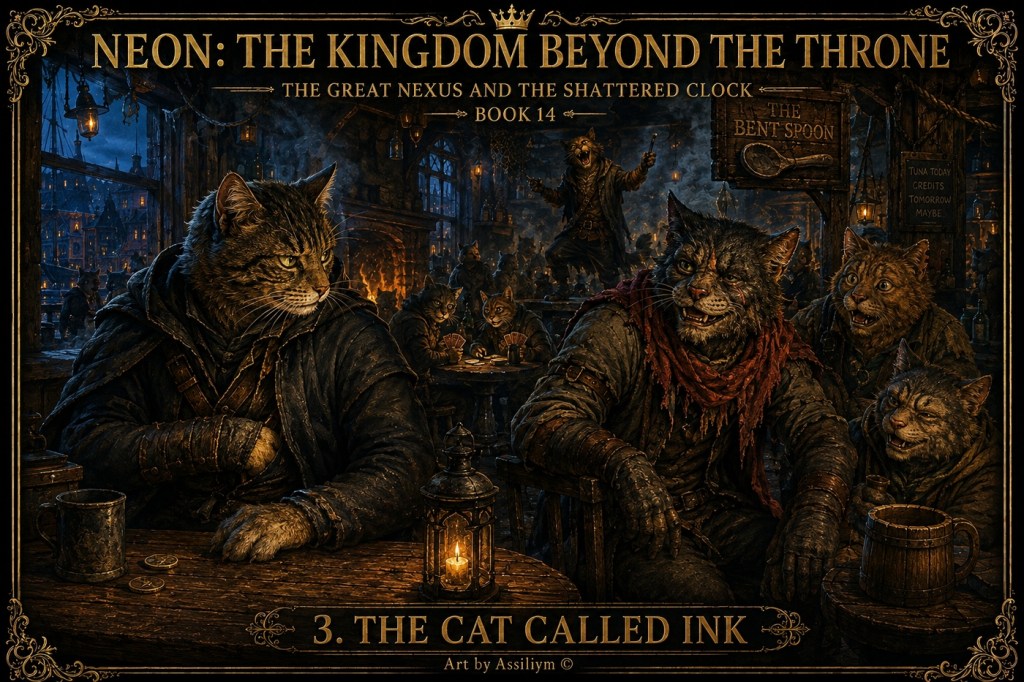
Cinder Hollow was where things were made after law had refused the commission.
Broken presses. Cheap metal. Hidden stamps. False-bottom crates. Wedding notices for cats who were already married elsewhere. Death notices for cats who needed a day’s absence from creditors. Guild passes with the ink still wet enough to blush. There were alleys there where every door had once been a trade and was now three crimes wearing an apron.
The dead print shop stood behind a cooper’s yard, its sign hanging by one hook:
MORVAN & SONS — RESPECTABLE PRINTING
No cat in living memory had seen a Morvan, a son, or respectability enter the building.
Rook knocked twice.
Waited.
Knocked once.
A small hatch opened.
One eye looked out.
“What?”
“I have a baptism for a corpse.”
Silence.
Then the eye lowered.
“Shoes.”
Rook lifted one paw.
The eye studied it.
“Stolen.”
“Yes.”
“From who?”
“A cat who complained too late.”
The hatch closed.
Bolts shifted.
The door opened just enough.
“Come in before the street learns spelling.”
The room inside smelled of vinegar, lampblack, hot wax, copper salts, old leather, damp paper, and lies that had been drying for thirty years.
Shelves climbed every wall. Papers hung from strings. Seals lay in little wooden trays: guild marks, parish stamps, toll-house tokens, noble crests, merchant seals, river permits, mourning stamps, marriage circles, debt-court squares. Some were real. Some were false. Some had started real and been persuaded into larger careers.
Behind a long bench sat a thin old tom with pale fur stained beyond rescue.
His paws were extraordinary.
Blue on the claws. Red along the pads. Green across one wrist. Black ground into the lines. Gold dust beneath two nails. Purple near the knuckles. Brown where wax had once burned him and never quite forgiven the skin.
No one called him Master.
No one called him sir.
They called him The Ink.
Because no one remembered what colour his paws had been born.
The Ink looked at Rook over little round spectacles.
“Too young.”
“For what?”
“Whatever stupidity you brought.”
Rook took out the yellow packet.
The Ink’s expression did not change.
His paws did.
They stopped moving.
That was more frightening.
Rook placed the packet on the bench.
“I need copies.”
The Ink did not touch it.
“Of what?”
“Paper.”
“Paper copies itself every time a fool repeats a rumour. What kind?”
Rook unfolded the cloth.
Yellow sheets showed.
The Ink leaned forward.
Still did not touch.
Old forgers, Rook knew, respected traps the way priests respected relics: with fear disguised as manners.
The Ink said, “Where did you get that?”
“No.”
“That was not a price question.”
“And that was not an answer.”
The Ink’s stained claws hovered over the first sheet.
“May I?”
“No cutting.”
“I asked may I, not may I ruin it.”
Rook nodded.
The Ink lifted the first page with two ivory slips, never letting paw-oil touch the surface. He carried it to the lamp. Tilted it. Smelled it. Breathed on one corner. Held it above black velvet. Looked through the fibres.
Then he muttered something very old and very rude.
Rook’s ears lifted.
“That bad?”
The Ink ignored him.
He took a lens from a drawer, examined the margin marks, then the seal scar, then the fold lines.
His face became less like an old forger and more like a doctor listening to a chest that should not still have a heartbeat.
“Can you read it?” Rook asked.
“No.”
“You barely looked.”
“I looked long enough to know I do not want to read it by candle while a thief breathes near my elbow.”
“Can you read it later?”
The Ink’s eyes flicked to him.
“Perhaps.”
“Perhaps is expensive.”
“Dead is dearer.”
Rook leaned on the bench.
“What is it?”
The Ink gave him a look of deep professional contempt.
“If I knew, I would have read it.”
“What kind of code?”
“Not tavern.”
“I knew that.”
“Not thieves.”
“I knew that too.”
“Not merchant. Not simple church. Not pure Treasury. Not pure court.”
The Ink lowered the page.
“This is mixed sickness.”
Rook liked that less than he wanted to show.
“Mixed how?”
“Old court abbreviations. Church ledger habit. Treasury number discipline. Little obedience dots from legal clerks. Someone built this for cats who had already agreed where the bodies were buried.”
Rook swallowed.
“Can you copy it?”
The Ink finally smiled.
It made him look worse.
“I cannot read a snake’s prayer, little apple, but I can copy the scales.”
“Do not call me that.”
“Then do not bring fruit-shaped trouble into my shop.”
The Ink began to prepare.
He did not simply take paper.
 Vuk Stribog