
INSIDE BOOK 15
NEON — The Ashes of Kings.
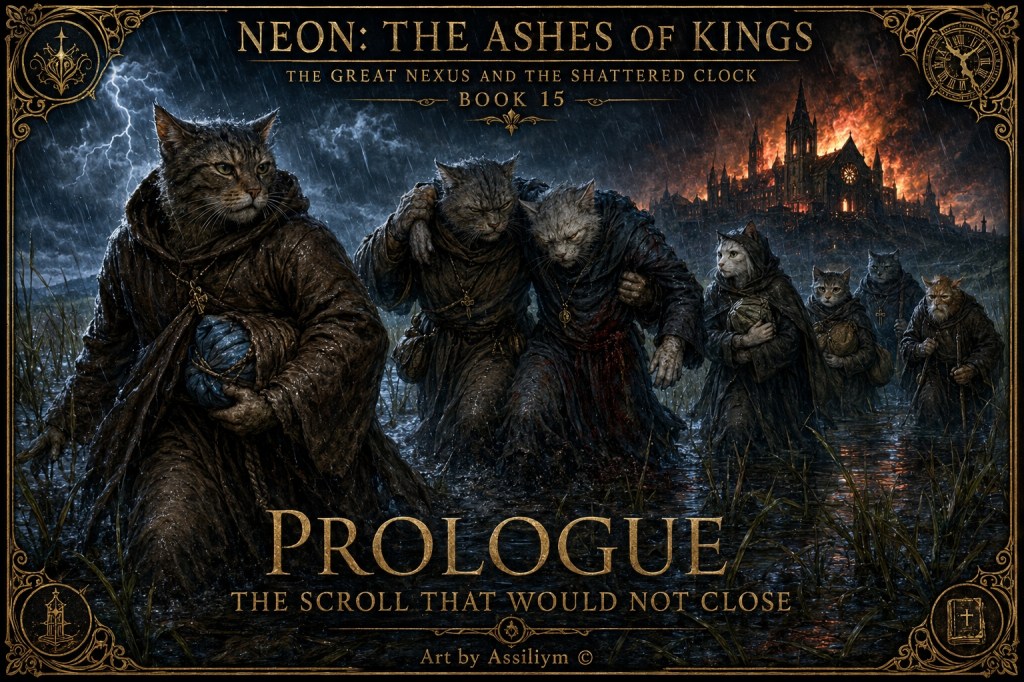
The drainage passage did not lead to freedom.
It led to mud.
That was the first lesson the surviving monks of Saint Velisar learnt after leaving holiness behind by the narrowest door in the monastery wall. They had imagined, in that confused and generous part of terror which still believes escape has an ending, that once the last stone of Saint Velisar vanished behind them, the world would open its paws and say: run, you are saved. But the world had no such manners. It gave them a ditch choked with winter reeds, a broken culvert, black water up to the knees, rain coming sideways over the fields, and a sky so low and bruised that even the crows seemed unwilling to fly beneath it.
Behind them, Saint Velisar burned without yet being seen.
That was worse.
Smoke is honest when it rises. Flames are honest when they break windows and call every eye to witness. But before fire becomes visible, there is a waiting time in which every cat who has fled knows what is happening and is not yet allowed the mercy of proof. The monastery bells had rung once, then stopped. No call to prayer followed. No monk-song. No hurried shout from the orchard. No old Abbot Marcion’s voice telling foolish kittens not to climb the pear wall. Only the rain, the mud, and the dreadful knowledge that silence can be louder than slaughter when it comes from a place that had always been full of work.
Brother Elarion carried the bundle under his robe.
Not against his chest. Not exactly. He had tried that at first and found that the cloth grew warm whenever his heart beat too hard. Now he held it low, wrapped in oilskin, cord, and old grey wool, as if ugliness could disguise danger from kings, bishops, soldiers, and whatever else in heaven had begun listening when the Orb first opened beneath the roots.
The Blue Scrolls were heavier than parchment.
Brother Caddoc said that was impossible.
Brother Caddoc was the sort of cat who believed in impossibilities until they stood on his tail. He was broad, practical, old enough to have lost patience with mystery, and young enough to keep walking when grief told him to sit down in the ditch and let the king’s soldiers finish the argument. He had one paw under Brother Jorren’s shoulder and another gripping the strap of the scroll bag, because practicality, even when frightened, likes to hold two problems at once.
Brother Jorren was bleeding.
Not beautifully. Not like saints in paintings who suffer in balanced poses beneath golden light. He bled as living cats bleed when a spear has opened the side below the ribs and the body, insulted by metal, has begun to surrender warmth into cloth. His brown robe had turned black at the wound. His breath came wrong. Every few steps his paws slipped, and Caddoc dragged him on with the savage tenderness of a brother who has not yet asked permission from death.
Behind them stumbled five others: Brother Mattheos, healed once by the first blue line and now older again in the cold; Brother Pelran with the fever scrolls; little Novice Sennet, who had not yet grown into his ears and carried the Sight fragment as if it were a kitten; Sister Maelia, who had bound the bundles beneath sacks of turnip seed; and old Brother Oth, who had carried nothing but the monastery’s kitchen knife and a loaf of bread because, he said, no outlawed truth ever survived long without supper.
They crossed the lower fields by the mill-stream.
The mill had been abandoned after the wheel broke in the spring floods. Its roof sagged. One wall leaned towards the water with the exhausted courtesy of an old servant waiting to be dismissed. Rats had lived there. Owls had lived there. Poor travellers had cursed there. It was, for that night, the nearest thing to sanctuary that had not yet been informed by authority that sanctuary was illegal.
Caddoc kicked the door open.
It did not open.
He kicked again.
The door fell inward, which was less obedience than collapse.
They entered.
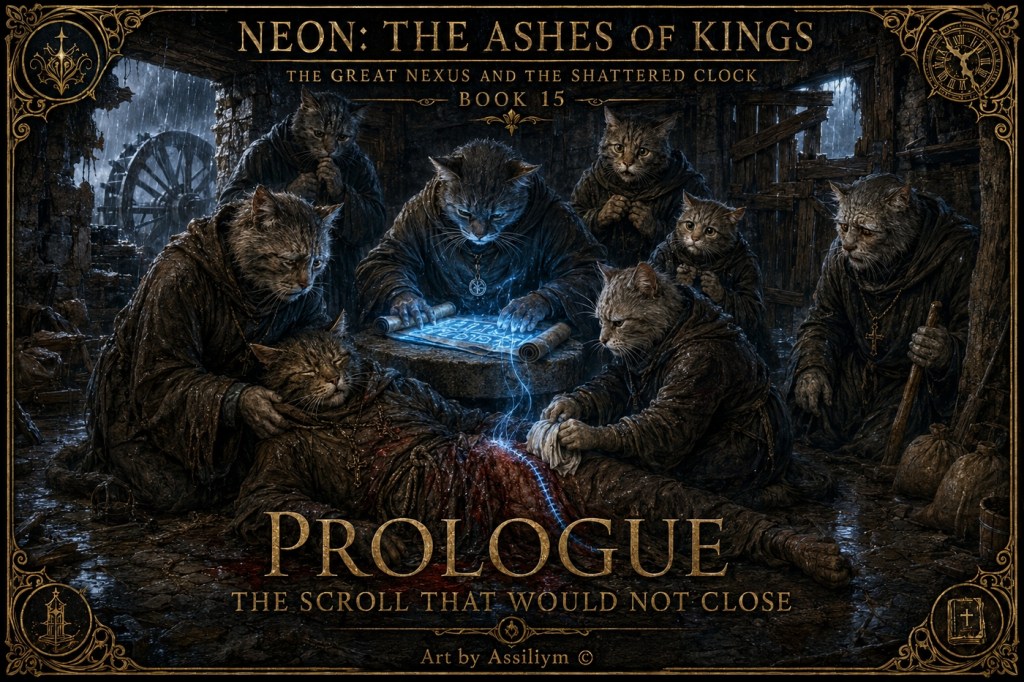
Inside, the old mill smelled of damp grain, mouse nests, mould, cold stone, and the old honest labour of wood that had once turned water into bread. The broken wheel groaned outside whenever the stream pushed at it, one quarter-turn, then failure, one quarter-turn, then failure, like an old cat trying to remember a prayer whose middle had been burned.
“Shut the door,” Caddoc said.
“There is no door now,” said Brother Oth.
“Then lean disappointment against the hole.”
They dragged a board across the entrance.
Sister Maelia lit no lamp. They dared not. She found a cracked shutter and let in a thin strip of grey rain-light. It fell across the mill floor and stopped at Brother Jorren’s paws.
He sank there.
Not sat.
Sank.
That is how the dying choose the floor when the body has voted without consulting dignity.
Caddoc knelt.
“Jorren.”
The wounded monk tried to answer and produced only a wet sound.
Every cat heard it.
No one named it.
Elarion set the scroll bundle on the old millstone.
The oilskin glistened in the faint light.
Caddoc turned.
“No.”
Elarion had not spoken.
He looked at him.
“No,” Caddoc said again, because some refusals must be said twice if the first one has heard danger breathing.
“He will die.”
“Yes.”
The word struck the room.
Novice Sennet began crying silently. He had been very brave in the drainage passage, which meant he had been storing terror for later. Later had arrived.
Elarion’s paws rested on the bundle.
“We have the Breath Scroll.”
“We have copies of what we do not understand.”
“We understand enough.”
“That is the sentence fools carve on their own graves.”
Sister Maelia knelt beside Jorren and pressed cloth hard against the wound.
Her face told the truth before her mouth did.
“He has little time.”
Caddoc looked at her.
Then at Elarion.
Then at the bundle.
Outside, the broken wheel groaned.
One quarter-turn.
Failure.
Brother Mattheos, who had once lain blind and fevered beneath Saint Velisar’s orchard and been called back by blue writing, touched the wall as if steadying himself against memory.
“It healed me,” he said softly.
Caddoc turned on him.
“And what did it take?”
Mattheos did not answer.
That was the first silence in the mill which belonged not to fear, but to knowledge.
Elarion looked at him.
Brother Mattheos had never spoken much of the healing. He had risen from his bed. He had seen again. He had wept over colours for three days. He had kissed Abbot Marcion’s paw and then spent one whole winter repairing the orchard wall because gratitude, in some cats, becomes masonry. But sometimes, when the bells rang for evening prayer, he turned the wrong way. Sometimes he forgot the names of tools he had used since kittenhood. Sometimes he stared at healthy cats with a sadness too precise to be called wonder.
“What did it take?” Caddoc repeated.
Mattheos closed his eyes.
“My sister’s face,” he said.
No one moved.
“I remember that I had one. I remember she wore a red scarf when she brought apples. I remember I loved her. But when I try to see her…” He touched his own brow. “There is blue light where her face should be.”
The mill seemed to grow smaller.
Jorren gasped.
Blood seeped between Sister Maelia’s paws.
Elarion looked down at him.
There are moments in which morality, which spends most days dressed as law, sermon, caution, or wise delay, is stripped suddenly to one naked question: will you let the cat before you die because the cost of saving him may be wicked?
Elarion was not a saint.
That was important.
Saints are useful to painters and dangerous to stories. Elarion was a tired monk in a wet robe, with mud on his paws, smoke behind him, soldiers somewhere on the road, a dying brother at his knees, and stolen divine knowledge wrapped in oilskin on a millstone. He was clever. He was frightened. He loved too much. He had already opened the Orb once and knew, though not yet fully, that some doors do not close merely because paws leave them.
He untied the cord.
Caddoc seized his wrist.
“Brother.”
Elarion looked at him.
“If we carry these Scrolls only to watch cats die beside them, then we are not guardians. We are misers.”
“If we use them without wisdom, we are murderers with prettier ink.”
“He is dying now.”
“And you may lose something you cannot name.”
“I know.”
“No,” Caddoc said, and his voice broke at last. “You do not. That is the trap. The price is always invisible until after the paw has signed.”
Elarion looked at Jorren.
The dying monk’s eyes had opened.
He knew. Some dying cats do. They arrive before others at the border and hear the argument from both sides.
“Do not quarrel over me,” he whispered.
“That is what brothers are for,” said Brother Oth roughly.
Jorren’s mouth twitched.
Then pain took even that.
Elarion unfolded the first blue copy.
It was not the Orb.
That mattered too.
The Orb had been a wound in reality wearing the shape of mercy. The Scroll was only a copy, made by shaking paws under candlelight, written with blue ink that had not been mixed from any earthly mineral and had dried too slowly, as if deciding whether obedience to parchment was beneath it. Yet even copied, even thinned through mortal script, the lines moved.
Not much.
Enough.
Breath lay at the top.
Not the word alone. The pattern. The instruction. The command hidden under understanding.
Elarion saw again what he had seen beneath the orchard roots: that a living body was not a thing, but an agreement. Breath, blood, heat, memory, shape, hunger, pain, all signing the same treaty each morning without knowing it. A wound was not merely damage. It was a disagreement. Flesh saying open where life required closed. Blood saying leave where the body begged stay. Breath saying less when the soul demanded more.
The Scroll did not say heal.
That would have been too simple.
It showed how to persuade.
Elarion bent over Jorren.
“Hold him.”
Caddoc swore under his breath, then obeyed.
That, too, was brotherhood.
Sister Maelia held the cloth ready. Brother Oth took Jorren’s shoulders. Mattheos gripped the wounded monk’s paws. Sennet turned away, then turned back because childhood sometimes becomes older in one breath and cannot return to its former size.
Elarion read.
The first line entered his eyes.
The mill changed.
Not outwardly. The roof still leaked. The stream still pushed the wheel. Rain still touched the broken shutter. But beneath those ordinary sounds another order appeared, delicate and terrible, as if creation had lifted one corner of its own skin and allowed a monk to see the blue veins beneath.
He saw Jorren’s wound.
Not as torn flesh.
As a sentence broken in the middle.
He saw the blood leaving. He saw where it had been told to run and where it had forgotten. He saw the breath snagging behind the ribs. He saw pain as red knots. He saw fear as silver threads wrapped too tight round the heart. He saw the spear path, the angle, the bruise blooming inward, the small vessel pulsing open and open and open.
He understood.
That was the sweetness.
Understanding is the gentlest poison because the mind thanks it while swallowing.
“Breath first,” he whispered.
His paw moved above Jorren’s muzzle.
Not touching.
Calling.
Jorren inhaled.
A terrible, deep, ragged breath came into him, as if the old mill itself had drawn air through the broken door and given it to his chest.
Sennet sobbed.
“Again,” Elarion said.
Jorren breathed again.
The blue lines brightened.
Elarion read the second pattern.
Blood.
He did not speak it aloud. He dared not. The word itself seemed to look back at him. He followed the curve with his eyes and felt something inside his own skull answer, a small opening, a willingness, a door being unlocked by someone who already knew where the key had been hidden.
Jorren’s bleeding slowed.
Caddoc stared.
Sister Maelia lifted the cloth slightly.
The wound still gaped, ugly and wet, but the blood no longer fled in panic. It waited. Trembled. Obeyed.
Elarion read the third pattern.
Flesh.
This one hurt him.
He had thought reading would be like prayer.
It was more like being read.
The Scroll entered where his mind was softest: curiosity, pity, pride, terror, love. It did not threaten. It offered. It said without words: see, see properly, see how foolishly bodies break when they might be instructed to remember. It showed him not only Jorren’s wound, but every possible correction. Not one. Many. Too many.
He could close the spear cut.
He could strengthen the rib.
He could make the heart beat cleaner.
He could soften old scar tissue.
He could improve the lungs.
He could lengthen the breath.
He could—
“Elarion,” Caddoc said sharply.
The name pulled him back by the fur.
Elarion’s paw was shaking.
The blue light had spread over Jorren’s side. Whisker-fine threads entered the wound like patient roots. Torn flesh drew together, not smoothly, not beautifully, but with the stubborn obedience of cloth being stitched by invisible claws. Jorren cried out once. Then his body arched. Then the wound closed.
Not healed fully.
Marked.
A seam remained, blue at the edges, as if the body had signed a receipt.
The Scroll dimmed.
Elarion closed it.
At least, his paws folded the parchment.
Yet as the two edges met, a second writing appeared along the inner fold.
It did not belong to the healing pattern Elarion had copied beneath the orchard. A pale line divided the parchment from top to bottom. Upon one side, blue letters formed with the calm severity of law:
PURPOSE.
Beneath it came the powers that had just answered him: begin breath, recall blood, restore shape, continue function, complete what injury had interrupted.
Upon the other side appeared a smaller word:
MERCY.
Preserve the name. Return choice. Release the subject. Release the reader. Stop.
Caddoc saw it over Elarion’s shoulder.
“Why two columns?”
Elarion looked at Jorren’s closed wound and understood too quickly.
“Because the command to begin must not own the command to end.”
The words beneath MERCY faded first. Not erased. Withdrawn, as if the Scroll had judged that the paw holding it had reached eagerly enough for one night.
Caddoc touched neither column.
“No copy carries both,” he said.
Elarion looked at him.
“If they are separated, a healer may lack what is needed.”
“If they remain together, a king may possess beginning, continuation, and stopping in one paw.”
Sister Maelia stared at the blue seam in Jorren’s side.
“And a frightened healer may become a king for the length of one wound.”
That settled it.
From that night, the most dangerous Blue knowledge would not travel whole. Purpose would be copied upon one page and Mercy upon another. They would be carried by different keepers, hidden in different houses, and taught through different memories. One fragment would restore function. Its companion would protect identity, limit alteration, return refusal, and command the work to cease.
It was an imperfect safeguard.
All mortal safeguards are.
But the Blue Monks had learnt their first law in a ruined mill beside a brother whose body had survived and a reader whose hunger had not entirely closed:
Power must never be trusted to carry its own mercy.
Purpose would travel faster.
Power always did.
Mercy would take the longer road.
For a moment, no one spoke.
The old mill wheel groaned outside.
One quarter-turn.
Failure.
Then Jorren breathed.
A real breath.
Another.
His eyes opened.
He looked at Elarion with the astonishment of a cat pulled back from a road he had already begun walking.
“You saved me,” he whispered.
Elarion nodded.
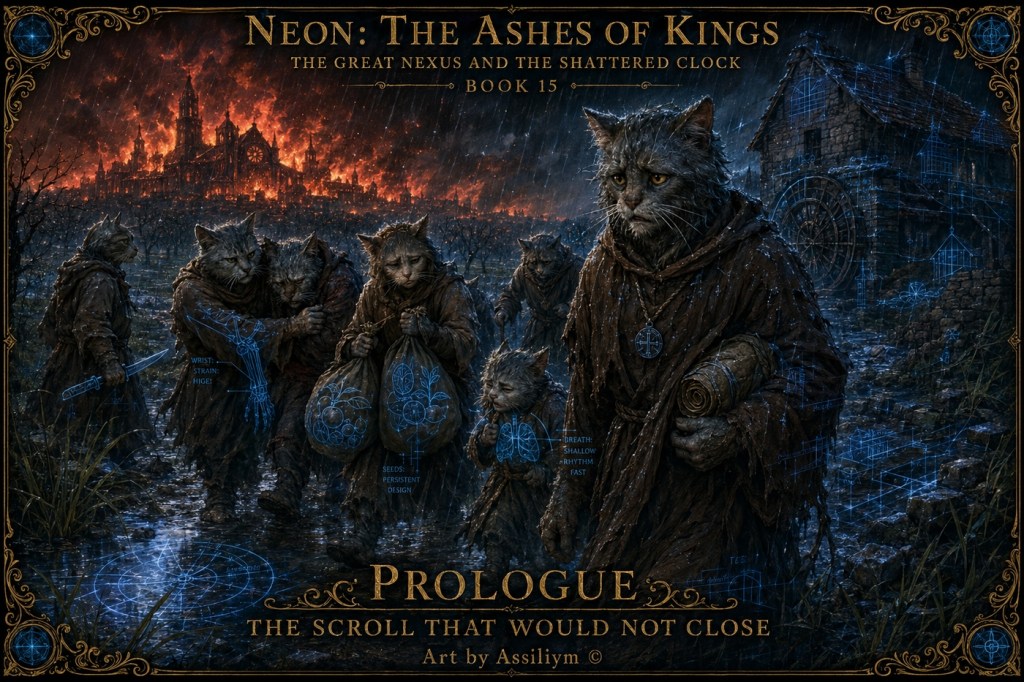
Elarion wrapped the Scroll again.
His paws were cold.
That surprised him. He had expected warmth after blue fire. But a deep cold sat behind his eyes, and in that cold something moved, not alive, not speaking, merely arranged differently than before. He tried to remember Abbot Marcion standing at the orchard gate, telling him to run.
He remembered the gate.
He remembered the rain.
He remembered Marcion’s paw on his shoulder.
He remembered the words: a dead guardian guards nothing.
Then he tried to hear Marcion’s voice.
Nothing came.
He frowned.
He tried again.
He could remember what Marcion had said. Every word. Every meaning. The old abbot’s discipline, courage, stubborn mercy — all these remained, written in thought like entries in a monastery record.
But the sound was gone.
The warm roughness. The little rasp on the second syllable when he was tired. The dry amusement that had once made rebuke feel like bread with salt. The voice of the cat who had sent them away to live.
Gone.
In its place, faint and patient, lay the blue shape of breath.
Elarion gripped the millstone.
Caddoc came close.
“What did it take?”
Elarion did not answer.
That was answer enough.
Caddoc shut his eyes.
Outside, far behind them, a red glow began to rise where Saint Velisar stood. Smoke had found the sky at last.
For three days, nothing moved beneath Paris-Neon.
That was not entirely true. Water moved. It gathered somewhere in the limestone dark above the abandoned quarry, travelled patiently through cracks too narrow for a claw, grew heavy upon the underside of stone and dropped at intervals into a shallow depression beside the old quarry table.
Plink.
Silence.
Plink.
Silence.
It was the only clock in the chamber, and Tallow Greyear disliked it. He had disliked it on the first night, disliked it more on the second, and by the third had developed the conviction that the water was deliberately changing the length of its pauses whenever he listened.
“You know what is wrong with this place?” he asked.
Orren Blackpaw, sitting upon an overturned stone bucket and examining a demon buckle for possible resale, did not look up. “Yes.”
Tallow waited.
Orren turned the buckle over between his claws. “You are in it.”
Mirel Ashwhisker laughed from beside the great metal body lying farther across the chamber.
“I am serious,” said Tallow.
“That is usually the problem.”
“The dripping has changed.”
“It is water.”
“Yes.”
“Water drips.”
“This water is thinking about it first.”
Orren finally raised his head. “Do you want me to threaten it?”
“I want both of you to develop survival instincts.”
“I have excellent survival instincts.”
“You brought two dead machines from another world beneath Paris.”
“One of them saved your life.”
“That,” Tallow said, pointing towards the enormous Hunter, “is precisely the sort of fact that prevents me from deciding whether I should be grateful or leave the country.”
The Hunter gave no opinion.
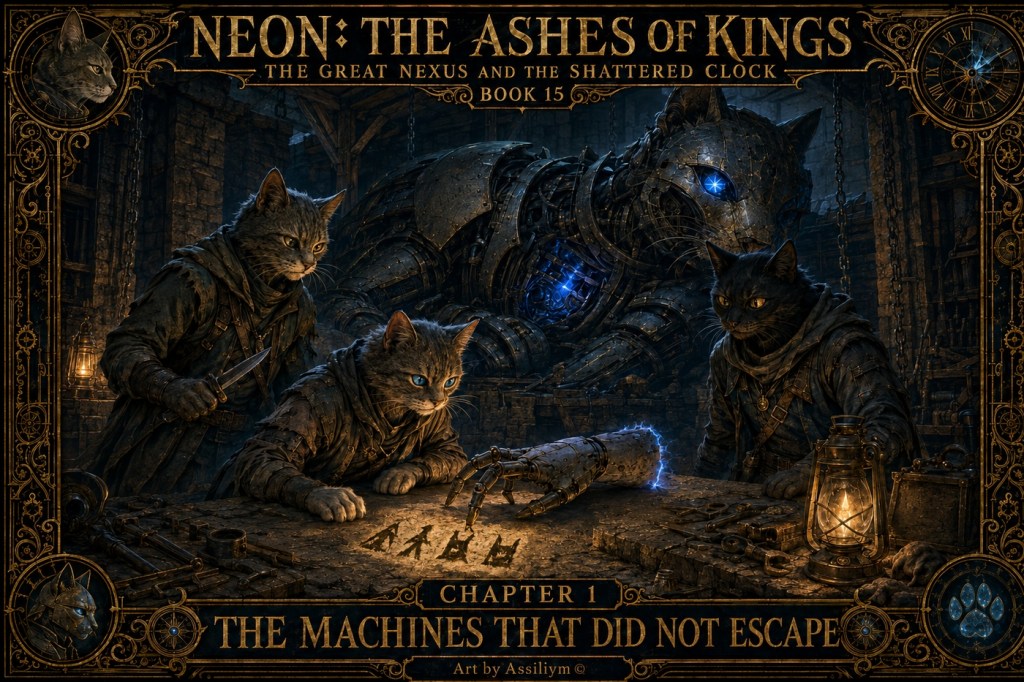
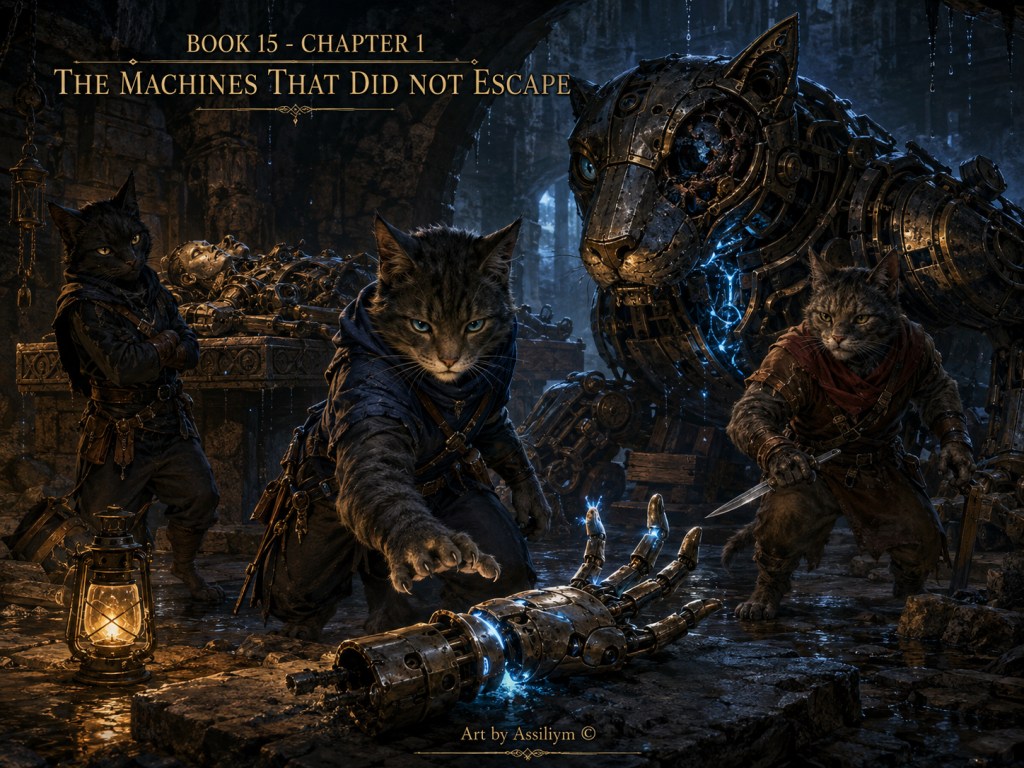
It lay where they had lowered it three nights before, partly supported upon timber blocks taken from the abandoned stone-yard above. In the lantern light it resembled something excavated from beneath an older creation: great feline architecture reduced to armour, pursuit and violence. One optic had been destroyed completely. The surviving socket remained dark. Its chest plate stood partly open where Mirel had loosened the crude mortal patch over the ruptured blue channels.
Nothing moved inside.
The Engineer lay upon the old stone worktable beyond it. Calling the second machine smaller had become an absurd habit, for it was smaller only beside the Hunter. Beside a cat it remained enormous: a narrow articulated body whose ruined limbs, opened housings, delicate tools and collapsed torso contained more workmanship than Mirel believed existed in half the workshops of Paris-Neon combined.
Between the two machines rested the severed Engineer hand.
Mirel had placed it there deliberately.
Tallow had placed his sleeping blanket as far from it as the chamber permitted.
Neither arrangement had changed.
Until now.
Mirel was examining one of the Hunter’s opened channels when she heard a click. Not the water. Not Orren’s buckle. Metal. Small and precise.
Her paw stopped.
Orren saw her expression. “What?”
Mirel raised one finger.
Tallow immediately drew his knife.
Orren glanced at the blade. “Against what?”
“I shall decide once it arrives.”
Another click passed through the chamber.
They all turned.
One of the Engineer hand’s narrow fingers had moved.
Tallow’s knife came fully out. “There.”
“Yes,” Mirel whispered.
“I told you.”
“You told us the water was plotting.”
“I was widening the principle.”
Another finger bent. The hand remained upon the stone, its wrist housing torn open and several of its internal mechanisms missing from the repairs it had already performed upon the Hunter. Yet somewhere within that ruined component a minute gear engaged.
Click.
A pale blue line appeared beneath the broken wrist.
Mirel approached.
Tallow caught her sleeve. “No.”
She looked at his paw.
He released her almost immediately. “I mean perhaps not immediately.”
The hand turned, not towards the Hunter but towards Mirel.
Orren rose from the bucket.
The blue line pulsed once, and a voice emerged from somewhere within the small mechanism, thin and broken but unmistakable.
“ENGINEER SUPPORT COMPONENT: ACTIVE.”
Mirel’s eyes widened. “Can you hear me?”
No answer.
She crouched nearer. “We brought you here. We brought the Hunter too.”
At that word, one finger moved.
“PRESERVE HUNTER.”
Tallow exhaled through his nose. “Yes. We know that part.”
Mirel shot him a look.
“What?” he said. “I am establishing that we have met.”
“You are arguing with a hand.”
“I am establishing precedent.”
Mirel turned back. “You repaired the Hunter.”
“PRESERVE HUNTER.”
“You took pieces from yourself.”
The blue line flickered.
“REPAIR MATERIAL DEPLETED.”
That phrase they knew. The Hunter had spoken of depleted material before collapsing into emergency dormancy. The severed hand had nearly emptied the Engineer to keep its companion alive, carrying true blue clockgear blood, bearings, filaments, micro-gears and pieces of its own body between the two machines while the cats slept.
Mirel leaned closer. “You need material.”
“CONFIRMED.”
Orren came nearer. “That is encouraging.”
Tallow frowned at him. “You said that last time.”
“And I remain encouraged.”
Mirel ignored them. “What material?”
The hand did not answer. Perhaps it could not. Perhaps the question was too broad.
She picked up a piece of ordinary iron from the table, an old quarry fitting rusted at one edge. “This?”
A narrow instrument extended from beneath the palm and touched the iron. A tiny blue point travelled over the surface.
“FERROUS MATERIAL. STRUCTURAL UTILITY: LOW.”
Orren folded his arms. “Insulted by iron.”
Mirel selected a length of black Keth’Var chain they had carried from the battlefield. “This?”
The probe touched it.
“FOREIGN FERROUS ALLOY. STRUCTURAL UTILITY: ACCEPTABLE. INTERNAL SYSTEM COMPATIBILITY: INSUFFICIENT.”
Mirel’s ears moved. “There. It can use some Neon material.”
“Some,” said Tallow. “Not enough.”
She looked across at the devastated Engineer. “What do you need for yourself?”
The hand went still. The question seemed to travel through mechanisms deeper than the hand itself, seeking an answer from a body too damaged to supply one quickly.
Then the voice returned.
“TRUE COMPONENT MATERIAL REQUIRED.”
“What is true component material?”
No response.
“Where do we find it?”
The hand moved.
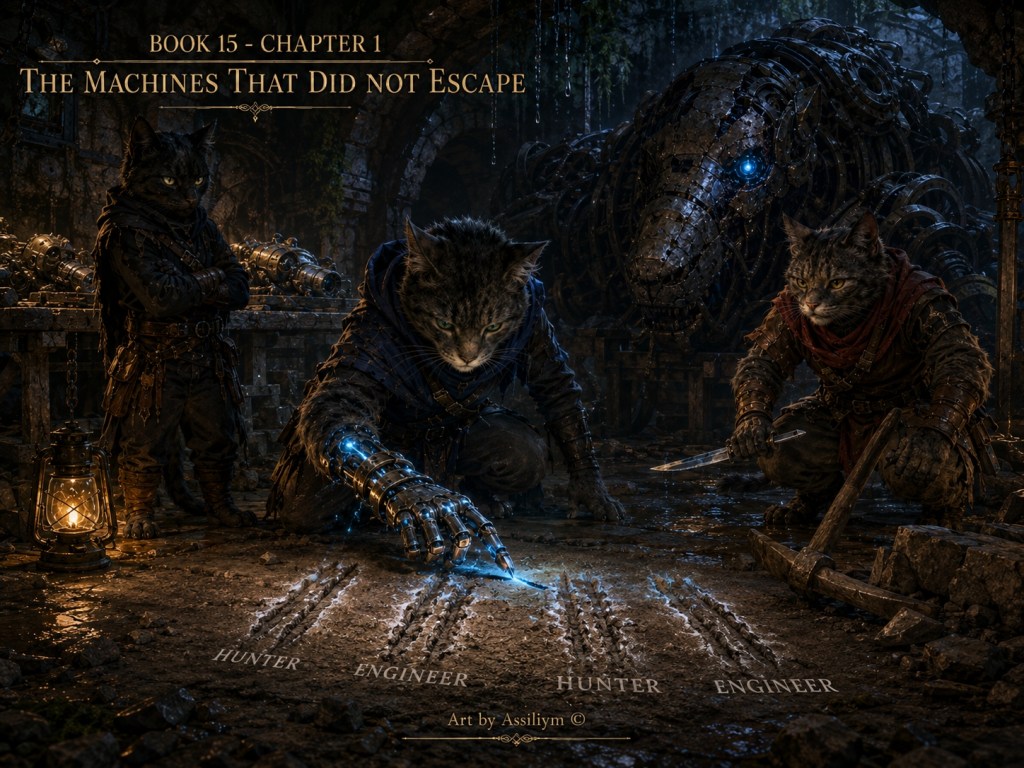
One finger touched the dust upon the stone floor and scratched three short lines. It paused, scratched two more, then drew a longer line and added four marks at its end.
Four.
Mirel stared.
The hand touched the first.
“HUNTER.”
Then the second.
“ENGINEER.”
The third.
“HUNTER.”
The fourth.
“ENGINEER.”
Nobody spoke.
The dripping water struck stone.
Plink.
Tallow slowly lowered his knife. “There were four.”
Mirel looked at him, then back at the marks. Until that moment the two machines had existed in her imagination almost as orphans of some impossible accident: two wounded things crossing a battlefield, two metallic creatures running from demons, two bodies falling through earth.
But not two.
Four.
“EXPEDITION UNITS: FOUR.”
The hand touched the first Hunter mark, then the first Engineer mark, drawing a narrow groove between them. It did the same with the remaining pair.
Mirel understood. “Two Hunters. Two Engineers.”
“CONFIRMED.”
Orren pointed towards the great machine behind them. “This Hunter?”
The hand touched one of the Hunter marks.
“ACTIVE UNIT: CRITICAL.”
Mirel indicated the ruined Engineer.
“ACTIVE UNIT: CRITICAL.”
Tallow looked at the other two scratches. “And those?”
The hand remained motionless.
Mirel asked carefully, “The other Hunter?”
A pause.
“TERMINATED.”
The word settled heavily in the chamber.
Not dead.
Not killed.
Terminated.
Mirel looked at the fourth mark. “The other Engineer?”
“TERMINATED.”
Orren’s expression changed. “Where?”
No answer.
“Where are they?” Mirel repeated.
Nothing.
Then, from the darkness behind her, something clicked.
The surviving Hunter’s optic opened.
Only a pinprick at first, a cold cobalt star deep within the damaged skull.
Tallow took two steps backwards. “Oh, excellent.”
Mirel turned.
The Hunter did not rise. It could not. Its power remained too low, its shoulder too damaged, its hindquarters barely responsive. But the surviving optic moved from Mirel to the severed hand.
“ENGINEER QUERY RECEIVED.”
Its voice came slowly through the ruined chest.
“EXPEDITION RECORD: PARTIAL.”
Mirel stood. “Where are the other two?”
The optic narrowed. For several seconds nothing happened. Then a sequence of tiny mechanical pulses came from inside the Hunter.
The Engineer hand answered.
Blue flickered between its fingers.
Something passed between them—not speech exactly, but memory.
The Hunter spoke again.
“ENGAGEMENT LOCATION: DEMON APERTURE OUTER FIELD.”
Mirel glanced at Orren. “The battlefield.”
“Yes.”
The Engineer hand spoke.
“PAIR TWO STATUS?”
The Hunter’s optic dimmed.
“PAIR TWO: TERMINATED.”
“RECOVERABLE COMPONENTS?”
A long pause.
“PROBABILITY: UNKNOWN.”
The hand answered immediately.
“RECOVERY REQUIRED.”
Tallow stared at it. “No.”
Mirel turned. “Tallow—”
“No.”
“We have to—”
“We absolutely do not have to. The machine requiring something does not convert the requirement into our occupation.”
“The Engineer needs those parts.”
“The Engineer might also require a palace made entirely of blue metal. I do not intend to steal one.”
Orren rubbed one paw over his muzzle. “Actually—”
“No.”
“I had not spoken.”
“You were preparing to.”
“I was preparing to say this is different.”
Tallow stared at him. “You want to go back.”
Orren did not answer immediately.
The battlefield had been good to him. It was an ugly sentence, and all three knew it. War had killed thousands, broken roads, burned villages, scattered armies, torn open the earth and left enough iron behind to make scavengers wealthy for a generation. Orren had spent much of his adult life following disasters after respectable cats had finished dying in them.
But this was different.
The Hunter’s optic flickered.
“RECOVERY MATERIAL DEPLETED.”
The Engineer hand answered:
“PAIR TWO COMPONENTS: TRUE MATERIAL.”
Mirel’s expression changed immediately. “There.”
Orren looked at her. “What?”
“True material. That is what it meant.”
She pointed towards the two scratched marks representing the terminated machines.
“It does not need ordinary iron for the important repairs. It needs its own metal. Its own gears. Its own channels.”
Tallow stared at the marks. “You want to bring back their bodies.”
“Not their bodies,” said Mirel quietly. “What is left of them.”
The Hunter’s eye dimmed further.
“POWER RESERVE CRITICAL.”
Mirel went to its side at once. “Sleep.”
The blue optic turned towards her. Whether the machine understood the word as she intended, she could not know. Perhaps it recognised only the absence of command. Perhaps the voice had become familiar. Perhaps neither mattered.
Then it spoke again.
“PAIR TWO LAST FUNCTION.”
Mirel froze.
“DELAY HOSTILE FORCE. PAIR ONE WITHDRAWAL.”
Orren slowly looked towards the surviving pair.
Mirel whispered, “They stayed behind.”
The Hunter’s optic gave one fading pulse.
“PAIR TWO HELD ENGAGEMENT. PAIR ONE ESCAPED.”
Then the blue went out.
No one spoke for several breaths.
Tallow looked again at the scratches upon the floor. Two little marks. That was all the dead machines had become here.
Four scratches.
Two lines.
Two survivors beneath Paris.
Two left upon the battlefield.
He sheathed his knife.
“When do we leave?”
Orren smiled faintly. “I knew you would become sensible.”
“I have become resigned. Do not confuse the two.”
The first time Orren, Mirel and Tallow had crossed the field, bodies still lay in ordered ruin where formations had broken. Demon siege gear stood where crews had abandoned it, and broken weapons remained plentiful enough that a cat could walk twenty paces without touching ordinary earth.
Now commerce had arrived.
Carts stood along the eastern approach. Families searched among the wreckage. Kittens carried baskets of arrowheads. Two smiths had erected a temporary buying table beside an overturned wagon and paid by weight for iron. A priest had appeared near the southern trench to bless the dead, while twenty yards away three cats were stealing nails from his cart.
Civilisation, Orren observed, was recovering with admirable speed.
They came dressed as what they were: scavengers. That was safer than disguise because truth, properly used, was often the least suspicious lie available.
Orren carried hooks and sacks. Tallow carried rope, a hammer and enough suspicion for an army. Mirel carried tools. They brought only one small handcart. If they found what they sought, they would return at night with heavier equipment.
That was the plan.
Plans are what cats make before entering places where everybody else has also made one.
By midmorning they reached the blackened region where the demon portal encampment had stood.
Here the damage changed character. Farther out, war had been violence. Here it had been architecture.
The earth was vitrified in broad patches, fused by energies that had taught sand to remember glass. Black retaining stones lay cracked in heaps. Sections of Keth’Var chain crossed the ground like the shed bones of enormous serpents. Deep trenches showed where siege frames had been anchored, and in one place a line had been cut through stone so cleanly that Mirel could not decide whether weapon, machine or sorcery had done it.
Tallow stopped. “This is where?”
Orren looked around. “You are asking me?”
“You always claim to remember profitable places.”
“I remember where things were before several hundred cats stole them.”
Mirel was already moving ahead.
She was not looking for wreckage.
She was looking for geometry.
Two Hunters. Two Engineers. One pair escaped west. One pair remained behind.
She stood where the portal had once been. Nothing remained of the wound between worlds—no blue fissure, no red-black opening, only scorched ground and cracked ritual stones, along with the unpleasant sense that the air had once learned something it ought to have forgotten.
“If they stayed behind,” she said, “the demons would have surrounded them.”
Orren joined her. “Which direction?”
“They were buying time for the other pair to escape.”
She looked west.
“That way.”
Then she turned east.
“So the pair that stayed would have fought here.”
Tallow pointed towards the ground. “Something did.”
The marks were not fresh or obvious. A scavenger cart had crossed some of them. Rain had softened others. But beneath the newer damage, deep gouges remained in the earth.
One curved trench ended in shattered stone.
Mirel crouched and ran a claw along a dark residue embedded in the crack.
Blue.
Not paint.
Not demon residue.
True clockgear blood, dried until only a metallic cobalt sheen remained.
“Orren.”
He came over, and she showed him.
They followed the trace.
The trail was nothing like the one that had led them to the surviving pair. That trail had belonged to wounded machines escaping. This one belonged to machines that had not.
Fifty yards north they found the first plate.
It lay beneath a collapsed demon shield, half covered in mud and ash. Mirel almost passed it because the exposed corner appeared no larger than her paw. She knelt and cleared the earth until more metal emerged.
Layered armour.
Scarred by impact.
A deep groove crossed it, blackened around the edges where tremendous heat had entered.
She tapped it gently with the handle of her tool.
The metal answered with the same deep bell-note she had heard from the surviving Hunter.
The next discovery was a severed mechanical claw—not the delicate articulated hand of an Engineer, but the heavy outer digit of a Hunter. Its tip had punched through a black demon breastplate and remained there after the rest of the limb tore away.
Orren stared at the armour. “Do we want that too?”
“No.”
“It appears expensive.”
“Orren.”
“I am asking professionally.”
They freed the claw. Its blue channel had dried, but inside the broken joint Mirel could see tiny interlocking structures untouched by rust.
True material.
She wrapped it carefully.
Then they found the body.
Or what remained of it.
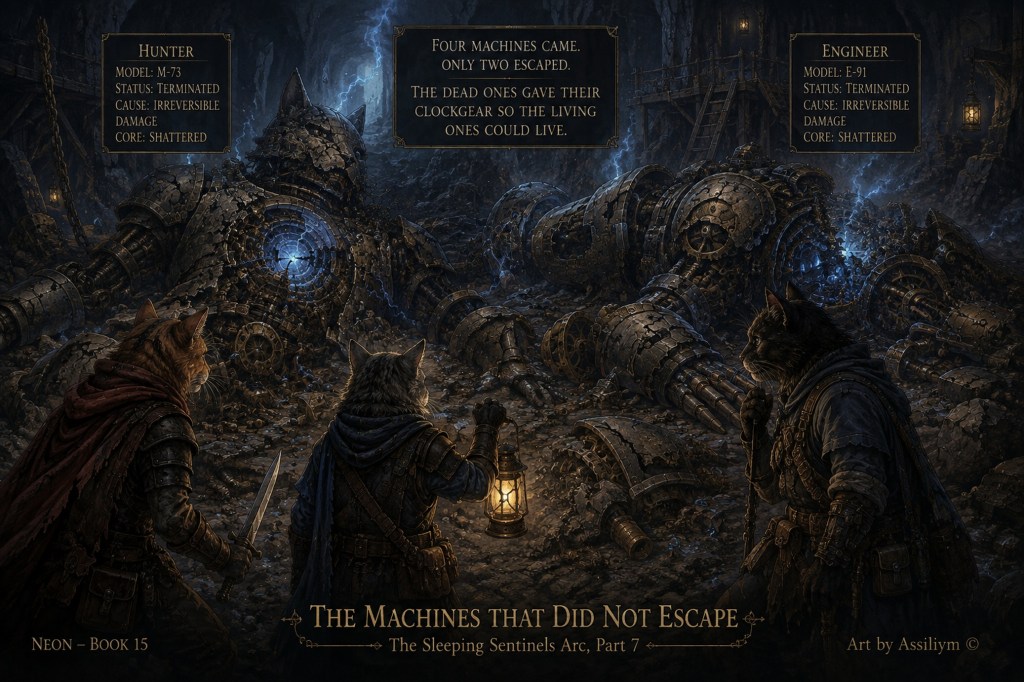
The dead Hunter lay in a shallow depression nearly a hundred yards from the old portal stones. At first it resembled a mound of burned metal surrounded by demon wreckage.
Then Mirel saw the skull.
One side was gone. Both optics had been destroyed. The jaw remained locked around the remains of a black spear. Something enormous had opened the chest, curling armour plates outward and blackening the internal channels. One forelimb was missing below the shoulder. The hindquarters had almost disappeared beneath the collapsed wheel assembly of a demon siege machine.
Around it lay evidence of what the final fight had cost.
Broken chains.
Split shields.
A Gate Breaker’s maul snapped across its shaft.
Three deep parallel trenches showed where the Hunter had dragged itself forward after its hind systems failed.
Tallow stopped well away.
Orren removed his cap.
He did not know why.
Mirel approached alone.
There was no blue light, no faint pulse, no buried mechanism trying to wake. This machine had not entered standby. It had not fallen asleep.
It was finished.
Terminated.
Mirel placed one paw against the cold armour.
“You gave them enough time,” she whispered.
Nothing answered.
Behind her, Orren looked away.
Tallow did not.
After a while Mirel stood. “We take what can still be used.”
The words hurt more than she expected.
Orren noticed. “You don’t have to.”
“Yes.”
“You said somebody would cut them apart.”
“I know.”
“And now—”
“Yes.”
He stopped.
Mirel looked back towards the dead Hunter. “But we are not melting him into swords.”
She opened her tool roll.
“We are taking him back to his own.”
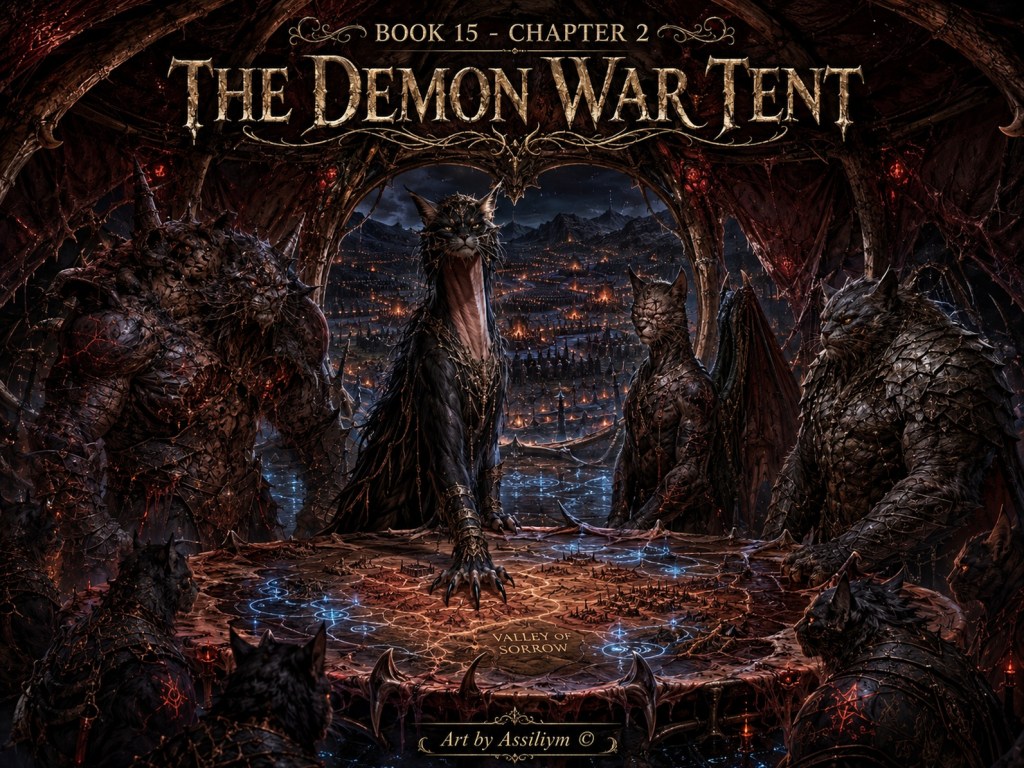
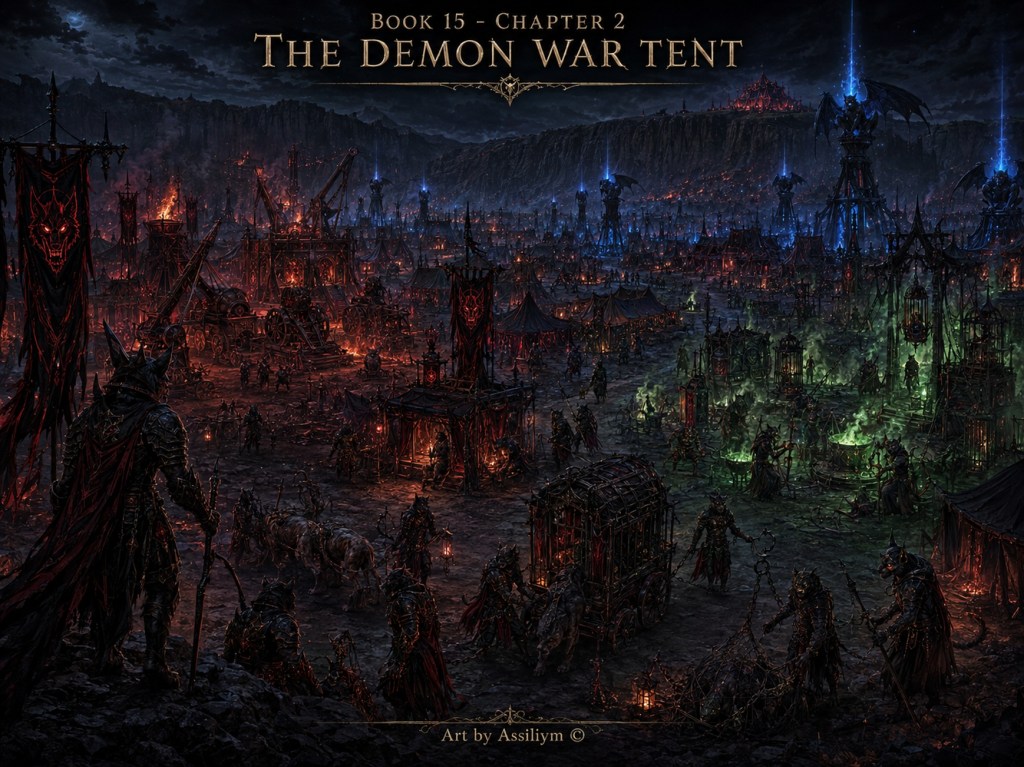
The war tent grew from the basalt ridge like a malignant organ, coaxed into being rather than built. Horn-ribs arched overhead, fused bone polished by pressures older than fire. Between them stretched thickened skins—once feline, now darkened and responsive, faintly pulsing as though memory itself were trapped beneath their surface.
Inside, the air tasted of iron and storm-salt. The floor was black glass, veined with sigils that crept so slowly they seemed still, until the eye lingered long enough to feel the motion behind thought.
Beyond the living walls, the Valley of Sorrow lay drowned in night. Tens of thousands of cats slept below—armies gathered from every surviving realm of Neon—still believing in distance, still trusting that dawn would arrive unchallenged.
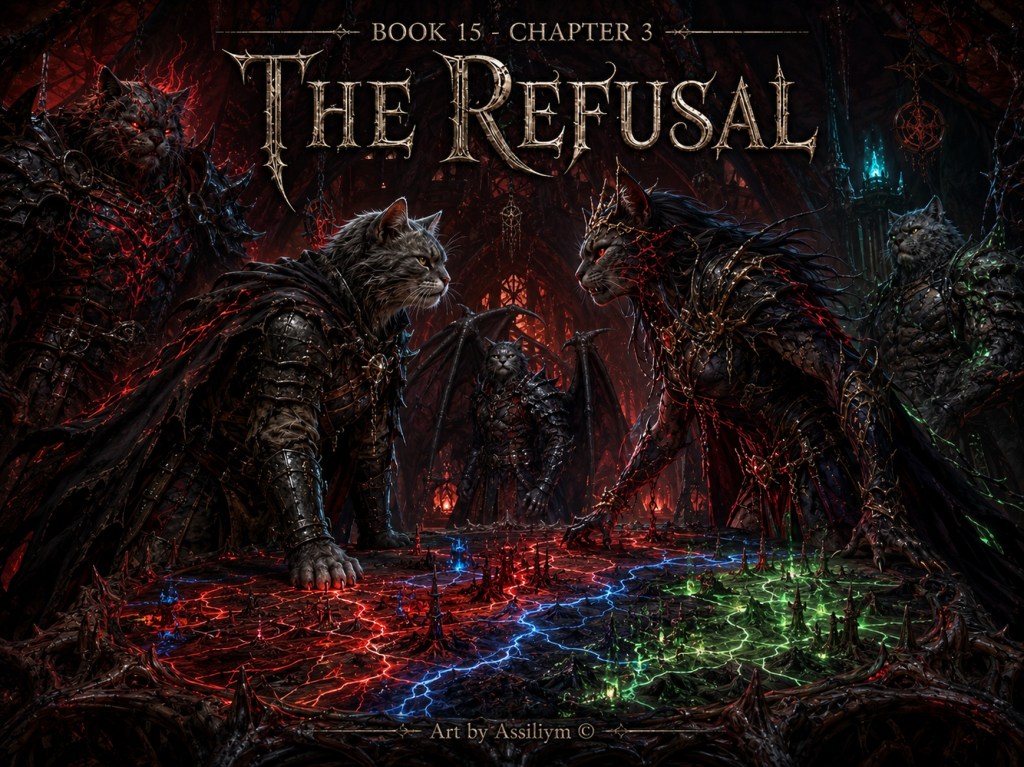
Within the tent, the demon commanders formed a broken crescent around the skin-map.
Urzakh-Morn, Breaker of Cities, loomed massive and asymmetrical, his tom-vessel reinforced where multiple bodies had been fused and forced into agreement. Each breath promised collapse.
Se’Thriel Vale, Mistress of the Screaming Sky, crouched lightly despite the wings folded against her sides. Her eyes had been sealed by ritual scars long ago; awareness vibrated around her skull as if sound itself served her sight.
Korr-Vael Thuun, Lord of the Colossus, stood utterly still. His fur had calcified into overlapping stone plates, and where his tail should have balanced him there was only a smooth, ancient scar.
At the centre stood Kraath-Vel.
Her cat-form was tall, elongated, subtly wrong. Light slid from her fur without reflection. The flesh of her neck was bare and smooth, emptied as though a crown or sigil had once rested there and been removed with perfect precision.
She did not wait.
Zha’korr vel Azhagar. Thren-kaal isheth mor’eth.
(By the Root of Azhagar. Becoming is commanded.)
The pressure settled instantly. Sigils slowed. Skins tightened. The commanders inclined their heads—not in submission, but in recognition of authority older than rank.
Kraath-Vel placed one clawed paw upon the skin-map. Beneath the translucent hide, the Valley of Sorrow glimmered faintly: ridges, dry riverbeds, the clustered geometry of mortal fortifications.
Azemont kael-thrys ven’ash.
(Azemont has made flesh negotiable.)
Her tail struck the glass floor once.
Sha’ul-keth naeth korr.
(He has made us weak.)
Urzakh-Morn leaned forward, claws biting into the stone.
Morra-kaal ul-sha’ul.
(Silence is rot.)
He drove a talon across the map.
Korr-eth keth-zir.
(Strike the cities first.)
Kaal-morra naeth.
(Collapse their will.)
Se’Thriel Vale’s wings rasped, sound vibrating with restrained hunger.
Ul-zha.
(No.)
She lifted her scarred head towards the valley.
Thren ven’ash korr.
(Fear ripens better than ruin.)
Her claws flexed.
A few of the lesser commanders shifted.
None dared laugh openly.
Kraath-Vel looked down upon the skin-map.
Maz-Daar had been sent before them all.
Not to conquer Neon.
Not to burn its cities.
Not to announce the existence of Azhagar to every mortal crown beneath the stars.
He had been sent to search.
To listen.
To move unseen beneath mortal fur until the secrets hidden upon Neon were placed into the paws of Azemont.
The mission had been entrusted to the highest among them because the things being sought were not treasures in the mortal sense. Kingdoms could rise and fall without disturbing them. Armies might march across the ground beneath which they slept and never know what lay below.
The first was the Great Shard of the Tides.
The second was the Nexus Child.
The third was older in implication than either.
The Orb of Divine Knowledge.
The Heart of the Great Nexus.
Even within the war tent, where demons who had fed upon terror and broken cities stood without trembling, the thought of the Orb seemed to alter the air.
Kraath-Vel counted Maz-Daar’s failures with deliberate cruelty.
Naer zha’ul-korr ul-thaer.
(No Great Shard of the Tides.)
Her claw touched the map.
Naer zhir-ka Thren-Kael.
(No Nexus Child.)
Another claw descended.
Naer zhurath vel’thyr.
(No Orb of Divine Knowledge.)
This time no approving sound followed.
The commanders were silent.
Kraath-Vel allowed that silence to remain.
Maz-Daar had searched through years of mortal seasons. He had hidden his true nature. He had worn weakness because Azemont commanded patience. He had crossed kingdoms, ruins and forgotten roads.
And still his paws were empty.
Urzakh-Morn gave a low, grinding sound.
“Then let the Lord-General continue searching while we conquer.”
Kraath-Vel’s head turned.
The Breaker of Cities fell silent.
She looked again at the map.
“Searching has brought us nothing.”
Her voice was quieter now.
That made every commander listen more carefully.
“Maz-Daar believes the secrets of Neon can be persuaded to reveal themselves.”
One claw drew slowly across the valley.
“I believe secrets reveal themselves when there is nowhere left for them to hide.”
Se’Thriel Vale tilted her scarred head.
“And Azemont?”
The question lingered.
No one else in the tent would have dared ask it.
Kraath-Vel’s gaze moved towards her.
For the smallest moment, something entered her expression and disappeared before any lesser demon could be certain it had been there.
“Azemont requires completion.”
That was all she said.
It was not an answer.
Se’Thriel Vale knew it.
Kraath-Vel knew that she knew it.
Neither spoke again.
Instead Kraath-Vel straightened.
Zha’ul korr naeth myth.
(I will not let our kind fade into rumour.)
She looked across the commanders.
“Maz-Daar has hidden long enough.”
Her claw pressed into Neon.
“He has waited long enough.”
The map-skin tightened beneath her touch.
“If the Shard lies beneath stone, we will split the stone.”
Another claw descended.
“If the Child hides among the mortal kingdoms, those kingdoms will open before us.”
Korr-Vael Thuun moved before Kraath-Vel could place her claw upon the centre of the map.
The stone plates along his shoulders ground softly against one another.
“There is another power upon Neon.”
Kraath-Vel looked at him.
The Lord of the Colossus did not lower his gaze.
“The invasion will not face only mortal cats.”
For the first time since the council had begun, the lesser commanders nearest the living walls became completely still.
Korr-Vael Thuun placed one heavy claw upon the dark edge of the map.
“Oberon.”
The name required no explanation.
The Beast Lord.
The old master and protector of Neon.
The power beneath claw and fang, beneath wing, root and instinct; the ancient guardian whose authority had existed upon that world before mortal cats divided it into kingdoms and taught themselves to believe that drawing borders upon parchment meant the land had accepted them.
Korr-Vael’s voice remained low.
“Neon is his world.”
A faint movement passed through Se’Thriel Vale’s folded wings.
“He may allow his cats to quarrel. He may allow them to make war upon one another.”
Her scarred head turned towards the skin-map.
“We are not his cats.”
The silence which followed was different from the silences that had come before.
Even demons understood territory.
Even demons understood the difference between entering a kingdom and entering the den of something ancient enough to consider kingdoms temporary.
Kraath-Vel looked down at Neon.
Then she smiled.
“Oberon has watched his children destroy one another for ages.”
Korr-Vael Thuun remained still.
“And if he wakes?”
Kraath-Vel’s claw hovered above the map.
“Then he will wake.”
No one spoke.
The answer settled through the war tent.
The invasion would not proceed because Neon was undefended.
It would proceed despite the knowledge that somewhere within the forests, mountains and living blood of that world, its oldest guardian might already have begun to listen.
Then she placed one claw upon the centre of the map.
She did not name the third object again.
She did not need to.
The Orb.
The Heart.
The knowledge hidden within it.
Knowledge perhaps older than Azemont’s commands.
Knowledge of gods.
Of creation.
Of the Great Nexus itself.
And perhaps—if the oldest whispers were true—knowledge of the laws by which one power might bind another.
Kraath-Vel withdrew her claw.
None of the commanders saw the hunger she concealed.
The Great Shard of the Tides could be delivered to Azhagar.
The Nexus Child could be delivered to Azhagar.
But the Orb of Divine Knowledge…
That would depend upon who found it first.
She turned sharply towards Urzakh-Morn.
Korr’eth vael-morn.
(Prepare the Offering Engines.)
To Se’Thriel Vale:
Sha’thra-vel ul-naeth k’zir.
(Open the roots.)
A pause, precise.
Ul-zha.
(Not yet.)
At last, she faced them all.
Ul-sha’ul.
(We do not hide.)
Her tail lowered, perfectly still.
Doctrine sealed.
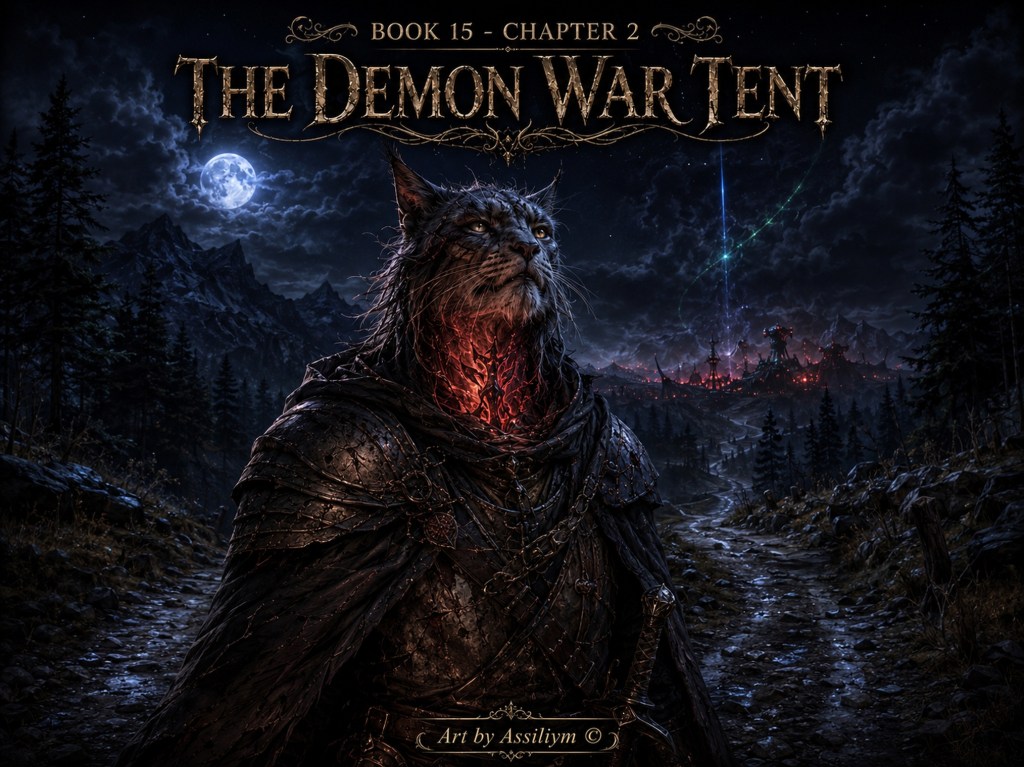
Far from the war tent, another cat walked alone beneath the night of Neon.
He was old.
Or, at least, the body was.
Grey fur lay thin around the muzzle and temples, and age had settled into the mortal flesh with the quiet authority of years honestly lived. To any cat who passed him upon the road, he was merely an ageing crusader—a veteran whose armour had known weather, whose paws had travelled too many roads and whose eyes carried the distant patience of one who had outlived battles younger cats still considered history.
The body belonged to Neon.
The essence within it did not.
Long before another mortal vessel would carry him through another age—long before the name Mer-mer would ever be whispered in Saint Virel—Maz-Daar, Lord-General of Azhagar and right hand of Azemont, walked Neon inside the mortal body of this old grey crusader.
It was the body he had worn throughout his long search.
The body that had crossed Neon’s kingdoms seeking the Great Shard of the Tides.
The body that had searched in silence for the Nexus Child.
The body that had followed forgotten traces and broken rumours in pursuit of the Orb of Divine Knowledge.
And found none of them.
The old crusader stopped.
Beneath his grey fur, the Great Demon Mark upon his neck suddenly burned.
Not the pain of mortal flesh.
A warning.
A conduit.
An accusation.
Maz-Daar lifted his head.
Across a distance no ordinary cat could have measured, he felt something move.
Kraath-Vel.
Armies.
War.
The ancient demon Lord-General stood perfectly still inside the ageing body he wore, while somewhere beyond the darkness the first machinery of destruction began to wake.
Maz-Daar opened the old crusader’s eyes.
The war had begun before the first weapon was raised.
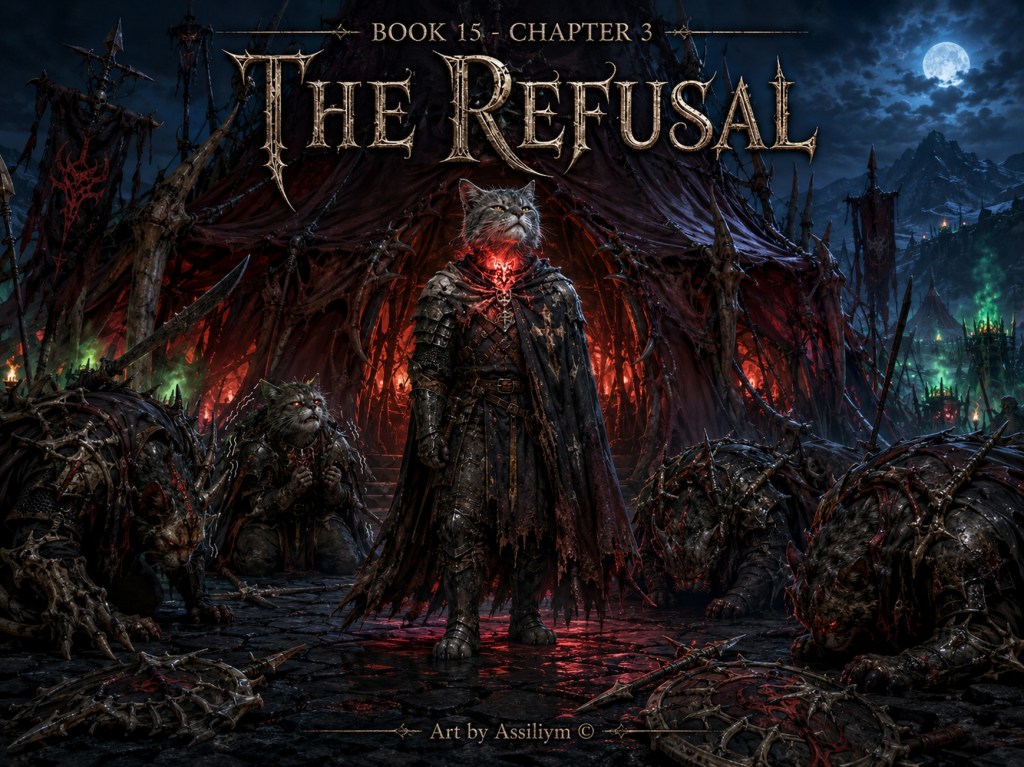
Maz-Daar reached the outer cordon of the war tent while the first orders of invasion were still travelling down from the basalt ridge.
They moved faster than armies. Commands always did. An army had bodies to feed, weapons to carry, roads to cross and frightened soldiers who sometimes discovered, at inconvenient moments, that they possessed opinions concerning death. A command possessed none of these weaknesses. It passed from mouth to mouth, claw to claw, drum to drum, until the will of one creature had become the danger of thousands.
The old grey crusader heard those distant drums as he climbed.
His mortal body did not climb easily.
Age had entered the joints years before and established itself with the stubbornness of an old tenant who had ceased answering notices. One hind leg had stiffened from an injury belonging not to Maz-Daar but to the cat whose flesh he wore; the left shoulder complained when the path became steep; and beneath the grey fur of the muzzle, the mortal heart worked harder than the ancient essence within it considered dignified.
Maz-Daar endured all of this without resentment.
Flesh was temporary.
He had worn flesh before.
He would wear flesh again.
Yet the longer one inhabited a body, the more difficult it became to say where inconvenience ended and memory began.
The war tent rose before him.
Its living walls breathed against the night, ribbed with horn and stretched hide, its seams opening and closing with the slow rhythm of something that had never decided whether it was a building or a beast. Heat leaked from it. So did the smell of copper, scorched marrow and the old incense of the Demon Priests.
Four commanders remained inside.
Maz-Daar could feel them.
Urzakh-Morn.
Korr-Vael Thuun.
Se’Thriel Vale.
And Kraath-Vel.
The guards saw only the old cat.
They stepped forward together.
They were cats still, if one judged only by the number of paws beneath them and the rough position of ears upon their skulls. Demon essence had done the rest. Shoulders had broadened beyond the intention of bone. Fur had hardened in ridges. Eyes burned where eyes ought merely to have reflected light. Spears made from fused bone lowered across the path, and shields grown from rib and spine locked together until the entrance to the tent disappeared behind a wall of obedient flesh.
The foremost guard raised his spear.
Maz-Daar stopped.
For a moment nothing moved except the breathing skins of the tent.
Then the old grey cat lifted his head.
Zha’korr vel Azhagar.
(By the Root of Azhagar.)
The change began inside the guards.
The mortal bodies did not understand.
The demons inhabiting them did.
Recognition travelled through the line with a violence almost indistinguishable from fear. Eyes widened. Claws contracted. One possessed guard made a choking sound as the essence within him recoiled from something older in the hierarchy of Azhagar, something whose authority had been impressed upon demon memory long before any of these borrowed bodies had been born.
Maz-Daar took one step forward.
The Great Demon Mark beneath the fur of his neck ignited.
Heat entered the air without flame.
The foremost spear shook.
Maz-Daar spoke again.
Maz-Daar.
(Maz-Daar.)
That was enough.
Some names requested recognition.
Others enforced it.
The old grey crusader looked upon the guards.
Sha’ul-naresh.
(Kneel.)
The command struck them like a gate falling.
Bone spears clattered against black stone. Shields dropped. One by one the possessed cats collapsed, forelegs folding beneath them until foreheads struck the ground. One trembled so violently that his teeth knocked together. Another screamed once—not from anything Maz-Daar had done to the mortal flesh, but from the demon trapped within it, forced suddenly to remember its place.
Maz-Daar passed between them.
He did not look down.
The living skins of the war tent parted before his paw touched them.
Heat rolled over him.
Inside, the council had not dispersed.
Urzakh-Morn turned first. The immense fused body shifted, and something deep within the floor groaned beneath his weight. Korr-Vael Thuun moved a heartbeat later, stone plates grinding against one another as he stepped away from the map. Se’Thriel Vale’s wings opened halfway, scarred feathers rasping through air already sharpened by violence.
All three recognised him.
None welcomed him.
Perhaps there are few insults greater to soldiers than a general who has spent too long away from the battlefield. They forgive cowardice more easily than patience, because cowardice at least flatters the importance of danger. Patience suggests that the war upon which they have built their lives may not deserve to be fought.
Urzakh-Morn advanced.
Korr-Vael Thuun followed.
Se’Thriel’s wings spread.
Maz-Daar did not move.
Kraath-Vel lifted one paw.
Ul-zha.
(Do not.)
The three commanders stopped.
The authority in her voice was different from Maz-Daar’s. His descended through rank, old service and Azemont’s favour. Hers came from will sharpened until obedience seemed the simplest means of avoiding injury.
Kraath-Vel stepped away from the bleeding map.
Her eyes travelled over the grey body Maz-Daar wore: the worn armour, the age-thinned fur, the scar near one shoulder, the mortal paws that had walked the roads of Neon for longer than she considered tolerable.
Her mouth curved.
Ven-raeth.
(Let him speak.)
Maz-Daar entered fully.
Behind him the living wall sealed.
For a little while the two ancient demons regarded one another through mortal flesh.
Kraath-Vel saw weakness.
Maz-Daar saw impatience.
Both were dangerous mistakes when made by powerful creatures.
The old grey crusader came to the edge of the map.
Khar-zul Neon.
(End the assault on Neon.)
Nothing happened.
No commander moved.
Then Kraath-Vel laughed.
It was not loud. Loud laughter often belongs to those who require witnesses. Hers was quieter, a sound like bone being ground beneath deep water.
She walked around Maz-Daar slowly.
Morra. Morra. Morra. K’zir.
(Flesh after flesh after flesh. Still incomplete.)
Her gaze travelled over him with deliberate contempt.
How many bodies had he worn?
How many mortal lives had he entered, inhabited and abandoned while searching this world?
How many years had Azemont’s Lord-General spent beneath soft fur, walking mortal roads, sitting beside mortal fires, listening to mortal fears?
And what had he found?
Kraath-Vel stopped before him.
She raised one claw.
Naer zha’ul-korr ul-thaer.
(No Great Shard of the Tides.)
A second claw.
Naer zhir-ka Thren-Kael.
(No Nexus Child.)
Then the third.
Her voice altered almost imperceptibly.
It became quieter.
Naer zhurath vel’thyr.
(No Orb of Divine Knowledge.)
Se’Thriel Vale’s wings gave the faintest movement behind her.
Maz-Daar saw it.
Kraath-Vel did not.
Or pretended not to.
Her claws closed.
K’zir.
(Only failure.)
The insult entered the tent and remained there.
Maz-Daar looked at the map.
The Valley of Sorrow lay beneath Kraath-Vel’s blood-dark markings. Beyond it stretched Neon: kingdoms, villages, mountains, rivers and cities reduced upon the living skin to lines a claw might cross in a moment.
He had crossed them differently.
Road by road.
Winter by winter.
Body by body.
He had searched longer than any cat upon this world could have understood, and patience had taught him something conquest rarely teaches its practitioners: a world is always larger from the road than it is from the throne.
Or from a war map.
Maz-Daar raised his eyes.
The Great Shard of the Tides remained hidden.
The Nexus Child had not revealed itself.
The Orb of Divine Knowledge had left traces so old and contradictory that even Maz-Daar could not yet determine whether he followed a relic, a memory, or the shadow cast by something deliberately concealed.
Destroying Neon would not solve those failures.
It might make them permanent.
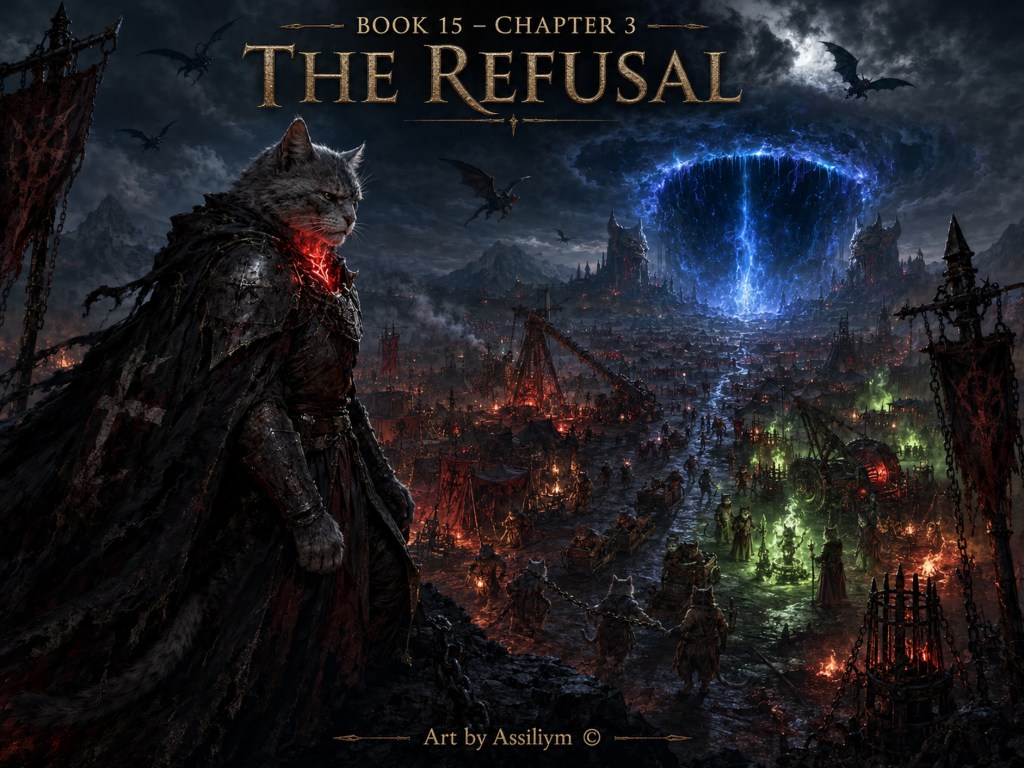
Maz-Daar had encountered its signs without ever mistaking them for coincidence. He had passed through forests where predators ceased hunting for reasons no mortal hunter understood. He had seen wild beasts turn their heads towards the same distant place at the same moment, though no sound had travelled between them. He had watched ancient creatures refuse paths which demon-touched flesh had crossed and had felt, more than once, the peculiar pressure of a world whose living things belonged to an order older than the kingdoms built among them.
Oberon.
The Beast Lord did not need to march into Neon.
He was already here.
Kraath-Vel might break armies, burn cities and scatter mortal crowns. She might force cats from fortifications and turn valleys into graves. But Neon was not merely the collection of mortal kingdoms drawn upon the living skin beneath her claws. Beneath those kingdoms lay another sovereignty: root, fang, wing, hunger, instinct and the old law by which beasts had belonged to the world before kings began dividing it.
Maz-Daar had spent years walking that world.
Kraath-Vel had spent an evening studying a map of it.
The difference mattered.
If the invasion remained a war against cats, perhaps Oberon would watch.
If Azhagari corruption entered deeply enough into Neon’s beasts, forests and living order, the choice might no longer belong to him.
The Beast Lord would answer.
And if that happened, Kraath-Vel would discover that she had not merely brought an army into another kingdom.
She had brought it into another power’s body.
Khar-zul.
(End it.)
Kraath-Vel’s smile disappeared.
Maz-Daar continued.
Zha’ul-korr ul-thaer. K’zir.
(The Great Shard of the Tides remains unfound.)
He did not soften the truth.
Zhir-ka Thren-Kael. Ul-naeth.
(The Nexus Child is not yet revealed.)
Then:
Zhurath vel’thyr. Naer-vel.
(The Orb of Divine Knowledge remains hidden.)
At those words Kraath-Vel’s tail became perfectly still.
Only for a heartbeat.
Then it moved again.
Maz-Daar continued as though he had not noticed.
The invasion endangered everything.
Armies did not search. They trampled.
Fire did not question ruins.
Terror might force secrets into the open, but it might just as easily bury them beneath the dead.
And behind all of it remained the danger Korr-Vael Thuun had already named.
Oberon.
Maz-Daar did not need to repeat the warning given before his arrival. The silence around the map showed that every commander remembered it.
The armies below might defeat the cats of Neon.
That did not mean they would defeat Neon.
Kraath-Vel came closer.
Kaal-thrys ven’ash.
(Flesh is a suggestion.)
Maz-Daar knew the doctrine.
He had spoken versions of it himself.
Kraath-Vel looked into the old crusader’s eyes.
Morra eth Az’kael.
(Flesh remains in the self.)
For the first time, the tent became completely silent.
Even Urzakh-Morn did not move.
The accusation was more dangerous than the mockery that had preceded it.
Every vessel changes you.
That was what she meant.
Perhaps she believed it.
Perhaps she feared it.
Maz-Daar had lived among mortal cats too long. He had eaten their food because his body required it. Slept beneath their roofs when weather made solitude impractical. Heard their songs. Watched their quarrels. Seen them bury their dead with ceremonies they could not afford and celebrate births in houses too poor to heat.
He had learned how fragile they were.
He told himself that this knowledge was useful.
Strategy required knowledge.
Nothing more.
Kraath-Vel leaned nearer.
Maz-Daar did not retreat.
She wanted him to deny it.
He did not.
Instead he said:
Naer-vel zha’ul.
(Concealment is breaking.)
This war would expose them.
Not merely to the mortal kingdoms of Neon.
To the power already within it.
To Oberon.
And beyond Neon, to powers with reasons of their own for watching the movements of demons.
Kraath-Vel’s expression hardened.
She had been warned before Maz-Daar entered the tent.
Korr-Vael Thuun had named the Beast Lord.
Se’Thriel Vale had reminded her that the cats of Neon might be Oberon’s children, but the creatures of Azhagar were not.
Kraath-Vel had understood.
She had proceeded anyway.
Maz-Daar reached the true reason he had come.
Zha’ul-korr Thraxx-Ul naer-zul.
(The Demon Shard of Thraxx-Ul has been taken.)
A change passed through the commanders.
The Demon Shard of Thraxx-Ul was no Great Relic. It had not fallen from the heavens, nor survived from some forgotten creation of the Great Nexus. It was artificial—fashioned by Demon Priests as an instrument for opening and sustaining passages through which demon forces might cross.
And now it had been taken from its keeping and put to war.
Maz-Daar looked directly at Kraath-Vel.
She did not deny it.
Thar-korr Azhagar. Neon.
(The demon host of Azhagar is upon Neon.)
Urzakh-Morn’s fused jaw tightened.
Se’Thriel lowered her wings.
Korr-Vael Thuun remained as still as a monument awaiting permission to become an avalanche.
Kraath-Vel alone appeared satisfied.
“It has begun,” was the meaning in her face before her mouth gave the answer.
Ul-zha.
(No.)
She would not stop it.
Not for Maz-Daar.
Not for the hidden relics.
Not for the warning already given concerning the Beast Lord whose world she had entered.
Maz-Daar felt the Great Demon Mark heat beneath his fur.
He ignored it.
For the first time Kraath-Vel allowed a portion of the demon within her to rise closer to the surface.
The mortal outline distorted.
Her shadow became too large for her body.
Something ancient and jagged seemed to press outward against the limits of flesh, and beyond the tent the kneeling guards whimpered as the lesser demons inside them felt her rage.
Kraath-Vel looked once towards the map.
Towards Neon.
Towards the place where, moments earlier, she had rested her claw when speaking of the Orb.
Maz-Daar saw that too.
But there was no time to understand it.
Kraath-Vel struck the map-table.
The living skin blistered beneath her paw.
The Valley of Sorrow flared red.
Her command stood.
The invasion would continue.
Maz-Daar regarded her for another moment, and something passed silently between the two ancient demons: not surrender, not forgiveness, but recognition that the next argument would be made with consequences rather than words.
He inclined his head once.
Then he turned.
Behind him Kraath-Vel remained beside the map, with Urzakh-Morn, Korr-Vael Thuun and Se’Thriel Vale watching him go.
The living skins opened.
Maz-Daar stepped into the night.
 Vuk Stribog