
INSIDE BOOK 16
NEON — The Valley of Sorrow: The Sleeping Sentinels
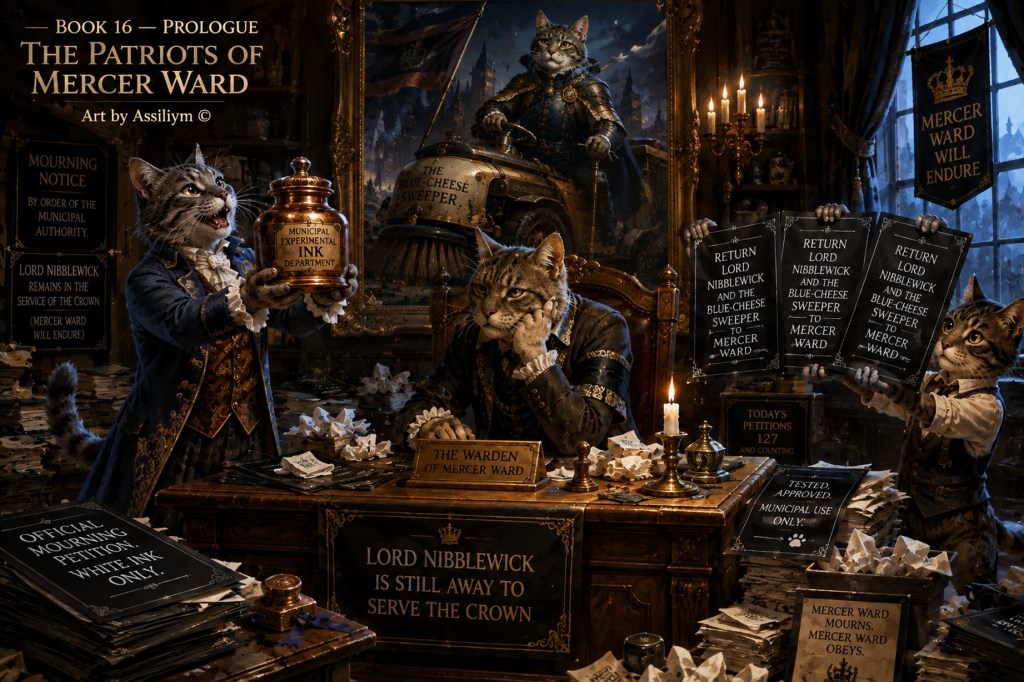
There are districts which endure grief privately, closing their shutters, lowering their voices and placing a small lamp beside whatever chair shall never again be occupied.
Mercer Ward was not one of them.
Mercer Ward had never possessed a private emotion when a public notice might be printed, stamped, witnessed, taxed, displayed in three windows and discussed beside a cheese stall. Its joy required tickets. Its indignation required forms. Its civic pride required a trestle table, two clerks, a rope line and at least one sign beginning with the word OFFICIAL.
Its grief, therefore, had become administrative.
Black mourning sheets hung from shop fronts and tavern windows. Black paper covered the municipal notice boards. Black-paper fines were carried through the alleys by inspectors whose expressions suggested that bereavement, although painful, did not suspend gutter regulations. Across Borel’s press room, black sheets emerged beneath the rollers in long solemn ranks, each one bearing white spaces where nobody had yet discovered how to print anything visible.
At the centre of this municipal sorrow sat the Warden of Mercer Ward.
He occupied his office beneath the largest portrait of Lord Nibblewick available within the district’s collection. It was not the best portrait. The whiskers were too heroic, the ears had been enlarged by a painter who believed nobility was chiefly a question of surface area, and the Blue-Cheese Sweeper beneath His Small Lordship looked capable of conquering a province rather than collecting cabbage leaves.
The Warden considered it spiritually accurate.
He sat beneath it with a black band around one foreleg, a pile of used handkerchiefs upon the left side of his desk, a smaller pile of unused handkerchiefs upon the right, and an expression suggesting that the Crown had not merely retained Lord Nibblewick at the palace but had personally removed the sun from Mercer Ward.
Pinchford entered carrying a copper ink pot.
He did not enter quickly.
Triumph is a delicate thing in municipal offices. It must pass through corridors, avoid senior clerks, survive questions concerning departmental authority and reach the appropriate desk before another cat claims to have authorised it.
Pinchford had survived all four dangers.
Behind him came the junior clerk from the Municipal Experimental Ink Department, carrying three black mourning sheets upon which brilliant white writing could be read from the far side of the room.
Pinchford stopped before the desk.
The Warden did not look up.
Pinchford waited.
The Warden took a handkerchief from the right pile, pressed it beneath his nose and placed it upon the left.
Pinchford cleared his throat.
“Your Honour.”
The Warden lifted one paw weakly.
“Another petition total?”
“No, Your Honour.”
“Has the palace released Lord Nibblewick?”
“No, Your Honour.”
“Has the palace returned the Blue-Cheese Sweeper?”
“No, Your Honour.”
The Warden looked towards him at last.
“Then what news can possibly justify that expression?”
Pinchford’s expression, which had been one of restrained professional victory, became uncertain.
“The white ink has been successfully created.”
The junior clerk raised the mourning sheets.
Upon the first appeared:
LICENCE FOR THE TEMPORARY EXTENSION OF A CHEESE TABLE
Upon the second:
FINE FOR AN UNAUTHORISED GUTTER PROJECTION
Upon the third:
RETURN LORD NIBBLEWICK AND THE BLUE-CHEESE SWEEPER TO MERCER WARD
The letters were clear, pale and dignified.
The Warden examined them.
For one hopeful instant, Pinchford believed the achievement had reached him.
The Warden’s lower lip trembled.
“Can the ink bring him home?”
“No, Your Honour.”
“Can it operate the Sweeper?”
“No.”
“Can it force King Luis to understand that liberation without municipal return is only improved kidnapping?”
“No, Your Honour.”
The Warden turned back towards the portrait.
“Then it is only ink.”
Pinchford’s shoulders lowered.
The junior clerk lowered the sheets.
The Warden reached blindly towards the right-hand pile of handkerchiefs.
It was empty.
Pinchford looked at the pile, looked at the Warden, placed the ink pot carefully upon the desk and resumed his old post beside the chair.
He took a clean handkerchief from the cupboard.
The Warden accepted it without looking.
Thus ended Pinchford’s career as the discoverer of white ink.
It had lasted eleven breaths.
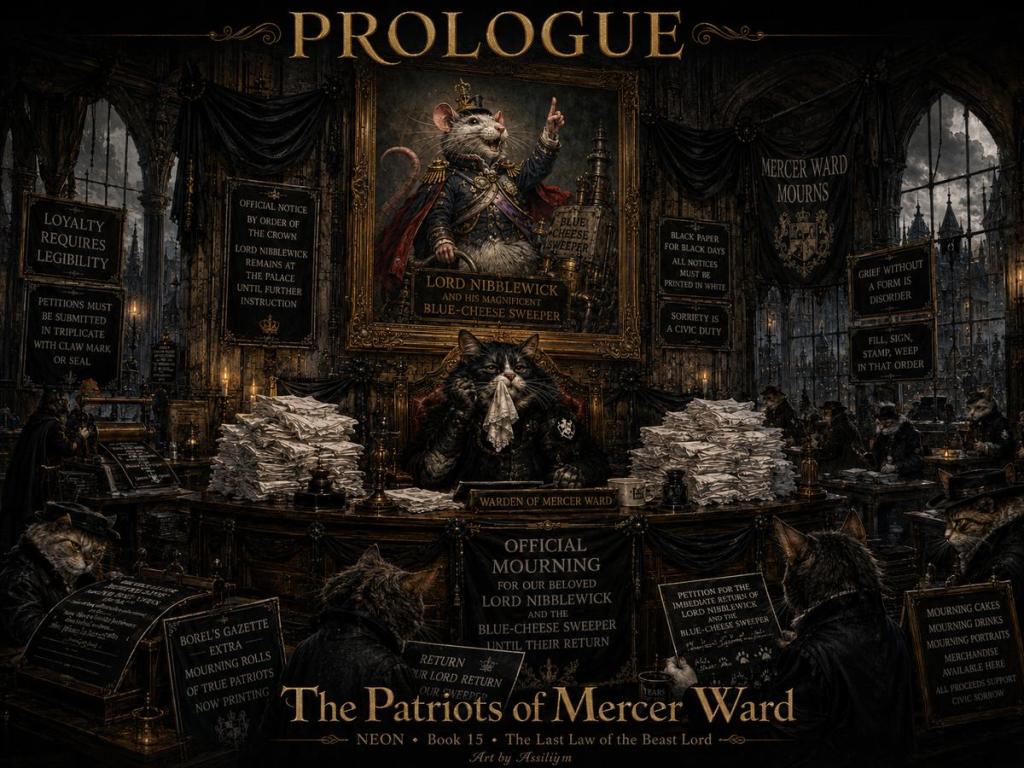
The ward discovered at once that unreadable fines had possessed certain advantages.
A fishmonger in Button-Mercer Alley had received three black-paper penalties during the mourning period and spent two peaceful days believing they were ceremonial condolences. When Inspector Vale returned carrying a white-ink pen and read them aloud, the fishmonger discovered he had been fined for a leaking barrel, an obstructed passage and a haddock displayed beyond the lawful edge of commerce.
“This is oppression,” he said.
“This is visibility,” Inspector Vale replied.
“Yesterday the fines were invisible.”
“They were still valid.”
“How could I obey what I could not read?”
Vale considered this.
“I shall refer the question to the Department of Retrospective Legibility.”
“Will that cancel the fines?”
“No. It may create another form.”
The fishmonger’s face fell.
Inspector Vale placed the petition beside the penalties.
“Sign here.”
The fishmonger stared.
“What is that?”
“The petition requesting the immediate return of Lord Nibblewick and the Blue-Cheese Sweeper to their lawful civic home.”
“Is signing mandatory?”
“No.”
The fishmonger relaxed.
Inspector Vale opened his notebook.
“But I am writing down the names of every cat who refuses.”
The fishmonger looked at the notebook.
Then at the fines.
Then at the white-ink pen.
“Where do I sign?”
“Here. And here.”
“Why twice?”
“Once as a merchant and once as a resident.”
“I sleep over the shop.”
“Then you may also sign as a household.”
The fishmonger signed three times.
Inspector Vale studied the names.
“A respectable beginning.”
Across Mercer Ward, voluntary enthusiasm became unusually well recorded.
Cats signed outside bakeries, inns, workshops, laundries and cheese stalls. They signed before receiving licences, after receiving fines and during inspections which the inspectors insisted were entirely unrelated to the petition resting upon the same clipboard.
A tavern keeper signed as proprietor, resident, employer, customer of municipal sweeping, admirer of His Small Lordship and a cat personally offended by palace appropriation.
A widow signed for herself, her late husband, her visiting sister and the memory of a kitten who had once seen Lord Nibblewick from across the alley.
A cheese seller signed seven times because, as he explained, blue cheese possessed several commercial grades and each had suffered independently.
By midday the number of signatures exceeded the number of cats known to reside in the ward.
Pinchford brought the first total to the Warden.
“Your Honour, there may be a difficulty.”
The Warden was examining the petition sheets through swollen eyes.
“What difficulty?”
“We possess twelve thousand registered residents.”
“A proud population.”
“We have fourteen thousand three hundred and eleven signatures.”
“A prouder population.”
“Signatures are not population.”
“They represent the population.”
“There are more signatures than residents.”
The Warden considered this with the patience of a cat listening to a lesser form of arithmetic.
“The additional signatures belong to guests and household pets.”
“Guests are not residents.”
“They reside while visiting.”
“Temporarily.”
“Patriotism need not be permanent to be recorded.”
Pinchford looked down at the figures.
“One cat has signed eight times.”
“Excellent.”
“Under eight descriptions.”
“Versatile.”
“Resident. Merchant. Customer. Admirer of Lord Nibblewick. Defender of the Sweeper. Opponent of palace appropriation. Friend of civic cleanliness. And”—Pinchford lowered the paper—“cat passing through the ward on personal business.”
The Warden’s eyes filled again.
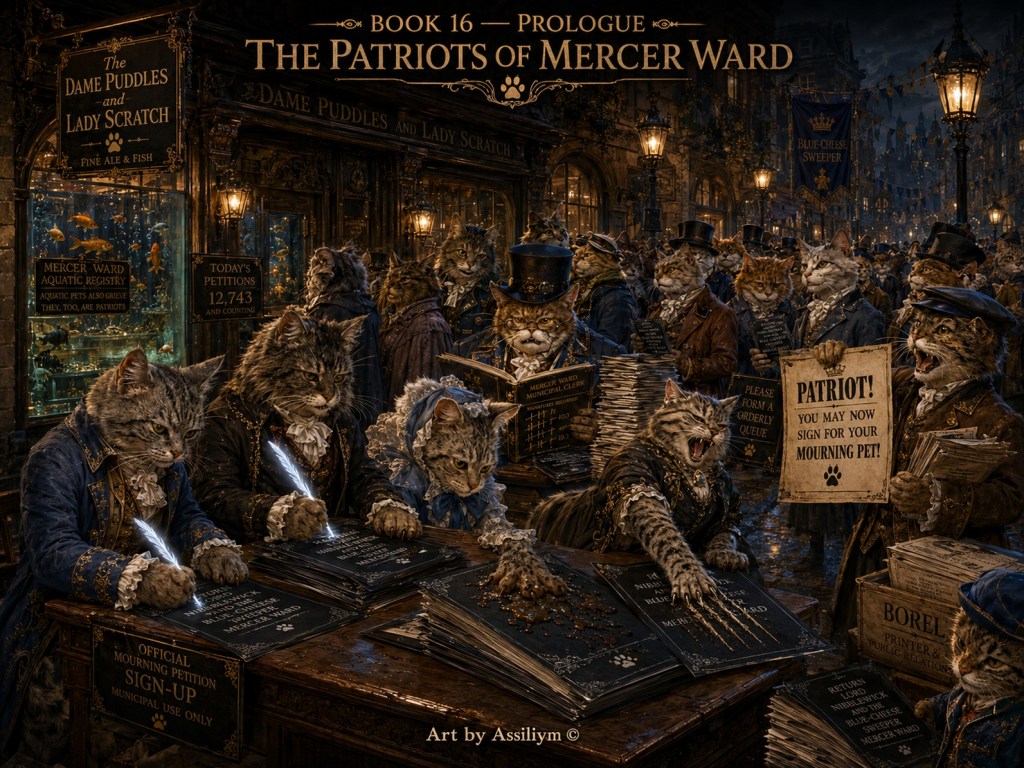
Pinchford turned to the next page.
“The Warden’s office fish have not yet signed.”
The Warden became still.
“Why not?”
Pinchford looked towards the aquarium near the window.
Five small silver fish moved among the water plants, unaware that their civic failure had been noticed.
“Because they are fish, Your Honour.”
The Warden rose slowly.
He crossed the office and stopped before the aquarium.
“You see them, Pinchford?”
“Yes, Your Honour.”
The Warden pointed.
“Even they are grieving.”
Pinchford waited.
The fish continued circling a little stone castle.
“They refuse to talk,” the Warden said.
Pinchford drew one breath through his nose.
“But, Your Honour, fish naturally do not talk.”
The Warden turned.
“It does not matter, Pinchford.”
“No, Your Honour.”
“It does not matter.”
He pointed again towards the aquarium.
“One does not have to talk to be a patriot.”
Pinchford looked at the fish.
The largest fish opened and closed its mouth.
The Warden’s voice softened.
“A creature may grieve in silence. It may remain sad within itself. It may carry sorrow beneath the surface.”
“Literally, in this case.”
“Pinchford.”
“Forgive me, Your Honour.”
The Warden took another handkerchief.
“They are silent because our beloved Lord has not returned.”
“They were silent before he left.”
“Then they anticipated the grief.”
Pinchford looked at the aquarium.
The fish looked back with the ancient caution of creatures who had accidentally entered government.
The Warden returned to the desk.
“Prepare a proclamation.”
Pinchford opened his notebook.
The Warden stood beneath Lord Nibblewick’s portrait, one paw upon his chest.
“Every grieving cat may sign the petition in the name of his grieving pet.”
Pinchford’s pen stopped.
“Every pet?”
“Every mourning pet.”
“How shall grief be established?”
The Warden looked almost offended.
“Has the pet received Lord Nibblewick back?”
“No, Your Honour.”
“Then the grief is established.”
“Must the pet understand the petition?”
“One does not have to understand government to support it.”
Pinchford wrote that down before remembering he probably should not.
The Warden continued.
“Pawprints shall be accepted.”
Pinchford wrote.
“Claw marks.”
He wrote.
“Feather marks.”
He wrote more slowly.
“Beak impressions.”
“Your Honour—”
“And approved aquatic representation.”
Pinchford looked towards the aquarium.
“How does a fish make an aquatic representation?”
The Warden considered.
“With dignity.”
That afternoon, Borel’s press began shaking the back room of The Dame Puddles and Lady Scratch.
The first page carried the headline:
MERCER WARD HONOURS ITS TRUE PATRIOTS
Below it appeared:
THE FULL ROLL OF CITIZENS WHO HAVE SIGNED MORE THAN FIVE TIMES
And beneath that, in letters nearly as large:
PATRIOT! YOU MAY NOW SIGN FOR YOUR MOURNING PET!
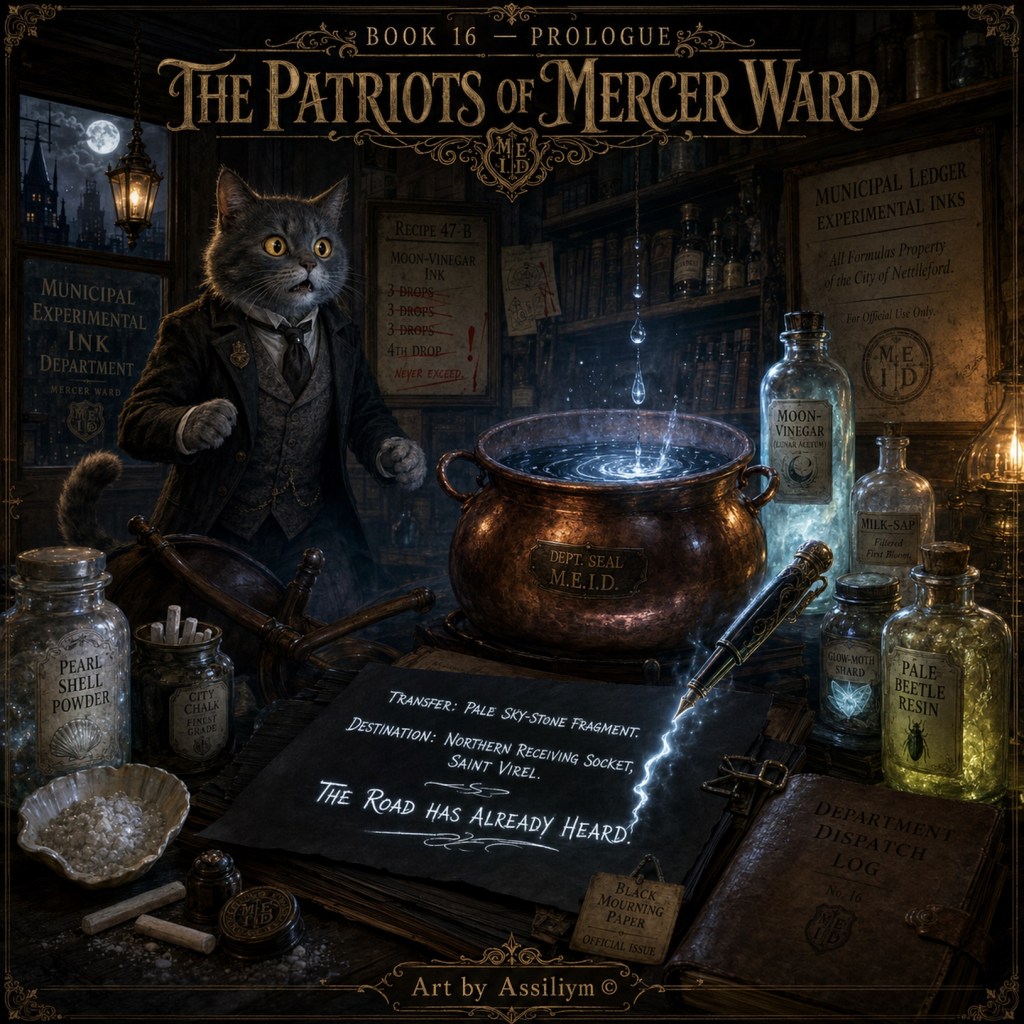
Only after the last petition table had closed did Pinchford return to the Municipal Experimental Ink Department.
The room had been cleared of its earlier humiliations. The flour paste had been scraped from the bowls. The chalk-and-milk mixture which had dried into something resembling chapel plaster had been removed from the windowsill. Three spoons had been declared beyond municipal recovery. Along the central table stood a neat row of clean bottles waiting to receive the proper white ink.
Miette Paleclaw remained beside them in her silver Alchemistry Guild coat. Before her lay a pearl shell, powdered chalk, milk-sap, pale beetle resin, moon-vinegar and the carefully wrapped fragment of Glow-moth shard from which the ink drew its light.
Pinchford had brought a fresh ledger.
Miette looked at it.
“You are recording the recipe?”
“Mercer Ward does not permit important knowledge to survive only inside memory.”
“Memory is sometimes safer.”
“Memory does not carry a municipal seal.”
Miette decided not to pursue the point. She showed him how the pearl shell must be ground until no grit remained, how the milk-sap was added slowly so that it did not curdle, and how the pale resin had to be warmed without being allowed to smoke. The Glow-moth fragment went in last, producing a soft white gleam across the surface.
Then she lifted the little bottle of moon-vinegar.
“One drop.”
Pinchford wrote it down.
She added the first.
The mixture brightened.
“Two drops.”
The second entered.
The pale colour deepened until the ink resembled moonlight held in milk.
“Three drops.”
The third fell.
The mixture settled immediately. Its surface became smooth, stable and quietly white.
Miette dipped the pen and drew a line across a sheet of black mourning paper. The words appeared clearly:
MERCER WARD MUNICIPAL WHITE INK
APPROVED THREE-DROP FORMULA
Nothing flashed. Nothing moved. No older writing rose beneath the words. The pen did not attempt to continue by itself.
“There,” Miette said. “Three drops. Never four.”
Pinchford underlined the instruction in his ledger.
“Why?”
“Because three produces ink.”
“And four?”
“I have not tested four.”
“Then how do you know it should not be done?”
Miette looked at him with the patience of an apprentice already beginning to understand why Guild Masters aged badly.
“Because every substance has a point beyond which improvement becomes another substance.”
Pinchford considered this.
“Could the fourth drop make it whiter?”
“It could make it useless.”
“Could it make the writing brighter?”
“It could make the pot explode.”
Pinchford wrote beside the recipe:
FOURTH DROP — POSSIBLE EXPLOSION.
Miette glanced at the note.
“That is not precisely what I said.”
“It is more effective for junior clerks.”
They prepared six safe bottles together. Miette sealed each one, and Pinchford applied the Mercer Ward label. Her name appeared beneath the formula as discoverer, exactly as he had promised. She inspected the first bottle, then the second, and appeared faintly surprised that he had kept his word without reducing her credit to a footnote.
“The remaining materials are sufficient for another batch,” she said. “You may prepare it tomorrow.”
“Using three drops.”
“Exactly three.”
Pinchford closed the recipe ledger.
Miette gathered her tools and placed the moon-vinegar bottle at the far end of the table.
“I must return to the Guild before the evening bell.”
“The ink will be distributed to the inspectors in the morning.”
“And the petition clerks?”
“They will receive it after signing the Form for Temporary Custody of Luminous Municipal Fluid.”
Miette stopped at the doorway.
“You have a form for ink?”
“We have one now.”
The beginning of a smile touched her mouth.
Then she left.
Pinchford heard her steps descend the stairs and fade into the noise of Mercer Ward. For several minutes he remained alone among the labelled bottles, the cleaned instruments and the rare dignity of a municipal experiment which had finally succeeded.
He should have locked the room.
He should have returned upstairs to the Warden, who was still grieving beneath Lord Nibblewick’s portrait and had already exhausted the afternoon supply of handkerchiefs.
Instead, Pinchford looked at the unused ingredients.
Six bottles would not be enough for the following morning. There were inspectors, petition tables, licence clerks, archive counters, market officials and Borel’s printing cats waiting for white ink. Preparing another batch now would save time. It would also prove that he had understood the formula rather than merely watched a Guild apprentice perform it.
This was not ambition, he told himself.
It was administration.
He ground the pearl shell. He measured the chalk. He added the milk-sap and warmed the beetle resin exactly as Miette had shown him. The Glow-moth fragment dissolved into the mixture, and the copper pot filled with soft white light.
Pinchford opened the moon-vinegar.
“One,” he said.
The first drop fell.
“Two.”
The second followed.
From the office above came the Warden’s muffled cry:
“My poor Nibblewick!”
Pinchford’s paw paused.
“Three.”
He tilted the bottle.
One drop entered the pot.
Then another slipped from the lip behind it.
The fourth drop fell without sound.
For an instant nothing happened.
Pinchford stared into the copper pot.
The white ink darkened beneath the surface, not into grey or black, but into a depth through which pale light appeared to be travelling. A pulse moved around the rim. The Glow-moth fragment rose from the bottom although it possessed no reason to float. Every labelled bottle on the table gave one faint answering shimmer.
Pinchford put down the vinegar.
“No explosion,” he whispered.
This reassured him for less than a heartbeat.
The pen beside the pot rolled by itself.
It stopped against a sheet of black mourning paper left from the petition forms.
The pen lifted.
Pinchford did not touch it.
Its nib entered the white ink and moved across the black paper.
At first the lines appeared faintly, as though buried deep inside the sheet and approaching from the other side. They were not written in the hand of any Mercer Ward clerk. The letters were narrow, severe and older than the paper carrying them.
TRANSFER: PALE SKY-STONE FRAGMENT.
Pinchford leaned closer.
The pen continued.
DESTINATION: NORTHERN RECEIVING SOCKET, SAINT VIREL.
A coldness entered the room which had nothing to do with weather.
CONDITION: DORMANT WHILE THE GREAT TIK-TOK CLOCK REMAINS WOUNDED.
The light beneath the ink began moving northward across the surface of the pot.
THE ROAD MUST NOT ANSWER THE SHARD.
The pen stopped.
Pinchford stood without breathing.
The words remained still. Old words, he thought. An old record hidden inside reused black paper. Strange, certainly. Dangerous, perhaps. But still a record, and records belonged to clerks before they belonged to prophets.
He reached for his incident ledger.
The pen moved again.
No paw guided it.
Below the ancient writing, in a fresher white which seemed almost wet with light, it wrote:
THE ROAD HAS ALREADY HEARD.

Oberon lowered his antlers.
Not far.
Not as a command mortal eyes could have recognised.
The faint blue light along the tines travelled downward through his neck and shoulders. It did not leave his body. It did not flash across the ground. Yet something passed through the grass.
The mouse turned.
Another appeared beside it.
Then five.
Then twenty.
They moved away from Oberon in separate streams, disappearing between stones, beneath moon-grass and along the shallow cuts where rain had once crossed the valley floor.
Alarico watched them go.
“Mice.”
“Yes.”
“Those are his first soldiers?”
Grey looked towards the demon camp beyond the eastern folds of ground.
“Those are the soldiers the enemy will not count.”
More small creatures began moving.
Voles slid beneath the roots of the old hedges. Shrews darted through patches of dead grass with the nervous speed of creatures accustomed to surviving beneath larger hungers. Rats emerged from the drainage stones below the keep, some brown, some black, some bearing the pale scars of lives spent among granaries and riverbanks.
Squirrels descended from trees and crossed the broken ground in quick, low runs.
From beneath fallen timber came beetles.
From the wet earth near the drainage channel came moles and other burrowing creatures whose entire knowledge of war consisted of darkness, pressure and the difference between packed soil and soil which could be moved.
None looked towards the cats.
None waited for praise.
They passed around trenches, beneath the outer stakes and through gaps too narrow for a kitten’s head.
Roderic came down from the wall with Caedric and Valerius behind him.
“What are they doing?” the Lion-King asked.
Grey watched the last of the rats disappear over the eastern slope.
“Beginning.”
“Beginning what?”
“Oberon’s defence.”
Roderic looked towards the wolves, the stags and the great boars still standing beside the keep.
“With mice?”
“The wolves are being watched.”
Roderic’s ears shifted.
“By whom?”
“Everything capable of fearing a wolf.”
The old crusader pointed towards the eastern dark.
“No one watches the mouse.”
The creatures moved through the Valley of Sorrow without a sound large enough to reach a sentry.
They crossed the no-cat’s-ground where moon-grass covered pits and barbed stakes. They passed beneath the shadows of ruined walls. They entered ditches too shallow to protect a soldier and deep enough to conceal a hundred bodies the size of theirs.
The demon camp began beyond the next rise.
It stretched farther than any one animal could comprehend: ranks of tents, carts, armour wagons, cages, supply trains, tethered beasts and engines whose outlines stood black against the paling horizon.
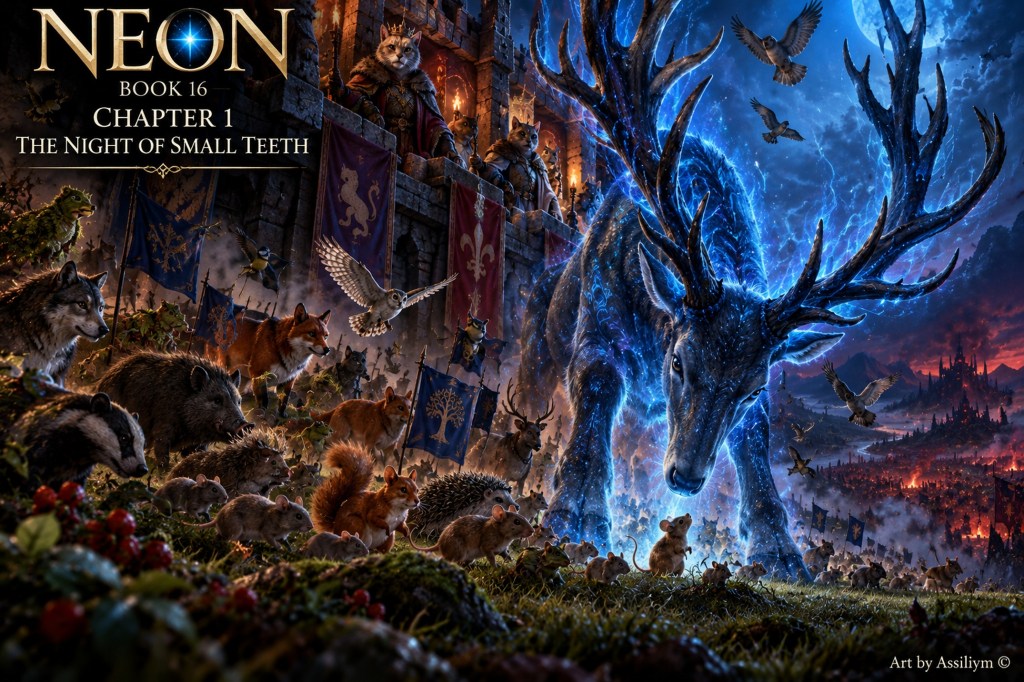
Clan Keth’Var had laboured for weeks to bring that army into the Valley.
Their carts stood wheel to wheel along organised lanes. Great wagons carried armour plates, spear bundles, replacement shields and the dark iron fittings required by siege crews. Captured horses waited beneath harnesses reinforced with leather, sinew and chain. Pack animals stood tied to feeding lines. Wooden frames supported spare ropes, pulley blocks and rolls of hide intended to repair whatever the coming battle damaged.
Farther forward waited the engines of Clan Morn’Zhur.
The Offering Engines were covered beneath heavy skins which moved faintly in the wind. Some stood upon enormous timber wheels. Others rested upon broad sledges intended to be hauled across broken ground. Their arms, beams and lifting frames had been bound together with cables thick as a cat’s foreleg.
Beside them waited more familiar siege weapons.
Catapults.
Armoured rams.
Heavy carts carrying plates for the Gate Breakers.
Loading frames.
Pulley towers.
Hauling platforms.
Everything which appeared immovable was attached to something intended to move it.
Everything intended to move was attached to something else.
Rope passed through the whole camp like veins.
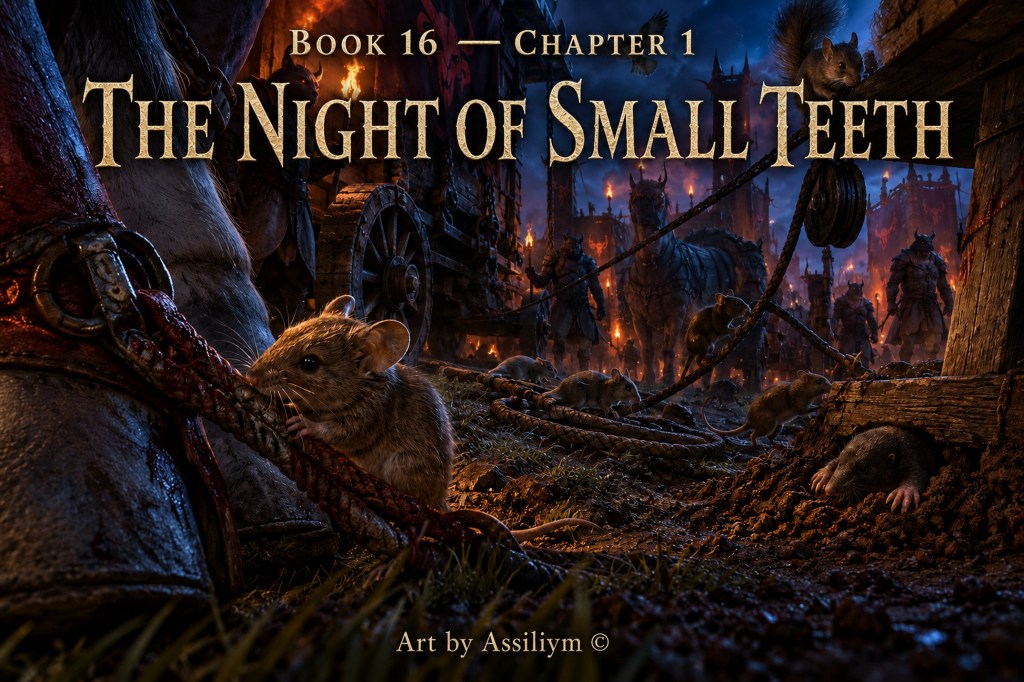
The first mouse entered beneath an armour cart.
A Keth’Var sentry saw it.
He lowered the butt of his spear and struck the ground beside the animal. The mouse vanished between the wheels.
The sentry watched for a moment.
Then he turned away.
The camp contained grain.
Grain attracted mice.
This was not information worth carrying to an officer before dawn.
Beneath the cart, the mouse found a narrow leather binding securing a wooden axle brace.
It smelled of fat.
Salt.
Old hide.
It began to chew.
Another mouse joined it from the opposite side.
The brace was thick enough that neither could have destroyed it before sunrise.
They did not need to.
They found the part already cracked by the long road into the Valley and widened what the journey had begun.
Farther along the transport line, rats climbed a cart stacked with armour plates.
The plates were metal.
Their fastenings were not.
Braided straps held the load against the frame. Rope crossed rope beneath the canvas. A single main line passed below the rear axle and had been tightened until the fibres groaned.
The rats settled beneath it.
Their teeth moved steadily.
They did not understand armour.
They understood grease, hide and salt.
Oberon had given them no lesson in siegecraft.
He had given purpose to instincts already present.
A squirrel reached the top of a pulley frame and found a cord passing across a wooden wheel. It bit through the outer fibres, stopped, listened to the camp and moved to another cord.
The rope remained hanging.
From below it appeared whole.
Inside, half its strength was gone.
The wood-boring beetles entered where rain, transport and hurried repairs had opened hairline cracks.
They worked inside the timber.
No guard could see them.
No demon priest could command them to stop.
A mole came up beneath one of the stabilising blocks supporting a loading platform. It did not know that the platform would carry stones, iron or living prisoners when the assault began.
It knew only that the earth had been pressed unnaturally hard.
It loosened it.
Another burrowing creature joined from the opposite side.
Soil moved grain by grain into darkness.
At the Draakh’Mor horse lines, the animals sensed the small intruders before the demon handlers did.
A bound mare lifted her head.
Her eyes remained dull beneath the binding marks cut into the leather around her face, yet one ear turned towards the grass. A field mouse passed beneath her forelegs and reached the harness strap connecting her to an iron-banded transport cart.
The mare did not stamp.
She stood perfectly still while the mouse climbed.
The strap smelled of her own blood.
It had been tightened against wounded skin for three days.
The mouse bit into it.
The mare’s nostrils widened.
A second animal emerged beneath the cart.
Then another.
Across the horse line, small teeth entered buckles, reins, leather knots and the braided cords used by the Beast-Binders to reinforce their control.
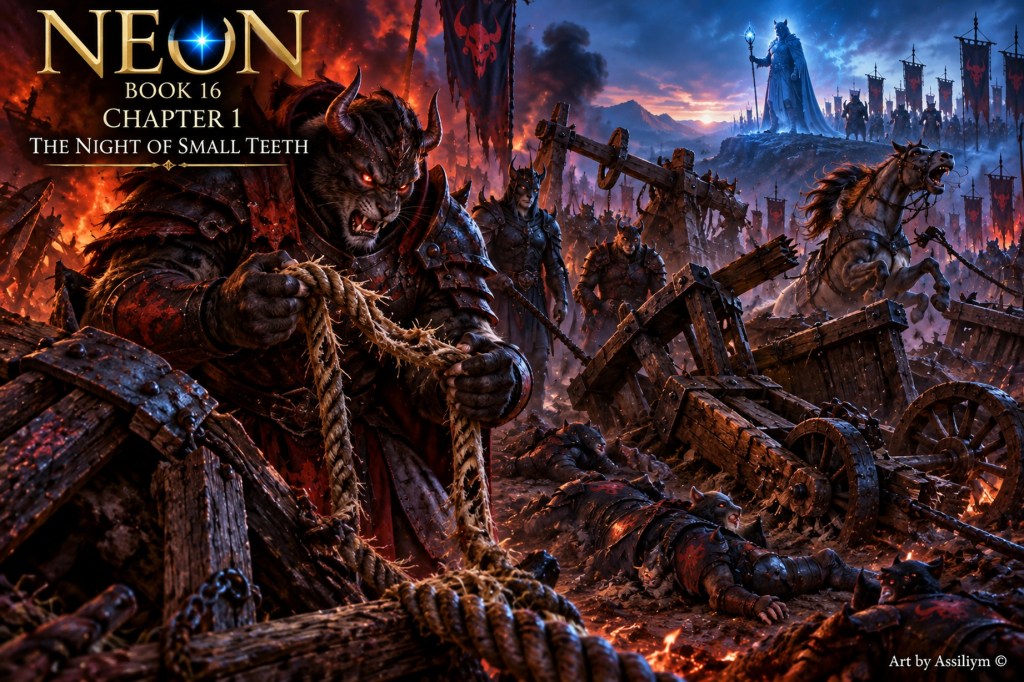
One Draakh’Mor handler heard chewing.
He lifted a lantern.
The sound stopped.
He found nothing except a horse staring towards the western forest.
The handler struck the animal across the muzzle.
The mare did not lower her head.
For the first time since the binding had been placed upon her, she pulled against the harness.
Not violently.
Only enough to tighten the damaged strap.
The nearly severed fibres whispered.
The handler heard that.
He crouched beside the harness and examined it.
A rat shot from beneath the cart and disappeared between his legs.
The demon swore.
He found three small tooth marks upon the edge of the leather.
“Hunger,” said the second handler.
The first looked across the line.
Several horses were awake now.
All faced west.
“Feed them.”
“They have been fed.”
“Then tighten the bindings.”
The second handler obeyed.
The damaged straps were pulled harder.
Their remaining fibres stretched.
Throughout the camp, the smallest army continued its work.
Rats entered beneath the catapult frames and gnawed the release ropes from below.
Voles found the thinner cords holding protective covers over pulley mechanisms.
Squirrels climbed stacks of replacement bindings and chewed through the cords securing them in neat rolls. When a repair crew later lifted the first bundle, half the stored rope would spill loose into the mud.
Mice entered armour carts.
They attacked the soft leather pads placed between plates to prevent movement. They chewed through straps which held shields upright. They opened grain sacks, not because the grain mattered to the battle, but because spilled food drew more creatures beneath the wagons and gave every sentry an ordinary explanation for what he saw.
Beetles disappeared into wheel hubs.
Moles loosened the soil beneath the heaviest machines.
Small birds descended silently from the demon camp’s darker edges and pulled at command ribbons, signal cords and tufts of coloured cloth tied to distinguish one engine crew from another. They carried the fragments towards the trees, where such materials might serve nests better than invasion.
The Demon War possessed generals capable of breaking kingdoms.
It had priests who could occupy corpses.
It had flesh-binders who could turn dead cats into walking engines.
It had sky-creatures capable of shattering thought.
Yet no command had been prepared for the theft of twelve red ribbons by nesting birds.
Near the largest Offering Engine, a Morn’Zhur guard finally saw enough movement to become suspicious.
He raised the alarm.
Not the great horn.
A smaller camp signal.
Three guards came with lanterns. They pulled back the heavy skin covering the forward pulley assembly.
Two rats dropped from the frame and ran.
The guards shouted.
One threw a knife.
It struck the wheel.
Another rat escaped through a gap beneath the platform.
The senior guard examined the rope.
“Chewed.”
A Morn’Zhur engineer was summoned.
He arrived furious at having been awakened for vermin. He ran one claw across the damaged fibres.
“Replace it.”
“With what?”
The guard pointed towards the Keth’Var supply line.
The engineer sent two soldiers.
They returned carrying a coil of replacement rope which unwound halfway across the camp because the cord holding it together had been eaten through.
The engineer stared at them.
“Find another.”
At the next rack, the ropes were intact.
They appeared intact.
The soldiers carried them back.
No one examined the inner side of the coil where dozens of small teeth had reached the fibres hidden against the wood.
The first damaged cable was removed.
The second was fitted.
The little creatures had already gone.
The engineer looked towards the western ridges.
The keep remained dark.
No cats moved beyond the trenches.
No scouts ran back towards the enemy.
No arrows came.
He turned towards his crew.
“Grain has drawn them.”
The senior guard looked at the Offering Engine.
“There is no grain here.”
“There is grain everywhere in an army.”
That explanation was reasonable.
Reasonable explanations are among the finest allies disaster possesses.
Upon the mortal side of the Valley, the kings saw almost nothing.
The wolves remained standing.
The stags did not move.
Oberon had neither advanced nor spoken.
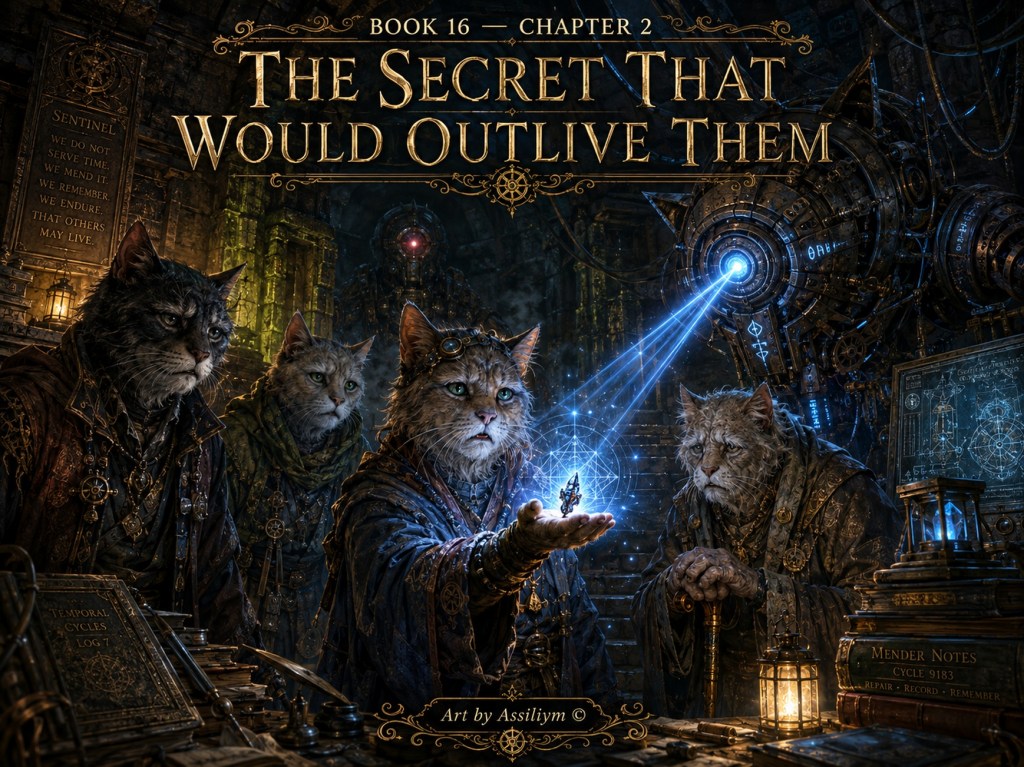
Six winters passed beneath Paris-Neon without Steel-Wheel coming through the wall, and in time this absence became less a source of relief than a condition of life. The unfinished receiving gate remained where the Engineer had begun it, buried in the deepest chamber of an abandoned limestone quarry whose existence had already been forgotten by most of the city above. Two black-blue Tik-Tok anchor stakes disappeared into the stone beside an incomplete arch of adapted sky-metal, and around them ran those impossible geometric scars which Mirel Ashwhisker had never learnt to look at comfortably. Whenever she followed their perfect lines for too long, she experienced the peculiar conviction that the wall had ceased to be a wall and become instead an argument about distance.
The Mender had not abandoned its work. Machines, Mirel had discovered, possessed none of the mortal talent for abandoning a difficult intention merely because years had passed, money had run out, friends had died or common sense had become increasingly persuasive. The damaged Engineer continued repairing itself whenever material permitted, continued repairing the Hunter whenever its own survival allowed, and continued measuring the gate whenever nothing more urgent demanded its tools. But Lucien Veyr had never returned the True Clock to it. He had repaired the clock sufficiently to preserve the mechanism, replaced one cracked wheel, straightened several teeth and remade part of the silver tongue, yet he refused to restore the complete Tik-Tok timing sequence which had once allowed the Mender’s work to accelerate.
This disagreement had hardened into ritual.
“TRUE-TIMING SUBSTITUTE: INCOMPLETE,” the Mender would announce.
“I am aware,” Lucien would answer.
“REPAIR CAPACITY: AVAILABLE.”
“So is my refusal.”
“MISSION DELAY.”
“I continue to admire your vocabulary.”
Orren Blackpaw had eventually begun betting with Tallow Greyear upon which sentence would arrive first. Tallow refused to participate because he considered wagering upon the complaints of an interworld Engineer to be one of those habits by which civilisations announced that they had become bored with survival.
The Hunter had improved as well. It could bear weight upon one forelimb now, and the surviving optic remained awake for hours at a time. Several ruined blue channels beneath its chest had been rerouted through repairs that offended Mirel aesthetically and impressed her mechanically. Yet it still could not move with anything resembling its original speed, and Tallow preserved this limitation as a private religious doctrine. Whenever Mirel remarked upon some encouraging repair, Tallow reminded her that a half-restored Hunter was still a Hunter, just as a half-collapsed roof remained a roof until the moment it chose to become masonry.
Six winters had also been enough for impossibility to become domestic. The four cats no longer descended into the quarry because a metal finger had moved or because some unfamiliar blue pulse had crossed a damaged channel. They brought bread, tea, candles, tools, ledgers, string, wire and arguments. Orren kept a small cupboard in one of the upper chambers containing cheap wine, dried sausage and objects he described as commercially patient. Mirel occupied an old quarry table with diagrams copied from mechanisms she only partly understood. Tallow had built shelves, then complained that shelves encouraged permanence. Lucien had acquired the only proper chair in the place and defended it by the simple strategy of being older than everyone else.
Fear had not disappeared.
A faint scraping followed.
Then another blow.
Across the chamber Orren slept on his back with one forepaw resting upon a wool sack whose contents no honest merchant would have admitted understanding. Mirel had fallen asleep at the table over a drawing of the Mender’s shoulder assembly. Lucien occupied the chair and appeared to be dead in the dignified manner of old cats who have discovered that alarming younger companions is one of the few pleasures age supplies without charge.
Tallow sat up.
“Orren.”
No response.
“Orren.”
A grunt emerged from the blankets.
“Someone is digging.”
Orren opened one eye. “You said that yesterday.”
“Yesterday was water.”
“You said the water was digging.”
“It was behaving suspiciously.”
Mirel lifted her head.
The next strike came through the quarry stone.
Not close.
But not distant enough.
Orren’s second eye opened.
Tallow folded his arms. “Apparently Paris has improved.”
Lucien stirred. “What has improved?”
“The stupidity.”
Another impact sounded through the wall, followed by the unmistakable crack of stone giving way under a metal tool.
Nobody laughed after that.
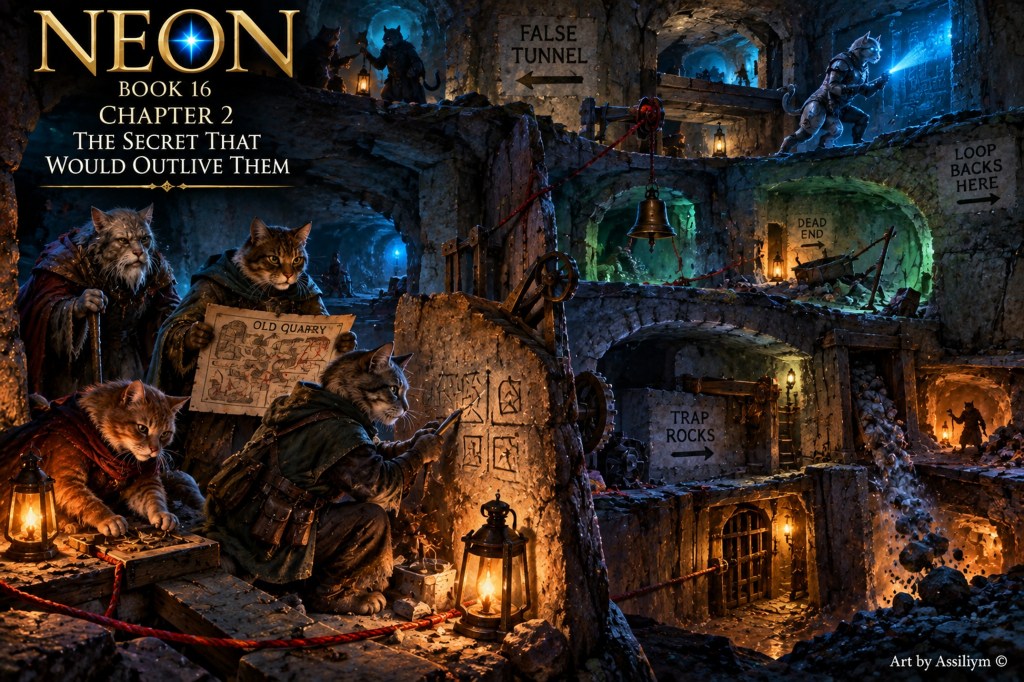
They extinguished the lamp and entered the lower passage without speaking. The outer galleries had been abandoned long before the Demon War, although abandonment beneath Paris was never the same thing as emptiness. Generations of cats had used the upper quarry for storage, smuggling, shelter, gambling, illegal burials, legal burials performed without adequate paperwork and several enterprises which became respectable whenever the correct official received a percentage. The old stone-yard above had been allowed to decay with great care. Broken carts leaned against one wall. Weeds grew through slabs. Two roof sections had collapsed naturally, which Tallow called negligence and Orren called free architecture.
Below that ruin, the four had strengthened three passages and concealed two others.
They had believed this sufficient.
The blows came from the northern burial approach, a narrow gallery that once led towards a fever crypt cut into the limestone during some forgotten epidemic. The bodies had vanished long ago beneath the competing attentions of priests, relatives, rats and water. The tunnel itself ended in a stone fall which Tallow had reinforced years earlier.
Someone was opening it.
The four moved through darkness until a pale line of lantern light became visible through cracks farther ahead. Voices accompanied it.
“Careful.”
“I am careful.”
“You dropped the chisel.”
“I dropped it carefully.”
A third voice muttered something, then said more clearly, “There is air coming through.”
Tallow stopped.
Mirel felt his body stiffen beside her.
Air mattered.
The stone fall had been meant to feel dead. A dead tunnel might be interesting to a desperate robber, but a sealed passage that breathed promised another chamber.
Mirel placed one paw against the wall. A faint current touched the fur between her claws. Somewhere beyond the intruders, an old fracture connected the burial approach with a deeper ventilation channel.
The grave robbers had not found the Sentinels.
They had found evidence that something remained to be found.
Orren leaned close enough that his whiskers brushed Mirel’s ear. “How many?”
She listened.
Four, certainly.
Possibly five.
Metal scraped stone again.
Then came a laugh.
“I told you. Old Lemaitre said soldiers hid pay-chests down here after the demon retreat.”
“Old Lemaitre says he married a duchess.”
“He says he nearly married one.”
“He says she objected.”
“Same story.”
Tallow’s ears lowered.
Orren, to Mirel’s surprise, looked relieved.
Tallow noticed. “What?”
“They are idiots.”
“That has not reassured me.”
“It should. Intelligent thieves ask what happened. Idiots ask what can be sold.”
The hole widened.
Mirel glanced back towards the deeper passage. “We cannot let them continue.”
“No,” Tallow said.
“Can you collapse the approach?”
“Yes.”
“How much?”
“All of it.”
Lucien’s voice came softly from behind them. “With the robbers inside?”
Tallow did not answer.
Mirel turned to him. “No.”
“They entered a sealed quarry with axes.”
“That is not a capital crime.”
“It is an occupational prediction.”
“No.”
Tallow breathed slowly through his nose.
Orren touched his sleeve. “We do not need them dead.”
Tallow looked towards the lantern glow. “Then what do you suggest?”
Orren’s smile was small.
Mirel knew that smile.
It was the expression with which he usually approached a buyer who did not yet understand that he had already purchased something.
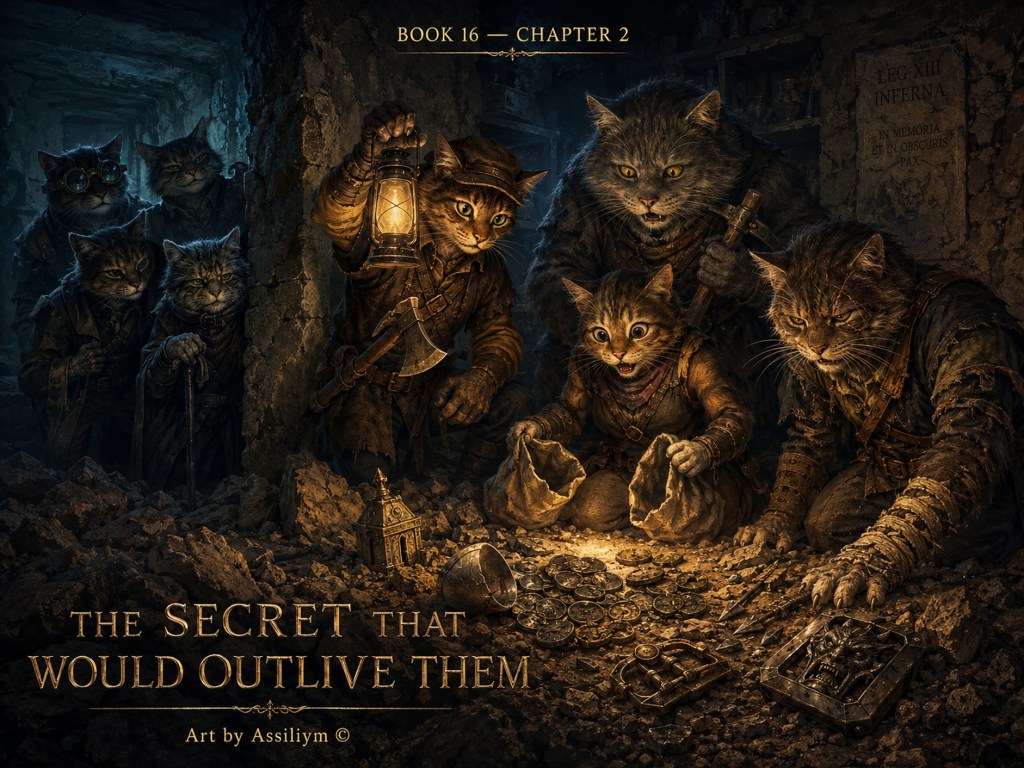
Twenty minutes later the grave robbers discovered treasure.
It had not existed twenty minutes earlier.
This improved its credibility enormously.
Beside the burial approach stood an old storage niche scarcely six feet deep and half buried beneath rotten shelving. While the robbers enlarged their entrance, Tallow and Mirel cleared enough rubble to expose the niche. Lucien helped remove one fallen plank and then announced that he had reached the age at which manual labour was chiefly useful for confirming the wisdom of avoiding it. Orren returned from the upper chamber carrying his sack.
From it came a demon buckle, two blackened military coins, a bronze cavalry clasp, three arrowheads, a cracked silver cup and a small reliquary he had purchased years before from a widow who insisted it belonged to a saint and a pawnbroker who insisted it belonged to a tavern.
Tallow stared at the collection.
“This is rubbish.”
Orren pushed one coin beneath a broken slab. “It is treasure.”
“It is rubbish.”
“Treasure is rubbish discovered by someone who has climbed far enough underground to become emotional.”
Mirel rubbed quarry dust over the reliquary.
Lucien examined the arrangement. “You planned this very quickly.”
“I sell things.”
“You are giving them away.”
“No. I am purchasing departure.”
The first grave robber entered through the opened fall carrying a miner’s lamp and a short axe. He was a narrow brown tom wearing a leather cap that had once belonged to somebody with a more convincing relationship to mining. Behind him came a thick grey cat with a pick, a young she-cat carrying two empty canvas sacks and a scarred older fellow whose paws were wrapped in cloth against rope burn.
Their lamp crossed the chamber.
The robbers began filling one of the sacks. Coins, buckle, clasp, reliquary, arrowheads; even the cracked cup disappeared. The young she-cat searched through rotted shelving and found nothing else, which should have been the end of it. Orren had calculated correctly that a small but plausible cache would satisfy thieves whose expectations had begun as tavern gossip.
He had failed to calculate the grey tom’s whiskers.
The cat stopped close to the rear wall and frowned.
“There is a draught.”
Nobody in hiding moved.
The brown tom came beside him. “From the hole behind us.”
“No. From here.”
He raised his lamp and watched the flame bend almost imperceptibly.
Tallow closed his eyes as though asking patience of an indifferent universe.
The grey tom touched the wall and smiled. “There is another chamber.”
That was when Orren gave Mirel the signal.
She pulled a cord no thicker than string.
Farther back along the burial approach, a carefully balanced slab dropped six inches and struck the floor. The sound crashed through the quarry with the enormous authority possessed by small events in underground places. Dust billowed from the tunnel. Before the robbers could decide whether the noise meant danger, Tallow released a second line. A quantity of loose gravel rushed down a hidden chute and rattled into the passage behind them.
The scarred cat spun towards the entrance.
“What was that?”
Lucien’s mechanism answered three heartbeats later. A weighted spindle, deliberately delayed, tightened another concealed line and struck a suspended iron bar in a gallery beyond sight.
Clang.
The sound travelled through limestone.
Silence followed.
Then another metallic blow.
Clang.
The young she-cat’s ears flattened. “That is not us.”
The grey tom still faced the rear wall, caught between treasure and survival. “There could be another room.”
The scarred cat had already seized the filled sack. “There could also be several tons of Paris attempting to occupy this one.”
The delayed iron bar struck a third time. Dust drifted from the ceiling. The brown tom required no further persuasion. He shoved the grey cat towards the opening, and within moments all four had vanished into the burial passage carrying Orren’s worthless treasure with the desperate care normally reserved for Crown jewels.
The four keepers remained hidden until the distant scrambling faded.
Tallow turned towards Orren. “They will return.”
“They will talk first.”
“That is worse.”
“No,” Orren said, emerging from concealment and examining the emptied niche. “Talking is the useful part.”
He was correct, although even Orren underestimated the speed with which Paris improved a story.
By sunset, a tavern near the western wall knew that grave robbers had found a Demon War cache beneath an abandoned quarry. By the following morning there had been three chests. Before midday there were seven, one filled with imperial silver, one with demon gold, another with jewels stripped from dead generals, and four whose contents differed according to the amount of wine already consumed by whoever described them. By evening an entirely fictional demon commander had acquired an enormous preserved claw, a golden helmet and a romantic attachment to a French duchess.
The four grave robbers protested every addition while drinking upon credit secured by the certainty that they knew where more treasure remained.
Orren arranged for two rounds to reach their table through a fish porter who owed him money.
The following night another rumour began travelling through the quarter. The quarry, so the story now went, had collapsed shortly after the cache was removed. A gang returning to search for the supposed deeper chambers had nearly been buried. The remaining galleries were unsafe. There was nothing left below but plague graves and unstable limestone.
Orren paid considerably less for that rumour.
There are lies which attempt to replace the truth, and there are others which merely arrive before it.
The first sort requires invention, courage and a good memory. It must construct doors where no house stands, supply witnesses who never existed and remember, months later, precisely which imaginary cat carried the candle. Such lies are difficult to maintain because the world possesses an irritating habit of continuing after they are spoken. Servants remember differently. Roads retain wheel marks. Letters survive fires. Bodies refuse to be buried where official statements have placed them.
The second sort of lie is simpler.
It does not ask to live forever.
It requires only an hour.
Perhaps a day.
Enough time for a frightened cat to escape, for a document to disappear, for a king to make another mistake or for truth itself to arrive too late to prevent the lie from completing its small and necessary work.
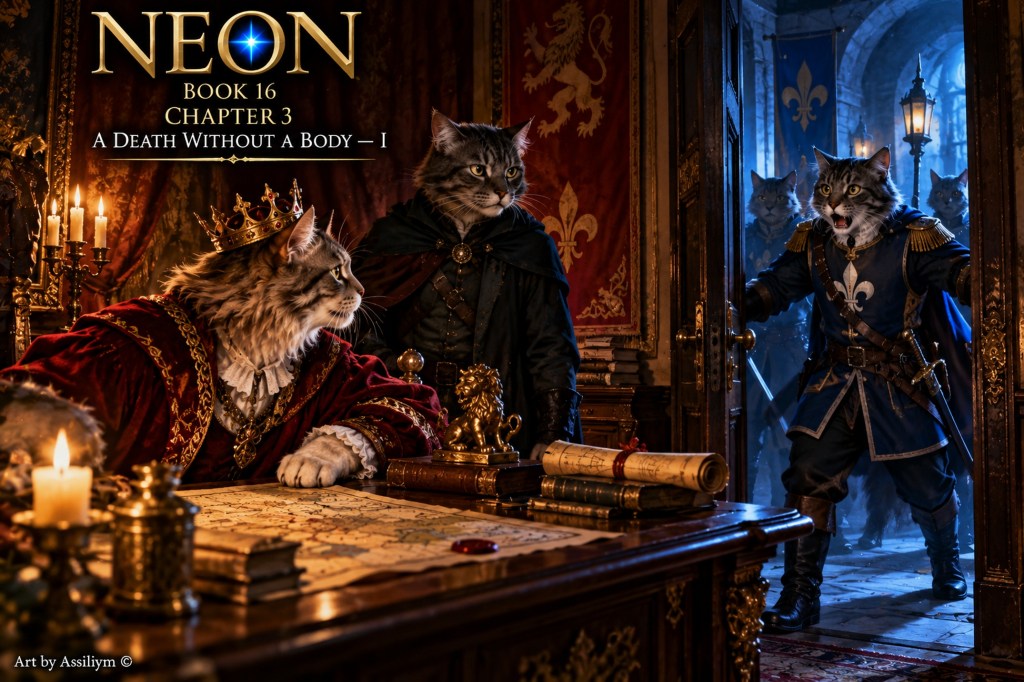
Vasili entered the King’s private chamber shortly before midnight.
No clerk waited inside.
No secretary sharpened a pen.
No page stood beside the door with a message tray. Luis had dismissed the servants from the corridor and ordered that the fire be maintained before they left, as though warmth might be permitted to witness what paper could not. The chamber therefore possessed the arranged solitude of places where monarchs prefer their commands to become events without first becoming records.
Rain remained upon the windows from the storm of the previous night. It gathered in the lower corners of the glass and distorted the palace lamps beyond, turning each flame into a trembling gold wound. The city outside had nearly settled, but palaces do not sleep when kings are waiting for news. Somewhere below, boots crossed the inner court. A stable door closed. A guard challenged a late carriage and was answered too quietly for the words to rise.
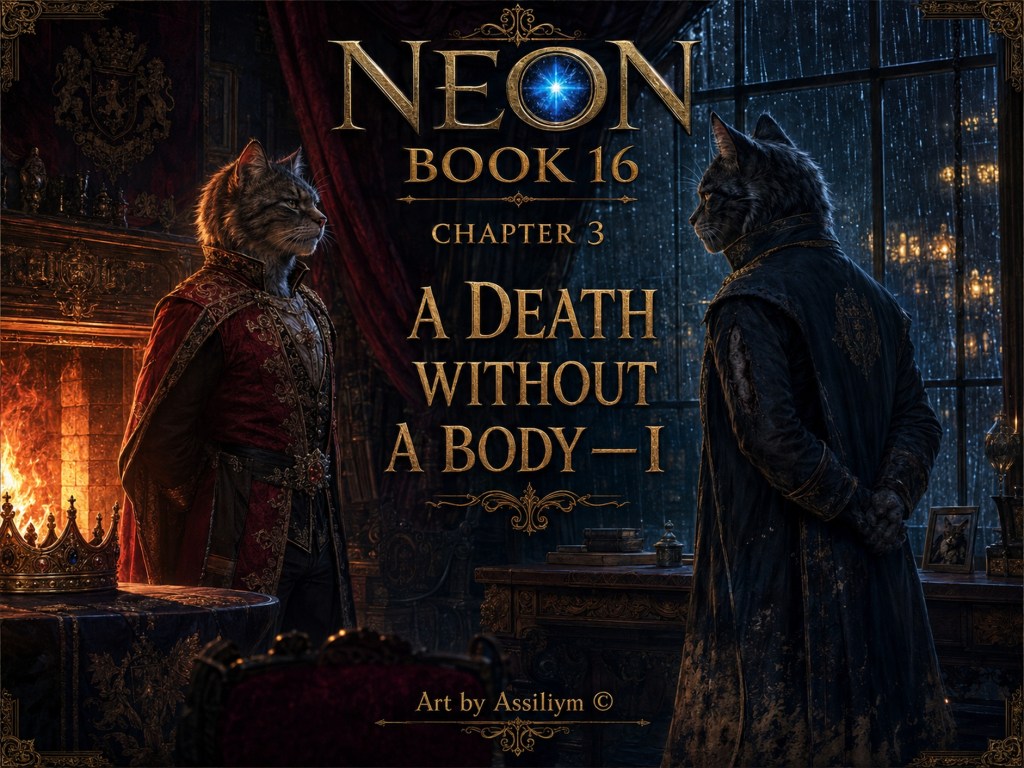
Luis stood before the fire with one paw resting against the mantel.
He had not changed for bed.
The dark royal coat remained fastened to the throat, and the narrow crown used within private apartments lay upon a side table near him. Without it he appeared younger, but youth had ceased to make him harmless. There are rulers who grow cruel because age has taught them suspicion. Luis had learned suspicion before age had taught him patience, which was perhaps worse.
He turned when Vasili entered.
The royal watcher closed the door behind himself.
For several breaths neither cat spoke.
Luis looked first at Vasili’s face, then at his coat, boots and paws, as though the lake might have left some visible answer upon him. Mud had dried along the lower edge of the cloak. One sleeve bore a narrow tear from the thorn bushes along the western bank. There was no blood. No royal jewellery. No object taken from the dead and brought back as proof.
The absence of proof entered the room before the report did.
Vasili bowed.
“The boat sank, Your Majesty.”
Luis’s paw tightened against the mantel.
The fire shifted behind him, sending light through the fur along one side of his face while leaving the other in shadow.
Vasili had prepared the report during the return journey.
He had arranged it carefully, not in sentences at first, but in limits. What had been visible. What could be claimed. What the archers knew. What they might repeat if questioned separately. What Luis wished to hear strongly enough that he might not examine the spaces between one fact and the next.
The boat had been far from shore when the arrows struck. That was true.
The light had been poor. Also true.
The old wood had broken beneath repeated impacts, water had entered, and both figures had vanished into the lake. True again.
Truth provides the strongest timber for a lie because it allows the false portion to remain small.
Luis stepped away from the fire.
“You saw them go into the water?”
Vasili inclined his head.
He had seen the boat overturn.
He had seen one figure break the surface.
He had seen movement among the lilies.
The rest had been darkness, distance and reeds swaying beneath a wind which made every shape capable of becoming either a drowning cat or an empty branch.
“Both entered the lake.”
The King’s eyes remained fixed upon him.
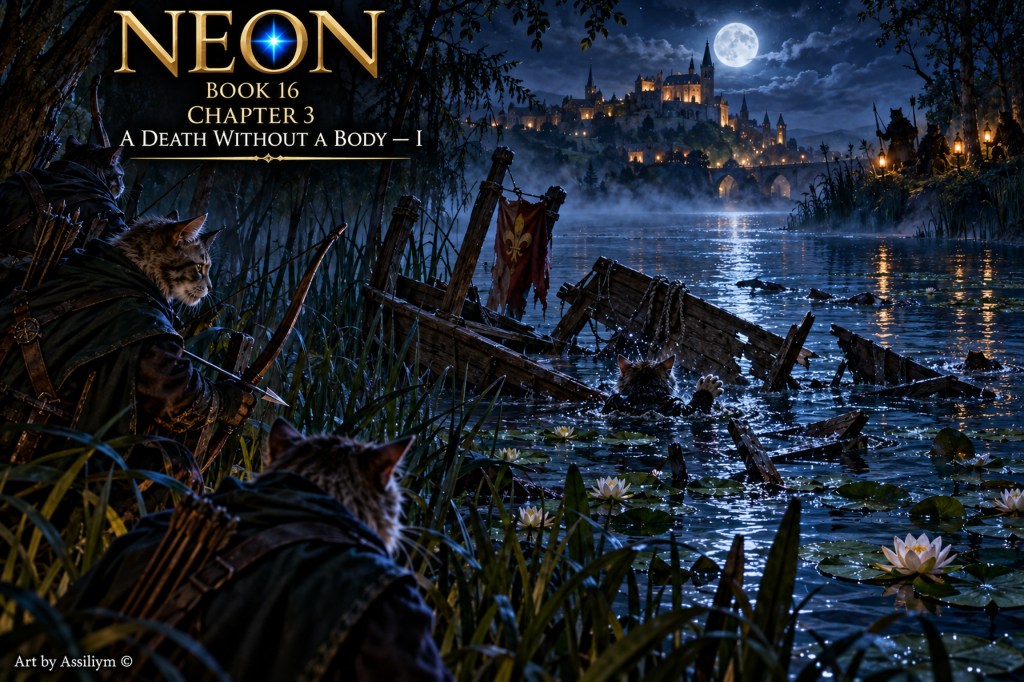
Luis had ordered the deaths of three lives, although he had named only two cats. He had done so in the calm language of geography: wait until the boat was far from shore, wait until both were together, then ensure neither returned. It was one of power’s old methods of protecting itself from the act it commands. Murder becomes easier when divided into distance, timing and weather.
Now the geography had completed itself.
The lake was far away.
The boat was beneath it.
The night had supplied darkness.
Luis asked about Sofia first.
He did not say my sister.
Perhaps the title would have made the question too intimate. Perhaps her name already carried enough blood between them.
Vasili answered with the confidence required by a king who had no body and needed certainty to replace it.
“The Princess is dead.”
The words altered Luis.
Not visibly enough for a servant to have understood. A courtier might have mistaken the small release in his shoulders for grief. Vasili knew better. The King had been holding himself against two possible futures. In one, Sofia remained alive, carrying scandal, defiance and a child beyond his control. In the other, the lake had simplified the royal family.
For one instant, Luis allowed himself to inhabit the simpler future.
Then suspicion returned.
“How do you know?”
This was the dangerous point.
Vasili had known it would come.
The royal archers had never approached the boat. They had watched through wet branches from the distant bank. Sofia’s face had not been visible. Neither had Armand’s. The figures were shapes upon dark water, one rowing, one seated, their clothes reduced by distance to differences in shadow.
Had any scout seen Sofia closely, the report would have become more complicated rather than less.
The Princess had left the villa visibly pregnant.
The figure upon the lake no longer carried the same shape.
A close witness might have seen that the child was gone from her body. A clever one might have understood that birth had occurred somewhere between the storm, the carriage and the lake. That understanding would have created a third search, and the third search would not have ended at the water.
No scout had seen enough.
Vasili therefore gave Luis a scout who had.
“One of my cats saw her gown when the boat turned. It was heavy, Your Majesty. Travelling cloth, soaked through. Once she entered the lake, its weight pulled her beneath the surface.”
The lie was modestly constructed.
It did not invent a conversation or a recovered body. It gave only a better view than any cat had possessed and converted an inference into observation.
Luis looked towards the dark window.
Perhaps he imagined the gown filling with water, its folds closing around Sofia’s legs, its weight becoming the final royal restraint he had failed to place upon her while she lived.
Vasili continued no further.
A lie offered too eagerly begins to smell of its maker.
The lie required patience.
Luis had very little.
“The lake will be searched again.”
Vasili bowed.
He did not ask whether the search was intended to rescue Armand or silence him. Some distinctions insult both cats when spoken aloud.
The King began giving instructions. Quiet cats only. No palace uniforms. Villages questioned through local officials rather than royal officers. The western road watched. Monasteries examined discreetly. Physicians asked whether they had treated an injured bishop without being told why the Crown wished to know.
At the word monasteries, Vasili’s face remained unchanged.
Somewhere beyond Paris-Neon, a newborn daughter slept beneath a roof Luis did not yet know to fear.
The King continued organising uncertainty into pursuit.
Then footsteps struck the corridor.
They came quickly.
Not the controlled pace of a servant carrying a message, nor the measured approach of a minister who had been summoned. These were military steps, accelerated beyond palace dignity. A voice challenged them outside. Another answered.
The door opened before Luis gave permission.
A royal musketeer entered, breathing hard, one paw still upon the hilt of his sword. He had crossed the palace too quickly to arrange his face for the King.
Luis straightened.
The musketeer bowed only after remembering to do so.
“Your Majesty—Bishop Armand is at the palace.”
For the first time that night, Vasili looked towards the door too quickly.
The musketeer swallowed.
“And he is very angry.”
 Vuk Stribog