
INSIDE BOOK 17
NEON — The Last Law of the Beast Lord
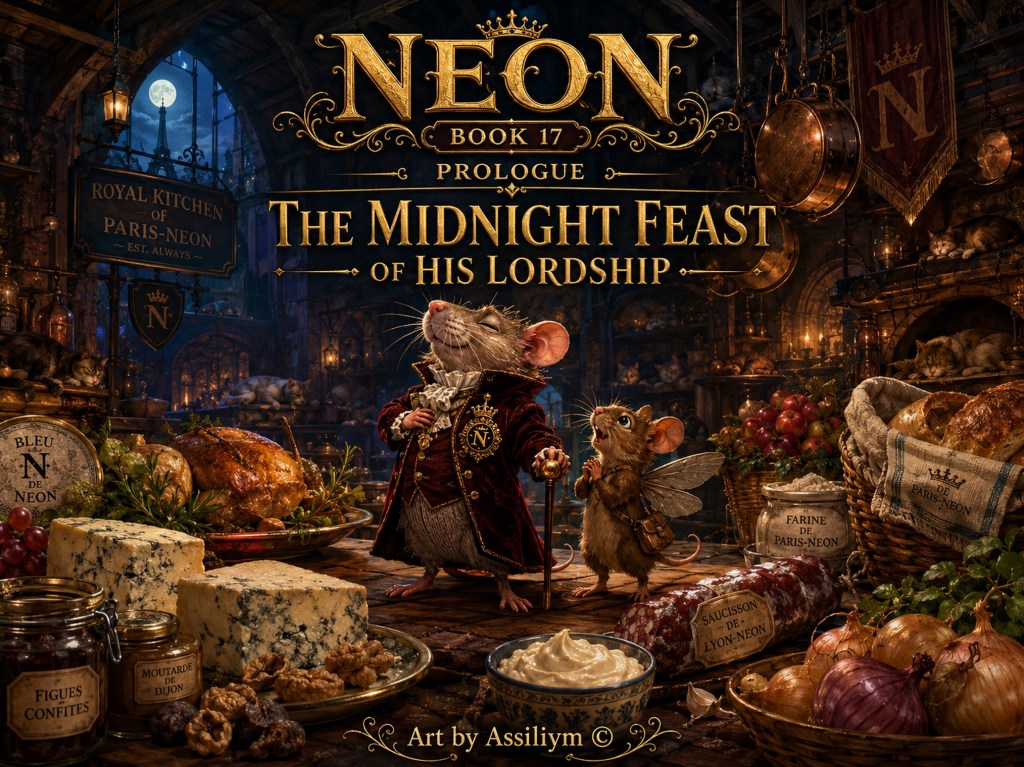
There are hours in every royal palace when government ceases to be visible. The King sleeps, ministers stop producing documents which other ministers must explain in the morning, guards cease changing posts with ceremonial precision and begin changing them with the quieter hope that nothing requiring heroism will occur before breakfast. Courtiers remove jewels, bishops remove arguments, servants extinguish lamps, and the kitchens—having spent the day feeding creatures whose importance increased almost perfectly with the number of dishes they required—finally surrender to silence. At midnight, the Royal Palace of Paris-Neon belonged to mice. Or so the Flying Mouse had always believed. Lord Nibblewick held a different constitutional interpretation.
His Lordship waited beside the door of his rooms until the last footsteps had faded from the corridor. One ear remained raised, his whiskers still except for the smallest twitch. Behind him, the Flying Mouse sat upon the carpet and watched with increasing fascination as one of the most celebrated creatures in France-Neon prepared what appeared to be an illegal expedition through his own residence. Somewhere below, a guard coughed. Farther away, a clock struck twelve. Nibblewick turned, his dark eyes brightening, and the Flying Mouse whispered, “Now?”
“Chrrp.”
He hurried to the little rack upon which his formal velvet coat hung and began dressing himself with tremendous seriousness. The Flying Mouse tilted her head. “You are wearing that? At midnight?” Nibblewick paused only long enough to point at himself, then at the coat, then at the little polished badge waiting beside it. “Yes, I understand that you are a lord.” He pointed again. “I understood the first time.” A sharp tchik corrected her. “Very well. A very important lord.”
That satisfied him. The velvet coat went on, the badge followed, and Nibblewick inspected himself in the small mirror beside the cabinet. He adjusted one whisker with both paws, turned slightly to examine the effect from the left and then from the right, and finally rose upon his hind paws. The Flying Mouse had lived too long among gutters, rafters and market stalls to be easily impressed by clothing, yet there was something undeniably remarkable about a rat no larger than a loaf of bread standing before a royal mirror in velvet and polished metal, looking as if France itself had been created merely to provide him with a suitable background.
“You really like being a lord.”
“Chrrp.”
“I noticed.”
He marched to the door. She hurried after him. “How far is the kitchen?”
Nibblewick stopped, thought about the question and pointed downwards.
“How far down?”
He pointed down again.
“Two floors?”
A shake of the head.
“Three?”
Another shake.
“Four?”
His whiskers twitched thoughtfully.
The Flying Mouse stared at him. “You invited me to supper without knowing how many stairs there are?”
Nibblewick immediately began washing one paw.
“That is not an answer.”
He continued washing it.
She smiled. “I am beginning to understand you.”
Nibblewick stopped with the paw halfway to his face and looked momentarily alarmed by this development.
Then he pushed open the door.
The palace beyond lay in a half-darkness of gold and shadow. Only every third wall lamp remained burning. Painted kings stared down from enormous frames; marble cats stood upon pedestals with expressions of permanent military confidence; tapestries showed battles, hunts, coronations and treaties whose participants had all been dead long enough for their mistakes to become decorative. To the Flying Mouse, the first corridor alone seemed vast enough to contain the whole stretch of roof beneath which she had slept the previous winter. A red carpet ran down its centre like a road. Brass handles rose higher than branches she would willingly have climbed without food at the end. She stayed close to Nibblewick, while he proceeded with the serene confidence of a creature who had never once considered whether he was permitted to be where he was going.
At the first corner, a palace guard appeared. The Flying Mouse froze. Nibblewick did not. He continued walking until the guard looked down and immediately bowed.
“Your Lordship.”
Nibblewick raised one paw.
Then the guard noticed the tiny brown creature beside him. His brow tightened. The Flying Mouse stopped breathing. Nibblewick stepped half a pace in front of her at once.
The guard looked from her to him. “Guest?”
Nibblewick gave one brisk chrrp.
The guard hesitated. There were rules for visitors, rules for animals, rules for noble visitors, foreign visitors, ecclesiastical visitors, military visitors, condemned visitors temporarily admitted under guard, ambassadors accompanied by dangerous gifts, and three separate palace regulations concerning bears. There was, however, no known rule concerning a mouse personally escorted after midnight by a rat Lord.
The guard chose survival.
“Good evening, Your Lordship.”
He bowed again and let them pass.
The Flying Mouse waited until they had turned the corner. “He believed you.”
Nibblewick glanced back proudly.
“He did not even ask who I was.”
A softer chrrp.
“That badge is useful.”
Nibblewick touched it, then strutted on. By the time they reached the second staircase, the Flying Mouse had understood something important: Lord Nibblewick did not merely possess privileges. He collected evidence of them. Every guard who bowed became another exhibit. Every servant who stepped aside strengthened his case. Every closed door which opened at the sight of the badge confirmed a philosophy in which aristocracy consisted largely of going wherever other creatures had been told not to go.
Two sleepy servants carrying folded linen flattened themselves against a wall as he passed.
“My Lord.”
Nibblewick acknowledged them.
The Flying Mouse whispered, “Do they always do that?”
“Chrrp.”
“You enjoy it.”
He offered no reply, which was answer enough.
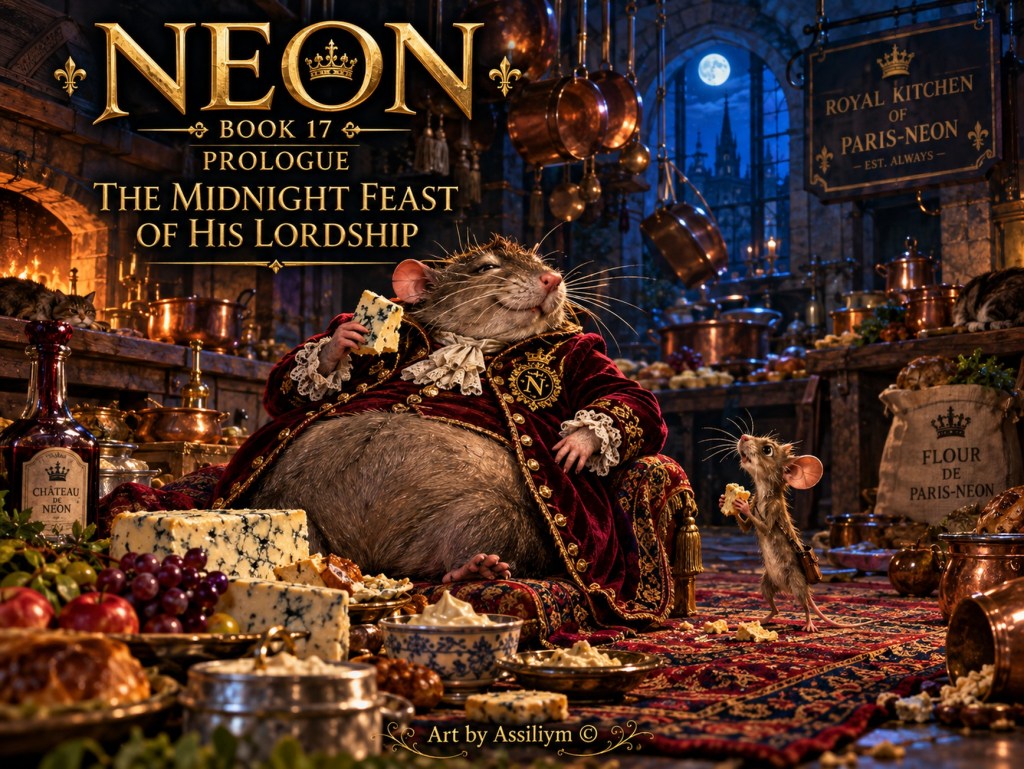
The main kitchen doors were shut, but the lower corner of one door had been worn smooth by years of carts and servants. Nibblewick inspected the gap. The Flying Mouse looked at the opening, then at his stomach, then back at the opening.
He noticed.
“Tchik.”
“I said nothing.”
He pushed against the door. Nothing happened. He pushed harder, his hind paws sliding backwards over the stone. The Flying Mouse folded her arms. Nibblewick stopped, looked at the door, looked at her, and pushed again.
“You want help?”
He responded with offended silence.
She put both paws against the lower edge anyway. Together they shoved. The heavy door shifted just enough. Nibblewick slipped through at once and continued into the kitchen as though collaboration had never occurred. The Flying Mouse squeezed after him.
Then she stopped.
“Oh.”
The Royal Kitchen stretched beneath high rafters darkened by generations of smoke. Long wooden tables occupied the centre of the room. Copper pans hung above them like bronze moons. Ladles, cleavers and spoons rested in ordered rows. Huge ovens slept behind iron doors, holding the deep warmth of the day. Baskets of onions stood beside sacks of flour. Loaves cooled beneath cloth. Somewhere in the darkness, a dripping tap counted seconds no royal clock considered important enough to record.
Nibblewick marched into the middle of it and spread both paws.
The Flying Mouse turned slowly. “All this?”
He nodded.
“For the King?”
Nibblewick made a dismissive motion.
“For you?”
He stood taller.
She stared at him. “You are saying the whole kitchen belongs to you.”
“Chrrp.”
“No.”
“Tchik!”
“You cannot own the entire Royal Kitchen.”
He pointed at his badge.
“That does not mean you own the kitchen.”
He pointed to himself, then to the food, and mimed eating.
The Flying Mouse considered the gesture. “You may eat anything you want here.”
A vigorous nod.
“Because you are a lord.”
Triumphant chrrp.
“That I believe.”
The expedition became a feast.
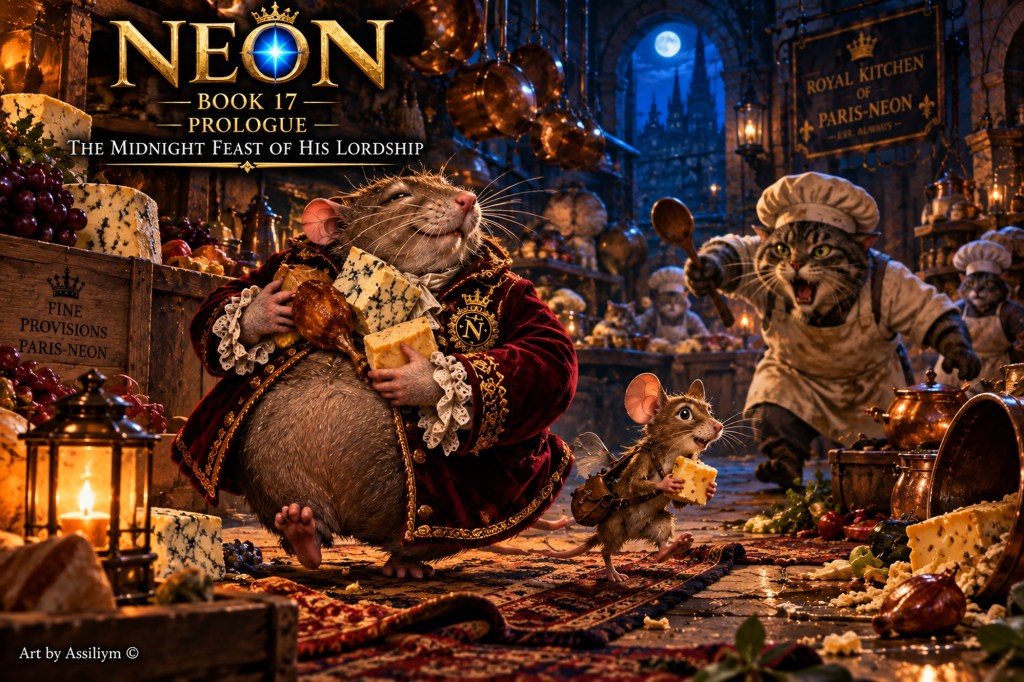
Nibblewick began with blue cheese because principle demanded it. He discovered a covered dish upon a lower shelf, climbed a flour sack, pushed the cloth aside and found several pieces left from the evening service. Naturally, he chose the largest. The Flying Mouse chose bread. Not because bread was rare, but because this bread was soft. She broke off a crumb and held it between both paws for several seconds before biting.
Her eyes closed.
Nibblewick stopped chewing.
She swallowed slowly. “Fresh.”
He watched her.
“I forgot,” she said quietly.
His head tilted.
“I forgot bread could be soft.”
For a little while the comedy left him. Nibblewick looked at the enormous abundance around them, then down at the tiny mouse beside him, and without ceremony pushed his piece of blue cheese towards her.
She laughed softly. “No. Keep it.”
He pushed it again.
“I don’t like blue cheese very much.”
Nibblewick’s expression changed as though she had confessed treason against civilisation.
“I know. Terrible.”
He pulled the cheese back protectively.
He climbed down from the table.
“Nibblewick.”
He trotted beneath the pantry shelf.
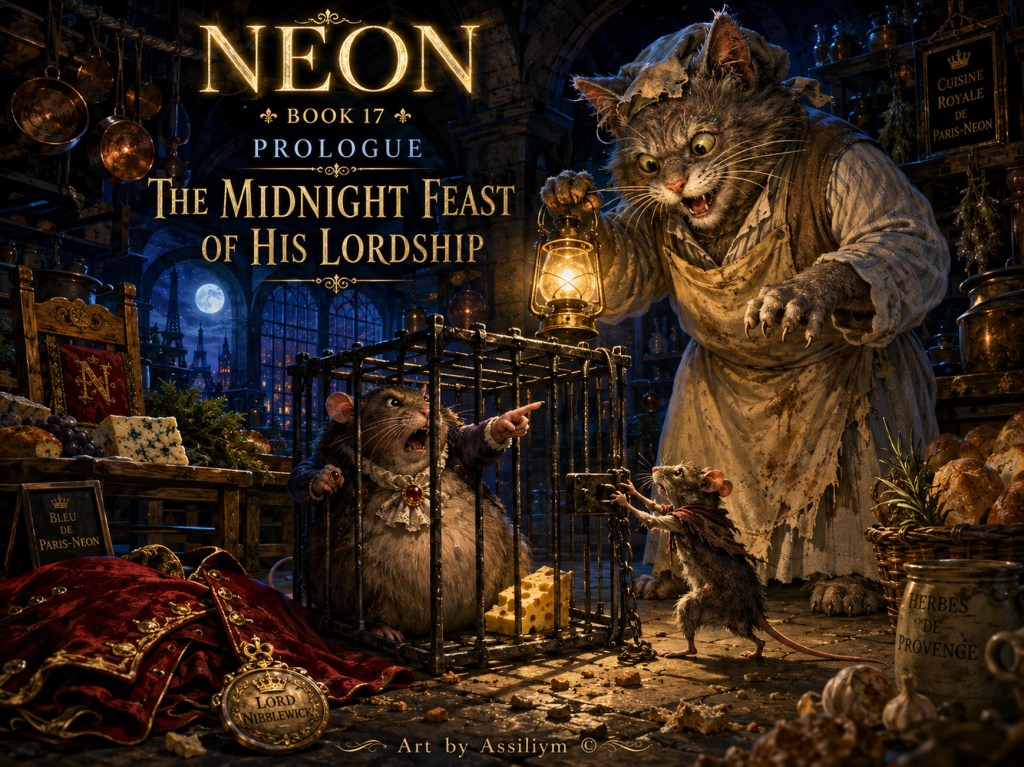
The Flying Mouse hurried after him and stopped beside the iron cage. Inside sat a square of ordinary yellow cheese. The door stood open.
She stared.
“That is a trap.”
Nibblewick glanced at her.
“A very obvious trap.”
He sniffed again.
“Do not.”
One paw went inside.
The Flying Mouse closed her eyes. “My lord.”
Another step.
“Please.”
The cheese waited three inches away.
Nibblewick advanced.
The door slammed.
CLACK.
For several seconds he did not move.
The Flying Mouse opened her eyes.
Nibblewick looked backwards at the iron door. Then forwards at the cheese. Then backwards again.
“I told you.”
He turned very slowly towards her.
She reconsidered at once. “I mean—it was an extremely sophisticated trap.”
“TCHIK!”
“Yes.”
Nibblewick seized the bars and pulled. Nothing moved. The Flying Mouse climbed onto the latch and tugged at the mechanism.
“Hold still.”
He pushed from inside. The cage rattled.
“Again.”
He shoved harder. The wire lifted a fraction.
“Again.”
Footsteps sounded beyond the kitchen.
Both stopped.
Slow footsteps. Dragging slightly. One foot heavier than the other.
The Flying Mouse whispered, “Someone is coming.”
Nibblewick pointed frantically towards the latch.
“I am trying.”
The footsteps reached the door.
She pulled again.
The latch rose another fraction.
Then the door opened.
A lantern entered first.
Behind it shuffled an ancient grey palace cat wearing a long nightshirt beneath a stained kitchen apron. His ears were ragged with age, his whiskers nearly white, his back slightly bowed. Three teeth remained visible when he opened his mouth, though whether all three remained on speaking terms with one another was uncertain.
He raised the lantern.
His eyes found the cage.
His face brightened.
“Ha.”
The Flying Mouse crouched behind the trap.
Nibblewick stared at the approaching cat.
“Got you.”
Nibblewick released the bars and immediately straightened.
The old cook shuffled closer. “Been eating my kitchen, have you?”
Nibblewick put one paw upon his chest.
“Tchik!”
The cook leaned nearer. “What?”
Nibblewick pointed furiously towards the chair where his coat and badge lay.
The old cook followed the gesture, but his eyesight was little better than his hearing. He saw a dark shape across the room, dismissed it and returned his attention to the rat inside the cage.
“Fat one.”
Nibblewick froze.
The Flying Mouse put both paws over her mouth.
The old cook crouched lower. “Very fat.”
Nibblewick produced a noise so offended that a younger cat might have reconsidered several choices in his upbringing.
The old cook smiled. “Good lungs too.”
The Flying Mouse stepped from behind the cage. “Excuse me!”
Nothing.
She shouted louder. “EXCUSE ME!”
One of the cook’s ears twitched.
“What?”
She pointed at Nibblewick. “He is Lord Nibblewick!”
The old cat squinted.
“Nibbles?”
“No! NIBBLEWICK!”
“Nibbled what?”
Nibblewick gripped the bars.
“TCHIK! TCHIK!”
The cook nodded. “Yes, yes. I can see what you’ve been doing.”
The Flying Mouse climbed onto the front of the cage. “He is a LORD!”
“Lard?”
“LORD!”
The old cook looked thoughtfully at Nibblewick’s belly.
“Well, there’ll be enough.”
The Flying Mouse stared.
Nibblewick stared.
Then the cook opened his mouth in a broad, almost toothless smile.
“I haven’t had rat in years.”
Silence seemed to spread through the kitchen.
Nibblewick blinked.
The Flying Mouse turned slowly towards him. He looked from her to the cook and then pointed at himself.
She whispered, “I think he means you.”
A squeal nearly escaped Nibblewick before dignity strangled it into a furious, rolling rrrrk. He threw himself at the bars. The old cook laughed.
“Strong too.”
The Flying Mouse ran to the side of the trap and pulled uselessly at the latch. “Wait! He belongs to the King!”
The old cook caught only one word.
“King?”
“Yes!”
He nodded solemnly. “King’s kitchen.”
“No—”
“King’s rat.”
“No!”
“Exactly.”
The cook reached for the cage.
The Flying Mouse jumped onto his paw and bit him.
Not hard.
Hard enough.
The old cook jerked. “Oh!”
The cage swung, Nibblewick rolled sideways, and the Flying Mouse dropped to the floor and ran beneath a stool.
The old cook peered around. “What was that?”
She darted beneath the table.
A paw swept after her and missed.
Nibblewick shook the cage furiously.
“Chik-chik-chik!”
“I know!”
The Flying Mouse raced towards the door.
Then she stopped.
Nibblewick was still inside the trap.
The gap beneath the kitchen door remained open. One dash and she could be through it, then into the corridor, then perhaps the gardens, then the city. She had survived for years by leaving trouble before trouble finished deciding what shape it intended to take.
She looked back.
Nibblewick had found her in a tree.
He had hidden her.
Fed her.
Brought her through doors which had always been closed.
Given her soft bread.
The old cook reached for the cage.
For one heartbeat, the Flying Mouse remained between survival and loyalty.
Then she turned around.
“No.”
She ran back.
The cook saw her and lowered one paw. She veered, jumped over his wrist, almost escaped—and he caught her by the tail.
She squeaked.
Nibblewick erupted.
“CHIK-CHIK-CHIK!”
The old cook lifted the tiny mouse at arm’s length.
“Little one.”
Nibblewick struck the bars with both paws.
The cook looked between his two prisoners: one very large rat, one very small mouse.
His old face became thoughtful.
Then pleased.
“Oh.”
The Flying Mouse stopped struggling.
She did not like that oh.
The cook looked at Nibblewick, then at her, then towards the pantry.
“That’s better.”
He placed the Flying Mouse inside a little wooden spice cage once used for transporting live dormice during a period when the royal kitchens had possessed unfortunate ideas about dessert. She seized the bars.
“You cannot do this!”
He shut the door.
Nibblewick pointed furiously towards the forgotten badge.
“TCHIK!”
The old cook lifted both cages.
“One fat rat.”
Nibblewick became still.
“One little mouse.”
There are names which vanish because no cat remembers them, names which are destroyed because power fears what they signify, and names which are removed so carefully from every ledger, inscription and surviving account that their absence becomes more deliberate than any monument. The forgotten leave ruins. The condemned leave accusations. Those who have been erased properly leave numbered pages which do not follow one another, lists containing spaces too neat to be accidental, diagrams whose empty fittings possess greater precision than the machinery drawn around them, and old clerks who cannot explain why an index refers to a chapter no book has ever contained.
Calix had left all of these.
His name had survived only because a tool had slipped, a file had failed or one ancient cat had decided that perfect destruction should not be trusted. Beneath the torn fittings where the Returning Measure had once rested inside the Sentinel’s hidden command plate, five narrow letters remained scratched into black metal:
CALIX.
Beside them stood the shorter record:
RETURNING MEASURE WITHDRAWN.
Nothing followed.
No date.
No destination.
No explanation of why the Page of Mercy had been removed from a Sentinel whose Purpose now threatened to open the road to the planet Tik-Tok.
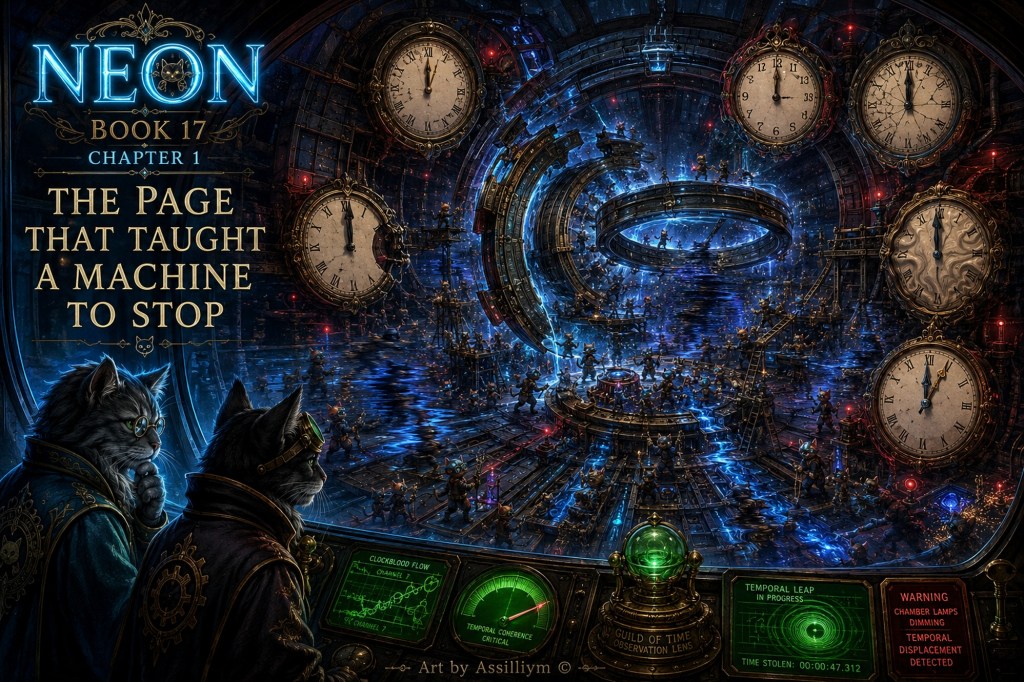
Within the reconstructed chest, the tiny workers had already begun the second false portal.
The first attempt had wounded distance across the Guild Hall, Mercer Ward, Saint Virel and Tik-Tok. It had stretched metal, injured time, returned two bolts where one had entered and allowed a distant world beneath a plated sky to look back through a doorway no true Route Engineer had aligned. Its failure had nearly pulled part of the observation chamber through the Hunter’s ribs.
The Broken Sentinel had regarded this as progress.
It had learnt that the first arches were too weak, that Clockblood must be divided into separate channels, that the pale sky-stone required more direct contact with the opening and that distance and time should not be entrusted to the same damaged support. It had removed the warped arches, measured every fracture and carried the pieces into a deeper construction chamber.
There, the Tik-Tok workers began again.
They did not build continuously. This troubled Varric Steelquill more than continuous labour would have done. For an hour they might remain entirely still, arranged along the inner rails like filings awaiting the movement of a magnet. Then the chamber clocks would lose several beats, the observation lamps would dim, and when ordinary time returned, an entire section of the new structure would stand completed.
On the first occasion, three empty ribs appeared where none had existed a breath earlier.
On the second, separate channels had been cut for distance, duration and return.
On the third, fourteen workers vanished from the visible rails. No opening appeared and no alarm sounded. Five minutes later, the missing workers returned carrying black metal upon which centuries of dust had gathered, although they themselves showed no mark of travel.
Varric measured the work.
Oriel Glass-Whisper watched the intervals.
“It is building more quickly,” he said.
She stood behind the blue observation glass with both paws resting upon the command rail, feeling the deep Purpose move through the Hunter like winter water beneath stone.
“No.”
Varric glanced towards her.
“The second structure is already larger.”
“It is not building more quickly,” Oriel said. “It is learning how to remove the time during which it was not building.”
Varric looked again at the completed ribs.
An engineer understands acceleration. He understands improved tools, divided labour, better measurements and the removal of unnecessary steps. He does not enjoy being informed that the construction has improved by subtracting idle hours from the world.
The chamber clocks did not help. Hélène Coldbar had ordered seven damaged timepieces placed around the Hunter, following the protection used around Madam Crumbolina. None agreed. One hurried. One stopped whenever the Hunter’s true eye opened. One possessed two minute hands and no hour hand. Another had been recovered from a Guild fire and struck each hour in reverse order. Yet during the workers’ temporal leaps, all seven displayed the same time for one impossible instant.
Then they disagreed again.
The Broken Sentinel remained physically motionless.
Its chains held.
Its head stayed bowed.
Oriel’s standing command continued to be obeyed.
Inside its chest, the second portal approached completion while the Guild searched for the one law capable of teaching Purpose that completion might be wrong.
The search began with every surviving Blueprint register.
At first Varric believed the records had suffered ordinary damage. Ordinary damage possesses variety. Water warps one edge and stains several pages together. Fire blackens the outer leaves before reaching the centre. Mice, less interested in historical significance than glue, eat wherever appetite directs them. Clerks misfile documents with a randomness made inevitable by employment.
The gaps surrounding Calix were not random.
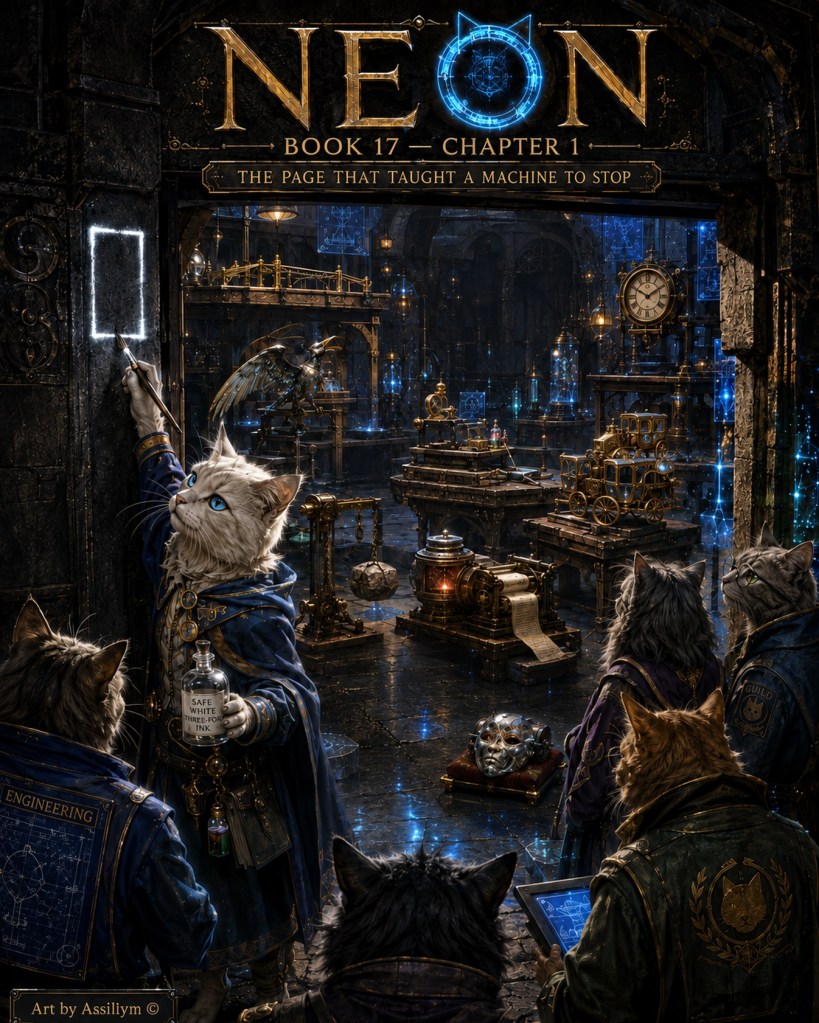
A register of Sentinel architects listed thirty-two names. The numbering passed from seventeen to nineteen.
An index to the First Route Systems referred to Section Twelve: Returning Measures. The volume itself moved from Section Eleven to Section Thirteen without a torn edge between them.
A payroll ledger contained regular monthly payments to metalworkers, command scribes, Blue readers and Clock Engineers. On one page, the final line had been removed so neatly that the ruled columns continued across the absence without interruption.
A diagram of the completed Sentinel showed the four specialist recesses—Route Engineer, Receiving Warden, Return Keeper and Clock Engineer—but left an exact vertical space above them where the flexible Mercy Page had been fitted. The fittings were drawn. The Page was not.
Miette Paleclaw sat beneath three lamps in the western archive and compared the page sequences.
She had been working since the false portal closed. Her silver Alchemistry coat lay over the back of a chair. Ink marked two claws. The safe three-drop white formula stood beside her in a sealed bottle, while Pinchford’s fourth-drop materials remained inside the black-glass containment box at the far end of the chamber, surrounded by clocks whose disagreement had become a Guild duty.
She turned one register forwards.
Then backwards.
She placed two missing-page reports beside each other.
Varric entered carrying another diagram roll.
“Nothing,” he said.
Miette did not look up.
“The Mind Handling archive?”
“Three references to the Returning Measure. All point towards documents which do not survive.”
“Do the document numbers survive?”
“Yes.”
“Sequentially?”
He placed the roll down.
“No.”
Miette opened a second index. “Engineering Registry Seven jumps from document four hundred and twelve to four hundred and fourteen.”
“Four hundred and thirteen was removed.”
“Armour Inventory Nine jumps from ninety-one to ninety-three.”
“Another removal.”
“Alchemistry’s Flexible Blue Materials list has two hundred and six entries. The total at the end says two hundred and seven.”
Varric studied her arrangement.
She finally lifted her eyes.
“These pages were not lost.”
“Then they were stolen.”
“No.”
The answer came from Oriel, who had entered without either hearing the door.
She approached the table and looked at the precise gaps.
“A thief removes the document he wants. These records have had the memory of the document removed around it. References, copies, payment lines, names, storage marks, even the error totals have been altered.”
Tarian Ashglaive followed her into the archive. “Destroyed, then.”
Oriel touched one empty line without placing her claw upon the paper.
“Protected from discovery.”
“By whom?”
She looked towards the distant Hunter wing.
“By a cat who understood that Purpose would eventually search its own history.”
Calix had not merely hidden the Mercy Page from kings, Guilds or collectors of forbidden Blue knowledge. He had hidden its trail from the system which would one day recognise the Page as an absent component.
That required more than secrecy.
It required incompletion arranged as defence.
Miette returned to the Engineering register. Near the lower margin of a page listing abandoned chambers, she found a faded symbol shaped like an open square whose fourth side had never been drawn. The mark appeared beside no room name, only beneath an old construction account charging twelve silver pieces for a door without hinges.
Varric recognised the symbol.
Not immediately. Recognition travelled through several expressions first: doubt, irritation, old professional memory and finally the embarrassment of an engineer discovering that a joke told to apprentices might contain historical truth.
“There is a chamber beneath the oldest Engineering foundation,” he said.
Tarian waited.
Varric continued reluctantly. “It is called the Chamber of Unfinished Works.”
Hélène examined the mechanism. “The line completed a circuit.”
Varric shook his head. “No physical circuit exists. The frame recognised the idea of completion.”
“Then why did Calix leave the line unfinished?”
Oriel looked through the dark seam.
“So that only a cat willing to complete the entrance could discover a room devoted to refusing completion.”
They removed the stones carefully.
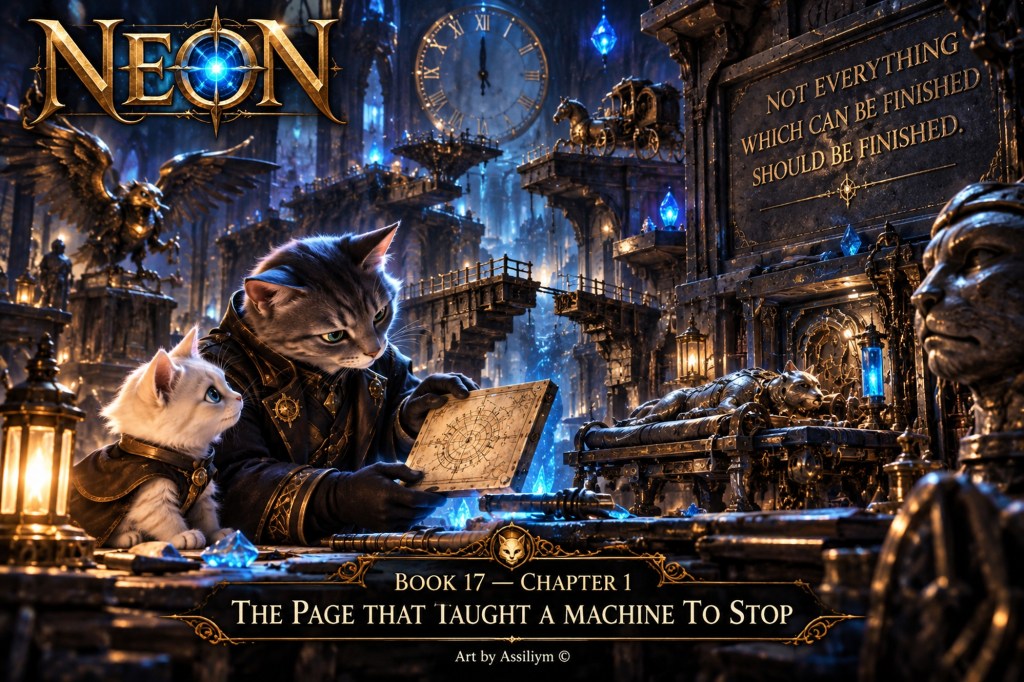
No trap opened. No Blue current crossed the threshold. The chamber beyond remained dark until the Guild lamps entered, one after another, casting long reflections across objects arranged upon low tables, shelves and stone platforms.
Everything inside was unfinished.
A bridge mechanism occupied the first table. Two metal arms could extend across a gap, but the final locking tooth which would have joined them had never been fitted. Beside it stood a clock with every wheel present except the last. Its hands moved whenever a cat approached, reached one minute before the hour and stopped.
A mechanical bird hung from the ceiling. One wing opened. The other could not close.
A healing device rested beneath a dust cover. Silver tubes, clean clamps and a narrow Blue reservoir surrounded a space prepared for the final needle. The needle lay beside it, wrapped and unused.
A miniature carriage stood one inch from the edge of a long table. Its wheels contained a wound spring. Its direction was perfectly straight. Had the final catch been released, it would have travelled beautifully for one second and then fallen.
Farther inside rested a lifting machine which could raise a stone but possessed no safe method of lowering it, a furnace which could reach impossible heat and no valve for release, a writing device capable of copying a page forever because no mechanism had been provided to tell it when the page was finished, and a small silver mask whose internal hooks had never been attached.
Some objects represented failed ideas.
Others represented successful ideas denied their final act.
Each carried a narrow black label.
BRIDGE: STOPPED BEFORE FALSE LOCK.
CLOCK: STOPPED BEFORE UNGOVERNED HOUR.
HEALING FRAME: STOPPED BEFORE SUBJECT BECAME MATERIAL.
AUTOMATIC SCRIBE: STOPPED BEFORE REPETITION REPLACED MEANING.
SILVER MASK: STOPPED BEFORE THE FACE COULD NOT RETURN.
Varric moved from table to table with increasing discomfort.
The mechanisms were not primitive. Several contained solutions modern Engineering had rediscovered only recently. The bridge arms distributed weight better than current Guild designs. The lifting machine used a counterbalance whose elegance would have earned its maker a permanent place in the Hall of Measures. The healing frame contained channels capable of separating living Blue contamination from ordinary blood.
None had been abandoned through incompetence.
Each had been stopped because its successful completion would have created a danger greater than the problem it solved.
At the far wall, words had been cut into black stone:
NOT EVERYTHING WHICH CAN BE FINISHED SHOULD BE FINISHED.
The disappearance of Lord Nibblewick was discovered at seven minutes past six in the morning by a palace maid whose first concern was not the stability of the kingdom, the dignity of the Crown or the possible abduction of one of France-Neon’s most celebrated noble creatures. Her first concern was cream.
There was cream upon the floor of the Royal Kitchen. Not much, but enough to be offensive. A pale streak crossed the leg of a chair; another had dried upon the edge of a saucer; bread crumbs marked the table beneath the pantry shelves, and a walnut had somehow travelled beneath the vegetable cabinet without any recognised servant admitting responsibility for its journey. The maid stopped in the doorway, placed both paws upon her hips and contemplated this evidence with the severe resignation of a cat who understood that aristocrats might overturn kingdoms without consequences but kitchen servants would still be blamed for cream.
Then she saw the velvet coat.
It had been left carefully across the back of a low chair.
Upon it lay a small polished badge.
The maid frowned.
She knew that coat.
Everyone in the palace knew that coat.
She crossed the kitchen, lifted the badge and read the engraved name.
Her tail stiffened.
Ten minutes later, Captain-Marshal Vaurin was standing in the Royal Kitchen.
He arrived already dressed, armed and displeased, because Vaurin considered six in the morning a perfectly respectable hour for danger and an offensively early hour for stupidity. Two palace guards followed him. Behind them came the maid, an assistant cook, the night pantry clerk and a junior officer who had begun taking notes before anyone had decided whether there was anything worth recording.
Vaurin examined the chair.
“His coat.”
“Yes, Captain-Marshal.”
“The badge?”
The maid handed it to him.
Vaurin turned the little piece of metal between two claws. The inscription caught the morning light.
LORD NIBBLEWICK.
He looked towards the assistant cook. “Where is His Lordship?”
The assistant cook swallowed. “We thought he was in his quarters.”
“You thought?”
“Yes, Captain-Marshal.”
“Who checked?”
Silence.
Vaurin looked at the junior officer. “Go.”
The officer ran.
Vaurin moved around the kitchen without touching anything else. There were crumbs beneath the table, a smear of preserve near a saucer, a small piece of blue cheese under the pantry shelf and, farther back, the old iron rodent trap standing open and empty. He crouched.
“Who owns this?”
The night pantry clerk looked uncomfortable.
“The old roof cook, I think.”
Vaurin looked up. “The what?”
“He used to work the roasting station, Captain-Marshal. Before my time. He still helps when there are large banquets. Sometimes. Mostly he lives upstairs.”
“Upstairs where?”
The clerk hesitated.
“In the old service rooms.”
“Which old service rooms?”
Another silence.
The Royal Palace contained more rooms than several villages, and generations of kings had built extensions with the confidence of cats certain that future servants would understand what they had meant.
The junior officer returned before Vaurin could pursue the question.
He was breathing hard.
“His Lordship is not in his rooms.”
Vaurin rose.
“The Sweeper?”
“There.”
“Where?”
“In the machine room adjoining his quarters.”
“Damaged?”
“No.”
“Moved?”
“No.”
“His other clothing?”
“Present.”
Vaurin looked down at the badge in his paw.
A rat could wander.
A celebrated rat could wander farther.
A rat who abandoned the machine he adored, the coat he wore whenever someone important might see him and the badge which transformed every corridor into personal territory was something else.
“Wake Lord Captain de Treville.”
The junior officer nodded.
“Wake Captain-Commandant René Belloc.”
Another nod.
“Close the palace gates.”
The officer stopped.
“Completely?”
Vaurin looked at him.
The officer ran.
Within twenty minutes, the Royal Palace ceased to behave like a residence and remembered that it was a fortress.
The inner gates closed first. Vaurin’s palace guard sealed the service courts, carriage exits, garden gates, roof passages and the smaller eastern doors through which merchants, cooks, delivery cats and servants entered during ordinary mornings. No cart departed without inspection. No laundry basket crossed a gate unopened. No basket of bread, coal, flowers, vegetables or devotional candles escaped the sudden suspicion that Lord Nibblewick might somehow be concealed beneath it.
The palace gardens were searched.
Then searched again.
Servants’ rooms.
Guest rooms.
Store cupboards.
Wine cellars.
Coal rooms.
Chapel vestries.
Attics.
Carriage houses.
Drain passages.
The little ornamental garden where Nibblewick had once chased a pigeon was inspected by six guards despite the pigeon’s complete refusal to cooperate.
Nothing.
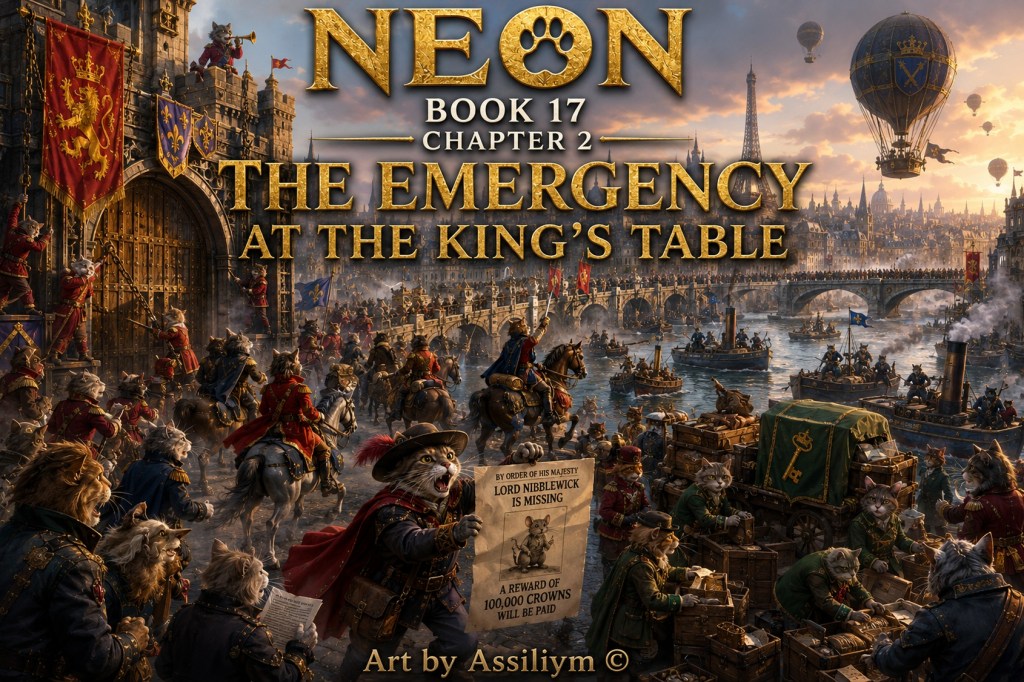
De Treville arrived while Vaurin was standing beside the Blue-Cheese Sweeper. René came immediately after him, scarlet coat buttoned incorrectly at one side and corrected before anyone except Vaurin had time to notice.
De Treville studied the untouched machine.
“He would not leave this.”
“No.”
“Unless carried.”
Vaurin nodded.
René looked towards the open maintenance panel. “Anything missing?”
“Nothing obvious.”
De Treville crouched near the floor. A few crumbs remained beside the machine, old enough to belong to previous feedings. No sign of struggle. No blood. No broken wood.
“Who saw him last?”
“Servants returned him to his rooms after evening attendance. No formal report after that.”
“Guards?”
“One corridor guard believes His Lordship passed shortly before midnight.”
“Alone?”
Vaurin looked at him.
“He is not certain.”
De Treville’s eyes sharpened. “Not certain whether he saw Lord Nibblewick?”
“Not certain whether he was alone. He recalls something small beside him.”
René frowned. “Smaller than Nibblewick?”
“So he says.”
The three officers considered the possibility.
De Treville looked towards the Sweeper.
“Leonardo?”
“In Marseilles,” said Vaurin.
That closed the easiest road. Leonardo could interpret Nibblewick’s complicated squeaks, gestures, suspicions and outrages in a way no other cat could. Without him, the palace possessed a missing witness whose language no one could properly speak and, apparently, a second creature whom no one could identify.
René folded his arms. “The King must be told.”
Vaurin looked at the badge.
“Yes.”
King Luis received the news before breakfast.
He had been reading provincial dispatches in a small private cabinet overlooking the eastern garden, dressed but not yet ceremonially imprisoned by the day. A tray stood untouched beside him. Armand had joined him moments earlier with three papers concerning grain, a judicial appointment and one abbey whose accounts had become theological only after Treasury clerks asked to inspect them.
Vaurin entered.
Luis looked up.
“What?”
The Captain-Marshal crossed the room and placed Lord Nibblewick’s badge upon the desk.
Luis stared at it.
For several seconds he said nothing.
Then he looked at Vaurin.
“Where is he?”
“We do not know, Your Majesty.”
Armand lowered the paper in his paw.
Luis looked at the badge again.
“You do not know?”
“No, Sire.”
“Is he in the palace?”
“We are searching.”
“Is the Sweeper gone?”
“No.”
Luis’s expression altered.
“The Sweeper is here?”
“Yes.”
“His coat?”
“Found in the Royal Kitchen.”
“The kitchen?”
“Yes.”
Luis pushed back his chair.
“Why was Lord Nibblewick in the Royal Kitchen?”
Vaurin chose the answer most compatible with survival.
“His Lordship appears to have developed private habits.”
Armand’s eyes moved towards him. “Midnight habits?”
“We are establishing that.”
Luis stood completely.
“And you have closed the palace?”
“Already done.”
“Gardens?”
“Being searched.”
“Cellars?”
“Yes.”
“Roofs?”
“Beginning.”
“Servants?”
“Questioned.”
“Carriages?”
“Stopped.”
Luis looked towards the window as if Lord Nibblewick might at that instant be crossing the lawn with an explanation.
Nothing moved except two guards searching beneath an ornamental hedge.
Armand placed the papers aside.
“Who would take him?”
Luis turned immediately.
“Mercer Ward.”
Vaurin said nothing.
Armand’s ears shifted.
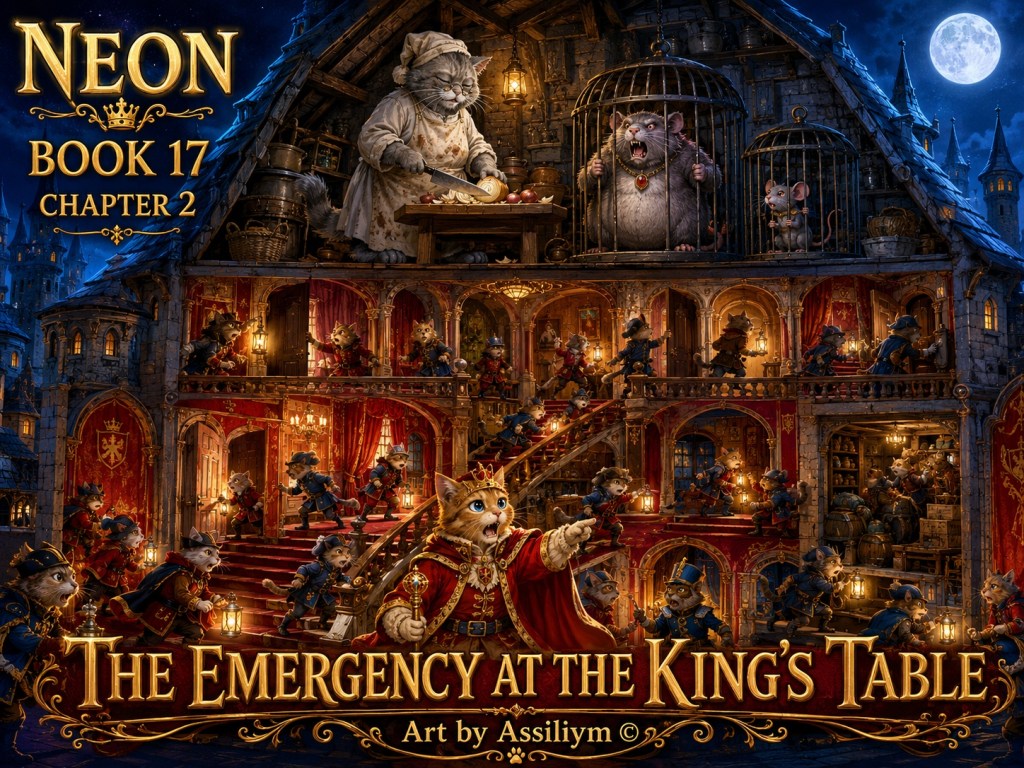
Luis began walking towards the door.
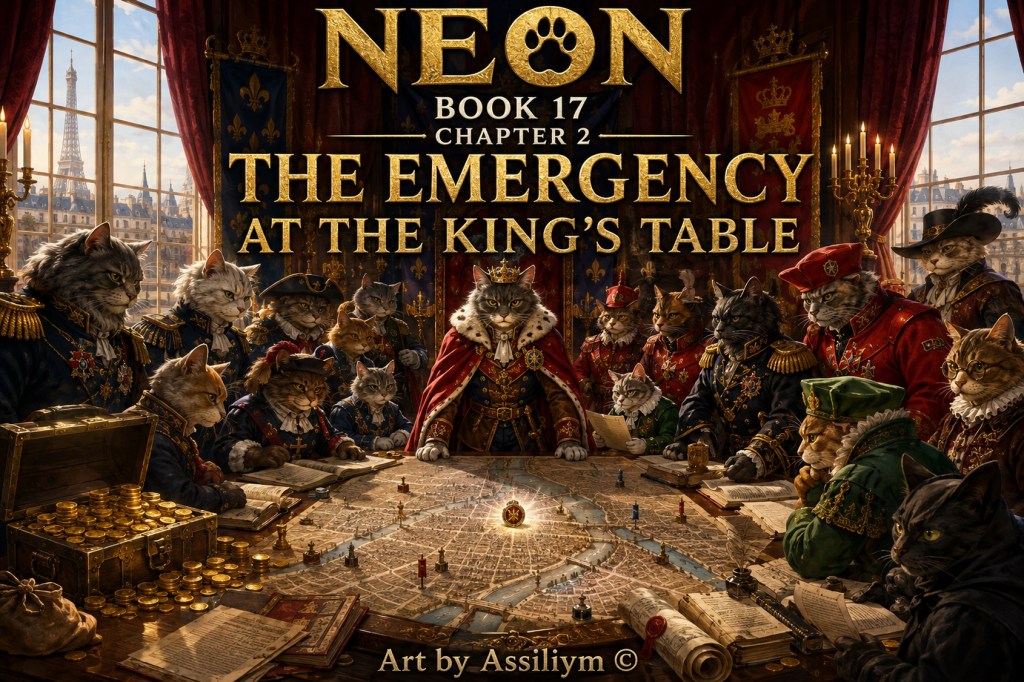
“Summon the King’s Table.”
Armand followed. “All of it?”
“All of it.”
“Army?”
“Yes.”
“Navy?”
“Yes.”
Armand stopped.
Luis turned.
“You intend to summon the Navy because a rat is missing from the palace?”
Luis looked at him for a long moment.
“A Lord is missing from the palace.”
Armand inclined his head.
“Of course.”
Luis continued towards the door.
“And summon Étienne Delorme.”
Vaurin nodded.
“Grand Inspector Valecourt as well.”
That made Vaurin glance towards him.
Luis noticed.
“If Nibblewick is inside a warehouse, factory, cargo yard, illegal cellar, carriage, boat, tavern, shop, merchant house or hole beneath a floor, I want someone opening it before the cat hiding him has time to invent paperwork.”
Armand resumed walking beside him.
“Paris will notice.”
“Good.”
Within an hour, the great chamber used for emergency Crown councils had filled with cats who had previously expected the morning to contain entirely different problems.
Armand took his place near the King. Captain-Commandant René Belloc stood with the scarlet severity of a cat whose Guards had already begun moving. Lord Captain de Treville arrived with the Royal Musketeer duty lists beneath one foreleg. Captain-Marshal Vaurin brought palace maps and the first search report. Treasury Minister Adrien de Valmire arrived carrying no visible sympathy for anything which might require emergency expenditure. Lord Justice Malvosin brought statutes, warrants and the expression of a cat who suspected the kingdom had once again begun acting before consulting law. Senior Clerk Aubert Marcenat sat near the centre with three sharpened pens and enough paper to ensure that no catastrophe escaped documentation.
Vasili took the least conspicuous chair available, which in a royal council invariably made him more noticeable to anyone experienced enough to look for him.
The Army followed. General Matthieu de Rochemont took the principal military place, old enough to understand that orders given in panic must first be translated into roads, numbers and tired soldiers. Beside him sat General Gaspard d’Aubeterre, whose talent was movement—rapid mobilisation, field command and making troops appear where bureaucracy had not yet accepted that troops were needed. Lieutenant-General Coris Valrémy arrived with maps already marked into defensive sectors.
Then came the Navy: Admiral Adrien Corvelle, quiet-eyed and river-minded; Admiral Thibaut de Mirecourt, who understood that every heroic blockade eventually became a problem involving flour, rope, fodder and angry merchants; and Vice-Admiral Roland Servain, who looked prepared to put warships against anything Luis pointed at, provided someone first explained whether the enemy could swim.
Étienne Delorme entered in the dark formal coat of the Merchant Guild Master and took a place appropriate to his institutional dignity.
Grand Inspector Matthieu Valecourt entered behind him.
The two acknowledged one another.
Politely.
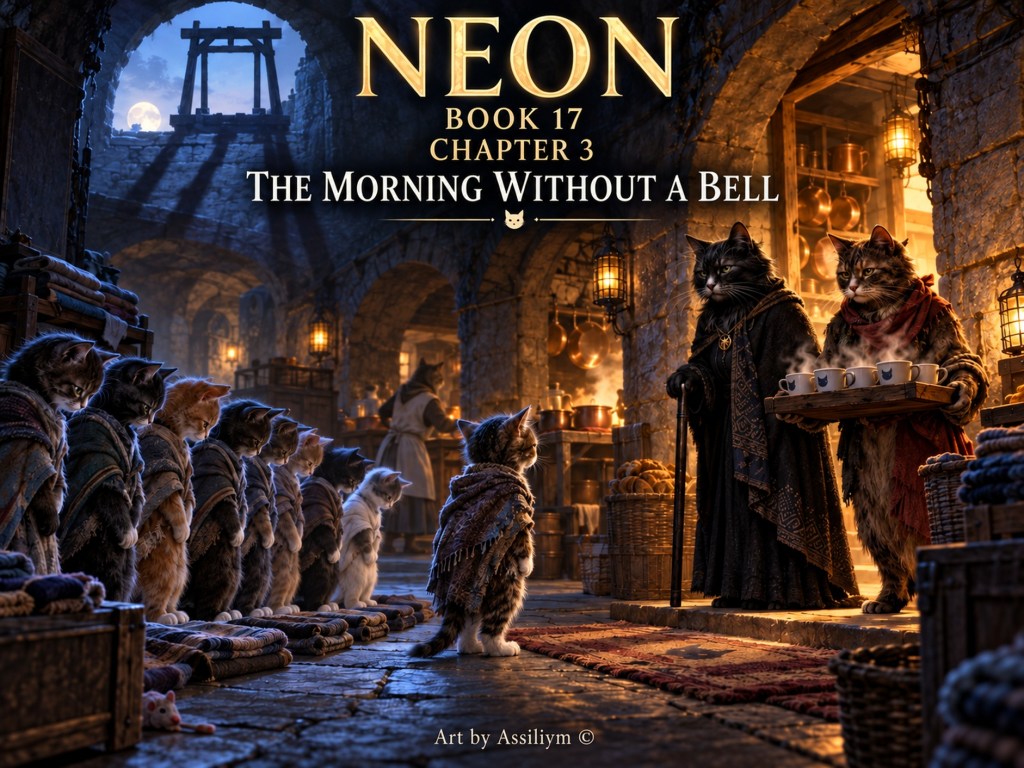
The eleven kittens woke beneath the Court of Miracles long before the first kitchen fire reached its proper heat. No bell had rung in the old leper galleries. The lamps remained low behind their wire shields, the deep wells whispered beneath stone, and only the ordinary night-work of the Beggar King’s hidden realm disturbed the buried quiet: a healer crossing towards the infirmary with clean bandages under one arm, a baker opening the flour room, a Silent Paw returning through the eastern passage with rain upon his coat. None of these sounds summoned the children, yet Brin opened his eyes as though struck by an invisible baton.
He did not stretch or examine the unfamiliar ceiling. His paws seized the blanket and folded it once, then again, discovered that the corners did not meet and began the task anew. Around him, the others stirred with the same frightened efficiency. Pip placed his mother’s letter inside his shirt before setting his feet upon the floor. The older ribbon-wearing she-kitten smoothed her younger sister’s bedding and tied the child’s shoes. The coughing kitten reached for her clothes despite the healer’s instruction that she might sleep as long as her body required. Within minutes all eleven stood in two narrow lines, the taller children first and the smaller behind them, because height had once determined labour assignment and fear rarely abandons an arrangement merely because the overseer has vanished.
Brin positioned himself nearest the doorway. His old shoes had spent the night beneath his blanket where no one could steal them, although every possession left within the chamber remained precisely where its owner had placed it. The children waited with lowered eyes while the underground kingdom continued around them, not yet understanding that no part of it was waiting for them to fail.
A young tunnel cat carrying folded cloths passed the doorway, saw the lines and stopped. He looked behind himself, perhaps expecting to find an officer whose command he had missed, but the passage was empty. When he asked what they were doing, Brin replied that they were waiting for the morning count. The cat explained that there was no count beneath the Court, which Brin received not as reassurance but as evidence that he had failed to understand the local name for it. Asked how the kingdom knew whether someone had run away, the tunnel cat answered that they generally asked where the missing cat had gone and, when necessary, went to look.
His further suggestion that a found child might be brought breakfast only deepened the suspicion of the lines. He therefore withdrew to find Old Sable, leaving the eleven kittens convinced that this unexpected freedom was probably a test designed to reveal which of them would leave first.
Old Sable arrived soon afterwards, the quiet tap of her plain black cane preceding her through the doorway. Rot came with her, carrying steaming cups of honey-water upon a broad wooden tray. Old Sable stopped at the entrance and studied the folded blankets, the guarded shoes, the stiff backs and the two lines arranged by children who had slept only in the shallow manner of the hunted.
“Who ordered this?” she asked.
Brin answered after the silence became too heavy. “No one.”
“Who woke you?”
“No one.”
“Then why are you standing?”
“Because it is morning.”
Old Sable entered slowly. When she asked what morning required, the answers came from different places: count, work list, debt changes, punishment for lateness, cold water for anyone still lying down. She listened without interrupting. Then she looked towards the beds, none of which bore the careless disorder of real sleep. Even the youngest child’s pillow had been placed squarely against the wall.
“You closed your eyes because you were afraid of being noticed,” she said. “That is not the same thing as sleeping.”
Brin lowered his gaze, yet Old Sable did not force him to look at her. She explained that there would be no morning count, no labour line and no punishment for a badly folded blanket. They could return to bed, wash, sit in the kitchen, help peel vegetables, mend clothes, carry light wood or do nothing at all. Food and shelter would not depend upon the choice.
The children remained motionless. Permission offered too many roads. A command had only one, and however cruel it might be, a child could at least know where the punishment waited. Old Sable understood that freedom given without guidance can resemble another trap to those whose choices have always been used against them. She therefore made the choices smaller. The hungry could come with her. The tired could stay. Anyone uncertain could sit near the kitchen door until certainty arrived. No answer would cost a meal.
Brin’s expression tightened. “What if everyone chooses to do nothing?”
“Then breakfast will still be served.”
“Who will make it?”
“Cats who chose kitchen duty. If none did, we would eat bread. If there were no bread, the Beggar King would discover that ruling an underground kingdom does not protect him from peeling onions.”
The Beggar King closed the Crown ledger. “No kitten from these chambers will be used as bait, messenger or watcher. No child will stand upon a road where the Crown can reclaim them. Silent Paws carry the danger. Siblings remain together. Guards live unless preserving a guard would cost a child’s life. Every name and document returns with us. There will be no banner, proclamation or mark claiming the rescue.”
Troll raised one paw. “Small omelette?”
“No.”
“What if a guard possesses a very round head?”
“No.”
“What if the head falls into a pan without assistance?”
Wolf looked towards him. “There will be no pans.”
Troll lowered his paw with the sorrow of a soldier serving beneath commanders hostile to proper equipment. “The operation is badly supplied.”
One of the kittens laughed. The sound surprised the room, especially the child from whom it escaped. Troll straightened with quiet pride, having accomplished by stupidity what many careful adults had not yet managed through kindness.
The laugh should have ended there.
It did not.
A small tom at the rear of the group stared at Troll for several seconds, gathering the courage required to address a creature whose shoulders appeared broad enough to support a market stall.
“Do you really make head omelettes?”
Troll looked towards Basti.
Basti immediately became interested in the ledger.
Wolf studied the map with exaggerated concentration.
Troll therefore understood that civilisation had abandoned him to the question.
“Yes,” he said solemnly. “Very dangerous recipe.”
Another kitten edged forward. “What goes in it?”
“Heads.”
The first kitten considered this. “What else?”
Troll’s brow furrowed with the intellectual strain of advanced cookery.
“Eggs.”
A third voice asked, “How many eggs?”
Troll stared at the ceiling as though the number might have been carved there by an ancient culinary order.
“Many.”
“How many is many?”
“More than small.”
The kitten who had laughed before laughed again.
This time two others joined him.
One of the smallest kittens walked directly towards Troll and placed both paws upon his knee. Troll looked down. The kitten looked up.
“Can I ride you?”
Troll blinked.
“No.”
The kitten began climbing anyway.
Troll looked towards Basti with the mute outrage of a military officer witnessing the collapse of discipline.
Basti turned a page which contained nothing requiring turning.
By the time Troll looked back, the kitten had reached his shoulder.
A second child interpreted this success as legal precedent.
Then a third.
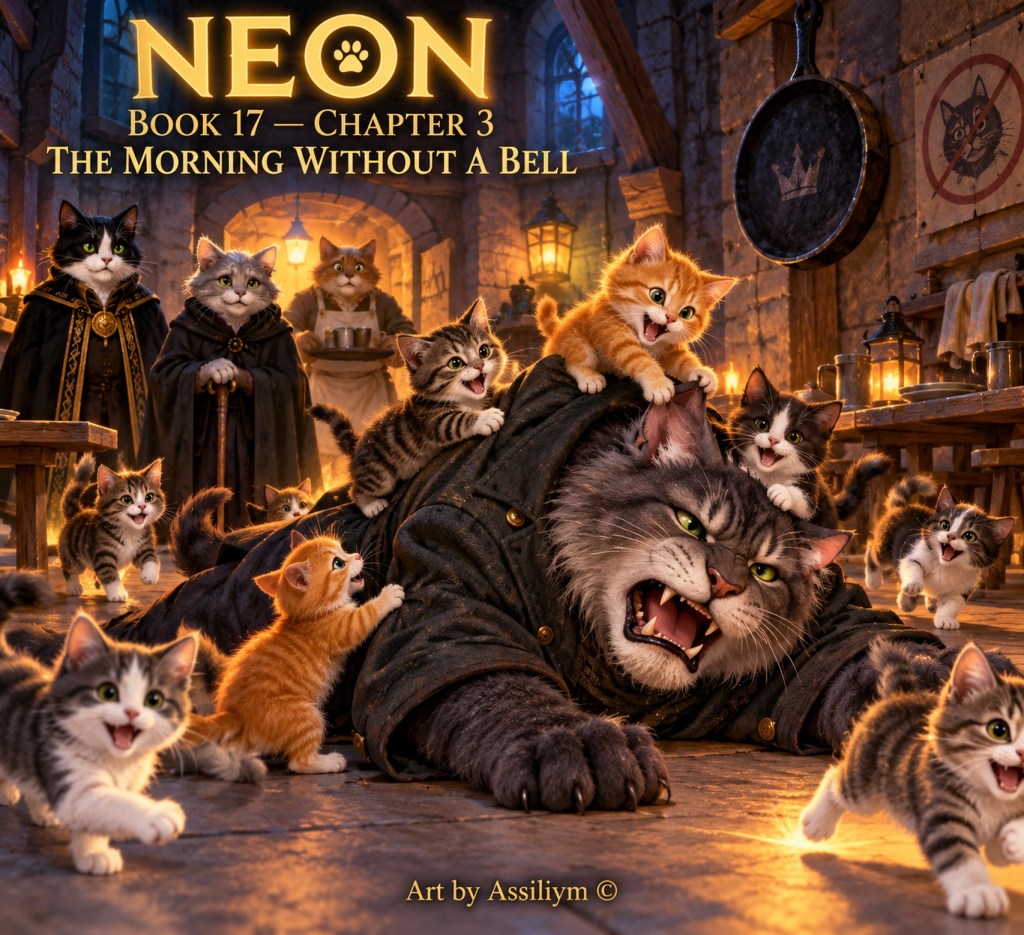
Within moments the cat whose passage through an ordinary doorway had recently been recorded as structural failure was carrying three debt kittens upon his back and a fourth hanging from the belt of his oversized coat.
“No,” Troll said.
Nobody obeyed.
“Troll is dangerous.”
A kitten sitting between his shoulders patted one ear.
“Go.”
Troll’s eyes narrowed.
Something terrible entered his expression.
The children froze.
Then Troll rose very slowly from the grain box.
“I MAKE…”
He drew himself to his full enormous height.
“…YOUR HEADS…”
The kittens began squealing before he finished.
“…EGGS OMELETTE!”
They scattered.
Troll charged after them.
Or, more accurately, Troll moved with enormous theatrical violence at approximately the speed of an elderly cart climbing a hill.
The kittens screamed and fled through the common-room arch, overturning nothing because Old Sable’s cane appeared suddenly beside the one stool which might have fallen. Troll pursued them with both paws raised.
“COME BACK! TROLL NEED BREAKFAST!”
“No!”
“HEADS!”
“You can’t catch us!”
“EGGS!”
“You haven’t got a pan!”
Troll stopped dead.
The children stopped too.
The smallest kitten pointed triumphantly at him. “Wolf took your pan.”
Troll’s face collapsed into genuine tragedy.
“Cruel Wolf.”
The children howled.
One darted behind him, jumped onto his back and shouted, “Captured!”
Two more attacked immediately.
Troll gave a roar which shook dust from the old plague arch and then collapsed dramatically onto all fours beneath their combined weight.
“Too many kittens! Troll defeated!”
“We won!”
“No omelette!”
“No heads!”
Troll rolled onto one side with extraordinary care, ensuring that every kitten had escaped before allowing his shoulder to touch the floor. Three climbed upon him anyway. One sat upon his chest. Another attempted to pull one of his ears flat.
The great rough cat lay motionless beneath them.
“Troll dead.”
The smallest kitten leaned towards his face. “Really?”
One eye opened.
“No.”
The kitten shrieked.
Troll sprang to his knees.
“MORE OMELETTE!”
The chase began again.
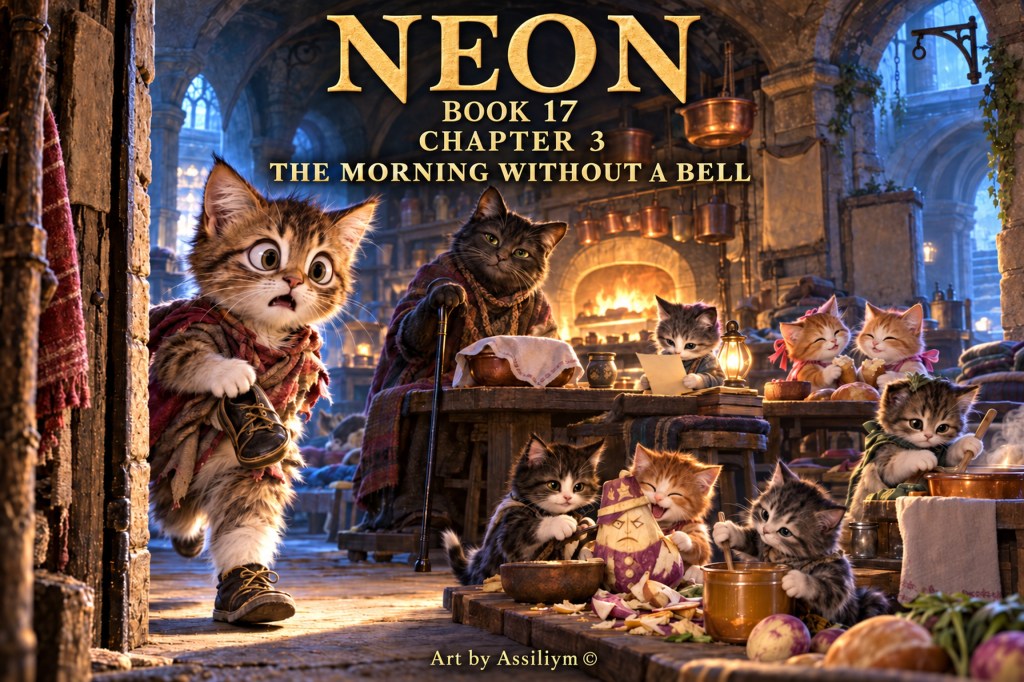
Three days passed beneath the Court. The kittens began discovering that time could contain events other than orders. They slept, though lightly. They hid bread beneath mattresses and carried cups from room to room because possession still felt temporary. Several continued folding blankets before dawn. Old Sable did not unfold them as a lesson or insist that safety be believed before it had been proved. She allowed the kingdom to repeat itself. Breakfast remained after lateness. Beds remained after mistakes. Supper was served to children who had performed no work. The coughing kitten improved under Rot’s steam, honey-water and the revolutionary treatment of not being driven into winter yards.
Rot’s other treatment was less medicinal and considerably more architectural.
She walked the permitted routes with the children until each could find the sleeping galleries, kitchen, wash room and common chamber without guessing. The Silent Paw at the eastern junction became familiar enough that the smaller kittens called him Door-Cat, to his private humiliation. No child crossed his post alone.
Once, a rag ball escaped beneath a bench, rolled through the arch and continued towards one of the deeper passages. A kitten ran after it. Rot caught the child gently by the shoulder before the second turn.
“Ball?”
The kitten pointed.
Rot sent an adult for it.
The child expected a scolding. None came.
“You remembered next time,” Rot said.
And next time, when a wooden hoop escaped towards the same passage, three children shouted for Door-Cat before any of them crossed the junction.
The two iron doors remained far beyond them, shut, barred and unseen from the living chambers. Rot inspected their locks each morning and each night. Basti carried one key. Rot carried another. Troll’s third key hung beneath his coat, tied on a cord thick enough that even his enthusiasm for omelettes could not misplace it.
Pip began learning the letters in his mother’s message. A tunnel scribe taught him M first, for mother, and then P, for Pip. Brin chose work each morning. He carried light wood, scrubbed one table and helped the boot-mender separate usable laces from broken ones. He refused payment because he expected wages to become another name for debt. The boot-mender repaired a better pair of shoes and placed them beneath his bed. Brin continued wearing the old pair, but he checked each evening that the new ones remained.
 Vuk Stribog