
INSIDE BOOK 18
NEON —The Eight Roads — Beneath a Changing Crown
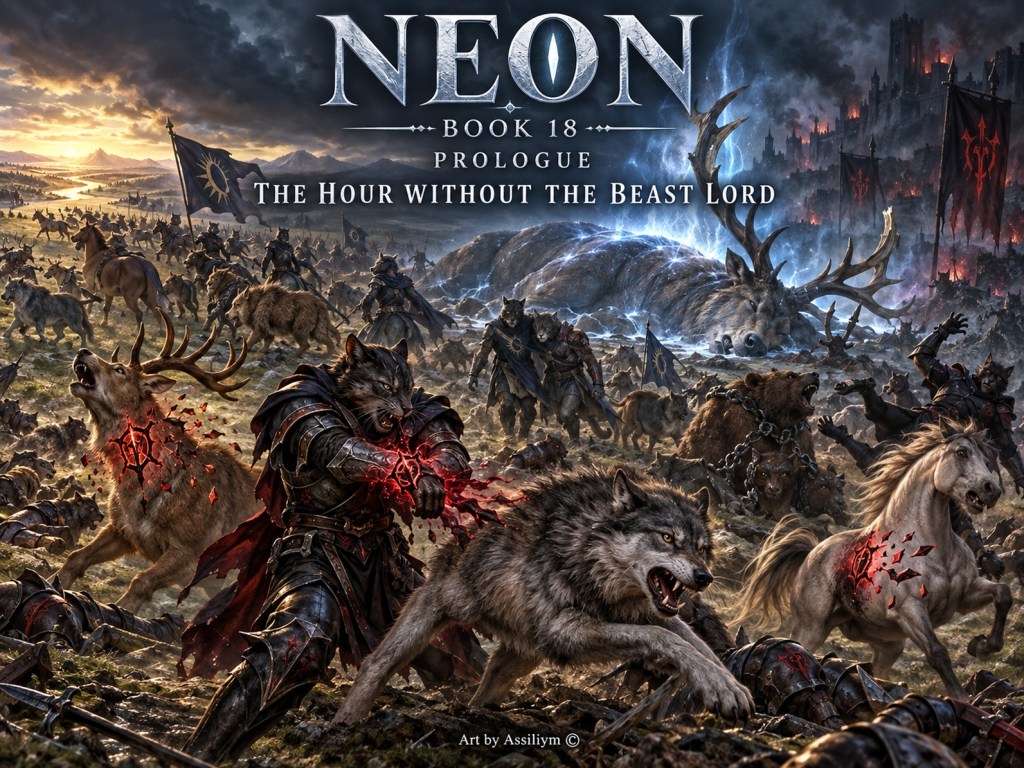
The war tent of Kraath-Vel had survived the afternoon, although very little else upon the eastern shoulder of the Valley of Sorrow could have made the same boast without lying. Its outer skins, once black and taut and severe as the ceremonial armour of some immense sleeping beast, had been pierced by arrows, burned by sparks blown down from the wounded heavens, and slit in several places by fragments of stone cast up when the earth itself had recoiled beneath the passage of the Storm-Drakes; yet demon hands had stitched those rents together with red cord, had braced a splintered supporting rib with iron stripped from the chassis of a ruined siege engine, and had driven fresh stakes through soil so soaked with rain, blood and the liquor of crushed roots that each hammer-blow brought a dark moisture slowly to the surface. Thus the pavilion leaned a little towards the west, as though the structure itself had acquired an interest in the citadel beyond the smoke, but it did not fall, and this persistence gave it something of the dreadful dignity possessed by ancient prisons, old gallows and dynasties which have outlived the virtues by which they were founded.
Within it stood the campaign table, still level because a Vael’Korr servant had wedged beneath one of its legs a fragment of an Albion shield. The detail might have amused a gentler historian: the defence of Neon, having failed to prevent the demons from reaching the Valley, had at least succeeded in preventing their furniture from rocking. Yet such small ironies are among the privileges of those who live long enough to describe wars; the dying seldom notice them. Upon that table the Valley had been reduced to obedient lines, convenient elevations, black markers, ivory hooks and little crowns carved in bone, for generals of every nation and every species have always possessed the same secret affection for maps, which allow cliffs to become scratches, cities to become symbols, and the screams of ten thousand creatures to be represented by the movement of a finger.
Many of Kraath-Vel’s pieces were gone. The cluster of black stones which had represented Korr-Vael Thuun’s Colossus had been swept into a bronze bowl at the edge of the table; they clicked against one another whenever thunder moved across the sky, and each little sound had about it something indecently domestic, like nutshells shaken in a kitchen. Three ivory hooks marking the principal Draakh’Mor beast-lines lay overturned. Several crimson counters belonging to the Soul Drinkers had vanished entirely, not because any clerk had misplaced them but because the creatures they signified had been torn from the air, burned out of their borrowed vessels, or scattered into whatever desolate road pure demon essence followed when it could no longer compel flesh to contain it. Near the eastern edge of the table four pieces of black volcanic glass represented the portal stones, and beneath them ran a narrow crack through the wood which had not been painted upon the map at all; it had appeared when the great wound into Thraxx-Ul widened above the ridge, as if even timber, dead and planed and removed from every forest memory, had objected to the violence being done to distance.
Kraath-Vel stood over this diminutive world and watched nothing but a single blue-black stone.
Her armour had not been changed since the assault upon Oberon. One plate above her left shoulder had been split almost through; beneath it, the feline vessel she wore had been stitched with black sinew by a Vael’Korr binder who had completed the work while arrows were still falling. A shallow cut crossed her muzzle, insignificant beside the wounds borne by the armies she commanded, yet strangely visible because it had dried in a red line beneath one eye. War, which is capable of collapsing mountains and devouring cities, is frequently vulgar enough to leave its signature in scratches. Beneath the black fur of her mortal form there moved, at rare intervals, a dull red luminescence, less like blood than the reflection of fire beneath very deep water.
Outside the tent there came the persistent noises of an army attempting to reconstruct itself before the enemy understood how badly it had been hurt: the hammering of new axle-pins into old wood; the squeal of rope pulled through iron; the slow cracking complaint of a siege arm being tested; the orders of Keth’Var overseers; the occasional shriek of a possessed vessel whose mortal joints had discovered that demon obedience was not the same thing as bodily endurance. Farther off, high beyond the tent and above the smoke, thunder travelled from north to south. It was not ordinary thunder. Ordinary thunder belongs to weather, and weather, however violent, is innocent. This sound belonged to something that had learned intention.
Kraath-Vel did not look upwards. She had spent too much of the day looking at gods.
The tent flap opened, and a Vhar’Kraath Marked Captain entered with the careful stiffness of one whose body had ceased making suggestions and had begun making demands. Half his right ear was gone. His left foreleg dragged. A broken piece of cuirass had been tied against his ribs with leather cut from an abandoned bridle, and the irony of that repair would not become apparent until later, when bridles themselves acquired a new military purpose. He crossed three paces of the hide floor and halted, waiting for permission to collapse in the disciplined manner appropriate to his rank.
Kraath-Vel lifted one claw. “Sha’ul-naresh.” — “Kneel.”
The captain obeyed, though the descent cost him enough that one paw trembled when it touched the ground. High Azhagary had no phrase for the small humiliation of pain before a superior; perhaps this was because demons regarded pain as information rather than injustice.
Kraath-Vel placed one claw beside the blue-black marker upon the table. “Speak.”
The captain lowered his head. “Oberon thren-kaar morra.” — “Oberon bore a mortal vessel.”
Kraath-Vel’s claw remained where it was. “And the vessel?”
“Morra zul.” — “The vessel is destroyed.”
She moved her claw away from the blue-black stone and touched one of the overturned ivory hooks.
“The beast-lines?”
The captain’s hesitation lasted no more than a heartbeat, yet it altered the room more completely than the report of Oberon’s death.
“Gone.”
Kraath-Vel raised her eyes.
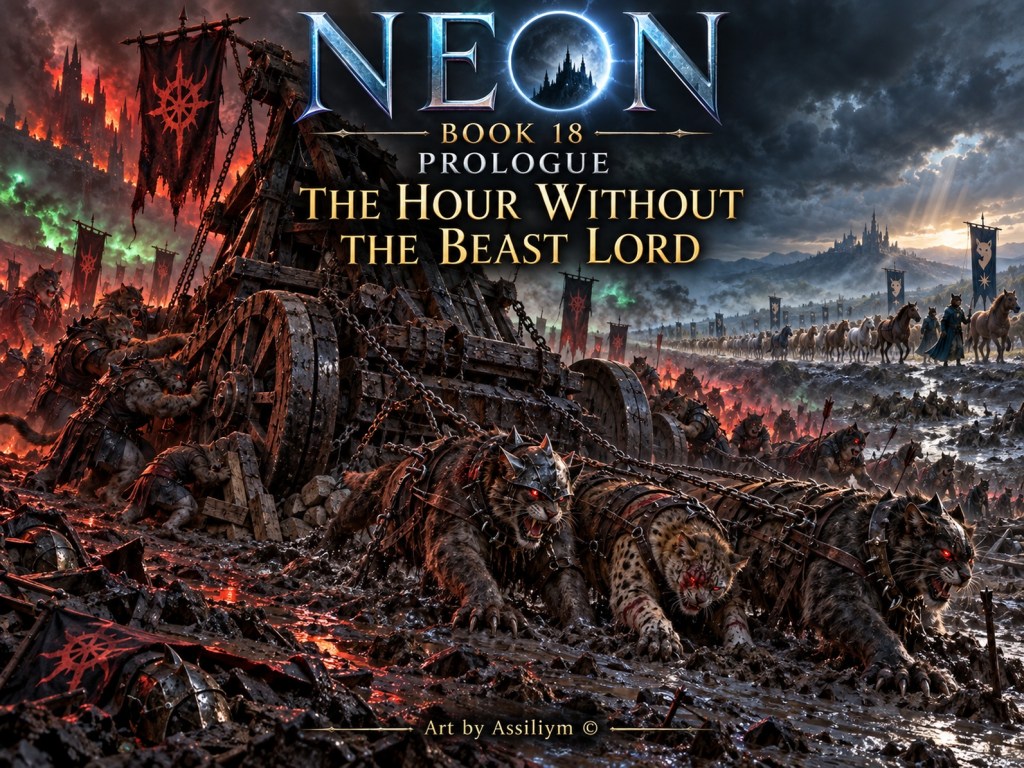
The captain continued, first in the formal cadence of the war-tongue and then, where no fixed formula served, in the clipped High Azhagary used for battlefield reporting. The Draakh’Mor marks had failed across the Valley. They had not weakened, flickered or become unreliable; they had broken. Horses had thrown their possessed riders. Bears had torn leather and iron together from siege wagons. Stags had trampled handlers whose marks they had obeyed only minutes earlier. Birds trained into signal patterns had scattered in every direction, and the very disorder of their flight had seemed to mock the geometry demons had imposed upon them. Wolves had withdrawn with the Army Without Banners, some carrying wounded cats by the scruffs of their cloaks, others limping beside boars, wildcats and frightened horses whose hides still bore the scars of Draakh’Mor harness.
Kraath-Vel listened without interrupting until the captain mentioned that three recaptured animals had been marked again.
“Three?”
“A horse, a stag and a wolf.”
“And?”
“The marks would not remain.”
“Would not?”
The captain looked towards the floor. “The first vanished. The second split. The third burned backwards through the handler’s paw.”
A silence followed, not because Kraath-Vel required time to understand the words but because every war contains one moment when a commander discovers that something assumed to be a rule has become merely a memory. The demons had chained beasts not simply with iron but with a grammar of domination: sigil, pain, command, submission, repetition. Oberon’s final act had not cut a few ropes. He had changed what the ropes meant.
Kraath-Vel looked once more at the little blue-black stone. She could imagine the stag where it had fallen: arrows protruding from the twilight fur, one antler broken, the last divine radiance withdrawn from flesh that would not rise again. The mortal vessel was dead. That was true. The animals were free. That was equally true. Victories and defeats are not always enemies; sometimes they inhabit the same hour.
She pushed the Oberon marker onto its side and said, almost thoughtfully, “Neon vel Oberon.” — “Neon belongs to Oberon’s living law.”
The captain remained bowed.
Kraath-Vel’s eyes hardened. “Ul-zha.” — “Not now.”
Then she straightened. “Summon the council. All great commanders. The lesser clan captains will wait inside the outer ribs. Bring me Keth’Var. Bring Draakh’Mor. Bring one priest from Zha’Keth and one from Vael’Korr. And bring a portal attendant who is still capable of answering questions.”
The captain rose with difficulty.
As he reached the entrance, Kraath-Vel added, “Do not send me one who is dying too quickly.”
He looked back.
“That is not compassion,” she said.
He bowed and disappeared through the skins.
Urzakh-Morn came first, because the Breaker of Cities was one of those beings for whom impatience had become an element of rank. He entered with the ponderous certainty of a siege tower that had somehow learned to walk. The right side of his armour had been opened during the battle and repaired with black iron staples which passed through both metal and the altered flesh beneath; the Vael’Korr workmanship was efficient rather than beautiful, which is the only beauty that interests armies. He carried upon him the smells of hot iron, smoke, burnt rope and the peculiar mineral dust produced when masonry, which has stood for centuries, is abruptly informed that it has no future.
His eyes went first to Kraath-Vel, then to the map, and finally to the bronze bowl of black counters.
“The Colossus,” he said.
“Is still destroyed,” Kraath-Vel replied.
Urzakh-Morn’s mouth tightened.
Se’Thriel Vale arrived while he was still contemplating this discourtesy of fact. One of her wings had been torn from the outer edge almost to the middle joint, and although it had been bound close to her body the membrane leaked a thin dark fluid that evaporated before reaching the floor. Her face, however, remained composed. Some creatures become pitiful when wounded; Se’Thriel became more attentive. She looked towards the roof whenever the surviving Storm-Drakes moved beyond it, listening to their thunder with the professional concern of a musician who has lost half an orchestra but intends to finish the performance.
Korr-Vael Thuun entered last among the great generals. Pieces of dried flesh clung to two hooks on his armour, not as trophies but because he had not yet had leisure to remove materials from his body after the destruction of his great construct. He said nothing when he saw the bowl containing the Colossus markers. He merely placed one paw upon the table, and his claws entered the wood.
Around these four—the commander and the three great generals—gathered the lesser authorities of the invasion. A Neth’Zhar bow-lord stood beneath one of the black ribs, his quiver almost empty but his gaze sharp. A Vesh’Raal path-master occupied the shadow beside the entrance and seemed less to have arrived than to have been discovered there. The Gor’Veth chain captain carried a circle of keys which struck one another softly whenever he breathed. Two Draakh’Mor handlers stood together with the empty rings of their ceremonial bridles hanging uselessly across their armour. A Keth’Var transport master came without sword or ornament, his belt crowded instead by wedges, rope gauges, axle hooks and the tools required for the unromantic labour without which heroic wars end very quickly.
Last came the priests.
The Zha’Keth representative had blood dried beneath both nostrils. The Vael’Korr binder’s left eye had clouded white. Neither condition excused them from service.
Kraath-Vel waited until all had settled into the hierarchy allotted to them; four at the table, the rest beyond it. Then she spread her claws upon the map and spoke the old opening formula.
“Zha’korr vel Azhagar. Thren-kaal isheth mor’eth.” — “By the Root of Azhagar. Becoming is commanded.”
Every demon lowered its head. High Azhagary did not possess the pleading architecture of prayer; it did not ask. Its oldest phrases stood nearer to laws, sentences, oaths and commands, as though language itself were an instrument by which reality could be forced to assume the correct posture.
Urzakh-Morn raised his head first. “Morra-kaal ul-sha’ul.” — “Silence is rot.”
“I expected no less from you,” said Kraath-Vel.
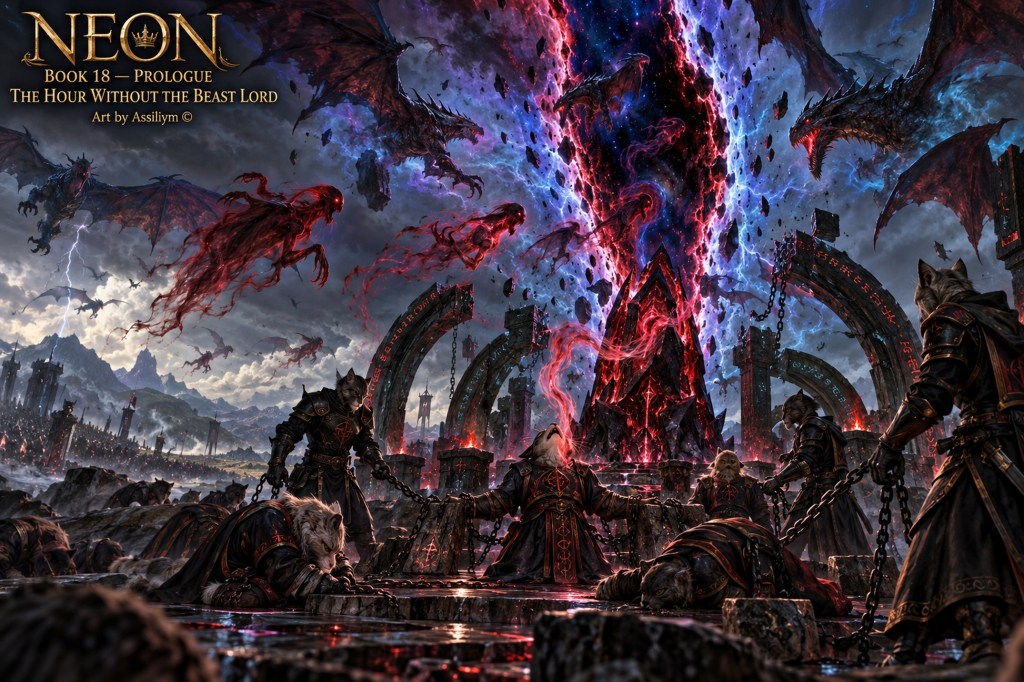
Kraath-Vel tapped the narrow ground where three approaches merged.
“Naeth-ridge vael-keth.” — “They anchor on the narrow ground.”
Then she traced the converging roads with one claw.
“Val-sha’ul thren.” — “The valley chokes there.”
Urzakh-Morn’s eyes narrowed with the satisfaction of a siege mind discovering that a road might be treated as a gate. “I can put the Breaker Host against it.”
“Not yet,” Kraath-Vel said.
His expression changed.
“We have spent too much strength attacking what cats are prepared to defend. I want them crowded first. Let the wounded reach the shield corridor. Let the horses enter it. Let bears and wolves and terrified infantry consume its width. Let every cat who wishes to retreat discover that something he has sworn to protect is moving more slowly than he is. Then you push.”
Se’Thriel smiled slightly. “You mean to make Oberon’s mercy obstruct them.”
“I mean to make it cost them.”
Korr-Vael Thuun spoke without lifting his claws from the table. “And if they abandon the beasts?”
Kraath-Vel looked towards the overturned blue-black marker.
“They will not.”
“How certain are you?”
“Certain enough to build a battle upon it. Oberon died before them. They will not answer that death by trampling the creatures he freed.”
Se’Thriel gave a low sound. “Mortals and their symbols.”
“Yes,” said Kraath-Vel. “It is one of their more exploitable diseases.”
Urzakh-Morn looked towards the citadel. “If they reach those walls, the hour closes.”
“Exactly. Therefore the wall must begin dying before they reach it.”
This brought the Keth’Var transport master forward. Kraath-Vel beckoned him nearer.
“How many engines?”
The transport master gave his report without embellishment, because embellishment is dangerous when standing between Kraath-Vel and Urzakh-Morn. Three ordinary stone-throwers had been destroyed beyond repair. Two more retained their frames but not their throwing arms. One had cracked along the axle bed and was being dismantled for timber and fittings. Several others, however, had been repaired. New torsion rope had been fitted where the Small-Toothed Army had chewed through bindings; wheel rims had been braced; broken pins replaced; one damaged throwing arm had been shortened rather than replaced, reducing range but restoring function.
Urzakh-Morn leaned forwards. “How many can fire?”
“Enough to open bombardment.”
“That is not a number.”
“It is the number that matters.”
The Breaker of Cities stared at him.
The Keth’Var master, who had survived several years by understanding the difference between courage and accuracy, added the exact figure.
Urzakh-Morn nodded. “Then move them.”
The transport master did not move.
Kraath-Vel noticed first. “What prevents it?”
The Keth’Var master glanced towards the two Draakh’Mor handlers.
Urzakh-Morn followed his gaze, and comprehension entered his face so gradually that Se’Thriel almost laughed.
“The draught animals,” he said.
“Gone.”
“The reserve horses?”
“Gone.”
“The chained bears?”
“Freed.”
“The heavy teams behind the supply line?”
“Most broke harness when Oberon’s final command passed through the Valley. The rest cannot be approached with bridle or trace.”
One Draakh’Mor handler stepped forward. “Vel-korr. Zha-naeth.” — “Rebind. Enforce.”
Kraath-Vel regarded him. “You tried that.”
“The handlers require more time.”
“How much?”
He hesitated.
“How much?” she repeated.
“We do not know.”
“The marks fail?”
“They resist.”
“Do not change the word because you dislike the answer.”
The handler lowered his ears. “They fail.”
“And the animals?”
“They remain dangerous.”
“Can they be killed?”
The question startled him more than it should have.
“Yes.”
“Then stop attempting to recover what cannot be recovered.”
The second handler stared. “Draakh’Mor does not abandon its beasts.”
“Those beasts have abandoned Draakh’Mor.”
A faint amusement moved across Se’Thriel’s face.
The first handler bowed his head. “Then what is our purpose?”
Kraath-Vel looked at the empty bridle rings hanging from his armour. “Spears.”
He said nothing.
“Any beast that turns towards the demon lines is to be killed. Any bear interfering with siege movement is to be killed. Any wolf attempting to drag away a wounded cat is to be killed. Any animal attacking a portal attendant, wheel, rope, camp or supply train is to be killed. You lost the power to own them. You have not lost the power to prevent them from serving our enemy.”
The humiliation upon the handler’s face was profound, but demons are not generally permitted the luxury of transforming humiliation into policy. He bowed. “Thren-esh.” — “It will be done.”
Kraath-Vel returned her attention to the Keth’Var master. “And the engines?”
“Weight remains the problem.”
“How much labour?”
He began describing the pulling force required, the condition of the road, the number of usable rollers and the slope towards the firing ground, but stopped when Kraath-Vel’s eyes moved from him to the companies visible through the open seam of the pavilion.
It took him a moment.
Urzakh-Morn understood next.
Se’Thriel understood before either of them spoke.
Kraath-Vel said only, “Thren-esh vel kael.” — “Completion is law.”
The Keth’Var master looked through the doorway at the soldiers.
Then at the empty Draakh’Mor bridles.
“I understand.”
“Do you?”
“We harness the host.”
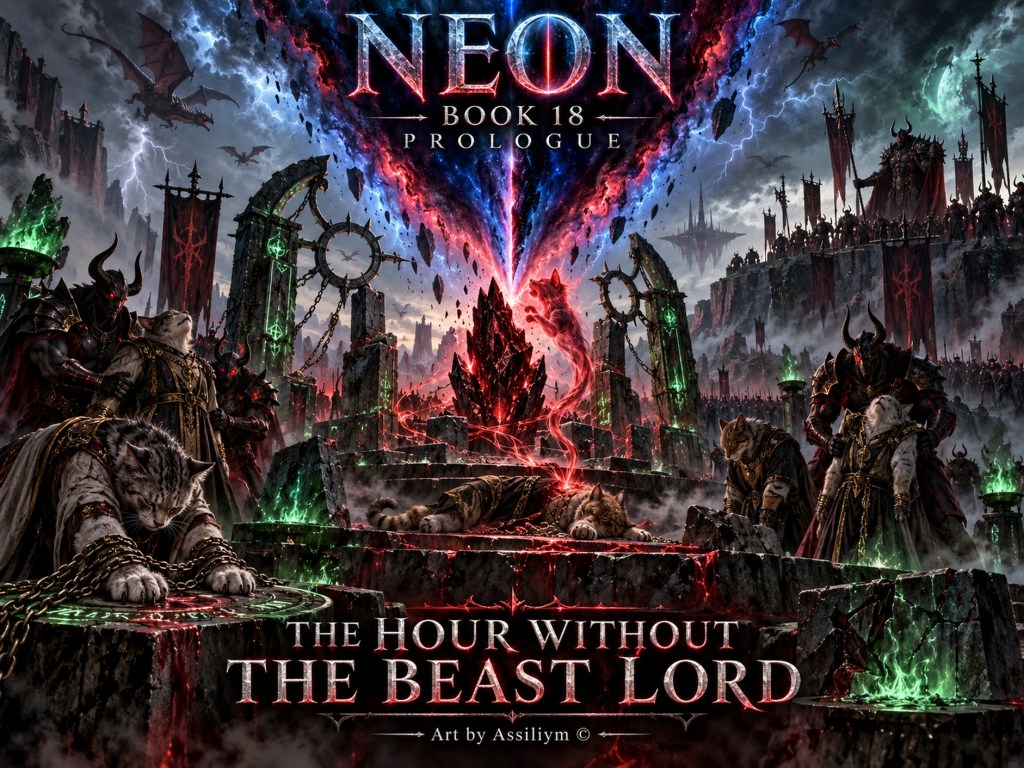
There are moments when a civilisation reveals itself in monuments, songs, burial rites and laws; there are others when all those ornaments fall away and the creature beneath them appears. Outside the demon tent, the new order moved through the army with the ugly efficiency of necessity. Harnesses which an hour earlier had been fastened around horses were cut apart and lengthened. Leather straps were punched with new holes. Ropes were threaded through iron rings and distributed across lines of possessed feline bodies. The first catapult was assigned twelve haulers, then eighteen when the wheels refused to rise from the mud, then four Iron Haulers behind the frame to push while Ash Sappers laid broken planks before the rims. A whip cracked, although the demon overseer soon discovered that the sound was redundant; obedience already lived inside the bodies pulling.
The ropes drew tight.
Shoulders lowered.
Claws entered mud.
For several seconds nothing happened except pain. Then the left wheel moved the width of a claw, and this miserable little motion—less than the length of a kitten’s paw—became the beginning of the renewed siege.
A possessed labourer slipped as the wheel mounted its first timber roller. The rim caught his hind leg and broke it with a sound barely audible beneath the groaning frame. No one halted the engine. Another soldier cut the damaged cat free from the trace, dragged him aside, stepped into the empty harness and leaned forward. Across the Valley, freed horses limped westward among soldiers who protected them; upon the eastern ground, demons placed themselves in the abandoned traces and pulled.
Kraath-Vel heard the first engine move from inside the tent.
She did not need to see it.
“Range?” she asked.
The Keth’Var master gave the estimate. If the ground held and the cats did not counterattack, the first engines could reach effective stone-throwing distance before darkness. The Blood Catapults could follow. The Offering Engines—
Urzakh-Morn struck one claw upon the map. “Korr’eth vael-morn.” — “Prepare the Offering Engines.”
Kraath-Vel looked at him.
He continued, “Vael-morn thren-esh.” — “Complete their activation.”
“Ul-zha.” — “No.”
The Breaker of Cities drew himself up. “The citadel is the obstacle.”
“The citadel is one obstacle.”
“The Offering Engines opened the northern mountain.”
“And what did they cost?”
“They succeeded.”
“Varnek’s citadel still consumed troops, priests and time. You wish to spend the most expensive weapon in the coalition before an ordinary stone has touched this wall.”
Urzakh-Morn placed both paws upon the table. “Walls are not frightened by patience.”
“No. Generals are.”
Se’Thriel’s eyes glimmered.
Urzakh-Morn ignored her. “If we give the cats time—”
“We are giving them nothing. You will bombard. Neth’Zhar will kill the cats who repair what you damage. Vesh’Raal will observe where the defenders run, which gates open, which stairways carry messengers and which old stones crack first. When the citadel reveals its weakness, then you may employ the Offering Engines.”
“The wall may not reveal enough.”
“All walls reveal enough. Pride is the only structure that believes itself seamless.”
For several heartbeats the two stared at one another. Then Urzakh-Morn inclined his head. “Thren-esh.” — “So it will be.”
Kraath-Vel turned to Se’Thriel Vale.
“What remains of your sky?”
“Enough.”
“That is a soldier’s answer.”
“Then I learned it from soldiers.”
Kraath-Vel waited.
Se’Thriel relented. The Sky-Eyes still possessed sufficient numbers for reconnaissance. Several Rending Talons remained flight-worthy. Whisper Bow ammunition had not been exhausted. The Deafened had suffered but could still advance beneath screams which would disorganise ordinary infantry. Soul Drinkers remained, though fewer than at dawn, and some of their altered vessels had been badly damaged. As for the Storm-Drakes, Se’Thriel paused until a deep roll of thunder crossed the pavilion roof.
“They remain.”
“How many?”
Se’Thriel gave the number.
Kraath-Vel nodded. “Do not waste them upon walls.”
Urzakh-Morn glanced over.
Se’Thriel said, “I had no intention of doing so.”
“Good. The defenders must fear the sky, not understand it. Sky-Eyes will mark officers. Rending Talons will strike archers and messengers. Whisper Bows will kill any cat who begins restoring order. Soul Drinkers remain above the compressed ground until the retreat crowds sufficiently.”
Se’Thriel smiled. “Thren ven’ash korr.” — “Fear ripens better than ruin.”
“Yes,” said Kraath-Vel. “And today we harvest it carefully.”
Only then did she turn to Korr-Vael Thuun.
The Lord of the Colossus had remained almost motionless since entering the tent. His claws were still buried in the table.
Kraath-Vel touched the bronze bowl.
The little black markers clicked.
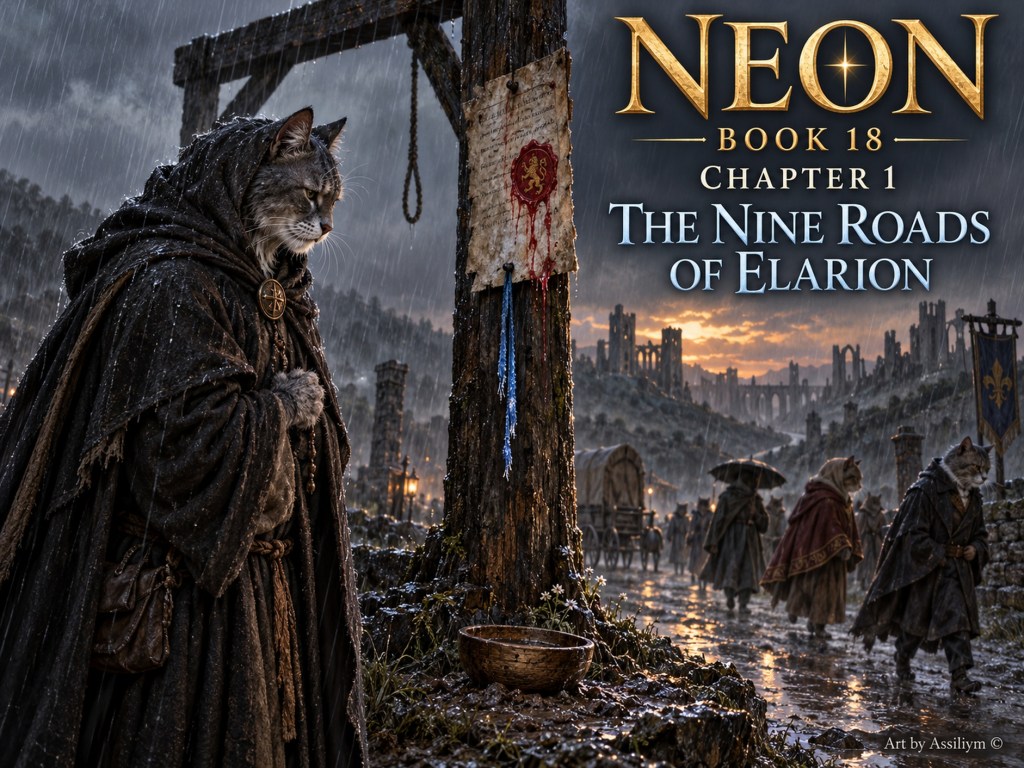
The royal proclamation had been nailed to the gallows with a carpenter’s spike too large for parchment and too small for justice, and beneath it, caught deliberately under the iron head as though the executioner had wished to add a signature which even the illiterate might understand, hung a narrow strip of faded blue cord. Rain had soaked the paper until the king’s seal ran red around its edges and the elaborate letters condemning celestial theft, unlawful correction of flesh, concealment of prohibited diagrams, and conspiracy against the ordained limits of mortal understanding had begun to bleed into one another; yet the cord remained unmistakably blue, darker where the fibres were wet, twisted gently whenever the wind came down from the hills. The monk who had worn it was no longer there. His body had been removed two days earlier, his rope saved because rope was expensive, his robe claimed by the parish constable because good wool should not be wasted merely because its owner had become a heretic, and his name scraped from the little wooden begging bowl which someone had left beneath the post. Only the cord remained, and Brother Elarion stood in the rain looking at it while carts rolled around him, farmers hurried home, and respectable cats passed without raising their eyes.
Years had gone by since Saint Velisar burned, although persecution, like debt, possesses a talent for making years feel shorter to those who owe nothing and longer to those who are being collected. King Odran had believed that the destruction of one monastery would close the matter; he had burned the scriptorium, questioned the brothers with rope, cold water, sleeplessness and crushed paws, tied Marcion and the others beneath the old oak, and departed with ashes upon his cloak and no Orb in his possession. Yet kings seldom understand the afterlife of precedent. A cruelty committed once in anger may later be repeated by officials in perfect calm, and what one ruler invents because he is hungry another inherits because it is convenient. Odran’s warrant had therefore survived Odran’s temper. Bishops copied its language. Magistrates shortened it. Guild clerks improved its accounting. Other crowns, learning that confiscated Blue manuscripts sometimes contained remedies, designs, machines, maps and substances of considerable value, discovered a theological enthusiasm for seizure which increased whenever the seized object could be sold, studied or hidden in a royal vault. What had begun at Saint Velisar as one king’s desire to possess a fallen relic was becoming what later centuries would dignify with a name: the Great Forbiddance.
Elarion had watched the change happen slowly enough that no single morning could be blamed for it. At first, Blue Monks were fugitives. Then they became criminals. After that came the more efficient transformation by which a criminal becomes a category. Laws were written against those who carried blue cords, then against those who copied certain geometries, then against healers who achieved results which approved physicians could not explain. A monk who corrected a fever without a licence became suspect; a mechanic whose wheel turned too smoothly became interesting to the Guilds; a midwife who knew an old pattern for slowing blood loss found herself asked where she had learned it, and if she answered badly, the question was repeated in a room without windows. The order scattered, and scattering saved it, but scattering also changed it. There were no longer enough bells to call the brothers together, no common kitchen, no orchard in which novices could be scolded for stealing fruit, no Abbot whose irritation could be trusted to arrive with breakfast. There were caves, barns, ruined chapels, cellars beneath inns, fishermen’s huts, abandoned toll houses, crypts, charcoal sheds and sometimes merely a road which two cats walked together for half a day before separating without saying where either meant to sleep.
Elarion took the blue cord from beneath the nail after sunset. He waited until the road was empty, climbed the muddy bank, worked the carpenter’s spike loose with the point of a small iron tool and wound the wet strip around his paw. The dead monk’s name had been Brother Tavren, though the proclamation called him a certain itinerant deceiver styling himself Brother Tavren, because authority often imagines that denying a name weakens the creature who bore it. Elarion had met him twice. Tavren had possessed a talent for bad singing and a remarkable ability to repair cracked clay bottles with flour paste, string and confidence. He had once carried a copied Breath Page through three provinces sewn into the lining of a grain sack, and had used it in a mining village to save two kittens whose lungs had filled with black dust. Neither child knew his name. Their mother did. She would remember him longer than the king.
Elarion folded the cord into the inner pocket of his robe and left the gallows behind. He had learned not to linger at memorials. Grief attracts witnesses, and witnesses, in those years, were a form of evidence.
Age had not yet bent him, but persecution had put small bends elsewhere. He no longer sat with his back to a door. He no longer wrote a full name when two initials would suffice, nor two initials when an ink blot could carry the same meaning. Before entering an inn, he noticed the kitchen exit; before accepting bread, he watched who had watched him accept it. He slept lightly, woke quickly, and could tell from the sound of boots on a stair whether the cats climbing were tired labourers, drunken guards or officials attempting quiet. A scar crossed the inner pad of his left paw where an iron gate had closed during an escape near Southmere. Cold weather made it ache before rain, which was useful enough that he had forgiven the injury. His muzzle had begun to grey. One ear bore a little tear. He had lost three teeth, two friends whose bodies he had seen, perhaps twenty whose bodies he had not, and more pieces of memory than he could count because the cruel arithmetic of lost memory is that one cannot inventory what has disappeared.
The Orb had taught him this.
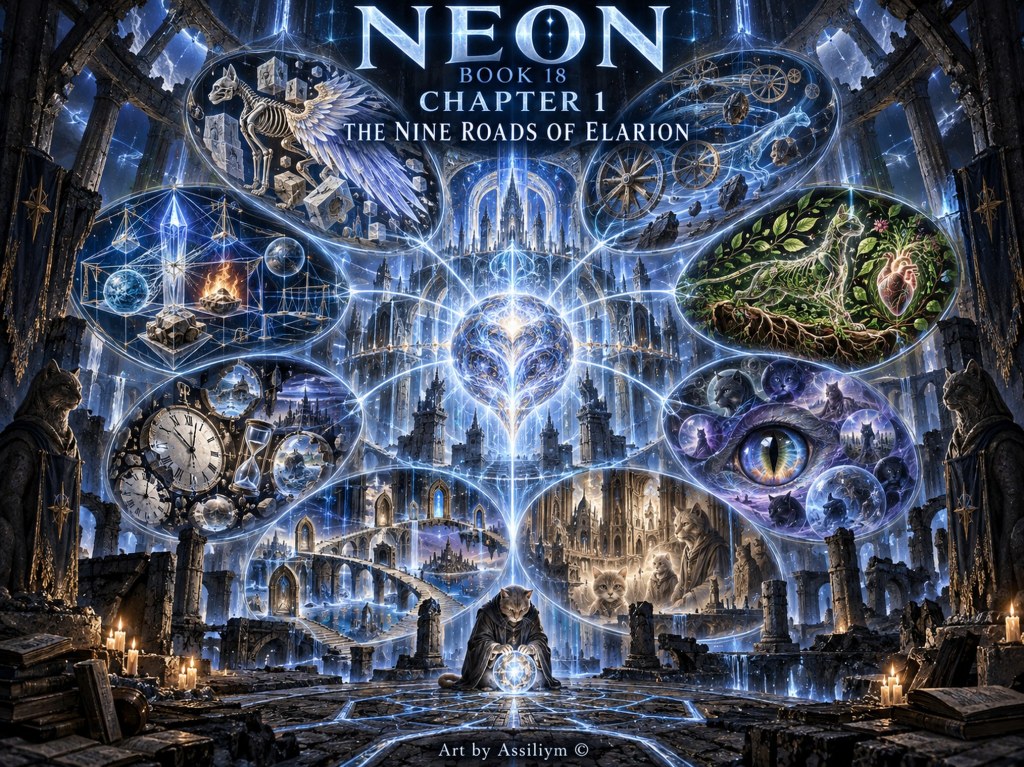
The first Blue Scroll he had copied at Saint Velisar had saved Mattheos from death’s edge and had taken payment neither openly nor at once. Elarion had once believed the miracle pure because Mattheos breathed, and for a young monk whose friend is dying, breathing is argument enough. Years later he had learned otherwise. Blue knowledge did not behave like a demon demanding a soul before service, nor like a merchant presenting a price before purchase. It gave understanding first. The price arrived afterwards, quietly, sometimes as fever, sometimes sleeplessness, sometimes obsession, sometimes a memory hollowed so cleanly that the victim remembered loving a face which the mind could no longer produce. That discovery had not taught Elarion to hate the knowledge. Hatred would have been easier. It taught him responsibility, which is the more exhausting burden because it leaves both danger and mercy alive.
The message that finally sent him back towards Saint Velisar reached him in a ruined wayside shrine where the roof admitted rain in six places and the saint carved above the altar had lost both ears to weather. Brother Caddoc was waiting there, wrapped in a brown travelling cloak with a small fire between his paws and the expression of a cat who had spent most of his life expecting civilisation to disappoint him and was becoming annoyed by the lack of novelty. He had grown white around the muzzle, but his back remained straight when he remembered to be angry. Beside him lay the weapon he insisted upon calling a long knife, although it possessed a guard, a soldier’s balance and a sword-maker’s mark.
Elarion looked at it before sitting. “Still a knife?”
“A cautious knife,” Caddoc replied.
“It has become longer.”
“The roads have become less friendly.”
“So has the knife.”
“The knife adapts.”
Elarion almost smiled, but Caddoc’s face prevented it. Between them, beside the fire, lay a folded scrap of grey paper darkened with rain. Elarion recognised one of the order’s emergency hands before he touched it.
“Grey Lantern?” he asked.
Caddoc nodded. “Gone.”
The shrine seemed to lose what little warmth the fire had given it. Grey Lantern House had once been a toll keeper’s cottage upon a road abandoned after a landslide moved commerce two valleys east. Six brothers had lived there beneath the respectable disguise of repairing farm tools and copying legal contracts for villagers who could not write. They kept no great treasure, which was precisely why Elarion had considered the place safe. There were medical copies, fragments of old mechanical work, a small book of monastery signs, and one incomplete route diagram whose lines behaved strangely whenever the paper was carried near Blue stone. Nothing there justified an army. But persecution has never required the value of what it seeks to equal the violence used in seeking it.
“How?” Elarion asked.
“Someone spoke. We do not know who. Soldiers came before dawn. Three brothers died there. Tevan and Orris were taken. Merel escaped through the roof and reached the shepherd road.”
Elarion stared at the paper. “Tevan knew Bracken Cellar.”
Caddoc did not answer.
That silence was enough.
Elarion lifted his eyes. “How long?”
“Five days.”
“And then?”
“He told them.”
The fire cracked softly between them.
Caddoc watched his face, perhaps expecting anger, but Elarion felt none towards Tevan. Anger required the comforting belief that another cat had failed where oneself would certainly have succeeded, and Elarion had lived too many years among prisons, wounds and frightened creatures to retain much faith in such fantasies.
“What did they do to him?” he asked.
“We have only Merel’s account. Sleep denied. Cold water. Paws crushed. They kept him standing until he could not. Then they began again.”
Elarion closed his eyes.
“He told them Bracken.”
“Yes.”
“At Bracken was Maelia.”
“Yes.”
“She knew Hollow Ford.”
Caddoc’s ears lowered. “Yes.”
“And Hollow Ford?”
“Taken three nights later.”
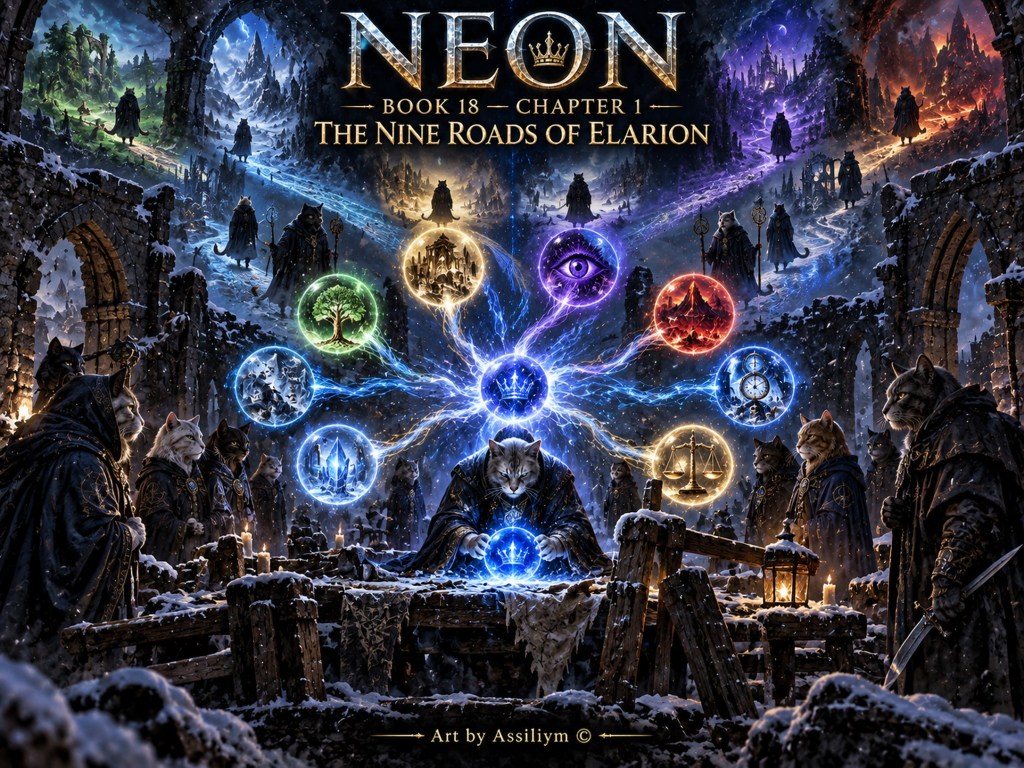
The rain outside had become steadier, flowing from the broken roof in silver ropes. Elarion could almost see the sequence without needing further detail: one captured cat, one name, another road, another door forced before dawn, another frightened keeper whose knowledge was perfectly harmless until someone decided that knowing where a friend slept was itself a weapon.
“How many?” he asked.
“Seven dead that we know. Eleven missing. Thirty-seven pages seized. More if Bracken had not moved its second chest.”
“And the Houses after Hollow Ford?”
“Warned.”
“How?”
“By name.”
Elarion opened his eyes.
Caddoc understood the question before it was spoken. “Yes. I know.”
“We warn cats by telling other cats where they are.”
“There is no other way.”
“There must be.”
“There is not.”
Elarion turned the grey paper over. On the reverse, beneath a smear of mud, someone had drawn the order’s old road sign: a broken circle with four tiny claw marks around it.
“We have built a chain,” he said.
Caddoc frowned. “We have built refuges.”
“A refuge known to another refuge is a chain.”
“That is an unpleasant way to describe friendship.”
“It is also accurate.”
Caddoc leaned towards him. “Do not begin blaming the brothers for knowing one another. That road ends somewhere stupid.”
“I blame no brother.”
“Then whom?”
Elarion looked at the rain falling through the roof, at the stone saint whose face weather had nearly erased, and then at the folded message. “Us. Not for being weak. For building a system that requires no one ever to become weak.”
Caddoc’s expression changed.
Elarion continued more slowly, because the thought was not yet complete and he feared completing it. “Tevan loved the brothers at Bracken. I know that. If love were enough, he would have remained silent. Courage was not enough either. Prayer was not enough. His body reached its limit before his loyalty did, and our protection depended upon his body never reaching that limit.”
Caddoc looked into the fire. “You cannot design a refuge against pain.”
“No.”
“Then what are you saying?”
“That we must design knowledge against confession.”
Caddoc raised his head.
For a moment Elarion heard another voice, older and calmer, speaking beneath Saint Velisar while the king’s soldiers hammered upon the monastery gate. Marcion had pressed the oilcloth bundle into his paws. Breath. Fever. Sight. Shape. Blood. Memory. Whatever fragments could be saved. Elarion, young enough still to mistake staying for courage, had protested. Marcion had answered with the patience of an Abbot who had already understood that martyrs are useful chiefly to painters and enemies.
Do not take all by one road.
If one is caught, another must remain.
At the time those words had meant scrolls.
Now Elarion felt them widen.
Caddoc saw something in his face and became immediately suspicious. “What are you thinking?”
Elarion stood.
“That question has never improved either of our evenings.”
“Elarion.”
“I must go somewhere.”
“Where?”
“I cannot tell you.”
Caddoc stared at him with an indignation so complete that, for a moment, the old monastery seemed to exist around them again. “You summon me to a roofless shrine, make me sit in water, explain that knowledge shared between friends is dangerous, and then announce you are leaving without telling me where?”
“Yes.”
“Excellent. The philosophy is already unbearable.”
Elarion gathered his cloak. “That may mean it is correct.”
“It may mean you are an idiot.”
“That has also survived examination.”
He left before dawn.
He travelled alone, changing roads often enough that even he began to resent himself. Twice he rode hidden beneath sacks in merchant carts. Once he crossed a river clinging beneath a ferry platform while the ferryman above argued with customs officers over salted onions. He spent three days disguised as a seller of turnips, a profession in which his ignorance became so obvious that one village widow purchased the entire basket merely to prevent him from continuing. He slept in a charcoal shed, an abandoned dovecote, and beneath a bridge whose resident spiders displayed more hospitality than most magistrates.
He saw the new persecution everywhere.
In one town a healing house stood empty, its door sealed with church wax. In another, a Guild notice offered payment for the surrender of unauthorised celestial diagrams. At a crossroads someone had painted over an old blue circle, but rain had peeled the newer whitewash away, so that the forbidden mark showed faintly beneath official cleanliness. A farmer told him of a monk taken because a lame kitten had walked after three visits. An innkeeper, not knowing whom she served, complained that the Crown now required registration of certain inks. “Blue ink,” she said, pouring Elarion weak beer, “as if colour itself has learned treason.”
Perhaps it had.
By the time Saint Velisar’s hills appeared beneath a grey autumn sky, Elarion had been gone from them so long that memory had begun repairing what fire destroyed. In dreams the chapel still possessed a roof. The scriptorium windows were whole. Mattheos sat beneath the orchard wall with a reed tucked behind one ear. Marcion came through the kitchen complaining that someone had again moved the salt. Memory, unlike history, is an architect with no respect for ruins.
Reality was less charitable.
There are defeats which merely hurt, and there are defeats which educate; and though the second variety is often praised afterwards by cats who did not personally suffer the bruises, it remains, while happening, very difficult to distinguish from the first.
The Warden of Mercer Ward had once marched upon Ash Town.
He had marched with ward guards whose helmets had been polished in haste, inspectors carrying municipal staves and short sabres, sweepers who had discovered that a broom held horizontally resembled a military instrument if the bearer possessed enough conviction, restaurant keepers, cheese merchants, publicans, loyal citizens, one fellow whose armour had consisted partly of a saucepan, and a locked box containing emergency blue cheese for Lord Nibblewick. Their banners had been brave. Their formation had been questionable. Their courage had been real.
They had meant to rescue their noble Lord from Madame Vira and Barrel Tom, those two thieves who had taken not merely the little rat from his glass residence but, with the commercial imagination peculiar to Ash Town, the Blue-Cheese Sweeper as well, having discovered that a famous rat sitting behind glass was merely a curiosity whereas a famous rat riding a mechanical rubbish sweeper became theatre.
The Warden had led his citizens towards the thieves.
Then he had seen the King.
Royal Musketeers had filled the road. Scarlet Guards had marched behind them. De Tréville’s veterans had moved with that quiet economy which distinguishes soldiers who have learnt the cost of unnecessary movement. René had been there; Vaurin had been there; Vasili had been there; and beneath the royal standard, with more steel around him than Mercer Ward could have gathered if every cheese knife in the district had been sharpened and registered for military service, had ridden Luis.
The Warden had stopped.
He had looked at his municipal sword, at his inspectors, at the brave sweepers, at the citizen with the saucepan, at the box of blue cheese, and finally at the army of France-Neon.
Then, because folly had never completely conquered judgement in him, he had recalled his troops.
Mercer Ward had gone home without its Lord.
The Crown had gone into Ash Town, freed Lord Nibblewick from thieves, recovered Leonardo’s Blue-Cheese Sweeper—and retained both.
The Warden had thought about this for a very long time.
Madame Vira and Barrel Tom had taken Lord Nibblewick without asking Mercer Ward.
King Luis had recovered Lord Nibblewick without asking Mercer Ward and thereafter had declined to return him.
The Warden understood that the two acts were not legally identical. The Crown possessed uniforms, seals, clerks, precedents, royal warrants and a vocabulary long enough to prove that nearly anything performed by a palace differed fundamentally from the same thing performed through a window at night.
Emotionally, however, the distinction had remained imperfect.
Mercer Ward had still been without its Lord.
And so the Warden had done what a Warden does when deprived of the object of his affection by a power too heavily armed to be shaken by the throat.
He had produced paperwork.
Grief became administrative.
Black cloth appeared first, spreading through Mercer Ward with the solemn abundance of ivy upon an abandoned house. It hung across municipal windows, wrapped office door handles, bordered notices, draped the little place where Lord Nibblewick’s glass residence had once stood and wound itself around broom shafts whose owners had previously imagined that sweeping possessed no ceremonial dimension. Clerks wore black bands. Inspectors wore black bands. Borel’s press printed upon black paper. The Warden ordered licences, notices, applications and eventually fines themselves to share in the public sorrow, for he considered it morally indefensible that a cat should be penalised for an obstructed gutter upon cheerful stationery while His Small Lordship remained absent.
This admirable principle produced an administrative difficulty.
Black ink could not be read upon black paper.
A lesser official might have withdrawn the order.
The Warden instead demanded white ink.
Thus one impossible municipal instruction had crossed the path of the Alchemistry Guild, Miette Paleclaw had eventually produced a proper three-drop formula, Pinchford had returned carrying the successful result with the weary dignity of a cat who had been commanded to discover something he did not understand, and the fines of Mercer Ward had once again become legible.
The Warden’s grief now possessed contrast.
Then came the petition.
It began reasonably, which is how many dangerous institutions begin.
A table was erected near the market. Residents signed their names. Shopkeepers signed. Merchants signed. Restaurant keepers signed. Inspectors carried copies through the ward. Borel printed notices. Cats who had seen Lord Nibblewick riding the Blue-Cheese Sweeper signed because they remembered the little figure standing upon the machine with his whiskers forward and his paws arranged like a magistrate inspecting inadequate sanitation.
Then the Warden discovered categories.
A resident might also be a merchant.
A merchant might also be an employer.
An employer might also be a customer of municipal sweeping.
The same cat might additionally be an admirer of Lord Nibblewick, a defender of the Blue-Cheese Sweeper, a victim of reduced paw traffic and a citizen personally aggrieved by continued royal retention.
The signatures multiplied.
Guests signed.
Temporary lodgers signed.
Visiting relatives signed.
Cats merely passing through Mercer Ward discovered that temporary presence did not disqualify temporary patriotism.
Then the Warden widened the franchise further.
Household animals were grieving too.
This had been established by a test of such elegant simplicity that Pinchford had been unable to defeat it.
Had the pet received Lord Nibblewick back?
No.
Then grief was established.
Pawprints appeared.
Claw marks.
Beak impressions.
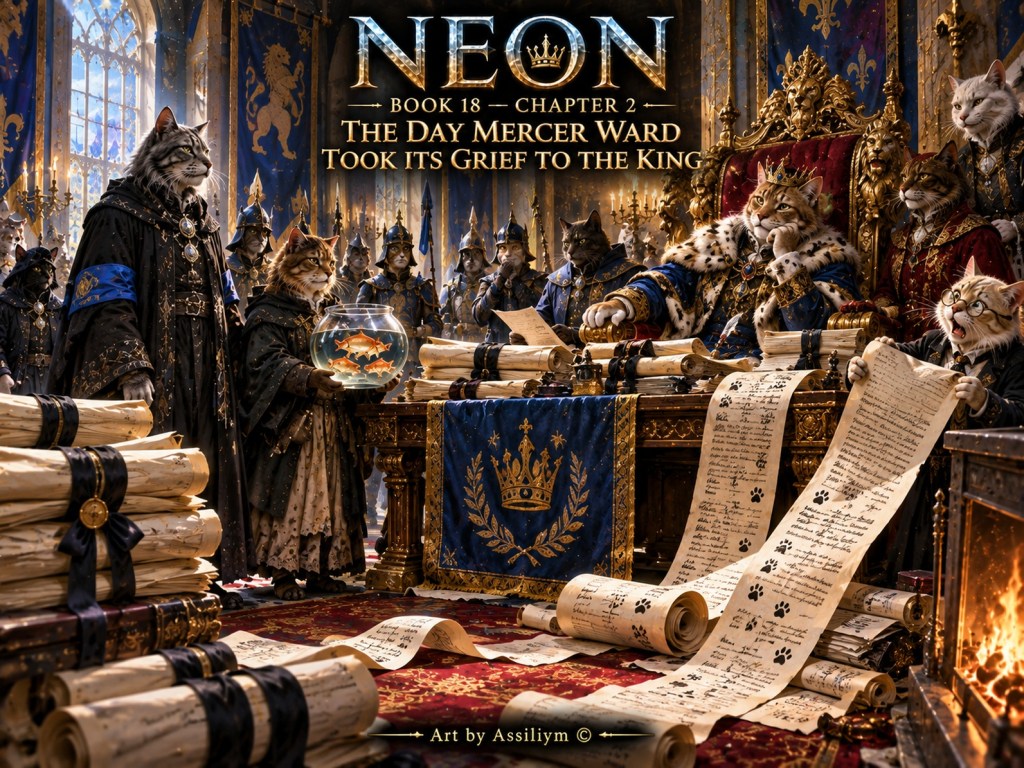
By seven bells the Warden had assembled not an army but something potentially much more inconvenient to a monarch: a representative delegation.
He chose it carefully.
The wealthy cats came first in his planning, but not first in the procession. There were merchants whose warehouses occupied entire lanes, grain dealers, cloth importers, cheese factors and restaurant proprietors whose accounts had suffered since Lord Nibblewick’s departure. Their presence mattered because the Crown understood trade, tax and revenue.
But the Warden refused to let wealth become the face of Mercer Ward.
If only merchants went to the palace, Luis could dismiss the affair as businessmen demanding the return of a profitable attraction. It had therefore to contain other cats, cats whose grief could not easily be converted into percentages.
Inspector Vale would attend, wearing mourning black over his municipal badge. Inspector Ruskett would attend too, his grey narrow face almost ideally designed for official occasions at which a cat might wish to be remembered only after documents disappeared.
Two widows were chosen.
A washerwoman.
A baker.
One ordinary householder.
And, at the Warden’s insistence, an elderly street sweeper who had spent thirty-eight years clearing Button-Mercer Alley.
The sweeper believed at first that he was being summoned for a disciplinary matter.
His coat possessed patches, his paws bore the thickened signs of work and his broom had outlived several municipal administrations. He had no commercial stake in Lord Nibblewick’s return, no portrait stall, no restaurant table to fill, no blue-cheese contract and no intention of becoming historically significant. He merely remembered the day Leonardo’s little Sweeper had passed down his alley with Lord Nibblewick riding above it while kittens shouted, and remembered that for one afternoon the street he had cleaned for most of his life had become a destination rather than a place richer cats hurried through.
The Warden put him near the front.
A King looking at merchants might see profit.
A King looking at inspectors might see bureaucracy.
A King looking at an old sweeper whose broom was wrapped in mourning ribbon might have fewer convenient explanations.
Then came the problem of the fish.
The Warden wished to take all five.
Pinchford opposed this for reasons of weight, transport, water displacement, danger to the fish and the basic proposition that an aquarium was not ordinarily part of a diplomatic mission.
The discussion lasted twenty-seven minutes.
At last they settled upon three.
A broad glass bowl was prepared with water from the office aquarium, a little weed and two smooth stones. The Warden himself supervised the transfer. The other two fish would remain behind, partly for their safety and partly, as he explained, because no prudent government exposed its entire aquatic representation to one diplomatic journey.
Pinchford was given responsibility for the travelling witnesses.
He took the bowl in both paws.
Three little silver bodies moved around the weed.
The Warden watched them with deep feeling.
“Do they understand?”
Pinchford looked into the water.
“No, Your Honour.”
The Warden sighed.
“Pure grief.”
Pinchford decided against further zoology.
Across the ward, Borel had already discovered what was happening.
No official had informed him.
Borel did not require officials for information when streets contained servants, clerks, customers, cooks, porters, inspectors, coach cats and cats who had seen a black flag being carried past a window and immediately improved the story.
His press began shaking the back room of The Dame Puddles and Lady Scratch before the Warden’s delegation had fully dressed.
Borel understood catastrophe as other cats understand weather. He could smell when a public event had achieved sufficient uncertainty to become profitable.
This one was magnificent.
A Warden.
A King.
A beloved stolen-rescued-retained rat.
Twenty-four thousand signatures from twelve thousand residents.
Black mourning banners.
Grieving household animals.
Three fish going personally to the palace.
Even Borel, whose moral imagination was rarely allowed to interfere with circulation, felt something approaching awe.
His morning edition appeared before breakfast.
Across the top, in letters designed to seize the eye and refuse release, ran:
MERCER WARD MARCHES TO THE PALACE
Beneath it:
24,311 SIGNATURES DEMAND THE RETURN OF OUR LORD
And underneath, with that exquisite irresponsibility by which a newspapercat may accuse a King while technically asking only a question:
WILL KING LUIS RELEASE OUR NOBLE SOUL?
The illustration showed the Warden leading the procession beneath black flags. Behind him walked merchants, workers, inspectors and citizens, while Pinchford bore a radiant glass bowl containing three fish whose painted expressions suggested that aquatic sorrow had recently been perfected as an art.
Marta read the proof.
She stared at the fish.
One had a tear running down its cheek.
“Fish do not cry like that.”
Borel, already sorting bundles, explained that grief was exceptionally difficult to illustrate underwater.
Marta then pointed out that the Warden appeared a head taller than every other cat in the picture.
Borel called this leadership.
Pinchford appeared almost priestly, bearing the bowl before rays of light.
Borel called this symbolism.
The newspaper also contained advertisements for mourning ribbons, blue-cheese rolls and a commemorative drink available while His Small Lordship remained absent.
Marta considered these in silence, which was usually the beginning of Borel’s punishment.
“You are profiting from the King’s refusal before the King has refused.”
Borel blinked.
He had genuinely not considered the sentence objectionable.
“If the King returns him, we print a Victory Edition.”
Marta closed the paper.
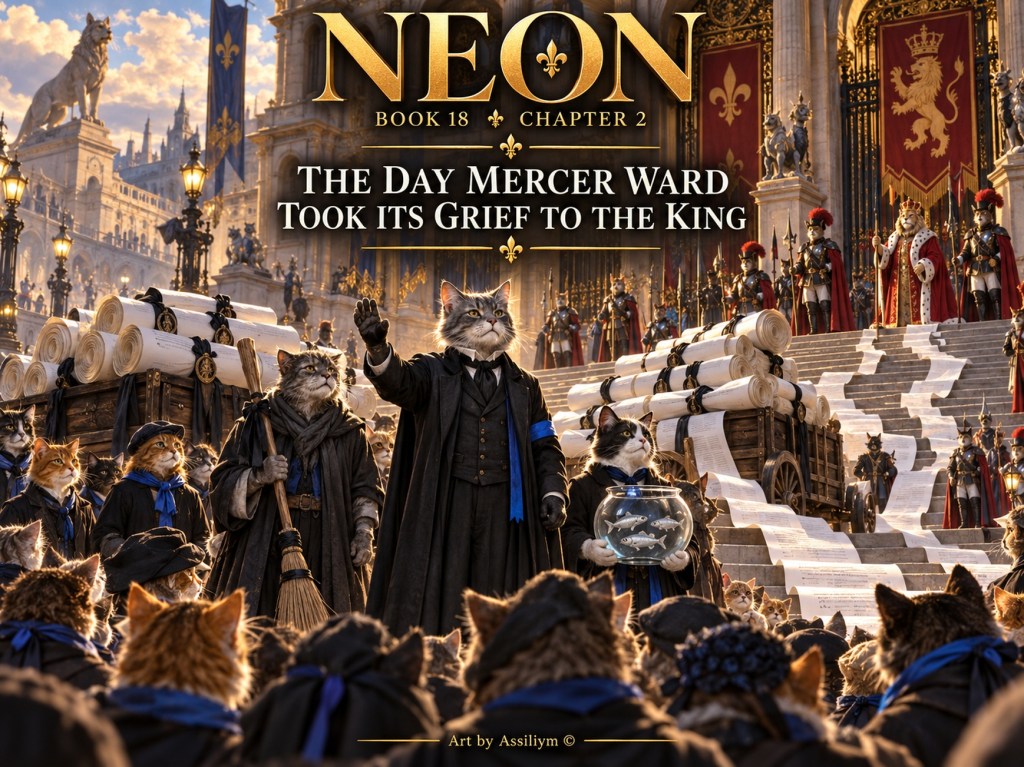
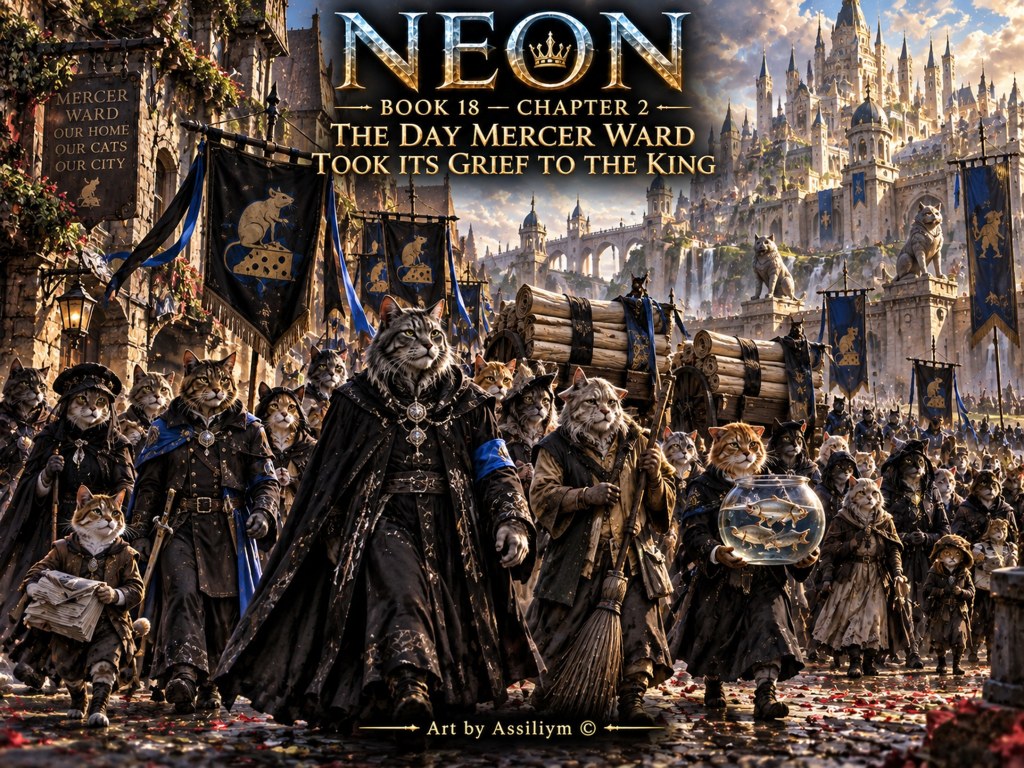
Merchants who usually wore wine-red, dark green or good blue had dressed in sombre coats. Restaurant owners wore mourning bands. The washerwoman had borrowed a dark shawl. The two widows needed no instruction. The old street sweeper’s coat had been brushed until age showed through more clearly than dirt, and someone had tied a wide black ribbon around his broom.
Three great banners waited.
The first read:
OUR BELOVED LORD NIBBLEWICK — WE WEEP FOR HIM
The second:
LORD NIBBLEWICK — THE GENTLE SOUL OF MERCER WARD
Inspector Vale had looked at that phrase for some time. He remembered Lord Nibblewick biting officials with admirable impartiality. He had elected not to interfere with civic poetry.
The third banner was simpler:
MERCER WARD ASKS FOR THE RETURN OF ITS LORD
Then Pinchford emerged.
He wore black.
His spectacles had been polished.
His expression attempted solemnity, though the weight of the bowl was already informing his shoulders that patriotism possesses mass.
The three fish swam within it.
A hush travelled through part of the square.
Kittens pushed forward.
One whispered that the largest fish looked terribly sad.
The largest fish was looking for breakfast.
The Warden descended the office steps.
He saw his delegation, then the crowd gathering behind it, then the black flags, and for an instant his face changed.
Beneath all the foolishness there had always been something true.
Lord Nibblewick had made Mercer Ward visible.
The little rat had ridden through its crooked alleys on Leonardo’s Blue-Cheese Sweeper while children ran after him and merchants from cleaner districts paid money to stand where they had previously been reluctant even to stop. The Warden had watched poor shops fill, taverns become noisy, streets cleaned because suddenly strangers were looking at them, and residents begin speaking the name Mercer Ward with an unfamiliar pride.
A district accustomed to being mocked had found itself loved for something.
That something had whiskers.
The Warden raised one paw, and the square quietened.
He did not deliver the speech he had given before marching upon Ash Town. That speech had belonged to rescue, banners and the possibility of violence. This day required another tone.
“Our Lord was stolen once,” he said.
The cats listened.
“He was rescued.”
Some lowered their heads.
The Warden looked towards the palace road beyond the rooftops.
“And he did not come home.”
No further explanation was necessary.
The banners rose.
Mercer Ward began walking.
At first there were fewer than a hundred official participants, though several hundred residents filled the square behind them. The Warden walked at the front with Inspector Vale and the old street sweeper. The wealthy merchants followed near enough to be visible but not near enough to become the entire meaning of the event. Tradescats, citizens and clerks came behind. Pinchford walked with the fish. Borel marched somewhat farther back, where he could simultaneously participate in history and observe its commercial possibilities.
His newspaper boys moved ahead of everyone.
The procession did not march perfectly, but grief asks less of feet than war. Black cloth moved above the street. The old sweeper’s broom tapped lightly upon stone. Petition carts creaked behind the delegation, for the twenty-four thousand three hundred and eleven signatures could not be carried with dignity by clerks alone.
Mercer Ward watched itself go.
Shopkeepers stood in doorways. Cats at windows removed hats. Kittens ran along the pavement until mothers caught them. A cheese seller placed a wedge of blue cheese upon his counter beneath Lord Nibblewick’s portrait as if the rat might smell loyalty across the city.
At the first crossing, six cats joined.
At the next, a seamstress came out of her shop, tied black cloth around one wrist and walked beside the procession until the end of her street.
An old tom held up a cheap portrait he had purchased during the great days of the Blue-Cheese Sweeper. In it, Lord Nibblewick stood upon the machine with one paw lifted, though the artist had exaggerated the gesture into something between a blessing and the command of an army.
The Warden saw the portrait.
He bowed to the old cat.
The old cat bowed back.
So the march grew.
Not into an angry crowd. The Warden watched carefully for that. He had learnt from Ash Town that emotion which ceases to obey becomes someone else’s weapon. Inspector Vale and the ward guards kept the route open. No chanting was permitted. No insults against the Crown. No throwing objects. The Warden would arrive at the palace as petitioner, not rioter.
Borel’s newspaper, unfortunately, obeyed no such restraint in spirit.
By the time the delegation left Mercer Ward, most of the morning edition had sold. One paper boy stood upon a fountain and shouted the number twenty-four thousand three hundred and eleven until someone asked how many cats actually lived in the district.
He did not know.
Borel did.
Borel immediately became interested in another street.
Pinchford was less fortunate. A curious merchant walking beside him asked the same question.
“Twelve thousand registered residents,” he admitted.
The stranger looked at the fish, then at the petition cart, then back at Pinchford.
“How have you got twenty-four thousand signatures?”
Pinchford continued walking.
“There are categories.”
The merchant waited for more.
None came.
There are explanations which acquire no dignity through completion.
As the procession entered richer streets, laughter appeared.
It began upon balconies.
A municipal Warden dressed for mourning was mildly amusing to cats accustomed to court funerals, polished coaches and grief performed beneath family heraldry. Three fish travelling to petition a King were considerably more amusing.
A young tom laughed openly when Pinchford passed.
Then he saw the rest.
The cloth merchant in expensive black.
The washerwoman whose shawl had been repaired at one corner.
Inspector Vale walking in formal mourning.
The widows.
The old sweeper with his ribboned broom.
Cats whose lives did not ordinarily touch one another except through bills, work, inspection and street dirt were walking beneath the same two absurd banners for the same little rat.
The young tom stopped laughing.
A procession may begin as comedy and become dignity merely by walking far enough.
The palace guards saw the black banners approaching in the late morning.
At first they expected a funeral.
There was black cloth, solemn pace, respectable citizens and enough emotional seriousness to suggest at least one important corpse.
Then the head guard found no hearse.
No coffin.
No priest.
Instead he saw a Warden.
Merchants.
Inspectors.
Workers.
A newspapercat.
An old street sweeper.
And Pinchford carrying three fish.
The guard captain came down the steps.
His training had prepared him for armed mobs, foreign envoys, bishops with complaints, provincial nobles, petitioners and the occasional cat who claimed the King owed him money.
It had not prepared him for aquatic sorrow.
He stopped before the Warden and asked their business.
The Warden formally requested an audience with His Majesty on behalf of the residents, trades, officers, households and grieving dependants of Mercer Ward.
The captain looked at the first banner.
OUR BELOVED LORD NIBBLEWICK — WE WEEP FOR HIM
Then at the second.
THE GENTLE SOUL OF MERCER WARD
He looked at the black clothing.
“Who died?”
Inspector Vale’s expression tightened.
“Nobody.”
The captain’s eyes moved back to the banners.
The Warden answered before misunderstanding could become offence.
“Absence need not become permanent before decent cats are permitted grief.”
The captain, recognising a sentence destined to become dangerous if argued with, sent a guard inside.
The delegation waited.
By the middle of that summer, Leonardo had discovered that a household could enlarge itself without permission.
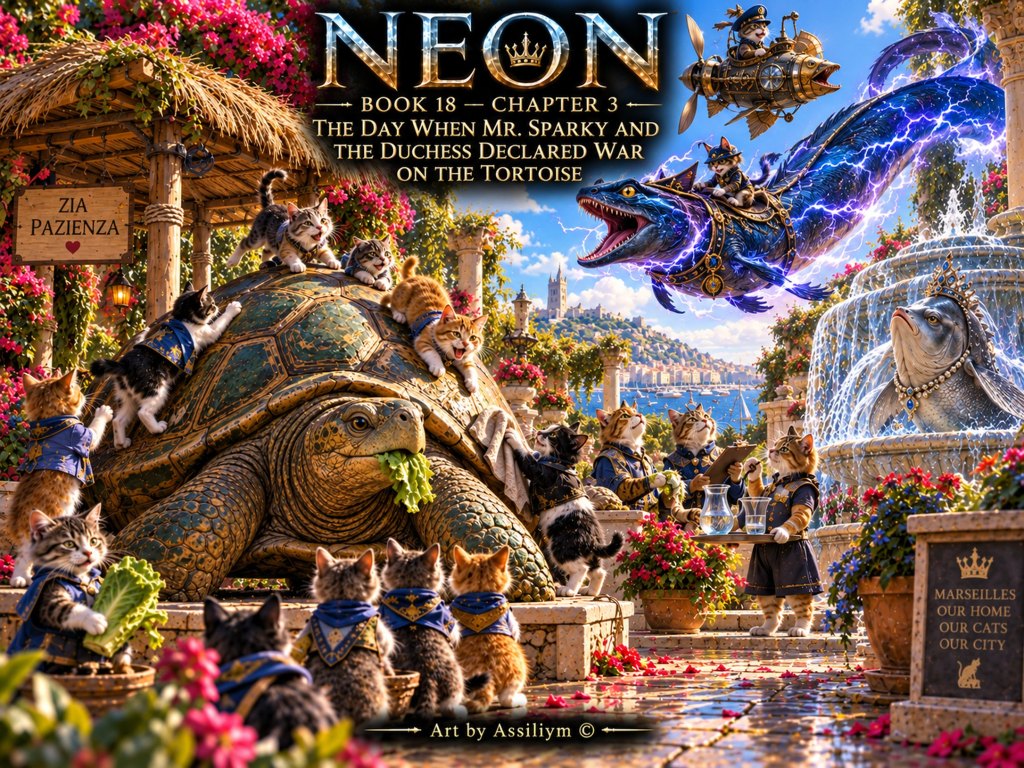
He had never issued an invitation, founded a dynasty, drawn up a charter or announced that the old royal castle of Marseilles was to become a refuge for creatures of unusual size, uncertain ancestry and increasingly unreasonable expectations. Yet somehow the lower garden now contained an enormous silver-blue moon-fish who answered to the Duchess, an ancient eel-drake of lightning with enough titles to exhaust a herald, a small mechanical flying eel who had appointed himself Air-Captain of almost everything, and, most recently, a giant tortoise whom Leonardo had rescued from the mud and roots of the ruined second fountain. There were also kittens. The kittens could not properly be counted because any attempt to count them produced more kittens, rather as crumbs produce sparrows and unattended political offices produce cousins.
The tortoise had changed the character of the place without appearing to notice that she had done so.
Leonardo had called her Signora Pazienza, because patience seemed less a virtue in her than a natural law. She had survived years almost buried beneath debris after the fountain drainage collapsed, living upon weeds, fallen figs and rainwater, while roots hardened around her shell and seasons passed above without consulting her. One rear leg remained stiff; one eye had the milky cloudiness of great age; old cracks crossed the broad shell in bronze and dark-green seams which had healed long before Leonardo found her. Yet she moved with enormous quiet certainty, as though the world might race if it wished but would eventually have to wait for her.
Leonardo, who maintained some respect for ceremony even in circumstances where ceremony had become ridiculous, called her Signora Pazienza of House Leonardo.
The kittens called her Zia Pazienza.
Within a week, the smallest had shortened this to Zia.
Whenever the great tortoise emerged from beneath the old oak, the cry travelled through the courtyard.
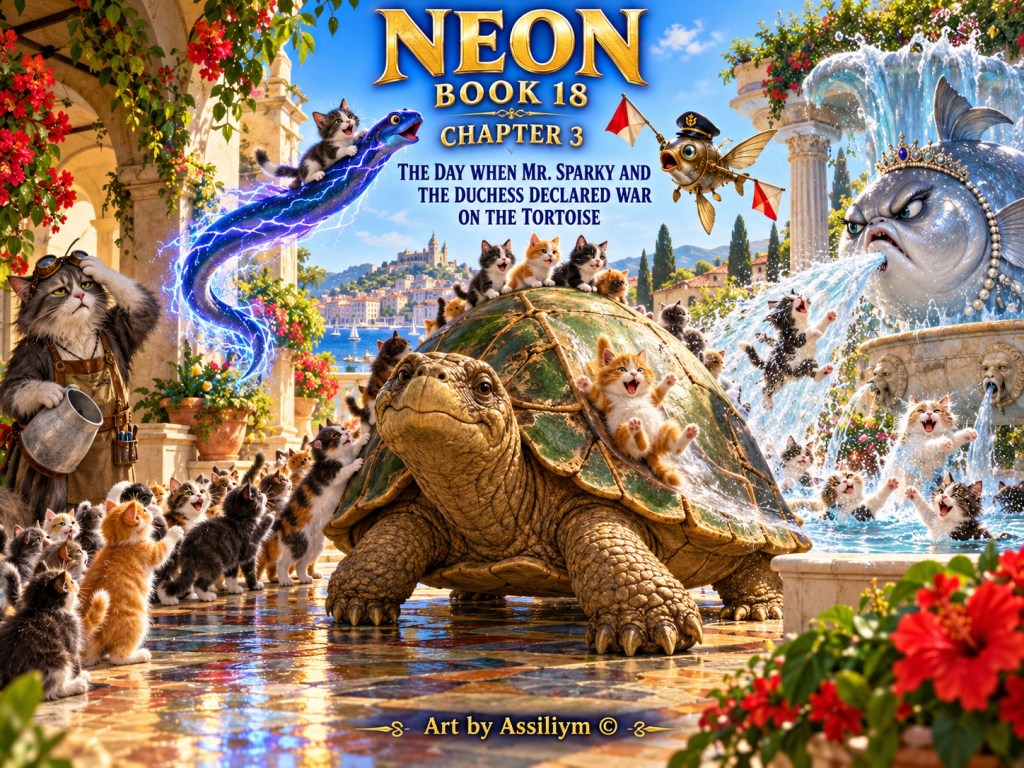
“Zia!”
And there they came.
The first children had discovered accidentally that the rear of her immense shell formed a magnificent polished slope. One kitten had slid down, landed on all four paws and shrieked with such delight that civilisation ended for approximately twenty minutes. Since then, the climb and slide had become a recognised institution. Leonardo, who had initially forbidden it, had then observed that Pazienza neither objected nor showed distress and had surrendered to the inevitable in the manner of a statesman pretending a rebellion was a reform he had intended all along.
He had, however, insisted upon rules.
This was where the six former Catica bearers found their new professions.
They had once belonged to the household of Duke Vittorio Bellaforte of Savoy, carrying His Grace in the Grand Catica—a broad reclining chair beneath an embroidered canopy, mounted upon polished poles and supplied with cushions, curtains and, because civilisation would otherwise have been endangered, a silver wine holder. Vittorio enjoyed the gentle rise and fall of the Catica so greatly that he usually fell asleep before the second bend of a road. The six cats carrying him experienced that soothing rhythm from another philosophical position.
Leonardo’s invention of a padded support which allowed the Catica to rest safely across Pazienza’s great shell had transformed their lives.
The senior bearer, Matteo Verdini, had taken charge of the two gardens Duke Vittorio solemnly promised after learning that the new Catica was powered principally by lettuce. Matteo embraced agriculture with the zeal of a commander who had finally been given an enemy incapable of issuing orders. He cultivated lettuce, cabbage, marrow, chicory and tender herbs, inspected the soil twice each morning and had divided the vegetable plots into what he called the Northern Reserve and the Southern Reserve, though they lay perhaps forty paces apart and possessed no military significance whatever.
Beppe Cucchiara became the keeper of Pazienza’s meals. He knew what she had eaten, when she had eaten it and whether somebody had attempted to supplement the approved ration with contraband fruit. Beppe regarded an unexpected cabbage leaf as other cats regarded an unidentified armed visitor.
Tomaso Guardia and Piero Campana became guardians of the kittens. Their task was not to prevent play but to prevent enthusiasm from becoming cruelty. No kitten might climb upon Pazienza’s head, tug her tail, crowd her eyes, push another child from the shell or attempt to descend inside a barrel. That last rule had been written after experience.
Nico Brillapelo and Luca Ombrelli had responsibility for shade and water during the fierce Marseilles afternoons. Between them they erected canvas screens, carried cool drinking water and shifted the awnings whenever Pazienza moved out from beneath the protection they had just spent half an hour arranging. Nico had also taken upon himself the polishing of her shell. Leonardo had forbidden wax, oil, furniture polish and every substance intended for objects rather than living creatures, so Nico used warm water, soft cloth and gentle brushes. He preserved the old moss in the deeper ridges because Leonardo said it caused no harm, but muddy pawprints drove him towards despair.
Thus an aristocrat’s six exhausted bearers had become gardener, feeder, guardians, water carriers, shade makers and shell keeper to an elderly tortoise.
None wished to return to their previous occupation.
Duke Vittorio’s promised gardens flourished. The kitchens surrendered lettuce. The kittens organised themselves into queues. Nico polished. Beppe fed. Matteo planted. Tomaso and Piero governed. Luca carried water. Pazienza ate whatever part of this administrative system happened to be edible.
The trouble began when Leonardo decided she needed a proper place to sleep.
He might have solved the matter with three walls and a roof, but Leonardo could no more build something badly than the sun could rise reluctantly. He studied the direction of the sea wind, the drainage of the lower garden and the angle of the afternoon heat. He set stout posts into stone footings, raised the sleeping ground slightly above winter water, made the entrance broad and gently sloping for Pazienza’s stiff rear leg and designed a wide thatched roof with deep overhangs. The sides remained open during warm weather, but woven screens could be lowered during rain. Inside lay dry sand, packed earth and straw, with a shallow drinking basin beside the entrance and enough turning room that Signora Pazienza would never discover that architecture had underestimated her width.
The kittens watched construction with the intensity normally reserved for executions, weddings and pastry.
Leonardo completed the structure late one evening.
By the following morning it had acquired shells, coloured ribbons, three tiny stools, two painted lettuces, a crooked flag and a large board over the entrance bearing the words:
ZIA TROPICAL HUT
A small tabby stood beside him with considerable satisfaction.
“Why tropical?”
The tabby pointed at the thatched roof.
“That does not answer the question.”
“It is tropical.”
“We are in Marseilles.”
“Yes.”
Leonardo looked down at the kitten. The kitten looked up at Leonardo. One possessed the mind which had conceived flying mechanisms, hydraulic devices, fortifications and machines whose purpose nobody else understood; the other possessed absolute confidence.
Confidence won.
Pazienza arrived presently, accompanied by the entire machinery of her new household. Matteo brought a lettuce leaf. Beppe carried breakfast. Nico carried his cloth. Tomaso and Piero restrained a body of kittens who believed inauguration entitled them to priority boarding. Luca brought cool water.
Pazienza walked beneath the roof, turned once, lowered herself into the shade and closed her good eye.
The children applauded.
Leonardo looked at the sign again.
It remained.
Thus Zia Tropical Hut entered the architecture of Marseilles.
Mr. Sparky discovered it before noon.
Thundraziel Voltrazimir, Last Coil of the Violet Sky, Keeper of the Purple Shell, Lord of the Blue Crackle, High Lord of the Nine-Storm Rivers, was accustomed to arriving somewhere and becoming the most interesting fact present. He could fly; he could coil through the air in blue-violet spirals; electricity wandered over his whiskers when he became excited, and when he struck Leonardo’s cooling mechanism at precisely measured points he could help produce enough ice to persuade a summer courtyard that civilisation had not entirely abandoned it.
Most importantly, kittens adored him.
Or had adored him.
Before Zia.
Mr. Sparky entered the courtyard in a sweeping blue-and-silver curve, descended past the restored fountain and performed a second loop which was unnecessary from the standpoint of travel but indispensable from the standpoint of entrance.
Nobody looked up.
The kittens were gathered around Pazienza.
One waited to climb.
Another descended the smooth rear of the shell and landed with a triumphant cry.
A third argued with Piero over whether a younger sister counted as luggage.
Mr. Sparky slowed in the air.
A spark passed from one whisker to the other.
Nothing.
He dropped lower.
One kitten glanced up and waved.
“Hello, Mr. Sparky.”
Then the child turned back to Zia.
There are few insults greater than politeness when one has prepared for admiration.
Mr. Sparky circled the tropical hut once. He inspected its roof, the coloured ribbons and the sign. He observed Matteo working in one of the two vegetable gardens. He saw Beppe arranging sliced marrow in Pazienza’s bowl. He saw Nico polishing the great shell with a soft cloth while Tomaso and Piero supervised a queue of children.
Then Luca emerged from the shade carrying a metal bucket.
Small pieces of ice knocked against its sides.
Mr. Sparky stopped in mid-air.
“What is that?”
Luca looked up. “Cold water.”
“I know it is cold water.”
“Then we are making excellent progress, my lord.”
Mr. Sparky descended until his nose nearly touched the bucket. “Where did the ice come from?”
“The cooling machine.”
“My cooling machine?”
“Maestro Leonardo’s cooling machine.”
“My lightning makes the ice.”
“That is also true.”
Mr. Sparky looked towards Signora Pazienza, who had begun stretching her neck towards the water basin.
“And where is that going?”
Luca poured the water.
“Signora Pazienza is thirsty, my lord.”
Mr. Sparky watched the ice he had helped create disappear into the tortoise’s basin.
He then looked around more carefully.
Two private gardens.
Six attendants.
A polished shell.
A sunshade.
Chilled drinking water.
A noble Catica whenever Duke Vittorio wished to sleep.
A tropical house.
And, perhaps most offensive of all, an entire generation of kittens who called her Zia.
Mr. Sparky’s fins stiffened.
Pazienza drank.
She had no idea a geopolitical crisis had begun.
Mr. Sparky flew directly to the royal fountain.
The Duchess rose from the silver water almost at once. She had never entirely forgiven Pazienza for attracting compliments within hearing of her basin and had already developed a habit of splashing any worker who praised the tortoise too enthusiastically. She now listened while Mr. Sparky presented the evidence.
“She has two gardens.”
The Duchess’s fins moved.
“Six attendants.”
A ripple crossed the water.
“Her shell is polished.”
The Duchess rose slightly higher.
“She has cold water.”
A splash struck the paving.
“A private tropical house.”
The Duchess slapped the fountain with her tail.
“And the kittens call her Zia.”
A sheet of water leapt over the rim.
Mr. Sparky nodded.
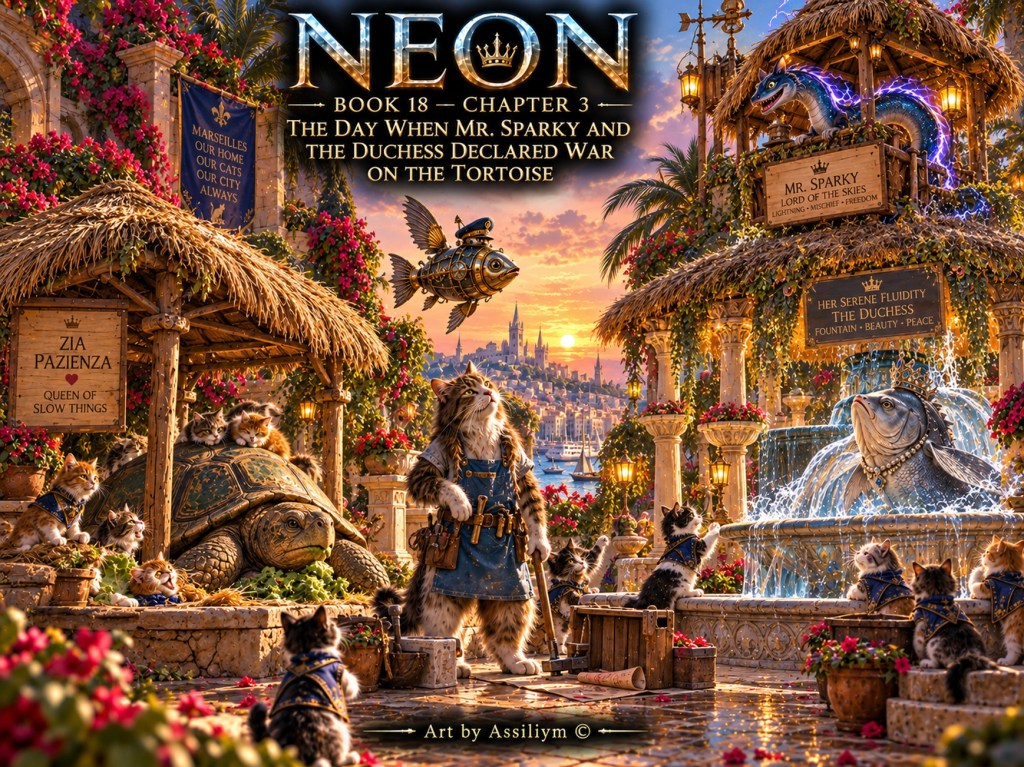
Mr. Sparky flew low over the courtyard and offered hide-and-seek. The kittens thanked him and said perhaps later. He produced a blue spark shaped almost like a crown, although one child thought it resembled a spoon. He flew through an arch, around the fig tree and upside-down past the old oak.
The tortoise took one step.
Three kittens cheered.
Mr. Sparky hovered beside her.
“I am considerably faster.”
No kitten disagreed.
“I can fly.”
“Yes,” said the tabby.
“I command lightning.”
“That is very nice.”
Very nice.
Mr. Sparky stared at him.
The tabby slid down Zia’s shell.
The Duchess’s campaign went no better. She splashed every child carrying vegetables towards Pazienza until the children discovered that if they approached in groups the fountain became a game. Within ten minutes they were running deliberately through the splash zone.
The Duchess believed she was repelling an invasion.
The kittens believed she was entertaining them.
Pazienza continued eating lettuce.
Towards midday a very small kitten came to Mr. Sparky.
The eel-drake, who was resting in offended magnificence upon a stone balustrade, deliberately looked away.
“Mr. Sparky?”
Silence.
The kitten came closer.
“Mr. Sparky, Zia cannot do something.”
His head turned immediately.
“What?”
The kitten pointed towards the tortoise. “Go up.”
Mr. Sparky blinked.
The child pointed from the bottom of the shell to the high front, where several kittens were climbing awkwardly with assistance from a low stone bench.
“She can go forwards,” the kitten explained, “but she cannot take us back to the top.”
Mr. Sparky looked at Pazienza.
Then at the top of the shell.
Then at the kitten.
A great change passed over him.
“Climb on.”
The first ascent was conducted with such caution that the kitten might have been a royal jewel. Mr. Sparky lowered himself, allowed the child to settle carefully across his back, rose only a few feet and carried his passenger in a gentle curve towards the front of Pazienza’s shell.
Air-Captain Tin-Fin noticed immediately.
The little blue mechanical eel descended from the upper arcade, landed upon Pazienza’s highest shell plate and began clicking with the grave authority of an officer who had just discovered an airport in need of management.
Mr. Sparky delivered the kitten.
Tin-Fin clicked twice.
The passenger dismounted.
The kitten crawled towards the rear, slid down the broad shell, landed upon the ground and immediately ran back.
Not to Pazienza.
To Mr. Sparky.
“I want another flight!”
Three other kittens heard.
Then seven.
Then twelve.
Within minutes the old queue beside the tortoise had disappeared.
The new queue formed in front of Mr. Sparky.
This altered his entire opinion of the morning.
He carried one kitten at a time, never more than one because Leonardo had drilled caution into him with sufficient persistence to survive even vanity. Up they went. Tin-Fin supervised arrivals. Down they came along Zia’s shell. Around they ran. Back to Mr. Sparky.
He was no longer merely popular.
He was infrastructure.
“Next!”
A kitten climbed aboard.
Mr. Sparky lifted.
Tin-Fin clicked.
Down came the passenger.
“Next!”
The Duchess, recognising that her ally had defected from the strategic objectives of the war, splashed everybody indiscriminately.
The children screamed with delight.
Signora Pazienza walked slowly through the middle of this transport network, entirely indifferent to the fact that she had become both road and destination.
Leonardo discovered the arrangement when he came out of his workshop searching for a cold drink.
He stopped beneath the arcade.
A queue of kittens extended across the courtyard.
Mr. Sparky carried one through the air.
Tin-Fin directed landing operations.
Pazienza functioned as the downhill portion of the system.
The Duchess was bombarding it.
Leonardo looked at the empty cold-water jug beside the workshop.
Then towards the cooling machine.
Then at Mr. Sparky.
“Mr. Sparky!”
The eel-drake pretended not to hear.
“Mr. Sparky!”
He turned reluctantly.
Leonardo pointed towards the cooling coil.
“We are low on ice. Go and make some, you lazy fish!”
The queue protested.
Mr. Sparky protested louder.
“I have passengers.”
“You also have a job.”
“I am operating an aerial transport service.”
“You are operating an excuse.”
A kitten tugged Leonardo’s sleeve. “Can he finish the queue?”
Leonardo looked at the queue.
It had grown.
“No.”
A collective groan travelled through the children.
Mr. Sparky descended with all the suffering dignity of a monarch summoned from battle to inspect plumbing.
He flew to the copper coil and performed the first cooling circuit badly out of principle. The spark struck a little wide.
Leonardo raised one eyebrow.
The second struck perfectly.
By the fourth circuit cold vapour rose around the water tank. By the sixth, the first new ice block was broken into pieces and distributed through jugs.
The workers applauded.
Mr. Sparky’s head rose.
His annoyance diminished.
By the eighth circuit he had again become Thundraziel Voltrazimir, Lord of Cold Water, Defender of Fruit Juice and Electrical Preserver of the Marseilles Labouring Classes, though nobody had actually given him those titles.
As soon as sufficient ice existed, he returned to the children.
The queue was still there.
He pretended he had expected nothing else.
 Vuk Stribog