
INSIDE BOOK 19
NEON —Before the Wedding Bells : A Week to Pay for Soup

There were charitable establishments in Paris which seemed to have been founded principally so that respectable cats might pronounce their names at dinner. They possessed carved saints above the entrance, brass plates polished brighter than the soup kettles, committees with vice-committees, honorary patrons who had never crossed the threshold, and annual reports so handsomely printed that it seemed almost indecent to enquire whether anybody had actually been fed. The Open Door belonged to a newer and less ornamental species. It stood in Mercers’ Ward between a stationer whose windows were forever filled with ledgers and a prosperous dealer in imported cloth who displayed velvet with the solemnity of a bishop exposing relics. Its brick frontage was narrow, clean and respectable without being magnificent, and above the green-painted entrance hung the little blue crown of the Royal Benevolent Society with the words THE OPEN DOOR beneath it.
There were fifteen beds inside, and unlike some of the Society’s more ambitious achievements elsewhere in Paris, all fifteen could be touched.
Five stood in a room for homeless toms, five in another for homeless she-cats, and five smaller bedsteads occupied the upper room reserved for abandoned, runaway and homeless kittens. The adult rooms were simple but sound: whitewashed walls, decent mattresses, clean sheets, a chest for every resident, pegs for clothing, and washstands that did not require prayer before use. Downstairs lay a modest common room, a kitchen, and an office where employment notices were copied, sorted and pinned to boards. There were cupboards holding donated coats, work clothes and boots; a shelf of inexpensive tools for residents entering trades; and a desk where cats who had forgotten their letters or arithmetic beneath the pressure of hunger could recover enough of both to face an employer without humiliation. The purpose of The Open Door was not merely to keep a cat dry. It was to move him, or her, onwards. A resident who found regular work was helped towards a rented room; the bed thereby released was given to another homeless cat, often before the mattress had had time to forget the shape of its former occupant.
The kitten room had become something else altogether. Nobody had designed it to be charming. Charm had accumulated there by donation. Five small beds stood beneath two windows, each with a little wooden chest at its foot. A low shelf held books, another held toys, and a round table bore the scars of pencils, spilled milk and several generations of determined colouring. The first blankets had been whatever the Society possessed; after the merchant wives of Mercers’ Ward discovered the existence of the room, uniformity surrendered completely. One bed had a blue cover, another a green-striped one, another a quilt embroidered with yellow flowers. Pillows appeared with tassels, stars and absurd little fishes. Wooden horses arrived, then cloth mice, dolls, picture books, carved carts and one painted dragon whose expression suggested that its maker had never seen a dragon but disapproved of them nevertheless.
The Three Parasites had learned an important lesson from these respectable houses, and because they were the Three Parasites they had learned it not as a moral principle but as an investment strategy.
A donor who gave a blanket did not merely want a receipt. She wanted to return three months later and see her blanket upon a bed. A furniture merchant who paid for a bed liked to point at the bed. A bootmaker who supplied six pairs of boots experienced a peculiar swelling of the chest when one of those pairs later walked past him upon the paws of a cat newly employed. Thus Pommier had established an unwritten law for the Society’s respectable establishments: anything that a donor could recognise was sacred.
If a widow gave five blankets patterned with golden leaves, those five blankets remained in the house. If a merchant donated a cupboard with his initials branded discreetly into the back, the cupboard remained against the wall. If a guildsman provided a stove, Pommier would sooner have sold Bellombre’s gloves than allow that stove to disappear before the donor’s next visit.
The principle was brutally simple. A blanket stolen once was worth one blanket. A blanket left upon a bed might bring another twenty blankets, a winter coal subscription, three wealthy friends and perhaps a purse of gold from some merchant who had previously regarded charity as something performed by other cats.
Money possessed considerably less sentimental stability.
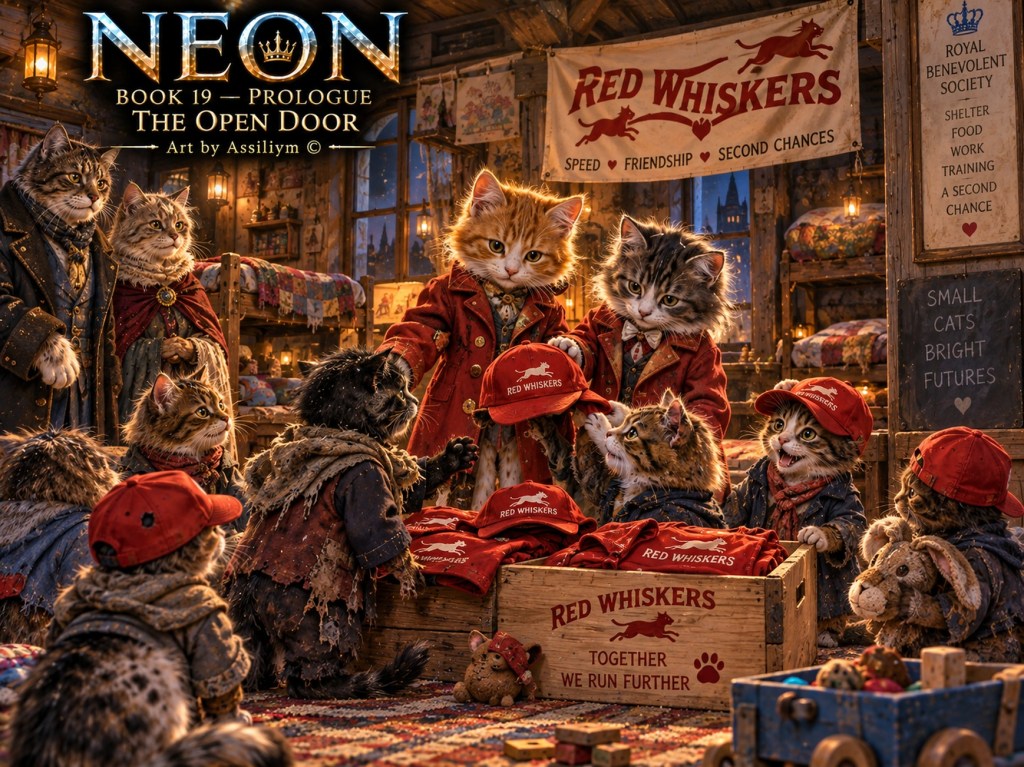
The Open Door surprised Marta before she entered. There was no collector stationed outside, no assistant thrusting subscription papers beneath the paws of respectable passers-by, and no enormous painted board announcing how many thousands of destitute souls had allegedly been redeemed before breakfast. Instead, a young tom in a patched brown coat was leaving as they arrived. He carried a small bundle beneath one foreleg and wore a pair of boots slightly too large for him but unmistakably new. A clerk standing in the doorway shook his paw and reminded him of an address in the warehouse district.
“Monday morning,” the clerk said. “Seven. Ask for Master Rousset, and do not celebrate your employment tonight by spending tomorrow’s breakfast.”
The tom grinned. “I know.”
“You knew yesterday too.”
“That was before employment.”
He went away laughing, and Marta watched him disappear into the traffic of Mercers’ Ward before entering the house.
Inside smelled of bread, soap, old timber and onions frying somewhere beyond the common room. A pair of residents sat copying addresses from an employment board. Near the wall, a she-cat was being fitted with a dark wool coat by an assistant who had apparently decided that dignity began with sleeves of approximately equal length. A merchant’s clerk sat at another table explaining warehouse tallies to an older tom, while near the stairs several pairs of donated boots had been arranged according to size.
Then Marta saw Pommier.
He saw her at precisely the same moment.
There was no introduction, nor any pretence that they were strangers encountering one another beneath charitable circumstances for the first time. Pommier knew Marta Borel. Marta knew Pommier. Bellombre and Canon Valençay were no less familiar, and the memory of their Black Lotto books stood between them as clearly as if Valençay had brought one under his arm.
Pommier’s expression passed swiftly through recognition into caution. “Madame Borel.”
“Chevalier.”
His gaze moved towards Lulo and Pippa, whose victories and absurd adventures at the hippodrome had made them rather more famous in Mercers’ Ward than Marta considered healthy.
“Master Lulo. Mistress Pippa.”
Pippa looked at him with the measured suspicion she had inherited from her mother, although unfortunately she had inherited her father’s appetite for loopholes as well.
Bellombre approached from the common room and gave Marta a small bow. “A pleasure to see the Borel family under a roof where nobody is taking wagers.”
“Yet,” said Marta.
Bellombre placed one paw over his heart. “You wound us.”
“I have watched you work.”
“That explains the accuracy.”
Canon Valençay appeared behind him, dressed in clerical black and, to Marta’s modest relief, carrying neither collection box nor Lotto ledger.
Her friend touched Marta’s arm. “Come. You wanted to inspect.”
“I did not say wanted.”
“You came.”
“That is not the same thing.”
They began with the adult rooms. The room for toms held five beds, four occupied and one stripped down to its uncovered mattress while clean sheets waited folded upon a chair. Marta stopped beside it and asked what had happened to the fifth resident.
“He left yesterday,” Bellombre said.
“Died?”
“No.”
“Removed?”
“No.”
“Prison?”
Bellombre’s mouth twitched. “Employed.”
Marta looked at him.
“A grain merchant took him on as a porter. He is sharing a room with another worker now.”
“And this bed?”
“Another cat is expected before supper.”
Marta examined the empty bed, then the other four, then the chests and washstand. “So you do not keep residents once they can support themselves.”
“That would rather defeat the name of the house.”
“The Open Door.”
“Precisely.”
The female room was fully occupied. Five beds, five chests, five residents. One older she-cat sat near the window sewing a button onto a work dress; another was reading an employment notice aloud to a younger cat; a third had placed a pair of polished shoes beneath her bed with such care that they seemed to possess legal standing.
Marta’s friend had barely entered before she gave a little cry and crossed the room.
“There!”
She touched a thick blanket patterned with small golden leaves.
Marta looked at her. “What?”
“My blankets.”
There was such absurd pride in the declaration that Marta nearly laughed, but the merchant’s wife had already moved to the next bed and found another. Then another. All five were there.
“I gave them last winter.”
The older resident with the sewing needle glanced up. “They are warm.”
“I chose the heavier weave.”
“We know. They take forever to dry.”
The donor blinked.
The resident smiled. “So we try not to spill soup on them.”
…
Lulo and Pippa had brought gifts of their own. They each carried a parcel upstairs, where the kittens from the previous visit recognised them almost immediately. The fifth bed was now occupied by a small black tom who had arrived the previous evening and still watched every doorway as though expecting somebody to order him back into the street.
“You came back,” said the tabby.
Pippa looked faintly offended. “Of course.”
“You did not say you would.”
“I thought it.”
Lulo placed his parcel on the table. “We brought something.”
They opened the packages.
Red appeared.
Five small Red Whiskers caps, properly made and carrying the official team mark, lay in one parcel; five matching shirts filled the other. They were not Lulo’s and Pippa’s own championship clothes, which had already acquired the sacred status reserved for childhood trophies, but new ones commissioned especially for the shelter kittens.
Silence fell over the room.
The little she-cat with the torn ear touched one cap with the tip of a claw. “For us?”
“Yes,” said Lulo.
“All of us?”
“Yes.”
“Official?” asked the tabby.
Pippa looked scandalised by the suggestion that she might distribute counterfeit team merchandise. “Papa complained about the price.”
Lulo nodded. “That means they are official.”
From the doorway came Borel’s voice. “I heard that.”
Everyone turned.
He stood beside Marta.
Pippa looked at him sweetly. “Was it incorrect?”
Borel considered the available answers, discovered that all of them were expensive, and chose dignity. “Continue.”
The caps were distributed. One proved too large and slipped over a kitten’s ear. Another was put on backwards and declared better that way. The tabby immediately pulled his shirt over his existing clothes and stood before the others as though expecting the national anthem.
The new black kitten did not take his shirt immediately.
“I cannot race,” he murmured.
Pippa crouched in front of him. “Neither can Dame Puddles.”
Borel made a small sound behind her.
Lulo attempted to repair the historical record. “She can participate.”
“Exactly.”
The black kitten looked uncertain. “Then why was she on the team?”
Pippa thought carefully. “Paperwork.”
Marta turned towards her husband.
Borel looked at the ceiling. “I wrote one form badly.”
“Historically badly,” Marta said.
The kitten smiled.
Lulo offered him the shirt again. “You do not have to race. It means you are with us.”
That was enough. The little tom took it.
The room became noisy immediately. One kitten wanted to know whether possession of a Red Whiskers cap entitled him to attend the hippodrome. Another asked whether Lady Scratch possessed an official shirt. Pippa explained that Lady Scratch rejected clothing on constitutional grounds; Lulo maintained that the problem had been the fit. Borel began to object to both interpretations but stopped when he noticed Marta watching the children.
She was not looking at him.
She was looking at the room.
One of the new pillows she had brought was already being placed upon the fifth bed. The books had gone to the shelf. The toys were being sorted onto the low cupboards. The blankets were folded according to size. Nothing had vanished through a side door. No assistant had whispered that the best items were needed at another Society property. No crate had mysteriously become an entry in a ledger and then ceased to exist.
Downstairs, one of Marta’s friends found her original golden-leaf blankets and exclaimed with undiminished delight, “My blankets!”
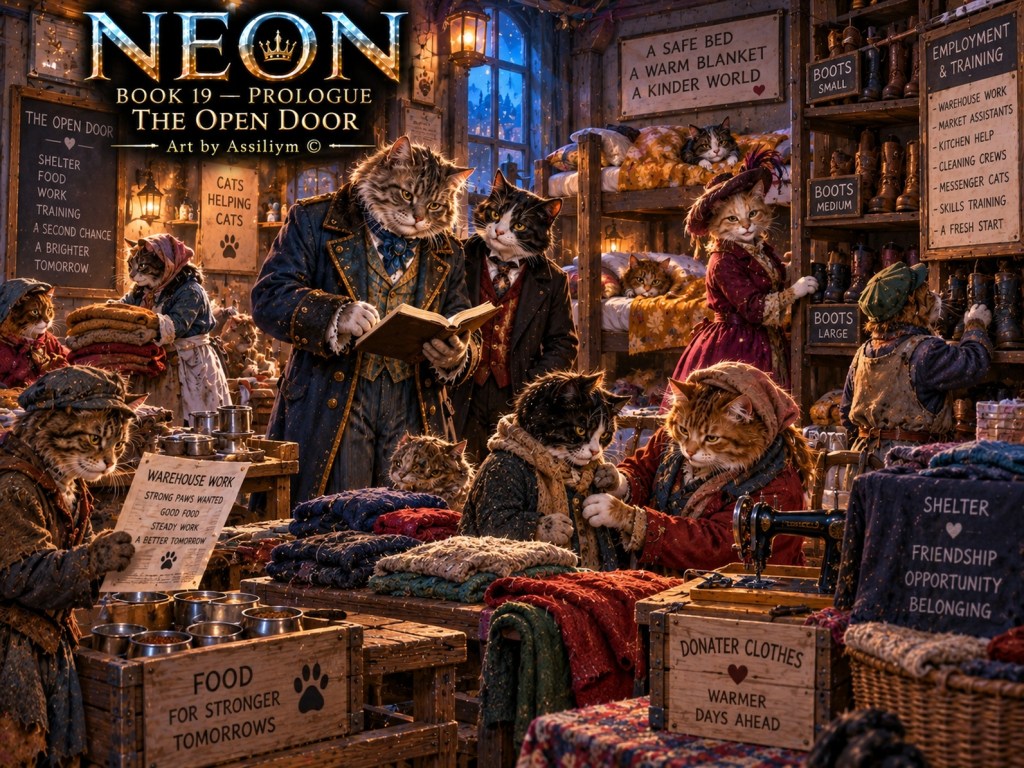
Pippa, meanwhile, had reached the limit of her interest in adult blankets. “Where are the kittens?”
Lulo tried to appear less eager, but his ears betrayed him.
Canon Valençay pointed towards the narrower staircase. “Upstairs.”
The kitten room was warmer than Marta expected and poorer than she wanted it to be. Five small bedsteads stood beneath mismatched blankets, with little wooden chests at their feet. A low bookcase leaned slightly towards the wall. The toy shelf held a cloth rabbit with one repaired ear, several wooden animals, a battered cart, coloured blocks and a doll whose bright yellow dress possessed considerably more confidence than the doll herself.
Four kittens occupied the room that morning. One small tabby tom sat at the round table struggling through a book. A grey-and-white she-kitten was building something from blocks. Another little tom lay upon his stomach turning pages. The fourth, a thin she-cat with a torn ear, sat near the window holding the repaired rabbit against her chest.
They all looked towards the newcomers.
Then they saw Lulo and Pippa.
The tabby slowly lowered his book. “You’re them.”
Pippa straightened immediately.
Lulo glanced sideways at her. “That could mean anything.”
“The Red Whiskers.”
Pippa’s ears rose.
“You won at the hippodrome,” said the grey-and-white kitten.
“We did,” Pippa replied with greater dignity.
“With the duck?”
“Dame Puddles,” said Pippa.
“And the chicken?”
“Lady Scratch,” said Lulo. “And technically she is still a chick.”
The kitten with the rabbit looked doubtful. “They really raced?”
Pippa folded her paws. “They participated.”
“With distinction,” Lulo added.
“Did the duck win?”
A pause followed in which the two Borel kittens confronted the responsibilities of history.
“Movement was not always central to Dame Puddles’ contribution,” Lulo admitted.
Pippa nodded gravely. “She provided authority.”
The four kittens burst into laughter.
Within minutes the distance between them had disappeared. Questions came from every side. Was the hippodrome really enormous? Had King Luis truly watched the races? Were the machines frightening? Had anybody fallen off? Could Dame Puddles steer? Did Lady Scratch really peck officials? How had a duck and a chick been allowed onto an official team in the first place?
“Paperwork,” said Pippa.
Marta turned towards the window before either of her children could see her smile.
Lulo explained that the registration form had required four players, not four kittens, and Pippa had discovered the distinction before their father had. The shelter kittens regarded this not as administrative error but as heroic cunning. By the time the story reached the moment Borel had already stamped the form, Dame Puddles had acquired the dimensions of a legendary general and Lady Scratch those of a revolutionary.
Marta sat near the doorway and watched.

The press had been working since before dawn. Its wooden frame shuddered in the back room, rollers groaned, fresh sheets accumulated on tables, and the smell of wet ink had spread into the tavern strongly enough to compete with breakfast. Borel stood beside the first finished copies with ink upon one cuff and the solemn expression of a statesman who had concluded a treaty without troubling the other signatories.
The principal engraving showed the five kittens of The Open Door standing beneath its sign in their newly acquired Red Whiskers colours. Each wore a red shirt and cap. One cap had slipped over its owner’s ear; another kitten had evidently decided that team membership required a military stance; the little black tom who had arrived only the previous evening looked uncertain whether the artist was immortalising him or preparing evidence for a court.
Above them, in the largest type available without dismantling another newspaper, Borel had printed:
FIVE HOMELESS KITTENS ADOPTED BY THE RED WHISKERS!
Marta stood very still.
Borel saw her.
She read the headline once more and asked, “Adopted?”
“Sportingly.”
“That word does not say sportingly.”
“The article does.”
“The headline says adopted.”
“Because ‘Five Homeless Kittens Receive Honorary Sporting Association with the Red Whiskers’ would require either smaller letters or a wider street.”
“The children have not been adopted.”
“They have been adopted by the team.”
“As what?”
“Honorary Red Whiskers.”
Marta looked at the engraving. “Did anybody ask them?”
“Lulo and Pippa did.”
“That is not a legal procedure.”
“In this family it has become a surprising number of legal procedures.”
She read the article itself and was forced, somewhat against expectation, to concede that Borel had not lied. The smaller print explained plainly that no legal adoption had taken place. The five children remained residents of The Open Door, but Lulo and Pippa, members of the victorious Red Whiskers, had welcomed them as honorary supporters, supplied proper team caps and shirts, and promised that when arrangements could be made the children would be invited to see the games.
Borel had even mentioned the five actual beds in the kitten room and the work of The Open Door with abandoned and runaway children. There was no rescue of forty-seven infants from a burning monastery, no orphan discovered clinging to Dame Puddles during a thunderstorm, and no claim that Pippa had carried six starving kittens across the Seine upon her back.
For Borel, this amounted to journalistic restraint.
Marta turned the page and discovered herself.
Another engraving showed the two carts outside The Open Door, loaded with blankets, pillows, clothing, books, food and toys. Marta stood beside one cart holding her inventory while Lulo carried a parcel and Pippa appeared to be giving instructions to three adults who had probably not requested them.
The heading read:
MERCERS’ WARD OPENS ITS HEART
Beneath it came the sentence:
Madame Marta Borel Leads New Effort for the Homeless Cats and Kittens of Mercers’ Ward.
Marta looked over the newspaper.
“Sabine.”
Borel knew immediately what was coming. “Mentioned.”
“Where?”
He shifted one paw towards the lower half of the article. “Fourth paragraph.”
Marta found it.
“Fourth.”
“It is an excellent paragraph.”
“She took me to The Open Door.”
“Yes.”
“She donated the first blankets.”
“Yes.”
“She persuaded several of those other ladies to contribute.”
“Yes.”
“And you put your wife in the first line and Sabine Vellier in the fourth paragraph.”
“The first line was becoming crowded.”
“Her name goes higher.”
“Second paragraph?”
“Borel.”
“Under the heading?”
“Under the heading.”
He sighed with the suffering of a newspaper proprietor persecuted by historical accuracy.
“And the other ladies are named,” Marta continued.
“They are represented collectively.”
“They are named.”
“There are eight of them.”
“Then you require eight names.”
“That costs ink.”
“So does printing ‘Borel’ in letters visible from Burgundy.”
“My name identifies the publication.”
“Your newspaper already identifies the publication.”
Borel drew himself up. “A newspaper can never possess too much identity.”
Marta turned another page.
Then she stopped.
The headline occupied nearly half the sheet.
BOREL DONATES GUILD WARD BUILDING FOR NEW CHARITABLE HOUSE
Beneath it, in only slightly more restrained type, ran:
ROYAL BENEVOLENT SOCIETY TO EXPAND ITS WORK INTO GUILD WARD
The article continued:
Unused Borel Commercial Property Offered for Conversion into New Shelter and Work-Training House, Subject to Lawful Transfer, Structural Survey, Guild Ward Permits and Approval.
Marta read down until she reached the sentence she had known would be waiting somewhere:
Borel, proprietor of the Republic of the Three Machines and the Hippodrome, whose attractions have brought sport, recreation and commerce to Mercers’ Ward—
She lowered the paper.

“You advertised the machines.”
“I identified the donor.”
“You advertised the Hippodrome.”
“Readers require context.”
“You have described yourself as a civic benefactor.”
“I am giving away a building.”
“Yesterday you said nobody had been promised it.”
“Yesterday nobody had.”
“And when did this change?”
“Between approximately four and six this morning.”
“You woke before dawn to give away a warehouse?”
“I woke before dawn to calculate the consequences of giving away a warehouse. At five twenty-three I accepted them.”
Marta continued to the bottom of the article and found one final piece of commercial genius:
Copies of this special edition may be obtained at The Dame Puddles and Lady Scratch, beside the Republic of the Three Machines and within convenient walking distance of the Hippodrome.
She lifted her eyes very slowly.
“You have advertised the tavern.”
“I have provided directions.”
“You advertised the machines.”
“Landmarks.”
“The Hippodrome.”
“Public orientation.”
“You have put your own name in larger type than the Royal Benevolent Society.”
“Typography is not a moral judgement.”
Lulo and Pippa entered at that moment carrying copies which were still damp enough to stain their paws. Pippa was delighted to discover that the shelter kittens occupied the largest engraving she had ever seen of anybody who was not royal, while Lulo had already found an error in the article concerning which child had first suggested the new caps.
“We are on the front page,” Pippa announced.
“The shelter kittens are on the front page,” Lulo corrected.
“We are mentioned.”
“Papa is mentioned everywhere.”
Borel regarded this as praise.
Pippa bent over the Guild Ward article and compared the letters with a seriousness usually reserved for championship standings.
“Papa’s name is bigger than Mama’s.”
Silence entered the room.
Borel looked at his daughter.
Marta looked at her husband.
Lulo, more experienced in survival, moved one small step away from the printing press.
Borel said, “The typesetter selected—”
“Borel.”
“The next edition can be adjusted.”
“Good.”
Pippa smiled with the satisfaction of a junior auditor.
By eight o’clock Marta’s name had become larger.
By nine, Sabine Vellier’s had moved from the fourth paragraph to directly beneath the heading.
Borel considered the matter closed.
Mercers’ Ward did not.
The first cat to arrive was Sabine herself.
She entered carrying a folded newspaper beneath one arm and wearing the calm expression of a she-cat who had spent years among cloth merchants and knew that the easiest way to defeat male resistance was often to wait until it became arithmetic.
Sabine Vellier was comfortably wealthy, silver-brown, immaculately dressed and possessed of that quiet authority which never required the room to become silent because sooner or later the room did so by itself. Her family’s money came largely from cloth, wool and commercial property, and she had been the friend who had first dragged Marta to The Open Door despite Marta’s deep suspicion of any charitable institution containing Pommier.
She laid the newspaper upon Borel’s table.
“You have decided.”
Borel straightened slightly. “I have.”
“The Guild Ward warehouse?”
“Yes.”
“The one with the loading yard?”
“Yes.”
“The roof still leaks?”
“Only during weather.”
Marta poured coffee.
Sabine sat down. “Then I shall pay the fees.”
Borel blinked. “Which fees?”
“All the lawful ones required to make the gift usable.”
For perhaps the first time that morning his newspaper had failed to prepare him for events.
Sabine stirred her coffee and explained that if Borel was donating the property, she would cover the legitimate legal and administrative expense of transferring it and preparing it for charitable use: the deed, registry charges, legal copies, property searches, survey applications, change-of-use filings, charity registration at the address, structural certification charges, inspection applications and the proper fees required by Guild Ward before any homeless cat could lawfully sleep there.
“Not the rebuilding,” she added. “Not furniture, beds or roof work. I am paying for the machinery of legality.”
Borel regarded her suspiciously. “All of it?”
“All lawful fees.”
“There may be many.”
“I can count.”
“There will probably be seals.”
“I can afford wax.”
“Surveyors?”
“If required.”
“Copies?”
“Yes.”
“Étienne’s office?”
“The proper filing and inspection charges, yes.”
Borel leaned back. He had donated an entire building and had expected, not unreasonably, to remain the greatest philanthropist in the room until at least luncheon. Sabine had given him perhaps forty minutes.
“You realise,” he said, “that this may become expensive.”
“So does an empty warehouse.”
Marta smiled into her cup.

The revised edition had barely begun when, elsewhere in Mercers’ Ward, the Three Parasites discovered what Borel had done.
Chevalier Pommier received the newspaper with breakfast and opened it expecting the usual mixture of machines, sporting disputes, municipal outrage and Dame Puddles presented as though she were a minor member of the royal family.
Instead five homeless kittens stared at him from the front page.
Pommier read the headline.
Bellombre, seated opposite him, looked over the top of his cup.
“What has Borel sold now?”
Pommier turned the paper around.
Bellombre examined the five red shirts and caps.
For several seconds he said nothing.
Then he murmured, “He has transformed five donated shirts into a civic movement.”
Canon Valençay leaned across the table. “Are those our kittens?”
“They are residents of The Open Door.”
“I recognise the little black one.”
Pommier turned the page.
There stood Marta, the two carts and half the charitable ladies of Mercers’ Ward.
Bellombre read over his shoulder. “Marta Borel leads the merchants’ wives.”
“Sabine Vellier has been promoted from paragraph four,” said Pommier.
Valençay nodded approvingly. “Justice moves swiftly when married to the proprietor.”
Pommier turned the next page.
Nobody spoke.
The headline seemed almost to strike the table.
BOREL DONATES GUILD WARD BUILDING FOR NEW CHARITABLE HOUSE
Pommier read it once.
Bellombre took the newspaper from him and read it again.
Canon Valençay leaned so far across the table that his sleeve entered the butter.
At last Bellombre asked, “Has he given us a building?”
Pommier considered the question.
“Apparently.”
Valençay looked from one to the other. “Did anybody tell us?”
“No.”
“Did we ask him?”
“No.”
“Have we seen it?”
“No.”
Bellombre found the smaller heading and read aloud: “‘Royal Benevolent Society to expand its work into Guild Ward.’”
Silence returned.
Pommier took back the newspaper, followed the article to its final paragraph and found Borel’s announcement that the proposed refuge would be developed by the Royal Benevolent Society once lawful transfer, inspection and approval had been obtained.
He lowered the sheet.
“He has advertised our shelter before we have seen the building.”
Valençay wiped butter from his sleeve. “Perhaps it is a very good building.”
“Perhaps it has no floor.”
“Then,” Bellombre said, “Borel will have advertised an unusually open shelter.”
Pommier read the article again.
Then something changed behind his eyes.
Bellombre noticed.
“You are calculating.”
“Of course.”
“That is Borel’s habit.”
“Today he has done it for us.”
Valençay frowned. “How?”
Pommier tapped the picture of the five shelter kittens first, then Marta’s carts, then the building announcement. “Yesterday The Open Door was one small Society house with fifteen beds. This morning it is a story. The kittens are a story. Marta is a story. The Borel family is a story. And now Borel has attached his own reputation to a Guild Ward property we have not yet spent a copper acquiring.”
Bellombre’s smile returned slowly. “And every merchant who dislikes Borel will want to give more than Borel.”
“Exactly.”
The first messenger arrived before Pommier had finished breakfast.
The second came twelve minutes later.
By ten o’clock there were seven.
One merchant wanted to know whether timber would be required. Another asked whether the Society intended to furnish separate male and female rooms. A third offered transport. Two merchant wives wished to know whether the proposed Guild Ward establishment would also shelter kittens. One note contained nothing but the question, WHO IS SUPPLYING THE WINDOWS?
Bellombre held it up.
“Competition.”
Pommier smiled.
“Charity.”
“Competition.”
“Call it whichever brings the boards.”
By late morning Borel’s tavern had become considerably more crowded than he had planned, which ordinarily would have pleased him. The difficulty was that most of the cats entering were not ordering wine.
Master Gaspard Lemoine arrived first among the senior merchants. His position in materials and wholesale trade had trained him to regard every public project as a pile of goods waiting to acquire invoices, and he placed Borel’s newspaper upon the counter with one paw.
“You have given an entire warehouse.”
Borel, who had now answered this question fourteen times, replied, “Yes.”
“And printed it.”
“I own a press.”
“You have also printed yourself larger than the Society.”
“That is irrelevant to the building.”
“It is relevant to me.”
Behind Lemoine came Master Casselin, the marble and building-materials merchant whose yard had supplied half the respectable courtyards in Mercers’ Ward while he complained bitterly about the poverty created by everyone else’s invoices. He carried another copy of the newspaper.
“I have stone.”
Borel stared at him. “Congratulations.”
“For the charity.”
“You have not seen the building.”
“Neither have you in years.”
Marta, sorting the newest letters at the end of the counter, covered a smile.
Casselin continued. “If the survey says the washrooms require stone, I will provide it. If the kitchen hearth needs rebuilding, I will provide what is necessary. If the rear yard needs paving—within reason—I will provide some of that too.”
“Within reason,” Borel repeated.
“I am charitable, not dead.”
Lady Églantine de Vaurieux arrived immediately afterwards, bringing with her two assistants and a conviction that no charitable dormitory in Paris should be permitted to possess curtains selected by toms. She represented textile and luxury cloth interests, and though Marta warned her that The House of the Working Paw was intended to be practical rather than aristocratic, Églantine merely replied that practical cats were also entitled to avoid sleeping beneath blankets the colour of boiled turnips.
“When the rooms are approved,” she said, “I shall supply the first proper sets of bedding. Male rooms and female rooms separately.”
…
Borel smiled.
By half past twelve, the presses had been stopped again.
The ordinary midday sheet was abandoned. Compositors began rearranging type while Borel walked between the cases dictating what he already regarded as the most important commercial announcement since the invention of the Red Whiskers.
The afternoon edition appeared beneath a new banner:
THE MERCHANTS OF MERCERS’ WARD WILL SPONSOR THE NEW CHARITY HOUSE IN GUILD WARD
Beneath it came:
BOREL GIVES THE BUILDING — MERCERS’ WARD GIVES THE HANDS, GOODS AND MATERIALS
Marta read the proof.
“That is better.”
Borel looked mildly disappointed that she had not found anything to attack.
She continued downward. Sabine Vellier’s pledge to pay all proper transfer, registration, survey-application and opening fees was given its own box. Gaspard Lemoine’s materials and wholesale support was listed subject to the builders’ plans. Casselin pledged stone and masonry materials where required. Lady Églantine de Vaurieux undertook bedding, linen and practical textile furnishing once room numbers were approved. Madame Célestine Vaupré pledged tables, benches, cupboards and resident storage. Carters offered transport. Other merchants promised ironwork, locks, nails, glass, kitchen goods and labour, all subject to inspection and actual need.
At Marta’s insistence the article repeatedly used the words proposed, subject to approval, and after inspection.
At Borel’s insistence the bottom of the page still contained:
Copies available at The Dame Puddles and Lady Scratch, beside the Republic of the Three Machines and the Hippodrome.
Marta found it.
“You kept the advertisement.”
“Continuity.”
“You mean profit.”
“Continuity of profit.”
Pippa, who had been comparing the type again, pointed at another line. “Papa’s name is still larger.”
Borel closed his eyes.
Marta said nothing.
Pippa looked from the page to her father.
Borel called towards the press room, “Increase Marta.”
A printer shouted back, “How much?”
Borel looked at his wife.
Marta smiled.
“Two points.”
“Four,” said Pippa.
Borel stared at his daughter. “Whose side are you on?”
“The Red Whiskers.”
“That was not the question.”
“It is always the answer.”
The afternoon edition reached the streets shortly after two.
Mercers’ Ward consumed it greedily.
Shopkeepers pasted copies in windows. Merchants sent editions to clients. Merchant wives circled the names of their friends. Cats who had donated nothing began to discover, with mounting discomfort, that other families had. Two brothers who owned competing warehouses each sent a messenger within twenty minutes because neither intended to allow the other to sponsor more beds. A kitchen-goods dealer, after seeing Célestine Vaupré’s name in respectable type, pledged pots, pans and utensils he had not considered giving away at breakfast.
The Three Parasites received the afternoon edition surrounded by unopened messages.
Bellombre read the new headline and laughed.
“He has done it.”
Pommier took the paper.
“Done what?”
“Turned charity into the Mercers’ Ward championship.”
Valençay examined the donor pledges. “There are no odds.”
“Give them until tomorrow,” Bellombre said.
Pommier did not laugh for long. He was studying the list.
Materials.
Stone.
Textiles.
Furniture.
Transport.
Legal fees.
Possible windows.
Possible ironwork.
Goods pledged before the Royal Benevolent Society had paid to install a single partition.
He looked towards the stack of messages.
“Do not ask them for money.”
Valençay frowned. “Never?”
“Not these cats. Not first.”

By the time the first warning reached Paris-Neon, Princess Anna had already vanished into the forest.
The city knew none of that yet.
It knew only that a Spanish military rider had nearly killed two horses carrying the same message north from the river road, that provincial posts were suddenly sending mounted cats in both directions, and that somewhere beyond the southern approaches to the capital an event had occurred serious enough for guards to stop wagons, inspect crossroads and demand fresh horses without pausing to argue over whose stable owned them.
The message itself had begun upon the wrong bank of a broken bridge.
Captain Esteban de Arriaga had watched helplessly while masked riders seized the Princess he had been ordered to deliver safely to the French court. The river had roared beneath him, the ruined timbers had spun away in the current, and for several intolerable minutes he had possessed soldiers, swords, horses and authority enough to command a small battle while being separated from Anna by less than the width of a river and more helpless than the poorest kitten upon its bank.
He had sent riders upstream and downstream in search of another crossing. He had dispatched others towards the nearest French posts with orders that admitted no misunderstanding.
Princess Anna Beatriz de la Cruz y Montemayor of Spain and Navarre had been attacked upon French soil.
The Princess had been taken.
Find her.
Warn Paris.
The message travelled faster than any carriage.
It passed from one exhausted horse to another, from a roadside military post to a Crown relay, then north through a chain of clerks and officers who added seals, signatures and increasingly alarmed expressions without improving the central fact.
By late afternoon one copy entered Paris-Neon.
By late afternoon plus several minutes, Borel had it.
This was less a consequence of official efficiency than of a peculiar property of Paris: anything important might require an hour to reach the proper minister and six minutes to reach a newspaper office.
Borel was standing over a compositor when the messenger arrived. The matter occupying him at the time concerned a municipal dispute over drainage stones in Mercer Ward, which Borel believed possessed sufficient outrage for a respectable second column but insufficient blood for the front page.
The outer door opened so violently that three loose proofs flew from a table.
A young cat in a road cloak came through it, breathing hard.
“Borel.”
Borel did not turn immediately. “If Mercer Ward has flooded, tell them to wait until I finish explaining why it was inevitable.”
“The Spanish Princess has been kidnapped.”
Borel turned.
The printing house stopped with him.
The press lever remained half lowered. A compositor held a line of type suspended in his paw. Somewhere at the back of the room a cat dropped a bundle of paper, and even that sounded indecently loud.
Borel crossed the floor.
“Say it again.”
The messenger swallowed. “Princess Anna. The Spanish convoy was attacked south of the city. A bridge failed. The convoy was divided. Masked cats struck the rear party and took her.”
“Alive?”
“She was seen alive when taken.”
“By whom?”
“The Spanish captain. He was trapped on the opposite bank.”
Borel’s face changed.
Not alarm.
Something more dangerous.
Professional concentration.
“Who are the kidnappers?”
“Unknown.”
“Ransom?”
“Unknown.”
“Spanish?”
“Unknown.”
“French?”
“Unknown.”
“Political?”
“I said—”
“Unknown. Excellent.”
The messenger stared.
Borel was already walking towards the press.
“Stop everything.”
The compositor found his voice. “Everything?”
“Unless Mercer Ward has kidnapped another princess while I was speaking.”
“No.”
“Then everything.”
Sheets were pulled. Type was cleared. The drainage dispute, which had believed itself destined for notoriety, disappeared beneath a pile of unfinished proofs.
Borel seized a broad sheet and wrote in heavy strokes:
SPANISH PRINCESS KIDNAPPED!
He stepped back.
“No.”
The compositor looked at him.
“Too small?”
“Much.”
The letters grew.
Borel added beneath them:
WHO ARE THE KIDNAPPERS?
Then, lower:
ROYAL CONVOY ATTACKED — PRINCESS ANNA TAKEN ON THE SOUTHERN ROAD
Borel turned towards the presses.
The compositor raised one paw.
“No.”
Borel looked at him.
“We have only just printed these.”
Borel glanced towards the copies announcing that Anna remained kidnapped.
“They are wrong.”
“They were correct twenty minutes ago.”
“History has abandoned them.”
“We printed four thousand.”
“Then sell them before anyone notices.”
The compositor stared.
Borel was already writing.
THE BRAVE LUIS SAVES THE PRINCESS!
He considered it, then added a second heavy line:
THE SPANISH PRINCESS SAVED!
Beneath that:
KING LUIS RIDES TO HER RESCUE!
And finally:
ROYAL PARTY RETURNING TO PARIS-NEON
The compositor looked over his shoulder.
“Do we know he personally found her?”
“We know he personally rode after her.”
“Yes.”
“We know she has been found.”
“Yes.”
“Then between departure and recovery I am prepared to grant His Majesty a reasonable amount of competence.”
The press groaned back to life.
The second edition went into the streets while the first was still being sold.
A newsboy outside the Pont-Neuf discovered the difficulty immediately.
“SPANISH PRINCESS SAVED! THE BRAVE LUIS—”
A broad tom seized his sleeve.
“Saved?”
“Yes, monsieur.”
The tom held up the first edition, purchased moments earlier.
“This says she has been kidnapped.”
“She had been.”
“You sold me this five minutes ago.”
“That was before she was saved.”
“I want my money back.”
“For accurate historical reporting?”
“It is already inaccurate!”
“No, monsieur. It is merely historical.”
The tom looked at the paper, then at the second edition.
“How much?”
“Two sous.”
“You are a thief.”
“Yes, monsieur.”
The second edition sold.
By early evening half Paris possessed two newspapers describing two different conditions of the same Princess.
Borel regarded this as progress.
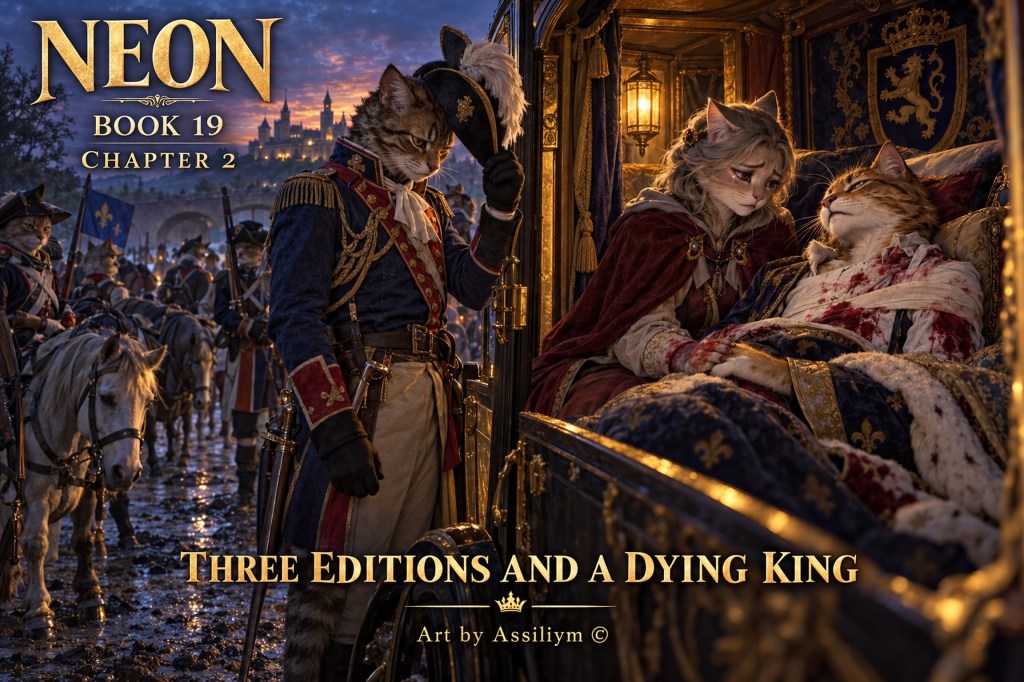
He had no idea that the best edition of the day was still approaching the city in a bloodstained carriage.
…
The royal party did not enter Paris-Neon immediately.
Captain Esteban found them first.
He had finally forced his way back across the river by a distant crossing, ridden through woodland tracks with several of his Musketeers and followed every report he could seize from villagers, guards and road cats. His horse was white with sweat by the time he saw the Spanish royal carriage moving north beneath a small French escort.
He drove his mount forward.
“PRINCESS!”
Anna heard him through the carriage wall.
The door was opened before the coach had fully stopped.
“Esteban!”
The Spanish captain reached the carriage and almost fell from his saddle in his haste to dismount. Mud covered the lower half of his cloak. One sleeve was torn. His face bore the exhausted fury of a cat who had spent hours imagining the speech he would give the universe if it returned his Princess alive.
Then he saw her.
Alive.
Whole.
Blood upon her paws, but not hers.
His shoulders sagged.
“Highness.”
“I am safe.”
“Are you hurt?”
“No.”
He caught her paws.
Then realised what covered them.
His eyes moved past her.
King Luis lay within the carriage beneath folded blankets, his shoulder and upper chest bandaged, the remnants of dark blood visible upon his shirt.
Esteban became still.
“What happened?”
Anna looked back at Luis.
“He found me.”
“The King?”
“He came himself.”
Esteban stared at the apparently unconscious figure.
“The bandits?”
“Driven off. He fought their leader.”
Her voice tightened.
“He was wounded.”
Esteban removed his hat.
For him there was no mystery.
He had seen the kidnapping.
He had watched Anna carried into the forest while the broken bridge imprisoned him on the opposite bank. He had ridden himself and his cats nearly to collapse trying to reach her.
And now she was alive.
The King of France appeared half dead.
Captain Esteban bowed his head.
“I owe His Majesty more than I know how to say.”
Luis heard this perfectly well and, behind closed eyes, experienced the first uncomfortable sensation that the plan had acquired moral debts not included in Vasili’s calculations.
Anna said, “We need to reach Paris.”
Esteban nodded. “I ride with you.”
That made the returning party considerably more official.
It also made secrecy considerably more impossible.
At the next Crown posting station the carriage stopped for fresh horses and a physician. Cats came running before the wheels ceased moving. Anna’s ladies, who had been recovered from the disordered convoy and brought forward by the Spanish escort, surrounded her. French officers saw the blood. Spanish Musketeers repeated what they knew. Captain Esteban demanded the fastest teams in the district.
A physician attached to the Crown post was brought at once.
Before he entered the carriage, Vaurin took him aside. The conversation lasted less than a minute and was conducted too quietly for Anna or the Spanish officers to hear. The physician’s expression altered once, then became professionally blank.
He was admitted to the carriage.
He emerged several minutes later wearing the grave expression of a cat who understood that His Majesty’s condition had become a matter of state as well as medicine.
“The King lives.”
Anna closed her eyes in relief.
“Is he safe?”
“The wound is serious. His Majesty has lost blood and must not be disturbed.”
This was true only in the sense that a quantity of blood had indeed been lost in proximity to His Majesty.
Anna accepted it as gospel.
Luis frowned. “What does Borel have to do with medicine?”
Vasili reached beside the chair.
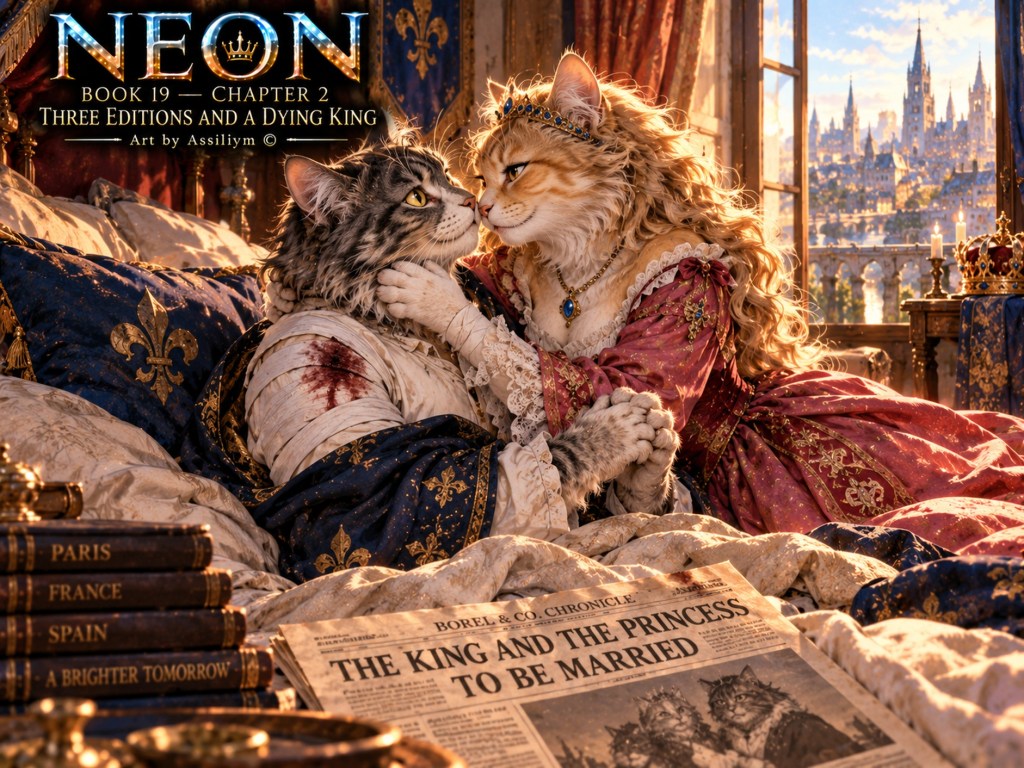
There lay three folded newspapers.
Luis saw them.
“What are those?”
“The present state of your health.”
Vasili took the first and placed it upon the bed.
SPANISH PRINCESS KIDNAPPED!
Luis stared.
“Already?”
Vasili put down the second.
THE BRAVE LUIS SAVES THE PRINCESS!
Luis’s mouth twitched.
Then the third.
THE PRINCESS WILL MARRY LUIS — IF HE LIVES!
Luis stopped smiling.
Vasili, by contrast, was deeply pleased.
“Three editions.”
“In one afternoon?”
“Borel has had a productive day.”
Luis picked up the first paper, then the second, then returned to the third.
“He printed this?”
“Paris is currently reading it aloud to itself.”
“How does he know?”
Vasili shrugged. “A carriage has thin walls, a royal road has many ears, and frightened ladies talk. I imagine the sentence passed through twenty mouths before reaching him.”
Luis looked again at the enormous headline.
Vasili leaned back.
“Well, Your Majesty.”
“What?”
The old spy chuckled.
“Now she cannot say no.”
Luis’s eyes lifted.
“Yes, she can.”
Vasili’s amusement faded.
“Majesty?”
“She can say no.”
Vasili tapped the newspaper. “She has already said yes.”
“No.”
“She promised to marry you.”
“She promised a dying cat.”
“You were the dying cat.”
“I was pretending.”
“An important distinction to us. Less so to her.”
Luis placed the paper down.
The room quietened.
He saw again the inside of the carriage. Anna’s paws red with rabbit blood. Her face pale. The desperate pressure of her hand around his. The way she had whispered just live after giving him the answer he had wanted.
“She was terrified.”
Vasili watched him.
Luis continued, more quietly, “She came here because I told her she could meet me and choose. I told her she could accept me or refuse me.”
“Yes.”
“And then I arranged a kidnapping, pretended to bleed to death in her lap and obtained an answer while she thought she was losing me.”
Vasili scratched lightly at the mark Anna had left upon his cheek.
“When described that way, Majesty, the plan loses some elegance.”
“It had elegance?”
“At the bridge.”
Luis almost smiled, but did not.
Vasili picked up the third paper.
“Whether you like it or not, Paris believes she has accepted you.”
“That is precisely the problem.”
Luis went to the window but did not open the curtain. Outside, somewhere beyond the palace wall, faint voices carried through the night.
One of them was shouting Borel’s headline.
Luis heard his own name.
Then Anna’s.
He turned.
“She can still say no.”
Vasili looked at him for several seconds.
Then nodded once.
“Very well.”
Luis looked suspicious. “That easily?”
“I helped you kidnap a Spanish Princess today. I have exhausted my appetite for argument.”
Luis looked down at himself. Beneath a clean shirt the shoulder was bruised darkly where Vasili’s blade had struck the hidden leather.
“When can I leave?”
“Tomorrow afternoon.”
Luis stared.
“Tomorrow?”
“If the physician announces the bleeding has stopped tonight, fever has not developed by morning, and His Majesty has miraculously retained sufficient strength to sit upright after noon.”
“I can sit upright now.”
“That is because you have not been informed how ill you are.”
“This is absurd.”
Vasili gathered the newspapers.
“No, Majesty. Absurd was the pig intestine. This is administration.”
…
Across the palace, Princess Anna had not eaten.
A supper tray arrived and cooled untouched.
A second was sent.
She ignored that too.
Her Spanish ladies remained with her, speaking quietly whenever silence became unbearable and falling silent whenever footsteps passed the door. Every time someone entered the outer apartment Anna looked up.
Every time it was not the physician, disappointment crossed her face.
“Any word?”
“His Majesty is resting, Highness.”
That was all anyone seemed able to say.
Resting.
Stable.
The physician was cautiously hopeful.
The wound had been serious.
He had lost much blood.
Anna began biting the edge of one claw.
Doña Catalina, the oldest of her ladies, gently caught her paw.
“My lady.”
Anna looked at her.
“You will have no claws left by morning.”
“I do not care.”
“You will when you wish to scratch somebody.”
“I shall use the other paw.”
Catalina smiled faintly.
Anna did not.
She stood and crossed to the window again.
Beyond the palace walls Paris-Neon glowed beneath thousands of lamps. Somewhere out there the city continued eating, drinking, bargaining, gossiping and shouting news about a day which Anna had not yet properly understood herself.
She turned away.
“I should be with him.”
“The physician said he must rest.”
“He came into a forest for me.”
“Yes.”
“And I am sitting here because a physician says he needs quiet?”
“He nearly died, my lady.”
Anna stopped.
The words struck every time.
Nearly died.
For her.
She returned to the travelling cases which had been brought into the apartment earlier but remained mostly unopened. One contained dresses. Another contained correspondence and personal papers which no servant was permitted to unpack without her.
Anna knelt beside it.
Catalina watched.
“What are you looking for?”
Anna did not answer.
She opened the inner compartment and drew out a narrow bundle tied with faded blue ribbon.
The ladies recognised letters.
Anna carried them to the chair near the lamp and sat.
For several moments she merely held them.
Then she untied the ribbon.
The first letter was years old.
The paper had softened at the folds from being opened many times. A younger Luis had written it before kingship placed formal secretaries around every sentence. His handwriting slanted unevenly when he became excited, and one line near the bottom crowded into the margin because he had clearly refused to begin another sheet.
Anna smiled despite herself.
“What is it?” asked one of the younger ladies.
“He complained about a banquet.”
Catalina smiled. “A prince complaining about food?”
“Not the food. The speeches.”
Anna began reading a few lines silently.
She remembered them.
Luis had counted seventeen speeches before pretending to become ill. He had written that if an eighteenth began he intended to climb through the chapel window and seek asylum among gardeners. In another letter he had asked what Madrid smelled like after rain. In another he had proposed several increasingly ridiculous methods of punishing a duke who had insulted Spanish horses.
Those letters had belonged to a boy prince who had spoken to her as Anna rather than Spain.
She took another.
And another.
Then the smile disappeared.
The paw which had written them might, at that very moment, be cold upon a pillow only a few corridors away.
Anna brought one letter to her lips.
She kissed it.
Her eyes closed.
“Please,” she whispered.
The ladies became quiet.
Anna pressed the folded page against her chest.
“Please let him live.”
Catalina came nearer.
Anna looked at the handwriting again.
“He loved me.”
Her voice was very small.
Catalina corrected her gently.
“He loves you, my lady.”
Anna looked up.
One of the younger ladies, Marisol, had tears in her eyes.
“He rode after you himself.”
Anna swallowed.
“He really loves me.”
“Yes.”
Another lady sat beside her.
“He is a King, my lady. And if you marry him, you will be his Queen.”
Anna almost laughed through the tears.
“That sounds like something my father’s ministers would say.”
“No.” Marisol shook her head. “The ministers would speak of Navarre and treaties and alliances. I mean something else.”
Anna waited.
The young she-cat smiled.
“He loves you.”
Anna looked down at the letters.
Marisol continued, carried now by the romance of it. “He heard bandits had taken you and rode into the forest. He fought them himself. He nearly died saving you. It is almost like the old fairy tales.”
Catalina glanced at her, perhaps considering intervention.
Marisol went on.
“How could any princess say no to that?”
The room became very quiet.
Anna looked from one lady to another.
No one was ordering her.
No one mentioned Spain’s interests or France’s crown. They were simply looking at her with the enchanted certainty of cats who believed they had witnessed a love story.
Anna lowered her eyes to Luis’s letter.
“I came because I needed to know.”
“Know what?” Catalina asked.
“Whether he was still there.”
“The King?”
“No.”
Anna touched the old handwriting.
“The prince.”
She remembered him arriving at the mill, mud upon his boots, sword in his paw, saying her name as though France did not exist beyond it.
“He was.”
Her eyes filled again.
“He came for me.”
Catalina placed a paw gently upon her shoulder.
Anna kissed the letter once more.
Then she whispered the thing she had been frightened to say even to herself before leaving Madrid.
“I love him.”
Marisol smiled.
Anna looked almost surprised by her own confession.
“I love him.”
This time the words were stronger.
Not because he was King.
Not because he had rescued her.
Not because she had promised marriage in a carriage soaked with blood.
Because somewhere across years of letters, memories, arguments and distance, the young prince had remained lodged inside her heart long enough for the King to find him again.
A knock interrupted them.
Anna was on her feet before the servant entered.
“The physician?”
“No, Highness.”
Her shoulders fell.
The servant held several folded papers.
“These were brought from the city.”
“What are they?”
“Newspapers.”
Anna almost dismissed them.
Then she saw her own name.
Marisol took the top sheet first.
Her eyes widened.
“Highness.”
Anna reached for it.
SPANISH PRINCESS KIDNAPPED!
She stared.
“What?”
The second paper appeared beneath it.
THE BRAVE LUIS SAVES THE PRINCESS!
Anna stared longer.
Then Catalina found the third.
She stopped.
“Oh.”
Anna looked at her.
“What?”
Catalina did not answer quickly enough.
Anna took the paper.
Across almost the entire width of the page:
THE PRINCESS WILL MARRY LUIS — IF HE LIVES!
Anna stopped breathing.
She read it once.
Then again.
Her head lifted slowly.
“Who is Borel?”
The ladies looked at one another.
Catalina answered carefully. “A publisher, Highness.”
“A publisher.”
“Yes.”
Anna pointed at the enormous headline.
“How does this publisher know what I said inside my carriage?”
Nobody volunteered an explanation.
Anna turned the sheet over as though the back might contain a confession.
“He was not in the carriage.”
“No, Highness.”
“He was not at the mill.”
“No.”
“He was not at the bridge.”
“No.”
“Then why does Monsieur Borel appear to know my day better than I do?”
Marisol was attempting desperately not to smile.
Anna saw her.
“This is not funny.”
“No, my lady.”
“You are smiling.”
“I am frightened.”
“You smile when frightened?”
“Sometimes.”
Anna crossed to the window.
A cry came faintly from outside the palace grounds.
“THE PRINCESS WILL MARRY LUIS—!”
She froze.
Another newsboy answered farther away.
“IF THE KING LIVES!”
Anna slowly turned towards her ladies.
“They are shouting it.”
Catalina maintained admirable composure.
“Yes, Highness.”
“In the street.”
“Yes.”
“I arrived in France today.”
“Yes.”
“I have been kidnapped, rescued and married before my trunks are unpacked.”
This time Catalina’s composure failed.
A small laugh escaped.
Anna stared at her.
Then, despite everything, Anna laughed too.
It lasted only a moment.
Her eyes returned to the third newspaper.
IF HE LIVES.
Her paw tightened around it.
“He had better.”
…
The following morning King Luis was officially improved.
Not recovered.
Vasili refused the word.
Improved.
The royal physician issued a statement describing a quiet night, continued weakness, absence of fever and cautious optimism. Paris responded by purchasing the third edition again from anyone who still possessed copies.
Inside the bedchamber, Luis was engaged in a dispute over trousers.
“I am getting dressed.”
“No,” Vasili said.
“I am receiving Anna.”
“In bed.”
“I am not proposing marriage from beneath a blanket.”
“You nearly died yesterday.”
“I am aware of the public version.”
“You will remain aware of it.”
Luis pulled on one boot.
Vasili removed the other.
Luis stared.
“Give me that.”
“No.”
“Vasili.”
“Majesty.”
“I can have you imprisoned.”
“You would have to explain why your dying self is walking to the dungeon.”
Luis considered murder.
The physician, who had entered during the argument, closed the door behind him.
“I recommend compromise.”
Luis pointed at Vasili. “Excellent. Tell him I can stand.”
“You can stand.”
Vasili looked betrayed.
The physician continued, “For a short period.”
Luis smiled.
“And you should appear weak.”
The smile vanished.
“Sit often. Favour the shoulder. Do not lift anything.”
Vasili nodded approvingly.
Luis said, “Whose physician are you?”
“At present? History’s.”
A servant announced Princess Anna.
Everything changed.
Luis dropped the argument.
Vasili collected the newspapers.
The physician adjusted the bandage.
Luis looked towards the mirror, saw that he appeared far healthier than yesterday’s rumours permitted, and sat quickly upon the edge of the bed.
“Pale enough?”
Vasili looked at him.
“No.”
“How does one become pale?”
“Think of taxes.”
Luis tried.
The door opened.
Anna entered carrying Borel’s third edition.
She saw Luis upright.
Her entire face changed.
Relief came first.
Then anger.
Then relief again.
She crossed the room rapidly.
“You are alive.”
Luis smiled. “Apparently.”
She stopped in front of him.
For one second he thought she might embrace him.
Instead she struck him lightly upon the uninjured arm.
“Ow.”
“That was not the wound.”
“No.”
“Good.”
Then she embraced him.
Carefully.
Luis closed his eyes.
Vasili and the physician discovered sudden professional interest in the far side of the room.
Anna released him and immediately examined his face.
“You look pale.”
“Taxes.”
“What?”
“Nothing.”
She held up the newspaper.
“Who is Borel?”
Luis saw the headline.
“A national problem.”
“How does a national problem know what I said inside my carriage?”
Luis looked at Vasili.
Vasili looked at the ceiling.
Luis said, “I genuinely do not know.”
“Everyone knows.”
“Yes.”
“They are shouting it outside.”
“That is usually what happens once Borel learns something.”
Anna put the newspaper upon the bed.
“So according to Paris, I am marrying you.”
Luis looked at the words.
His expression became quieter.
“Yes.”
Anna noticed.
“What?”
He reached for her paw.
“Sit.”
She did.
Vasili glanced towards the physician.
Both understood that they had become unnecessary.
They withdrew without ceremony, leaving the door partly guarded outside.
Luis remained silent for a moment.
Anna studied him.
“You are frightening me again.”
“I do not mean to.”
“Then stop looking like a King about to announce a war.”
Luis almost smiled.
“This is worse.”
“Worse than war?”
“For me.”
He picked up the newspaper.
“Anna, what you said in the carriage…”
She looked down.
“I remember.”
“You thought I was dying.”
“I thought you had died.”
“I know.”
Her paw tightened.
Luis continued carefully. “You were frightened. You had blood on your paws. The carriage was racing. You had just been kidnapped and rescued within the same afternoon.”
Anna watched him.
“You said you would marry me if I lived.”
“Yes.”
“And I lived.”
“Yes.”
Luis swallowed.
“You may still say no.”
Anna stared at him.
He forced himself to continue before courage abandoned royalty.
“I mean it. Borel does not decide for you. Paris does not decide. Spain does not decide. France does not decide. You came here because I told you that you could see me again and choose freely.”
Anna’s expression softened.
Luis looked down at their paws.
“You gave what you thought was a dying cat an answer because you were terrified of losing him. I asked Princess Anna to choose me freely. I will not steal the answer from a frightened cat in a carriage.”
For several seconds she said nothing.
Then suddenly she seized him and pulled him towards her.
Unfortunately, Princess Anna’s enthusiasm exceeded the physician’s instructions.
Her arm closed around the injured shoulder.
Luis nearly left the bed.
“OUCH!”
Anna released him instantly.
“Sorry!”
Luis froze.
The room changed.
His face went white.
Not taxes.
Terror.
Anna saw it and panicked.
“Luis?”
He stared at her.
She thought she had hurt him.
He thought she had answered him.
“Sorry?” he repeated faintly.
“Yes! I am sorry. I forgot the wound.”
Luis heard only the first three words.
His stomach dropped through France.
“Oh.”
Anna reached for him.
“Are you all right?”
He looked suddenly so pale that she became genuinely frightened.
“Luis!”
“I…”
He swallowed.
“You…”
“What?”
He seemed unable to complete the sentence.
Anna took his face gently between her paws.
“Tell me where it hurts.”
Luis looked at her miserably.
“You didn’t…”
He stopped.
Anna waited.
“You didn’t want me.”
She blinked.
“What?”
“You said sorry.”
There was a moment of complete silence.
Then Anna understood.
Her mouth opened.
“You thought—”
Luis looked away.
Anna stared at him.
The King of France, who had arranged the kidnapping of a Spanish Princess, broken a bridge, employed a pig intestine full of rabbit blood and fought a false bandit chief without losing his nerve, now appeared close to collapse because one word had sounded like rejection.
Anna began laughing.
Luis looked wounded in an entirely new place.
“This is not especially—”
“You silly cat.”
She caught him again.
Luis instinctively guarded the shoulder.
Anna was more careful this time.
She pulled him close enough that their noses almost touched.
“Of course I don’t like you.”
Luis’s eyes widened.
For the second time in less than a minute his heart attempted to abandon public service.
Anna smiled.
“I love you.”
He stopped.
Completely.
“I have loved you through letters, through years, through all the ridiculous things you wrote to me when you were a prince. I came to France because I needed to know whether that cat still existed beneath the crown.”
Luis barely breathed.
Anna touched his cheek.
“He does.”
Then, before the King could recover enough language to ruin the moment, she kissed him.
Not the frightened kiss of a princess beside a dying cat.
Not a courtly gesture offered because ministers waited.
A long, fierce, deliberate kiss given by Anna herself.
Luis forgot the wound, the newspapers, the palace, Spain, France and approximately half the responsibilities of monarchy.
When she finally drew back, he remained staring at her.
Anna smiled.
“Does that answer you?”
Luis blinked.
“I may need…”
Her eyebrow rose.
“Need what?”
“Confirmation.”
She kissed him again.
When she released him, Luis leaned back against the pillows looking as though the physician might genuinely be required after all.
Anna laughed.
“Better?”
“Considerably.”
The door opened cautiously.
Vasili put his head through.
“Majesty?”
Luis looked at him.
Vasili saw Anna.
Saw the King.
Saw the expression upon both faces.
His own smile began.
Luis pointed towards him.
“Vasili.”
“Yes, Majesty?”
“Find Borel.”
The smile widened.
Anna looked between them.
“What?”
Luis picked up the third newspaper.
“Apparently he requires an ending.”
Anna folded her arms.
Luis looked at her.
“May I tell him?”
She pretended to consider.
The pause nearly killed him again.
Then she smiled.
“Tell him I said yes.”
Luis turned immediately.
“You heard her.”
Vasili was already at the door.
“Another edition?”
“The final one.”
Vasili disappeared.
Luis called after him, “And Vasili!”
The spy stopped outside.
“Yes, Majesty?”
“This time make certain Borel gets the story after it happens.”
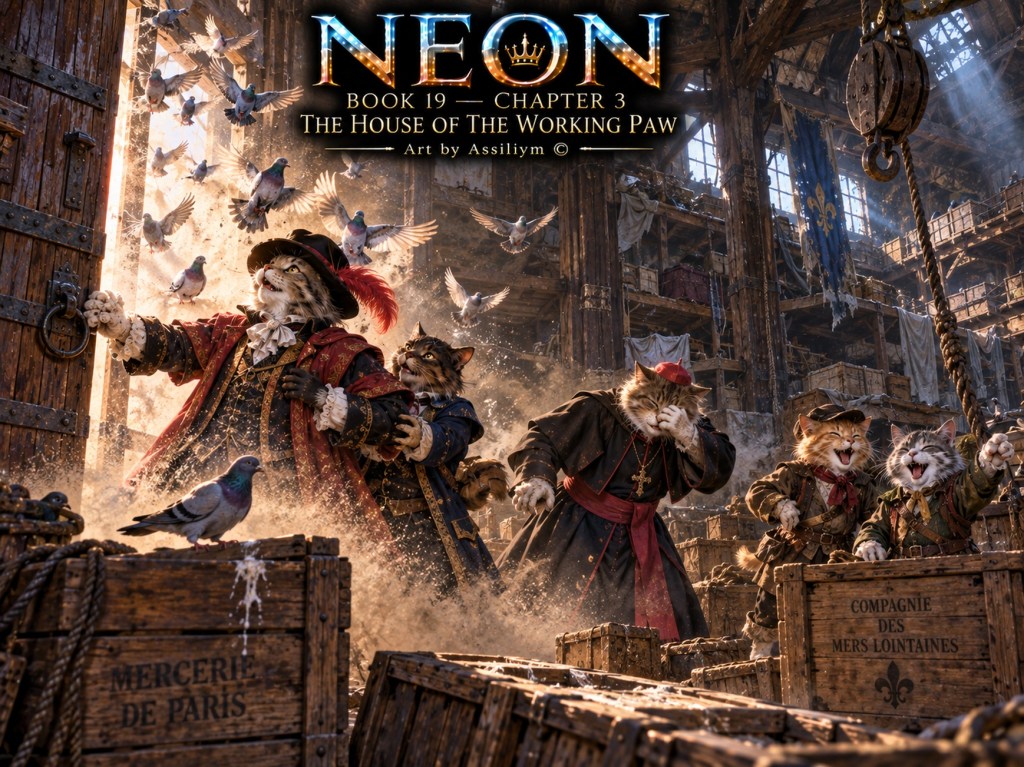
The warehouse had not expected visitors.
For years it had stood in one of the quieter commercial streets of Guild Ward with its shutters closed, its loading doors chained and its upper windows wearing a grey film which made the daylight beyond them appear permanently exhausted. Borel had acquired it during a period in which he had been convinced that every empty building in Paris represented an insult directed personally at a merchant who had not yet bought it. For several useful years it had held barrels, timber, crates of imported goods, broken furniture awaiting resale, sacks of grain which had been purchased cheaply and sold less cheaply, and once, for a memorable and financially unsuccessful winter, six hundred ceramic pitchers whose handles had proved unable to survive transportation. Commerce had eventually moved elsewhere. The warehouse remained. Renters had been proposed, rejected or frightened by the roof. Repairs had been postponed with the solemn regularity by which postponement eventually becomes a form of ownership, and the building had settled into that peculiar sleep of unused property: not abandoned enough to be ruined, not profitable enough to be loved.
Borel halted before it with the old iron key in one paw and a procession of cats behind him which had grown considerably larger than the private family inspection Marta had first suggested.
“This,” he announced, looking up at the frontage, “is a substantial commercial property.”
Marta examined the shuttered windows.
“It is an empty warehouse.”
“It was not always empty.”
“Neither was the Bastille.”
Borel looked at her. “The comparison is offensive to architecture.”
Master Casselin, who had come because masonry was involved and because he considered the inspection of other cats’ neglected buildings an inexpensive entertainment, leaned backwards until he could see the upper cornice. “Roof line has dropped slightly on the left.”
“It has settled.”
“It has sagged.”
“Settled.”
Gaspard Lemoine, standing beside him with a folded measuring rule protruding from his coat, glanced at the gutter. “That piece has settled into the street.”
Borel followed his gaze. A length of corroded gutter hung several inches lower than the rest and appeared to be contemplating independence.
“It requires adjustment.”
Marta folded her paws.
Borel turned towards the lock.
Behind them stood Sabine Vellier with her packet of legal papers; Chevalier Pommier, Bellombre and Canon Valençay; Lulo and Pippa, both wearing Red Whiskers caps because Pippa had decided that charitable property inspection was apparently a sporting event; Célestine Vaupré, who had come to judge whether future furniture could reasonably be introduced through the doors; and two assistants from Lemoine’s commercial house who had brought chalk, cord and a measuring rod despite nobody having formally asked them to do so.
The key entered halfway and stopped.
Borel pushed.
Nothing happened.
He withdrew it, wiped it upon his sleeve and tried again.
The lock remained loyal to the previous decade.
Casselin watched sympathetically. “Excellent lock.”
Borel glared at him.
“Very secure,” Casselin continued. “Especially against owners.”
Borel twisted harder. Somewhere inside the mechanism something protested with a metallic groan.
Pippa stepped closer. “Do you want me to try?”
“No.”
“I am smaller.”
“That is not an advantage against iron.”
“I have won things.”
“Not locks.”
Lulo examined the door. “Maybe the building does not want to be charitable.”
Marta turned her face aside.
Borel muttered something concerning children, inheritance and gratitude, braced one foot against the stone threshold and put his weight into the key. The lock resisted for another second, then gave with such sudden violence that Borel stumbled backwards into Bellombre.
Bellombre caught him by the shoulders.
“An auspicious beginning.”
“I had it.”
“Of course.”
Together they dragged the loading door open.
Dust came out first.
It rose in a pale sheet from the threshold, swirled around their boots and sent Canon Valençay into a coughing fit so ecclesiastically dignified that even Pommier waited before laughing. Beyond the dust lay a long warehouse floor receding beneath heavy rafters. Old storage racks leaned against one wall. Thick timber posts divided the space into broad bays. A pulley hung from an overhead beam, its rope stiff with age. Several faded merchant marks remained painted upon the plaster, and one enormous numeral from an old inventory had survived above a doorway without any surviving object to explain it.
Light entered reluctantly through the dirty windows.
A pigeon flew from the upper gallery.
Then another.
Borel looked at Marta.
“Former occupants.”
“They still appear to be paying no rent.”
“They are leaving.”
A third pigeon dropped something upon an abandoned crate.
Casselin nodded. “One has left notice.”
The children collapsed into laughter.
Borel walked into the building with what dignity remained.
The warehouse was neglected, but it was not worthless. That became apparent once the first impression of dust, stale air and pigeon government had passed. The main floor was wide and comparatively level. The principal walls were thick. A staircase at the rear climbed to a broad upper level which had once held lighter stock and account boxes. An old office occupied the front corner, still containing a desk, two shelves and a iron hook from which some forgotten clerk had once hung his coat. Behind the building, a pair of double doors opened towards the former loading yard.
That yard was worse.
Weeds had conquered most of the stones. Broken crates lay against the wall. One rusted wheel hoop protruded from the ground. A rain barrel had split so completely that it now served principally as an argument against barrels. The drainage channel had filled with leaves, moss and a quantity of soil sufficient to support three enthusiastic nettles.
Pippa looked around.
“Is this the garden?”
Borel answered immediately. “No.”
Marta came through the doorway behind her. “It could be.”
Borel turned. “It is a loading yard.”
“It is not loading anything.”
“It has historical function.”
“It has nettles.”
“Those can be removed.”
“Exactly.”
Borel realised what he had done and closed his mouth.
Lulo walked to the far wall, where an old cart ring remained fixed in the stone. “Could there be a bench here?”
Pippa had already advanced further. “And flowers.”
“No flowers yet,” said Marta. “First we find out whether the roof intends to remain above us.”
Casselin had already returned inside and was tapping the lower wall with the handle of his walking stick. Gaspard Lemoine examined one of the principal posts. Célestine stood in the centre of the warehouse turning slowly and measuring invisible furniture with her eyes.
Pommier did none of these things.
He stood almost perfectly still.
Bellombre knew the expression.
“What?”
Pommier did not answer.
His gaze moved from the front office to the upper floor, across the warehouse bays, towards the rear door and back again. He was not seeing dust, cracked plaster or merchant racks. He was dividing.
Marta noticed too.
“Do not count anything yet.”
Pommier looked at her.
“I have not spoken.”
“You have the same face Borel gets when somebody mentions an unused room.”
Borel objected. “I have several faces.”
“You have three. Profit, suspected profit and denied profit.”
Bellombre coughed into one glove.
Pommier smiled. “I was considering capacity.”
“There,” Marta said.
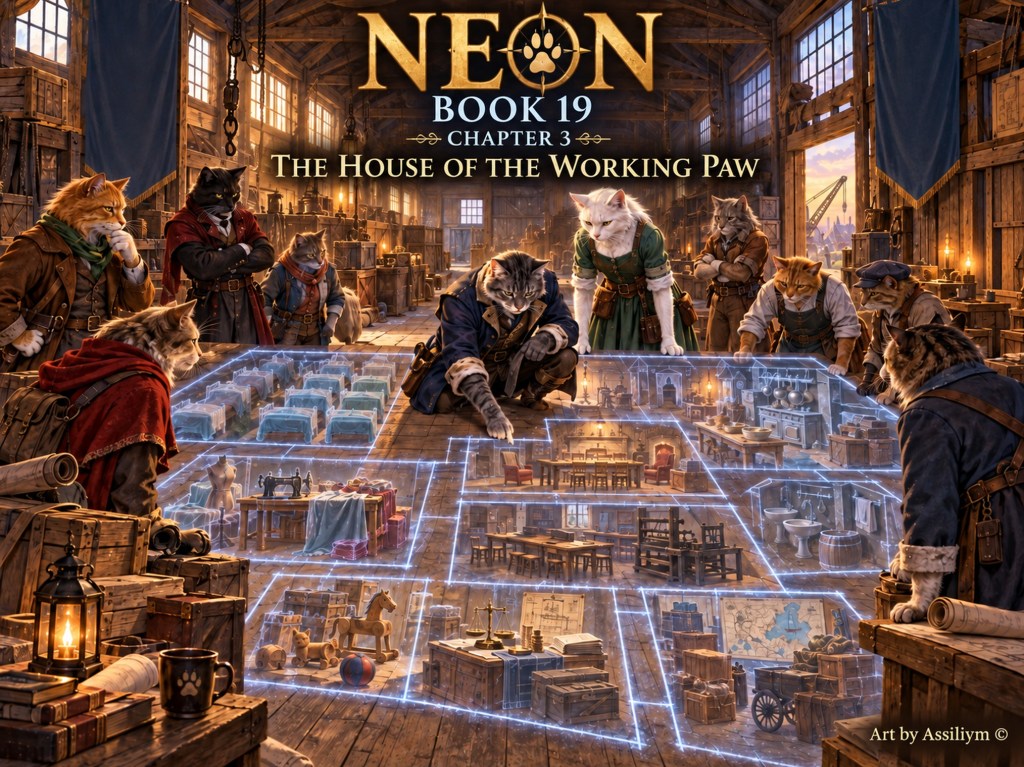
They found an old packing table large enough to carry Borel’s surviving pride, brushed the dust from it and spread paper across the surface. Lemoine produced his measuring rule. One of his assistants tied chalked cord between two posts and snapped the first straight line across the floor. The sharp blue-white mark upon the dusty boards changed the room more completely than any speech could have done. Until that moment the warehouse had still belonged to its past. The line suggested a future.
Pommier placed one paw upon the plan.
“Twenty.”
Marta looked up immediately.
“Twenty what?”
“Beds.”
“Physical beds?”
Bellombre smiled.
Pommier looked directly at her. “Twenty physical beds, Madame Borel.”
“Beds which can be touched.”
“Yes.”
“Beds with mattresses.”
“Yes.”
“Beds with cats actually sleeping in them when the house opens.”
“When occupied, yes.”
“Not twenty beds which become eighty-seven cats after you apply arithmetic to them.”
Canon Valençay suddenly found the ceiling interesting.
Pommier remained remarkably composed. “Twenty actual bedsteads.”
Marta nodded. “Good. I shall remember the adjective.”
Borel leaned over the plan. “Where?”
The building divided more naturally once they began measuring it. Four sleeping rooms could be created from the broader upper and side spaces without reducing them to cramped dormitories. Pommier proposed five beds in each room rather than ten packed into two larger halls. Marta approved at once. Bellombre saw the fundraising implications almost as quickly.
“Two male rooms,” he said, marking the plan lightly, “and two female.”
“Five each,” Marta replied.
“Ten and ten.”
“Twenty,” said Pommier.
Borel looked suspicious. “Still twenty?”
“Still twenty.”
“Good.”
The two teaching rooms took longer.
Célestine wanted one beside the common room because she thought residents learning household repair should be near the storage cupboards. Lemoine preferred both on the lower floor because materials could be brought in more easily. Canon Valençay suggested that one room could also serve for lectures on moral improvement until Marta asked whether moral improvement required sawdust.
“It can.”
“Then teach it elsewhere.”
Pommier finally drew two substantial rectangles along the ground floor, separated from the future dormitory areas and large enough for tables, benches, slates, small hand tools and visiting instructors.
“What will they teach?” Borel asked.
“Useful things,” said Pommier.
“That is not a trade.”
“Neither is printing headlines, yet you have prospered.”
Borel chose to ignore this.
The discussion soon became more serious, because Guild Ward contained enough dangerous trades to kill a charitable project through enthusiasm alone. Somebody suggested elementary smithing. Marta looked at the wooden floor, the timber beams and the roof which had already attracted professional doubt.
“No.”
Lemoine nodded. “No forge.”
Canon Valençay suggested metal polishing.
“Elsewhere,” said Marta.
Casselin proposed stone-cutting exercises until Sabine asked whether he intended to fill the shelter with dust before the residents arrived.
“Small stones.”
“No.”
Dyeing met a similar fate.
Sabine, whose household wealth came partly through cloth, was decisive. “Basic fibrework, sewing and mending, certainly. Measuring cloth, cutting patterns, patching, simple weaving. No dye vats. If somebody empties indigo into that drain, half Guild Ward will become blue before supper.”
Pippa brightened. “That sounds good.”
“No.”
“I did not ask anything.”
“You were about to.”
Pippa considered this accusation and found it difficult to refute.
The six practical routes gradually emerged, not as an imitation of the great Guild schools, but as a bridge towards them. Dolls and toys could teach hand assembly, stuffing, sewing, simple finishing, painting, patterns and repair. Weaving and fibrework could give residents competence with cloth and mending. Scribes, printers, bookbinders and mapmakers could teach letters, copying, folding, stitching, paper work, simple accounts and reading plans. Merchant skills could teach arithmetic, stock counting, invoices, weights, quantities and warehouse records. Building and woodwork could teach measurement, marking timber, simple hand-tool joints, light repairs and the fundamentals of material estimates. Carters, couriers and caravaners could teach route reading, manifests, labels, loading order, delivery records and the organisation of goods.
Borel listened with growing interest.
“You could actually make employable cats here.”
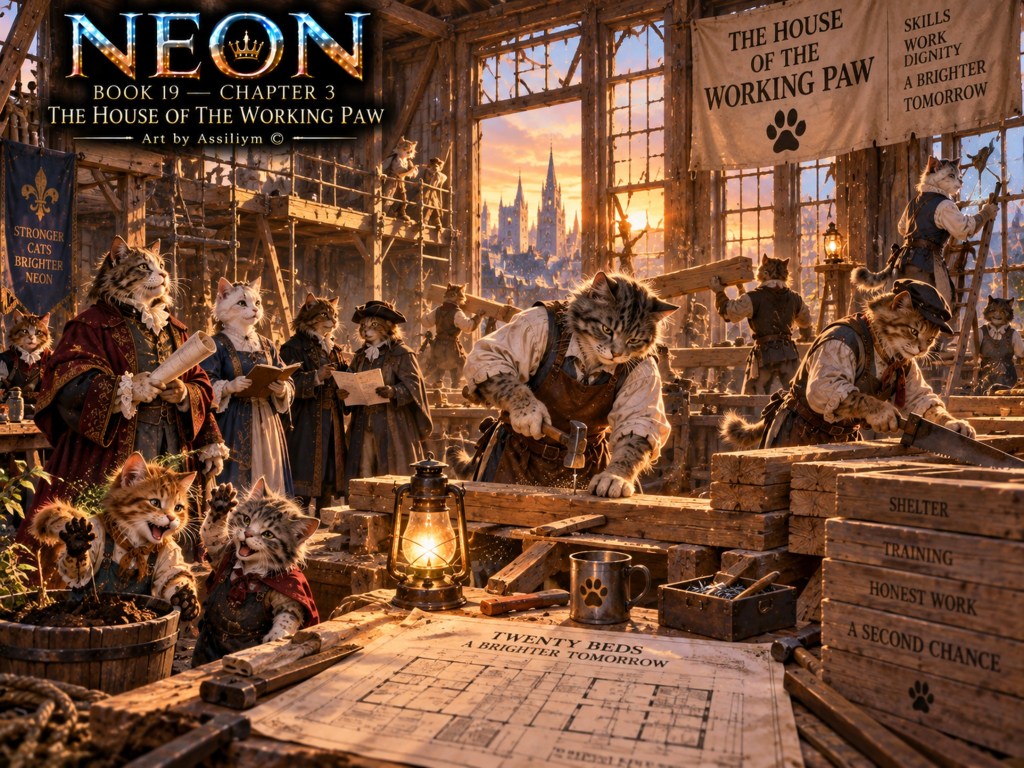
Gaspard Vernet arrived before the argument could mature.
He had not joined the first inspection because he had spent the morning at Guild business, but Borel’s afternoon newspaper had made remaining uninvolved increasingly difficult. As First Merchant of the chartered commercial Guild, Vernet entered the warehouse with less interest in its cracked plaster than in the list of proposed trades waiting upon the table.
He read it in silence.
Pommier watched him carefully.
Vernet tapped the first line. “Dolls and toys.”
“Yes.”
“Basic work?”
“Yes.”
“Not Guild certification.”
“No.”
He moved down the page. “Fibrework. Scribes and printers. Merchant skills. Builders. Carters.”
“Entry skills,” said Pommier. “Assessment, preparation, then recommendation onward where suitable.”
Vernet looked up. “Good.”
Canon Valençay seemed almost disappointed. “You approve?”
“I approve because they are not pretending to make masters.”
He turned towards Borel. “A cat who learns to measure a plank here has learned to measure a plank. He has not become a woodwright because he survived two Tuesdays.”
Borel nodded solemnly. “That should be printed.”
“No.”
“Small notice?”
“No.”
“Educational pamphlet?”
Vernet ignored him.
“The Guilds may send assistants or instructors on fixed days once the rooms are lawful and equipped. Residents should not be dragged through every trade merely because six are available. Assess them. Let them choose where possible. Some will suit accounts. Some carts. Some sewing. Some simple building work. Some will be hopeless at all six and excellent at something you have not yet thought of.”
“That sounds dangerously compassionate,” Bellombre said.
“It sounds efficient.”
“Ah. Better.”
They worked out the weekly arrangement while the light shifted across the dirty warehouse floor. Two rooms allowed two routes to be taught at the same time. Monday and Wednesday could belong to Dolls and Toys in one room and Scribes, Printers and Bookbinding in the other. Tuesday and Thursday would carry Weaving and Fibrework beside Merchant Skills. Friday and Saturday would be given to Building and Woodwork in one room and Carters, Couriers and Logistics in the other. Sunday would carry no formal classes.
Borel looked over the schedule.
“You have made charity into a timetable.”
Vernet answered, “That is generally how things happen twice.”
The common room was marked next, then the kitchen, wash facilities and a small office for the future manager or clerk. The old front office would serve well enough once repaired. Drainage posed more trouble. The rear wall would need work. Several windows would need replacing. The staircase required inspection. Casselin thought the lower masonry sound but refused to pronounce upon the roof without a builder.
That problem brought them to Étienne.
They did not go immediately. Borel, who had now mentally donated the building three times and financially regretted it six, insisted upon locking the warehouse before crossing deeper into Guild Ward. The irony of securing an empty building which half Mercers’ Ward had publicly volunteered to dismantle and improve was not lost upon Bellombre, but he had acquired enough experience with Borel to leave the remark unspoken.
The Royal Merchant Guild headquarters was busy when they arrived. Clerks moved through the lower hall carrying warehouse licences, market petitions and inspection notices. Two merchants were arguing over disputed weights near one office, and somewhere beyond an inner door a carter was explaining loudly why a broken axle should be considered weather rather than negligence.
Étienne Delorme received the group in an upper administrative room with Pascal Duret beside him and an expression which suggested that a merchant procession containing Pommier, Borel, Sabine Vellier, three children’s caps, building plans and Canon Valençay had not appeared on his schedule.
His eyes settled first upon Borel.
“What have you done?”
Borel looked offended. “Why assume I have done something?”
“You have brought Pommier and paperwork together.”
“A building,” said Marta.
Étienne looked at her.
“Guild Ward,” she added.
“That narrows the danger.”
Sabine placed the legal packet upon the desk. “Borel intends to donate his old commercial warehouse to the Royal Benevolent Society for conversion into a shelter and practical training house. I am covering the lawful fees attached to transfer and application.”
Étienne’s gaze moved towards Pommier.
Pommier smiled with exactly the expression of a respectable charitable administrator submitting a respectable charitable proposal.
The private irony required no assistance.
Only a short time earlier Étienne had stood inside another supposed Society property in Ash Town and discovered fifty-four beds which existed nowhere except paper. The Three Parasites did not know that. Pommier believed the old inspection at Merciful Lantern had passed unnoticed. Bellombre believed the lie still slept. Valençay, whatever theology he applied to it, had no reason to imagine that Étienne had already walked through the dust where their phantom charity ought to have been.
Now they stood before him voluntarily proposing twenty real beds in a building which could be found, measured, taxed, inspected and, if the paperwork survived, occupied.
Étienne gave no sign that the contrast amused him.
“Plans.”
Pommier handed them over.
Étienne read slowly.
Pascal moved nearer.
“Maximum residents?” Étienne asked.
“Twenty sleeping places,” said Pommier.
“Physical?”
Marta looked at Pommier.
Pommier did not look at her.
“Twenty physical beds.”
Pascal’s pen paused for the smallest fraction of a second.
Étienne continued. “Four dormitories?”
“Two male, two female. Five each.”
“Teaching rooms?”
“Two.”
“Residential and teaching space separate?”
“Yes.”
“Kitchen?”
“Ground floor.”
“Wash facilities?”
“Planned at the rear where drainage can be altered.”
“Rear exit?”
“To be cleared.”
“Upper floor?”
“Dormitory use only if the structural inspection approves it.”
Étienne nodded once.
The proposal was competent enough to irritate him.
He turned to Sabine. “Title transfer first.”
“Already being prepared.”
“Search for encumbrances.”
“Ordered.”
“Survey?”
“Awaiting application.”
“Change of use from commercial storage to charitable residential occupation.”
“Expected.”
“Fire and stove inspection.”
“Yes.”
“Sanitation.”
“Yes.”
“Drainage.”
“Yes.”
“Access and exits.”
“Yes.”
“Final occupation inspection.”
“Yes.”
Canon Valençay leaned towards Bellombre and whispered, “She is enjoying this.”
Sabine heard him.
“I am.”
Étienne placed the plan flat.
“No residents enter until final inspection.”
“Agreed,” said Pommier.
“No bed may be represented as operational until installed and approved.”
For a heartbeat Pascal looked down at his papers.
Marta nodded with satisfaction.
Pommier merely said, “Of course.”
Étienne continued. “Twenty is the maximum under this submitted plan. If you later wish to increase capacity, you submit again. You do not place two additional mattresses in a teaching room and discover twenty-two.”
Borel glanced at Pommier.
Pommier remained serene.
“Understood.”
“The two teaching rooms remain teaching rooms. No night overflow unless separately authorised. The kitchen stove must be inspected after installation or repair. The rear drainage must be opened before any washroom is approved. If the upper floor carries residents, the staircase and principal beams require structural sign-off.”
Casselin nodded from the back of the room. “Sensible.”
Étienne looked at him. “Were you invited?”
“Stone was mentioned.”
“Of course.”
The Guild Master returned to the papers. “I can authorise preliminary alteration work once ownership documents are accepted and the first structural report is filed. That is not permission to open.”
Pommier inclined his head. “Conditional conversion approval.”
“Yes.”
“Excellent.”
“No,” said Étienne. “Administrative.”
Borel smiled. “He dislikes enthusiasm.”
“I dislike enthusiasm with occupants beneath unsafe roofs.”
That ended the joke.
Sabine asked the clerk for the fees.
A figure was calculated.
Borel instinctively reached towards his purse.
Sabine put one paw over his wrist.
“No.”
“It is my property.”
“Your donation.”
“My paperwork concerns my donation.”
“My pledge concerns the paperwork.”
“I am capable of paying a registry fee.”
“I know.”
“Then—”
“No.”
Marta watched with considerable pleasure.
Sabine paid the lawful filing charges, initial survey application, title-processing costs and the first inspection fees without allowing Borel to rescue even one coin from philanthropy. When Canon Valençay asked whether charitable organisations qualified for reduced charges, Étienne said no. When the Canon asked whether clerical institutions did, Étienne said no again. When Valençay opened his mouth a third time, Bellombre put a paw upon his sleeve.
“Preserve something for theology.”
Pascal prepared the preliminary alteration notice.
At the bottom, in firm administrative lettering, stood the condition:
ALTERATION AUTHORISED SUBJECT TO STRUCTURAL COMPLIANCE. RESIDENTIAL OCCUPANCY NOT PERMITTED.
Marta read it twice.
“Good.”
Borel looked at her. “You enjoy prohibitions when they apply to other cats.”
…
Borel closed his eyes.
The inspection lasted more than an hour. The main lower beams were sound. Several upper joists required reinforcement. A section of roof near the rear had allowed water in and would need tiles, battens and partial replacement. The staircase could be retained after repair and strengthening. Two windows needed complete replacement; three others required new glazing and frames repaired. The old pulley was condemned immediately.
Borel objected.
“It has worked for years.”
Truebeam pulled once upon the rope.
Half of it came away in his paw.
“It has remembered work for years.”
The pulley was marked for removal.
The rear drain was opened with tools and produced a smell which caused Pippa to abandon her campaign for garden flowers until further notice. The old loading yard, however, proved large enough for the modest garden Marta wanted. Once cleared, it could hold herbs, a few vegetables, several fruit bushes, perhaps two benches and enough open ground for residents who had spent too much of life beneath other cats’ roofs to sit outside without being ordered to move.
Lulo and Pippa began clearing broken crate boards from one corner.
Borel watched them.
“That timber belonged to the warehouse.”
“It is rotten,” said Lulo.
“It is historic.”
Pippa held up a board which disintegrated at one end.
“History is coming apart.”
Marta laughed.
Truebeam’s journeymen stretched chalk lines across the floor. One future wall appeared, then another. A rectangle became the future first teaching room. Another became the second. The common room acquired boundaries. The washroom space was marked near the rear, subject to drainage work. Upstairs, four future dormitory areas were measured and adjusted until each could hold five proper beds with sufficient passage between them.
Pommier climbed the stairs and stood among the chalked divisions.
Bellombre joined him.
“Twenty,” Bellombre said.
Pommier looked at the empty rooms.
“Twenty.”
“All of them?”
Pommier glanced towards the lower floor, where Casselin was explaining stone requirements to one of Truebeam’s journeymen, Sabine was checking the permit notice, Marta was measuring a future cupboard wall with Célestine, Borel was complaining that somebody had written directly upon his floor, and Gaspard Lemoine’s assistants were calculating timber needs within sight of half a dozen merchants who had already promised to provide them.
“All twenty,” Pommier said.
Bellombre understood.
There were houses in which a number might be stretched. There were houses where a dormitory of twenty-five could become fifty-eight by the charitable miracle of ink. There were addresses where coal burned without stoves and salaries were paid to cats who never crossed a threshold.
Not here.
Too many eyes owned pieces of this building already.
Casselin would know his stone. Sabine would know every official fee. Célestine would recognise her tables. Églantine would recognise her linen. Lemoine would know which beams had come from his stock. Borel would print the whole affair twice if anyone failed to admire him properly. Vernet intended to send employers. Étienne held the legal plan.
A false bed in this building would have required deceiving half the commercial class of western Paris simultaneously.
Pommier was ambitious, not suicidal.
Below, Célestine called up, “Chevalier! Which room is the common room?”
“The large one beside the kitchen.”
“I require dimensions.”
“Take them.”
Bellombre looked at Pommier.
“You are letting her take them herself?”
“Yes.”
“Dangerous.”
“Profitable.”
Bellombre smiled.
The first donation arrived before the inspection had even finished.
A cart from Lemoine’s warehouse stopped outside carrying several lengths of sound timber—not enough for the whole conversion, but enough to begin reinforcement and framing. The delivery clerk produced an invoice marked DONATED — GUILD WARD CHARITABLE PROJECT, and Borel read it with the mixed emotion of a merchant delighted by free material and distressed that another merchant’s name appeared upon it.
A second cart brought iron brackets and nails promised by an ironmonger from Mercers’ Ward. Casselin sent word that stone for the washroom thresholds and hearth could be selected once Truebeam gave measurements. A glazier arrived to measure the broken windows. Célestine instructed one assistant to begin drawings for chests and benches, but Marta stopped her from manufacturing anything until final dimensions were fixed.
Églantine sent a messenger instead of appearing in warehouse dust. The note stated that bedding would be supplied after the room count and bed sizes were formally approved and added, in a hand unmistakably her own, that no respectable charitable institution would receive boiled-turnip blankets while she remained alive.
Marta showed it to Sabine.
Sabine nodded. “She means it.”
Borel looked at the note. “Can I print that?”
“No,” said three she-cats together.
Late in the afternoon Vernet returned with written confirmations from several of the six Chartered Guild routes. Nothing was final. No instructors had been assigned permanently. But the principle had been accepted: once the rooms were completed and the house approved, Guild assistants could visit on fixed days to provide introductory instruction and assess residents who might be suitable for further training or placement.
Pommier spread the draft timetable over the old warehouse desk. Monday and Wednesday: Dolls and Toys beside Scribes, Printers and Bookbinding. Tuesday and Thursday: Weaving and Fibrework beside Merchant Skills. Friday and Saturday: Building and Woodwork beside Carters, Couriers and Logistics. Sunday remained free of formal teaching.
Borel read the page.
“Why no Sunday?”
Canon Valençay looked at him.
Borel raised one paw. “I withdraw the question.”
It was near sunset when Marta finally asked what they intended to call the place.
That produced an unexpectedly long silence.
Borel suggested Borel House.
Nobody supported him.
He tried The Borel Guild Ward Benevolent Institute.
Marta stared at him until he removed his own name.
Bellombre proposed The Guild Ward House of Industry and Renewal, which everybody agreed sounded like somewhere unfortunate cats might be sent by a judge.
Canon Valençay suggested Saint Joseph’s House of Labour.
Pommier reminded him that not every wall required a saint.
Vernet wanted something practical.
Truebeam, listening while marking another line, said, “Call it what it does.”
 Vuk Stribog