
INSIDE BOOK 20
NEON — The City Beyond the Lie
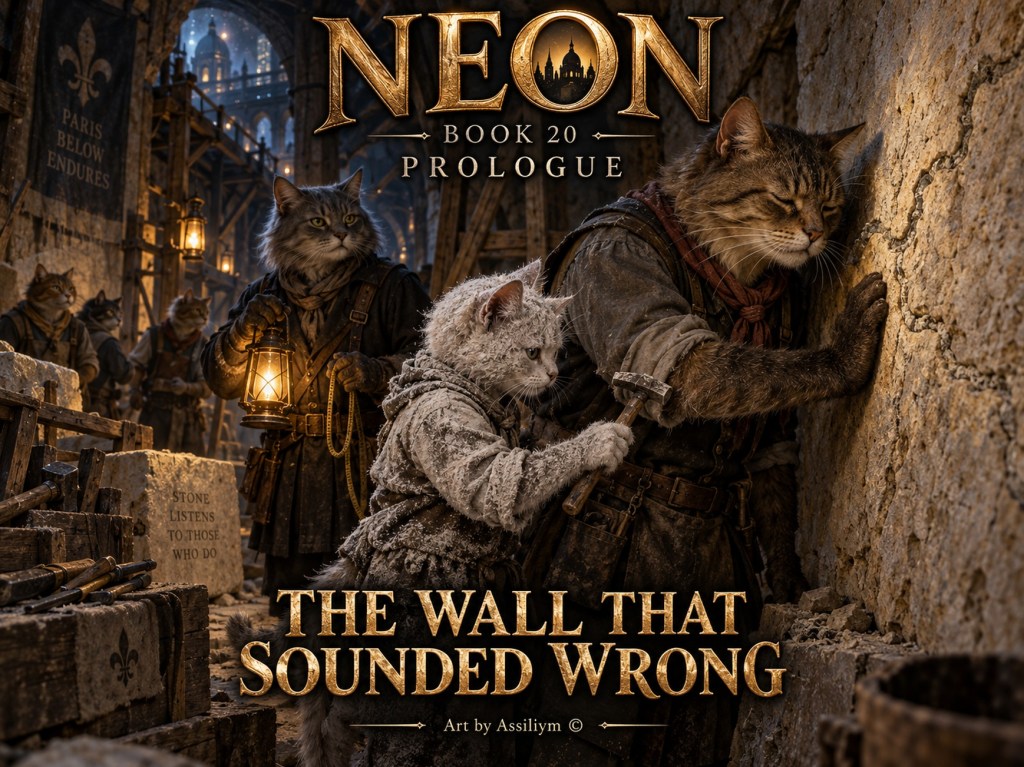
The Hollow Seal did not build roads for travellers who intended to admit that they had travelled.
That distinction separated its masons from respectable builders. A lawful mason constructed a cellar and hoped the owner would show it to guests; a lawful engineer cut a drain and expected some municipal fool to place it upon a map. The Hollow Seal preferred passages whose most successful feature was the continued conviction of everybody above them that no passage existed at all. Its finest roads possessed no milestones, no names and, wherever possible, no entrance that looked sufficiently like an entrance to encourage curiosity.
Gaspard Underwall had spent the greater part of his professional life improving upon this principle.
He was standing that morning beneath an abandoned cooper’s yard in the western quarter of Paris-Neon, regarding a limestone face with the expression of a cat who had just discovered that geology had submitted an inferior piece of work.
“No.”
Théodore Quietbeam lowered the measuring cord. “You have not yet asked what I think.”
“I know what you think.”
“I have not said it.”
“You were looking at the wall sympathetically.”
Théodore glanced at the limestone. “I was looking at the wall.”
“With sympathy.”
“I did not realise masonry possessed political expression.”
“Everything possesses political expression once somebody wishes to build through it.”
Behind them, three labourers carried timber braces into the half-finished gallery while Brin Mortarwhisk crouched near the floor, scraping loose lime from the joint between the new work and the old quarry stone. The young apprentice had acquired a coating of white dust so complete that only his eyes, whiskers and increasingly wounded dignity remained recognisably feline.
The new route had begun six weeks earlier beneath a warehouse which officially stored lamp oil, unofficially stored nothing anyone wished listed, and in practice stored considerably more than its owner had ever declared to the tax clerks. The Hollow Seal intended to connect that warehouse with an older underground road running beneath three streets, a disused dye house and the rear cellar of an establishment whose proprietor believed he rented the lower room to a society devoted to comparative hymn singing.
Gaspard had approved the hymn-singing explanation personally.
A society devoted to vice attracted attention.
A society devoted to religion attracted disagreement.
A society devoted to comparing hymns attracted nobody at all.
The route was not intended for heavy daily traffic. It was a reserve road, the sort of passage that became invaluable only after another passage acquired a watchman, an inspector, a collapsed roof, a murdered courier, a conscientious neighbour or some other form of civic obstruction. The Hollow Seal maintained many such roads beneath Paris-Neon, because one secret road was a secret and two secret roads were an escape.
This particular route had been supposed to end another twelve yards east, where an older Hollow Seal survey claimed the quarry narrowed against undisturbed limestone. Gaspard had intended to turn south there, reinforce the roof and join the older gallery from below.
Instead, the stone face before him occupied exactly the place where his route ought to pass.
Théodore checked the cord again.
“Eleven feet, eight inches.”
“It was eleven feet, eight inches the first time.”
“It remains so.”
“Then perhaps measure it with greater pessimism.”
Théodore regarded him.
“I have never known pessimism to shorten limestone.”
“It improves most measurements.”
Brin looked up from the floor. “Master?”
Gaspard did not turn.
“No.”
“I have not asked anything.”
“You have the same expression as Théodore.”
Théodore folded his paws. “Apparently apprentices now inherit expressions through proximity.”
Brin wiped dust from his nose, accomplishing nothing except moving it to the opposite side.
“The old mortar is strange.”
That brought Gaspard round.
“What mortar?”
Brin pointed.
The wall did not look built. That was the important thing. It looked like an ugly natural closure where the quarrymen of some forgotten century had stopped because the limestone thickened into poor stone. The surface carried old water stains, mineral flowering and several shallow cracks. No regular courses showed. No clean joints divided one block from another.
Gaspard crouched.
Brin inserted the tip of his small scraper into what appeared to be a natural fracture.
“Here.”
Gaspard touched it.
Mortar.
Very old mortar, dirty enough to resemble the limestone around it, but mortar nevertheless.
Théodore came nearer.
“How far does it run?”
“That is what I was trying to find.”
Gaspard glanced at Brin’s scraper.
“With that?”
“It is a scraper.”
“It is a spoon that has developed ambition.”
“It came from your tool chest.”
“That does not improve it.”
Brin wisely returned to the wall.
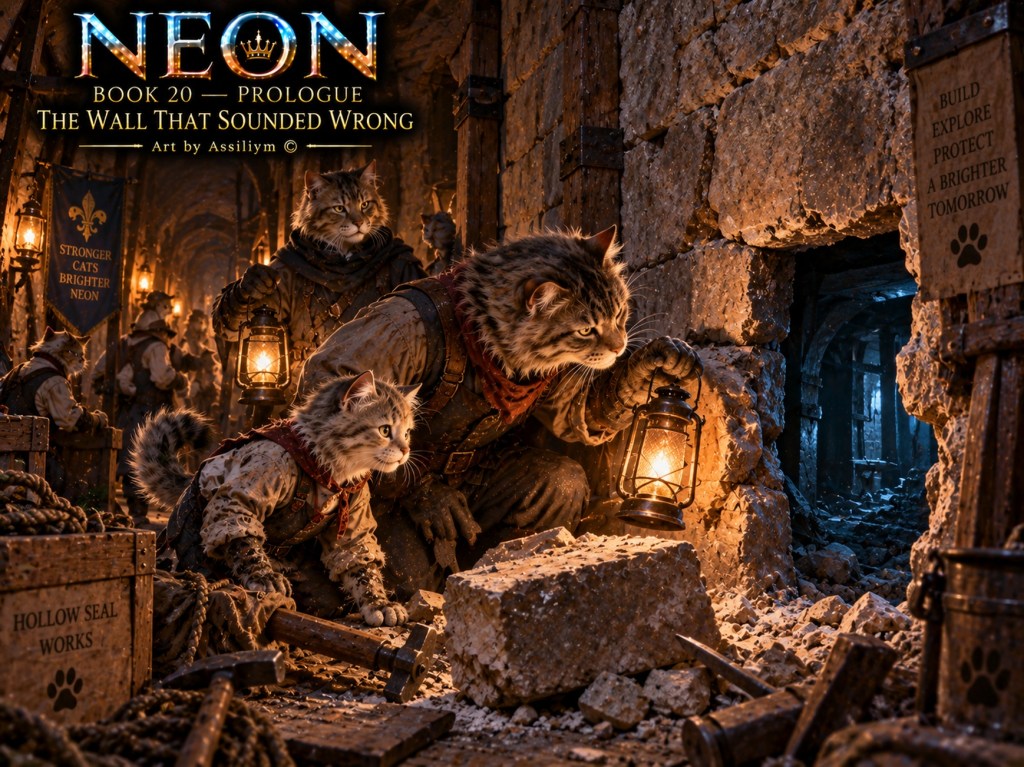
Together they cleared several inches without damaging the surface. The mortar line wandered. It did not travel horizontally like ordinary blockwork, but curved upward, vanished behind a mineral crust, appeared again and broke around what seemed to be natural stone.
Théodore frowned.
“Old repair?”
“Perhaps.”
“Quarry collapse?”
“Perhaps.”
Brin said, “A sealed working?”
Gaspard gave him a sideways look.
“Young cats enjoy sealed workings because they have not yet spent sufficient time inside one when the roof changes its mind.”
“I only meant—”
“I know what you meant.”
He stood, took the apprentice’s small hammer and struck the limestone once.
The sound was dull and dense.
Again, farther left.
The same.
Higher.
Solid stone.
Gaspard handed the hammer back.
“Old repair.”
Brin did not move.
Gaspard took two steps away.
“Master?”
“No.”
Brin looked at Théodore.
Théodore made the mistake of smiling.
Gaspard stopped.
“What?”
Brin swallowed. “May I strike it?”
“You possess a hammer. The question has become philosophical.”
Brin tapped the wall where Gaspard had struck it.
Tok.
He moved six inches.
Tok.
Another six.
Tok.
Then lower.
Tuk.
Brin stopped.
Théodore’s smile vanished.
Gaspard turned slowly.
“Again.”
Brin struck the same point.
Tuk.
Not hollow.
Not quite.
The difference was small enough that an ordinary mason might have blamed the shape of the stone, the angle of the blow or some internal fracture. Gaspard came back without speaking and placed one paw against the wall while Brin struck beside it.
Tok.
Tok.
Tuk.
He moved his paw.
“Again.”
Brin repeated the sequence.
Gaspard closed his eyes.
The youngest labourer stopped carrying timber.
Théodore looked towards him.
“Continue working.”
The labourer continued with such theatrical concentration that he nearly walked into a support post.
Gaspard pressed two claws lightly against the limestone. He did not possess magic. Hollow-Space Hearing was less mysterious than apprentices liked to pretend and considerably more difficult than masters allowed them to believe. Stone spoke through vibration, but it spoke badly. A cavity altered a blow. So did a crack, a wet pocket, rotten support timber, loose fill, a buried pipe, a mineral change and a hundred other things capable of killing an overconfident mason.
The craft was not hearing hollowness.
The craft was learning which lies stone preferred.
“Higher,” he said.
Brin struck.
“Left.”
Another tap.
“Harder.”
Tok.
“Not that hard. We are enquiring, not declaring war.”
Brin adjusted.
For several minutes the only sounds in the unfinished tunnel were the apprentice’s hammer and the distant scrape of timber.
At last Gaspard opened his eyes.
Théodore asked, “Well?”
“There is something behind it.”
Brin’s ears lifted.
Gaspard pointed a claw at him immediately.
“Do not look pleased.”
“I was not.”
“You looked pleased.”
“I looked professionally confirmed.”
“At your age those are the same expression.”
Théodore stepped closer and examined the irregular mortar.
“How large?”
“I cannot tell.”
“A cavity?”
“Probably.”
“Natural?”
Gaspard looked along the wall.
“No.”
That word changed the tunnel.
Until then the problem had been construction: wrong stone, awkward route, extra labour. Now every cat present became aware of the city above them.
Paris-Neon was old in the way only great cities became old. It had not been built once. It had accumulated. New streets climbed over Roman drains; cellars broke into older cellars; churches grew upon foundations belonging to houses whose owners had been dead for four dynasties. Quarry roads passed beneath palaces whose architects had never known the stone below had once possessed doors. Every generation buried something and confidently assumed the next would forget where.
The Hollow Seal prospered because generations were generally correct.
But hidden spaces had owners, even when their owners were dead.
Gaspard looked towards the labourers.
“Tools down.”
Nobody argued.
“Lanterns stay. Nobody leaves the gallery.”
One labourer frowned. “Master, I need—”
“You need nothing which requires telling another cat what we found.”
The labourer closed his mouth.
Théodore said, “We should inform Underroad.”
“Not yet.”
“If this is an unrecorded passage—”
“If this is three feet of abandoned drainage, Lucien Underroad will spend half a day telling me the mud has historical significance.”
“It probably will.”
“That is why I do not wish to hear about it until after luncheon.”
Gaspard returned to the wall.
They lowered the stone onto a folded cloth.
Behind it lay darkness.
Brin knelt.
The opening was barely large enough for his paw.
He lifted the lantern.
Gaspard caught his wrist.
“Not an open lantern.”
Brin blinked.
“Why?”
“If the chamber contains old gas, I should prefer to discover this without becoming a municipal crater.”
Théodore nodded approvingly.
Brin lowered the lantern.
Gaspard produced a thin candle stub.
Brin looked confused.
“You said no open lantern.”
“This is a testing lamp.”
“What makes it safer?”
“The flame is shielded behind gauze. If the air is wrong, it tells us before the whole gallery does.”
He lit the little testing lamp well back from the opening, checked the gauze and glass, then carried it slowly forward and watched.
The flame trembled towards the hole.
No strange colour.
No sudden extinguishing.
No explosion.
Gaspard held it there for several breaths.
“Air is moving inward.”
Théodore frowned. “From us?”
“Partly.”
“Then there is another opening farther in.”
“Or a fracture.”
Brin whispered, “Or another tunnel.”
Gaspard looked at him.
The apprentice managed not to appear pleased.
“Professionally confirmed,” Brin said.
“Not yet.”
They enlarged the breach.
The old closure came apart reluctantly, but not dangerously. Behind the false natural face lay a short thickness of packed rubble and another rough skin of stones. It was good work, though not extraordinary. Whoever had sealed the passage had wanted the outer wall to look abandoned and had possessed sufficient time to do it properly.
That mattered.
Smugglers blocked tunnels quickly.
Fugitives blocked them desperately.
Quarrymen blocked them safely.
Someone had blocked this one patiently.
By noon the opening was wide enough for Gaspard to put his head through.
A passage extended beyond.
He said nothing for several moments.
Théodore asked, “Well?”
Gaspard withdrew.
“Old quarry gallery.”
Brin’s eyes widened.
“How far?”
“Lantern.”
“You said—”
“The air has been tested.”
Brin handed it over.
Gaspard shielded the flame with one paw and leaned into the opening again. The light travelled along pale stone walls, caught the edge of an old timber post and disappeared at a bend perhaps thirty feet away.
The floor was dusty.
Very dusty.
No fresh pawprints.
No rat tracks.
No recent collapse.
Théodore crouched beside him.
“Timber?”
“Old enough to vote for a dead king.”
“Standing?”
“Mostly.”
“Marks?”
Gaspard looked again.
There were marks.
Not writing.
Old quarry cuts. Tool scoring. A shallow groove along one wall where something had once rubbed repeatedly against the stone. Farther in stood the remains of an iron bracket.
And on the floor, half buried beneath mineral dust, lay a fragment of blackened wood.
Gaspard pulled back.
“We open it fully.”
Brin smiled.
Gaspard pointed.
“After we brace it.”
The smile died.
Théodore laughed.
…
The wall took the rest of the day.
By dusk—though the underground possessed only clocks with which to imitate dusk—the old passage stood open from floor to shoulder height. They left the uppermost stones in place until two beams had been inserted beneath the lintel, then removed those as well.
No collapse came.
No hidden mechanism triggered.
No ancient curse announced itself.
Brin appeared mildly disappointed by the last omission.
Gaspard noticed.
“If something speaks from the dark and claims to be a forgotten prince, do not answer.”
“Why?”
“Because forgotten princes require money.”
Théodore added, “Or bodies.”
“Money first. Bodies later.”
Brin took the second lantern.
Gaspard went first.
The old gallery swallowed them in order: Master, Assistant, Apprentice. The labourers remained at the breach with instructions to retreat if the timber moved, the air changed or anybody screamed in a manner suggesting structural rather than personal difficulty.
The dust on the floor was deep enough to preserve every new pawprint perfectly.
Gaspard disliked that.
Not because it meant the tunnel was old.
Because it meant nobody had disturbed it.
Paris had rats everywhere. Cats everywhere. Beetles, thieves, children, drainage workers, escaped prisoners, priests with bad maps, grave robbers with worse morals. An abandoned passage beneath the city rarely remained untouched for long.
Yet this one had.
They walked twenty paces.
The first old timber support leaned against the wall, no longer bearing weight. Gaspard examined it.
“Cut by hand.”
Théodore touched a dark stain.
“Fire?”
“Lamp smoke.”
Brin pointed ahead.
“There.”
A small iron hook had been driven into the wall.
Nothing hung from it.
Five feet farther stood another.
Then another.
“Lamp brackets,” Théodore said.
Gaspard nodded.
“So somebody occupied the passage.”
“Quarry workers?”
“Possibly.”
Brin looked at the dust.
“Where are their things?”
“Gone.”
“Everything?”
“That is generally what gone means.”
The passage bent.
Beyond it widened.
Here the stone had been worked more carefully. A niche had been cut into the left wall. Its shelf still held the remains of something wooden which collapsed into powder when Gaspard touched it.
“Box,” he said.
“For tools?”
“Perhaps.”
Théodore pointed to a square discoloration beside the niche.
“Something hung there.”
Gaspard raised the lantern.
Four small holes formed a rectangle.
“Board.”
“A notice?”
“Or a map.”
Brin glanced back towards the entrance.
“This place is not on our maps.”
“No.”
“Could the board have been one?”
“Yes.”
“That seems rude.”
Gaspard looked at him.
“Maps frequently are.”
They went farther.
At fifty paces, the ceiling dropped low enough that Théodore had to duck. At sixty it opened again into an older junction.
Three passages departed.
One had collapsed naturally.
One narrowed into blackness.
The third had been sealed with ordinary rubble at some point in the past, then reopened.
Gaspard stopped.
Théodore came beside him.
“What?”
“Look at the floor.”
Brin crouched.
The dust changed.
Near the junction, the pale layer lay thick and undisturbed. Beyond the reopened passage it thinned, then thickened again.
“Water?” Brin asked.
“No.”
Gaspard moved the lantern sideways.
An old shallow track crossed the floor.
Not a pawprint.
Not a wheel rut.
Something had repeatedly dragged there.
Years ago.
Perhaps decades.
Perhaps longer.
The mark disappeared under dust and returned beside the wall.
Théodore examined it.
“Equipment.”
“Probably.”
“Quarry cart?”
“No wheel channel.”
“Stone sled?”
“Too narrow.”
Brin asked, “What then?”
Gaspard stood.
“We are not here to invent answers.”
They followed the right-hand passage.
The air became colder.
Not magically cold. Deep-earth cold, steady and indifferent to the weather above.
After another thirty yards they found the first door.
Or what had once been a door.
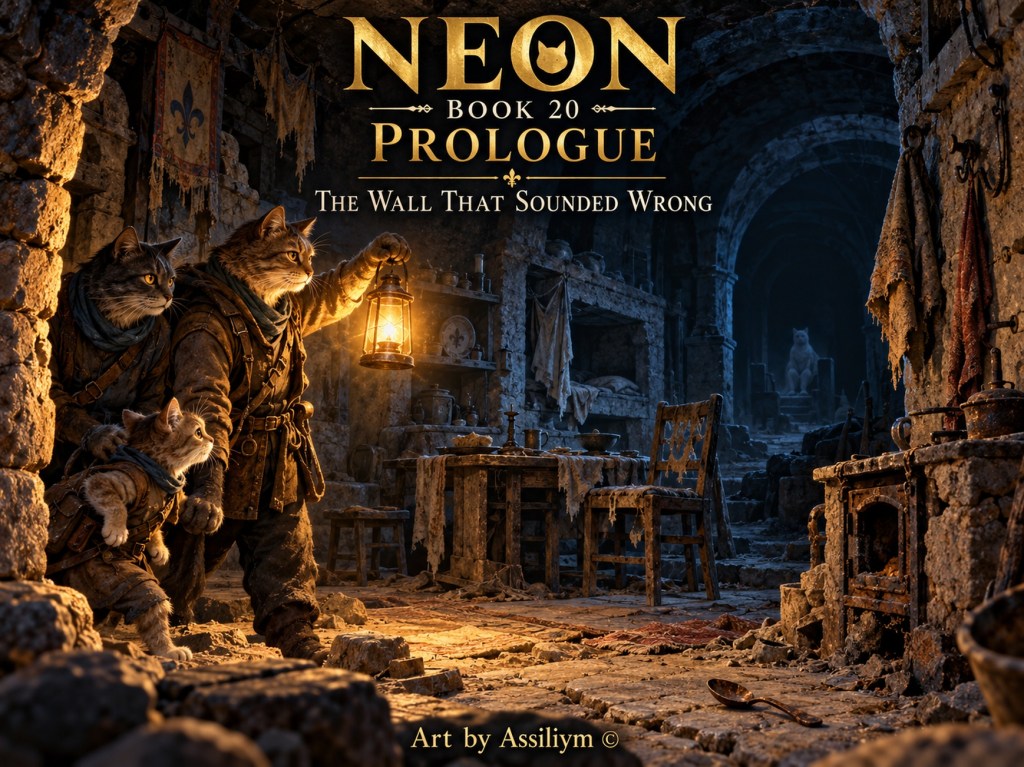
Only one hinge remained attached to the wall. The wood had collapsed inward and lay in black splinters beneath dust. Beyond it was a small chamber containing a stone shelf, two empty wall recesses and the rusted shell of a little stove.
Brin raised the lantern.
“Someone lived here.”
Théodore said, “For some time.”
Gaspard studied the stove.
The flue disappeared into a crack above.
“Enough time to care about warmth.”
Brin went to one recess.
“Nothing.”
The second held the remains of cloth.
It disintegrated when air moved across it.
Théodore found a spoon.
Not silver.
Not valuable.
Ordinary iron, almost eaten through with rust.
He turned it in his paw.
“That is more interesting than treasure.”
Brin looked puzzled.
“Why?”
“Treasure gets hidden. Spoons get forgotten.”
Gaspard took the spoon from him.
Ordinary domestic life.
That bothered him considerably more than a smuggler’s cache would have.
A thief might conceal gold beneath Paris for a season.
A family might hide for weeks.
But someone had built lamp hooks, a stove, shelves, sleeping recesses and storage within a quarry nobody remembered.
Someone had made a home in a place designed to disappear.
“Master,” Brin said.
Gaspard turned.
The apprentice was looking beyond the ruined door.
A second passage continued east.
At its far end the lantern light met a larger darkness.
Not another narrow gallery.
A chamber.
Gaspard took the lantern back.
“No one goes farther.”
Brin stared at him. “We have come this far.”
“And therefore possess more to lose.”
Théodore was already studying the ceiling.
“It looks stable.”
“The ceiling is not the only thing capable of being unstable.”
Brin looked into the dark.
“What do you see?”
Gaspard lifted the lantern as high as his arm allowed.
The light entered the chamber in a narrow golden wedge. It touched stone floor first, then the lower edge of something wooden.
A leg.
A chair, perhaps.
The beam travelled farther.
Another straight shape appeared beside it.
Then the edge of what looked like a table.
Gaspard moved the lantern slightly.
Something pale rested beyond the table.
The light did not reach enough of it to give the thing a name.
Brin whispered, “What is that?”
Nobody answered.
The air moving from the deeper room carried no smell of life.
No decay either.
Only dust, minerals and the dryness of a place from which even death had grown old.
Théodore took one step forward.
Gaspard put an arm across him.
“No.”
This time Théodore did not argue.
Gaspard lowered the lantern.
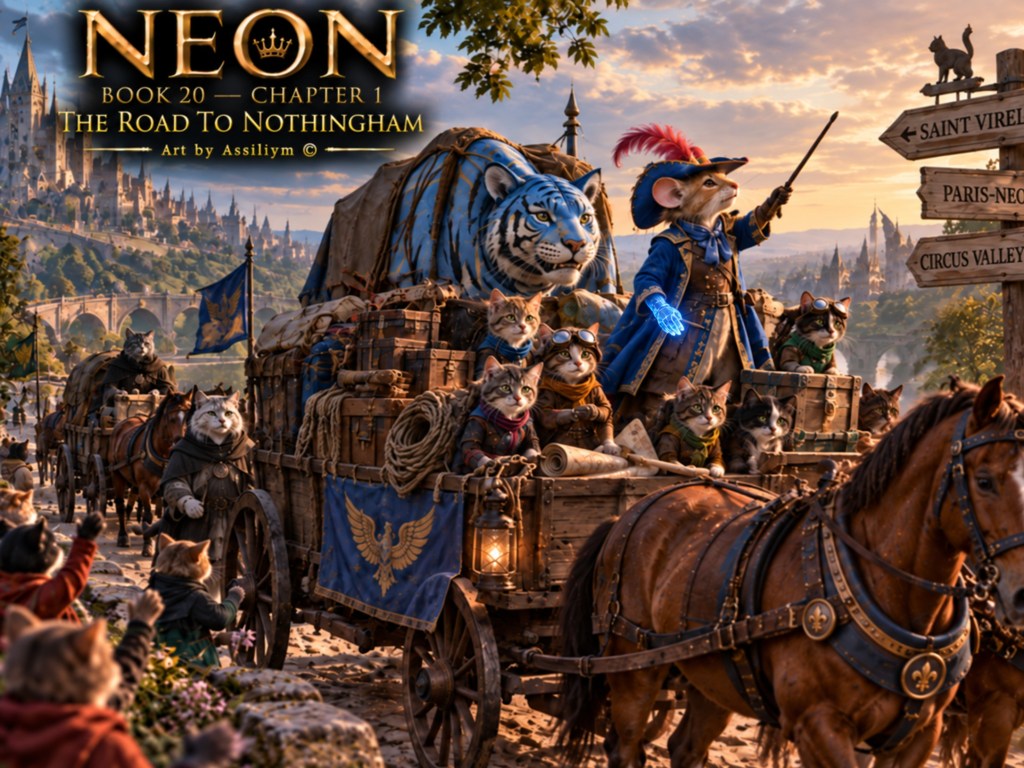
There are journeys upon which the destination is the most important thing, and there are others during which an idea climbs aboard unnoticed, occupies the best seat, eats somebody else’s provisions and arrives at the end considerably larger than any of the travellers. The road from Saint Virel to Paris-Neon belonged decidedly to the second kind.
Madam Crumbolina left Saint Virel beneath a sky so clear that Old Devil Kettle seemed almost respectable in the morning distance. Almost. A thin thread of smoke still rose from its broken crown, and the black lava tongues around the northern quarter remained where money, chisels and patience had temporarily abandoned their argument with the mountain. Yet the village itself was awake. Smoke came from the bakery chimney, carts creaked through the market road, the old mill turned, and from the meadow beside it came enough shouting to suggest that six kittens had mistaken departure for a military campaign.
Crispin had appointed himself responsible for loading discipline on the entirely reasonable grounds that he was Launch Captain and therefore naturally understood ropes. Milo Crumbtail had appointed himself responsible for checking that Leonardo’s precious Ground Command box was secured beneath three blankets and not, as he put it, “under anybody’s bottom.” Benoît Biscuitpaw had taken command of provisions and had already discovered that travelling food became mysteriously smaller whenever six kittens inspected it repeatedly. Nico Knotfur and Tibbin Tanglewhisker had been entrusted with the long striped tail of the tiger-kite and had managed, before sunrise, to wrap themselves into it twice. Pipkin Reedtail, wearing Madam Crumbolina’s spare goggles despite there being no aviation whatever taking place, had inspected the wheels of both wagons, the harness, the road, the gate, the bridge beyond the village and one chicken which he considered to be standing too near a turning radius.
The tiger-kite itself travelled partly dismantled upon the second wagon. Its great blue wings had been folded and padded, the striped tiger head wrapped beneath oilcloth, the lines coiled separately, and the crystal fittings packed with such care that even Crumbolina had permitted nobody except Milo and Crispin to touch the final straps. This was not yet a permanent removal from Saint Virel. Aveline had made that distinction so many times that even Pipkin could repeat it. The six kittens were travelling to Paris-Neon as a delegation with their parents’ permission, under escort, to see Circus Valley, inspect what Balzak intended to offer them and return if the agreement proved unsuitable. No permanent arrangement existed until the conditions were accepted. Aveline had written that sentence into the papers with enough firmness to frighten even Mer-mer, who was not required to sign them.
Father Luc and Brother Bernard travelled as the circus security escort. Father Luc had spent the first half-hour checking the wagon doors and the second half wondering whether six kittens could possibly require as much supervision as six kittens were demonstrating. Brother Bernard, who had the more patient temperament of the two, had merely counted them at every stop.
“Six,” he said as the wagons rolled beyond the last houses of Saint Virel.
Father Luc looked back. “You counted them three minutes ago.”
“Six then also.”
“They cannot reproduce while travelling.”
Brother Bernard considered Nico and Tibbin, who were presently disappearing beneath a blanket in search of a missing buckle.
“With these six, I prefer evidence.”
Aveline stood beside Baltz near the village gate. Toma and Mara were there too, with several of the kittens’ parents behind them. There had been hugs, warnings, promises, another round of hugs, and an extraordinary quantity of instructions concerning clean paws, sensible meals, strangers, traffic, sleep, cold mornings, hot afternoons, Paris streets, circus machinery and the apparently universal maternal belief that a kitten travelling under the protection of two security monks, Mer-mer, Madam Crumbolina and five other kittens would nevertheless perish instantly if he forgot his second scarf.
Crispin’s mother called after him, “And write!”
“I will!”
“Properly!”
“I will!”
“Not three words!”
Crispin looked at Mer-mer. “How many words are proper?”
“A dangerous question.”
Aveline called, “More than Gaston uses.”
That sent Baltz into laughter and Aveline into the sort of look which suggested her absent adopted son remained fully within reach of maternal criticism despite being many miles away at the Royal Musketeer Cadet Academy.
Crumbolina stood atop the front wagon rail as Saint Virel slowly disappeared behind them. She watched until the mill roof vanished beyond the hill, then until Old Devil Kettle itself became only a dark shoulder beneath the morning sky. Only after that did she turn around.
“Paris-Neon,” she said.
The six kittens cheered.
Brother Bernard counted them again.
…
The road was good for the first several miles and progressively less interested in civilisation thereafter. It crossed orchard country, climbed between wooded ridges and descended towards broad farming valleys where the late season had turned some fields gold and others brown. They passed carts carrying grain towards market, a travelling cooper whose wheels squeaked so violently that Pipkin demanded an inspection, and three monks going the opposite direction who exchanged blessings with Father Luc and then stared for some time at the enormous blue tiger head protruding beneath the oilcloth.
At the first bridge Pipkin ordered the lead wagon stopped.
The driver looked back. “Why?”
“Inspection.”
“Of what?”
“The bridge.”
“It has been here forty years.”
Pipkin adjusted the enormous goggles.
“That means it has had forty years to become suspicious.”
Father Luc rubbed his forehead.
Mer-mer climbed down with him.
The bridge was inspected.
It remained a bridge.
At noon they stopped beside a stream beneath a row of poplars. Benoît distributed bread, hard cheese, apples and small meat pies according to a system he claimed had been carefully calculated but which somehow resulted in him receiving the largest pie. Milo noticed. A dispute began. Crumbolina resolved it by removing half of Benoît’s pie and eating it herself.
“Pilot’s share,” she said.
“There was no pilot’s share.”
“There is now.”
Benoît looked deeply injured by aviation.
The wagons travelled again.
It was late in the afternoon, when the first excitement of departure had softened into the slower rhythm of wheels and road, that Crumbolina climbed from her place beside the tiger-kite and settled upon the front bench near Mer-mer. Crispin and Milo were behind them arguing about whether Paris-Neon winds would be better or worse than Saint Virel winds. Nico and Tibbin had fallen asleep against the same coil of rope. Benoît was counting provisions with the despairing concentration of a Treasury Minister discovering war. Pipkin was studying the road.
Crumbolina watched Mer-mer for some time.
“What is the circus like now?”
Mer-mer turned. “The Blue Kitten Circus?”
“No, the other circus Balzak owns.”
“There is no other circus.”
“Then yes.”
Mer-mer smiled. “Bigger.”
“That is Balzak. Everything becomes bigger except his willingness to pay for it.”
Father Luc, riding opposite, made a small sound which might have been agreement.
Crumbolina continued, “What do they actually do?”
“Everything.”
“That is not an answer.”
“It would be Balzak’s answer.”
“Mer-mer.”
“All right.”
He thought.
“Masha still draws.”
Crumbolina brightened. “Caricatures?”
“Very good ones.”
“Cruel?”
“Accurate.”
“Better.”
“Masha has discovered that important cats will pay surprisingly well to be insulted by art as long as everybody calls it portraiture.”
Crumbolina nodded approvingly.
“And Sedge?”
“Magician.”
“With Clout?”
“Always.”
“The rabbits?”
“Half-Ears and Broken Tooth remain professionally unconvinced by magic.”
Benoît immediately leaned forward from the rear bench.
“Does the sausage trick still exist?”
Mer-mer turned.
“How do you know about the sausage trick?”
“Brother Bernard told me.”
Every eye turned to Brother Bernard.
The monk looked mildly betrayed.
“It arose during a discussion of stage safety.”
Father Luc said, “Naturally.”
Benoît asked, “Does the rabbit become sausage?”
“No.”
“Then why call it magic?”
“Because Clout occasionally eats the evidence.”
Benoît sat back, thinking deeply about theatrical standards.
Mer-mer told Crumbolina about Old Horn and the Moon Train, Long-Ears and the Valley Express, about Redcrest’s difficult professional relationship with stage transformation and about Snip, whose principal artistic contribution remained the belief that any unattended possession constituted an invitation. He told her about Brother Paw-Ma and the quiet yard where cats came seeking stillness, blessings or at least something sufficiently close to either that Balzak could print it on a ribbon.
Crumbolina frowned. “Balzak charges them?”
“Balzak attempted several interpretations of the word donation.”
Father Luc said, “Eleonora corrected him.”
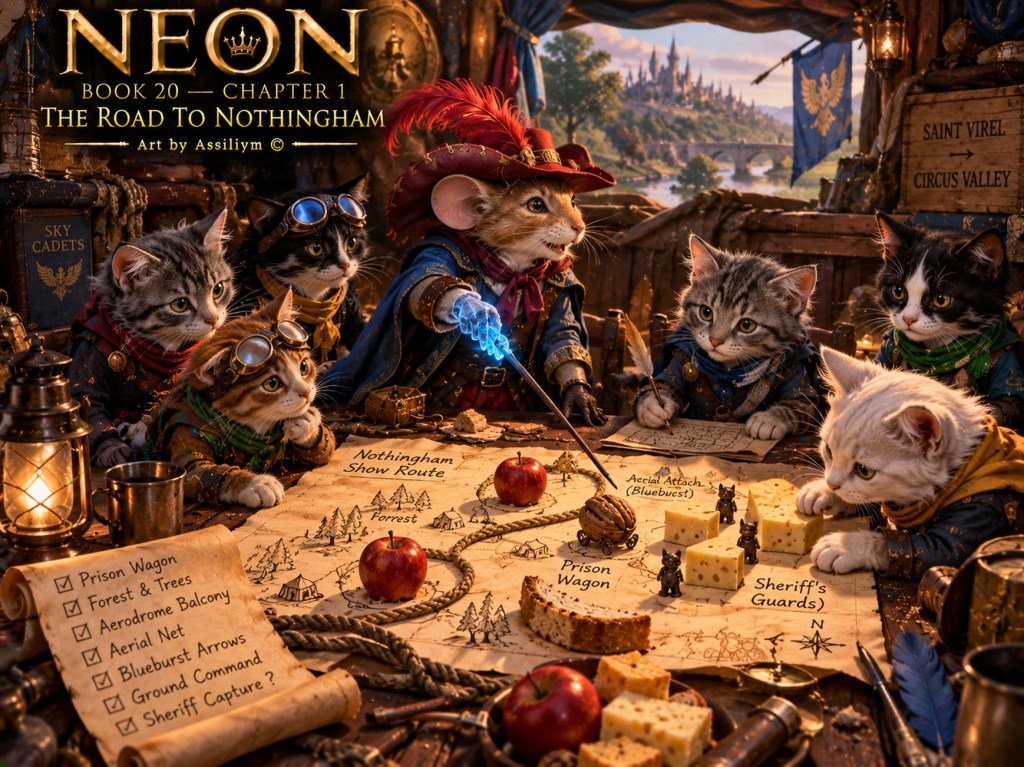
Mer-mer explained the rest. Patch fired the harmless arrows. The Sheriff mocked him. The poor cats demanded justice. The snake remained magnificently unimpressed. By the end she had acquired enough coloured arrow marks to resemble a civic festival, whereupon Snip dropped from the rigging, seized the money bag and ran away with it. Patch watched him disappear and told the Sheriff that now she understood the poor cats.
The entire wagon laughed.
Crumbolina laughed longest.
Then she stopped.
It was not sudden enough for anyone except Mer-mer to notice.
Her eyes had gone elsewhere.
Not to the road.
Not to the hills.
Somewhere behind them, perhaps, into an imaginary circus that did not exist yet.
“And that is the end?” she asked.
“Yes.”
“The Sheriff loses?”
“Usually.”
“Patch wins?”
“In his own way.”
“And they stay inside the circus?”
Mer-mer frowned. “Where else would they go?”
Crumbolina turned slowly and looked towards the second wagon, where Leonardo’s folded blue tiger-kite rode beneath its covering.
Mer-mer followed her gaze.
He knew that look.
“No.”
“I have not said anything.”
“You have thought something.”
“That is permitted.”
“With you, it is usually expensive.”
Crumbolina stood upon the bench.
“What if Patch loses?”
Crispin sat upright.
“What?”
“What if,” she repeated, “the Sheriff remembers him?”
Milo frowned. “Remembers what?”
“That he shot her.”
“With rubber arrows,” Mer-mer said.
“She does not know that emotionally.”
Father Luc laughed.
Crumbolina began pacing along the wagon bench, holding the rail whenever the wheels struck a rut.
“The Sheriff comes back richer. More taxes. More gold. More guards. She knows Patch will attack. So this time she prepares.”
Crispin was fully engaged now.
“Shields?”
“Yes.”
“More guards?”
“Yes.”
“A trap?”
Crumbolina pointed at him.
“Yes.”
She turned to Mer-mer.
“Patch enters exactly as before. Same green hat. Same speech. Same bow. The audience thinks they know the show.”
Mer-mer nodded slowly.
“Then he attacks.”
“Yes.”
“And?”
“He loses.”
Crispin looked almost personally offended.
“Patch cannot lose.”
Crumbolina looked at him.
“Why?”
“He is the hero.”
“Heroes lose all the time.”
“Then they are not heroes.”
“They are if they get up again.”
That quieted him.
Crumbolina continued. “Patch fires. The Sheriff’s guards have shields. He shoots left, they block. He shoots right, they block. He tries the old trick. The Sheriff knows it. Then—”
She slapped both paws together.
“Net.”
Nico and Tibbin immediately looked at one another.
“Net?”
“Big one. Hidden above the stage. Down it comes. Patch is caught.”
Mer-mer began smiling despite himself.
“The Sheriff finally defeats Patch of the Greenwood.”
“Yes.”
“And then?”
“She puts him in prison.”
Father Luc said, “On stage?”
“A wagon.”
Mer-mer stared.
“A prison wagon?”
“Wooden bars. Wheels. Nothingham crest. Patch inside.”
Pipkin asked, “Brake?”
Crumbolina looked at him.
“Yes, Pipkin. A brake.”
“Two.”
“Two brakes.”
He nodded, satisfied.
Crumbolina continued. “The Sheriff loads the peasants’ stolen gold onto the wagon. Her guards surround it. She says Patch is finished. She says the gold belongs to Nothingham.”
“And then Snip steals it?” Benoît asked.
“No.”
Mer-mer looked interested.
“No Snip?”
“Not yet.”
She smiled.
“The Sheriff leaves.”
“Leaves the stage?”
“Yes.”
“Into the dressing corridor?”
“No.”
“Then where?”
Crumbolina pointed down the road ahead of them.
“Outside.”
For several seconds the only sound was the wagon wheels.
Brother Bernard looked at Father Luc.
Father Luc looked at Mer-mer.
Mer-mer looked at Crumbolina.
“There is no outside stage.”
“There will be.”
“There is no road.”
“There will be.”
“There is no prison wagon.”
“There will be.”
Mer-mer began laughing.
“Michelangelo.”
Crumbolina nodded solemnly.
“Michelangelo.”
She jumped down from the bench and landed between the two rows of kittens.
“The great rear doors open. Everyone thinks the show is finished. But the Sheriff takes Patch out through the doors. The wagon goes into Circus Valley.”
Crispin said, “And the audience?”
“They follow.”
Father Luc frowned. “Thousands of cats cannot all follow a wagon.”
“Not on the road. Behind barriers. Some stay high.”
“High?”
“Balconies.”
Now Mer-mer understood.
Crumbolina spread her arms as though Circus Valley already lay around them.
“The main circus behind. Outside, a whole Nothingham road. Forest. Peasant houses. A bridge if Michelangelo wants one. The road goes all the way towards the flying ground. Cats on the ground watch beside the course. Rich cats can sit above it and see everything.”
Brother Bernard said, “Balzak will charge more for the balcony.”
Mer-mer shook his head.
“Balzak will charge more for breathing on the balcony.”
Father Luc considered this.
“Perhaps we should not mention chairs.”
“He will discover chairs.”
“True.”
The six kittens were no longer passengers.
They were planning war.
…
Crispin had taken out a piece of paper. Milo had moved beside him. Benoît forgot his provisions entirely. Nico and Tibbin were using a rope coil to represent the road. Pipkin had appropriated two apples as buildings and a crust of bread as what he called the western landing boundary.
Crumbolina crouched among them.
“The Sheriff comes out here.”
She moved the first apple.
“Patch is in the prison wagon.”
A walnut became the wagon.
“The guards are here.”
Benoît contributed four pieces of cheese.
“Those are guards?”
“They are temporary guards.”
“You are going to eat the army.”
“That is later.”
Crumbolina placed the cheese pieces around the walnut.
“The Sheriff thinks she has won. Then the Sky Cadets go to stations.”
Every kitten froze.
Crispin looked up.
“We are in the show?”
Crumbolina stared at him.
“Who did you think was launching me?”
Crispin grinned.
She pointed around the improvised map.
“You are not six kittens standing beside a kite while I fly. The audience sees everything. They see Ground Command. They see the launch. They see the tail. They see the landing ground.”
Milo asked, “We use the real command box?”
“Yes.”
Benoît: “Real provisions?”
“Yes.”
His expression brightened enormously.
Nico asked, “Real tail?”
“Yes.”
Tibbin added, “Real tangles?”
“No.”
Both looked disappointed.
Pipkin adjusted the goggles.
“Real runway authority?”
Crumbolina paused.
“Within reason.”
Pipkin interpreted this as complete victory.
She stood.
“The Sheriff’s wagon reaches the open road. Her guards are running beside it. Patch is still locked inside. Gold still on the wagon.”
She looked towards the folded tiger-kite.
“Then we launch.”
Crispin almost whispered it.
“All wings prepare.”
Crumbolina smiled.
“Yes.”
The words changed the imaginary road.
Even Father Luc could feel it.
The great blue tiger-kite rising from Circus Valley. The crowd turning upward. Crumbolina in the cockpit, crystal paw catching the light. Six small figures below doing what they had learnt at Saint Virel not because Balzak had given them costumes but because it was actually their work.
Milo leaned over the paper.
“How do we attack?”
Crumbolina answered immediately.
“A net.”
Mer-mer looked at her.
“Another net?”
“Not the same one.”
She raised both paws above the road map.
“Folded beneath the kite. Light. Wide. I fly over the guards. At the right moment I release it.”
Nico’s eyes widened.
“From the air?”
“Yes.”
Crispin began drawing.
“Guards here. Wagon ahead.”
“Exactly.”
Milo moved the cheese pieces.
“I call the range.”
“Yes.”
Crispin pointed.
“I call the release.”
“Yes.”
Benoît raised a paw.
“What do I do?”
“Do not eat the guards.”
He lowered it.
Crumbolina continued. “The kite comes low. The net opens. First guard looks up. Too late. He stumbles into the second. Second falls into the third. They all go down together.”
Tibbin laughed so hard that he knocked over the walnut prison wagon.
Father Luc was already thinking less like a spectator and more like a security director.
“Soft net.”
“Yes.”
“No hooks.”
“No.”
“Padded ground.”
Crumbolina nodded.
Brother Bernard added, “The wagon must already be beyond the drop zone.”
“Yes.”
“No animal beneath the net who has not rehearsed the fall.”
“Yes.”
Mer-mer looked from one monk to the other.
“You are helping.”
Father Luc replied, “I am preventing your entertainment from becoming a funeral.”
“An important distinction.”
The road climbed into another stretch of woodland. Evening light spilled between the trunks in long gold bars.
Crumbolina moved the walnut forward.
“The guards are caught.”
Crispin smiled.
“First strike.”
“Yes.”
“The Sheriff?”
“Escapes.”
Again the kittens objected.
Crumbolina held up one paw.
“She must escape.”
“Why?” Milo asked.
“Because if we catch everyone at once, the show is finished.”
That was persuasive.
“The Sheriff sees the guards inside the net. She runs faster. Patch is still in the cage. She still has the gold.”
Mer-mer said, “Where does she run?”
Crumbolina looked at the real trees sliding past the wagon.
Then smiled.
“Into the forest.”
Mer-mer followed her gaze.
“No.”
“Yes.”
“No real trees.”
“Of course not.”
Father Luc said, “Good.”
“Michelangelo trees.”
Father Luc’s relief disappeared.
Crumbolina’s imagination had now gone far beyond consultation.
“He builds a forest around the road. Big trees. Bigger than these.”
“Why bigger?”
“Because Balzak likes bigger.”
“That,” Mer-mer admitted, “is unanswerable.”
“But the trees are hollow. Stage trees. Already prepared to fall.”
Brother Bernard sat straighter.
“To fall where?”
“Across the road.”
“With the wagon moving?”
“Yes.”
“No.”
“Safely.”
“No.”
“Very safely.”
“No.”
Crumbolina looked at him.
“Michelangelo.”
Brother Bernard considered the name.
“Possibly.”
That was as close to surrender as security allowed.
Crumbolina reached towards the second wagon.
“And the tiger-kite needs something here.”
She indicated the front.
Milo guessed, “Signal lamp?”
“No.”
Crispin said, “Horn?”
“No.”
Pipkin said, “Road-inspection bell?”
“No.”
Benoît said, “Cheese box?”
Everyone looked at him.
“What?”
Crumbolina pointed at the imaginary front of the kite.
“An arbalest.”
Father Luc made a noise from somewhere deep within his religious education.
“No.”
“Small.”
“No.”
“For theatre.”
“No.”
“Blunt arrows.”
Father Luc paused.
Brother Bernard asked, “How blunt?”
“Very.”
Father Luc looked at him.
“You are negotiating.”
“I am establishing the dimensions of the danger.”
Crumbolina was delighted.
“No sharp head. A soft heavy tip so everyone can see it. And just behind the head—”
She stopped.
The idea arrived visibly.
“Blue dust.”
Mer-mer’s ears lifted.
“Blue dust?”
“A little paper pouch. Bright blue powder. When the arrow strikes the tree—puff!”
She threw both arms outward.
“Blue everywhere.”
The kittens stared.
Crumbolina stood on the moving wagon bench again, suddenly half pilot and half director.
“The arrow hits the tree. The blue pouch bursts.”
She slapped one paw into the other.
“Then—CRACK!”
Crispin jumped.
Father Luc stared at her.
Crumbolina grinned.
“Not a real crack. Hidden carpenter.”
Now she had all of them.
“Michelangelo puts carpenters below or behind the forest. The tree is already held by ropes and locks. The arrow hits the painted target. Blue dust bursts. The carpenter makes the great cracking sound—huge sound—like the arrow broke the trunk.”
Milo whispered, “Then releases the rope.”
“Yes.”
“But not immediately,” Crumbolina said.
Mer-mer smiled.
She had found the important part.
“One heartbeat.”
She held up one finger.
“The blue explodes.”
A pause.
“The crack.”
Another tiny pause.
“The branches shake.”
Her paws trembled in the air.
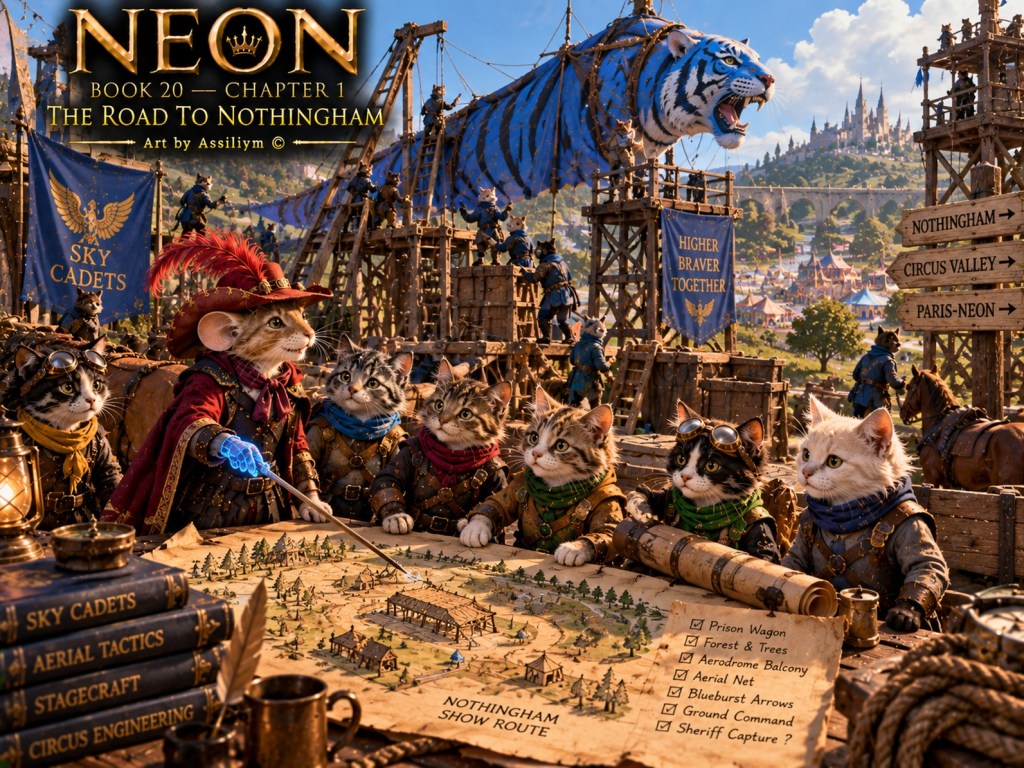
Her paw snapped forward.
“The Blueburst Arrow strikes the final tree.”
She spread her fingers.
“Blue cloud.”
Then she waited.
The wagon wheels rolled beneath them.
Nobody breathed.
Crumbolina smiled.
“The Sheriff laughs because nothing happened.”
Nico hissed in an excellent imitation of the snake.
“Missed!”
Crumbolina pointed at him.
“Yes.”
Then she made the sound.
“KRRRAAAACK!”
All six kittens shouted at once.
The imaginary tree began to shake.
Patch looked from the prison cage.
The Sheriff looked upward.
Leaves fell.
The enormous trunk leaned.
And then—
“BOOM!”
Crumbolina brought both paws down.
“The tree falls across the road.”
Crispin slapped the walnut to a halt.
“Wagon stopped!”
Milo: “Escape route closed!”
Pipkin immediately placed a crust of bread across the imaginary road.
“ROAD CLOSED.”
Father Luc looked at the bread.
“What is that?”
“Official barrier.”
“It is supper.”
“Temporary official barrier.”
Crumbolina crouched again.
“Now we go in.”
Crispin looked at her.
“The Sky Cadets?”
“The Sky Cadets.”
There it was.
The name had passed from suggestion into something that belonged naturally to them.
Crispin no longer looked like a village kitten riding to Paris. For a moment he looked exactly as he had at Saint Virel’s flying ground with the launch rope in his paws.
“We free Patch.”
“Yes.”
“Milo?”
“Ground support.”
“Nico, Tibbin?”
“Wagon ropes.”
“Benoît?”
He answered before Crumbolina could.
“Rescue provisions.”
Mer-mer laughed.
“Of course.”
“Patch may have been imprisoned a long time.”
“Three minutes.”
“Three dangerous minutes.”
Pipkin asked, “Me?”
Crumbolina looked gravely at him.
“Landing Engineer supervises access to the stopped wagon.”
His ears rose.
“And checks both brakes.”
“Both.”
He nodded.
The plan unfolded across the scraps of food and rope. The Sky Cadets would race from their protected station once the wagon stopped. Crispin and Milo would reach the prison cage. Nico and Tibbin would secure the wagon. Pipkin would make absolutely certain that no moving object remained capable of moving. Benoît would perform whatever mysterious emergency function Benoît believed food might solve. Patch would be freed.
Then Crispin asked the obvious question.
“What about the Sheriff?”
Crumbolina went still.
Mer-mer smiled.
There remained one cheese piece beside the walnut.
The Sheriff.
“She has the gold,” Milo said.
“Yes.”
“And the wagon is trapped.”
“Yes.”
“So she takes the bag and runs,” Crispin said.
Crumbolina looked at him.
“Exactly.”
The kittens leaned closer.
“Then what?” Nico asked.
Crumbolina opened her mouth.
Nothing came out.
Tibbin suggested, “Another net?”
“No. We already used the net.”
“Another tree?”
“No. Too much forest.”
Milo said, “Patch shoots her.”
“With rubber arrows,” Crumbolina replied.
“Enough rubber arrows?”
“No.”
Pipkin lifted one paw.
“Close the entire valley.”
Father Luc looked at him.
“With what authority?”
“Landing Engineer.”
“That authority is becoming dangerously constitutional.”
Benoît said, “Bait.”
Everyone turned.
“With what?” Crispin asked.
“Cheese.”
“She is a snake.”
Benoît shrugged.
“Everyone likes something.”
Mer-mer covered his face.
Crumbolina laughed.
“No. The Sheriff needs a proper capture. Bigger than the guards. Different.”
“Patch should help,” Crispin said.
“Yes.”
“And us.”
“Yes.”
“And you.”
“Yes.”
They thought.
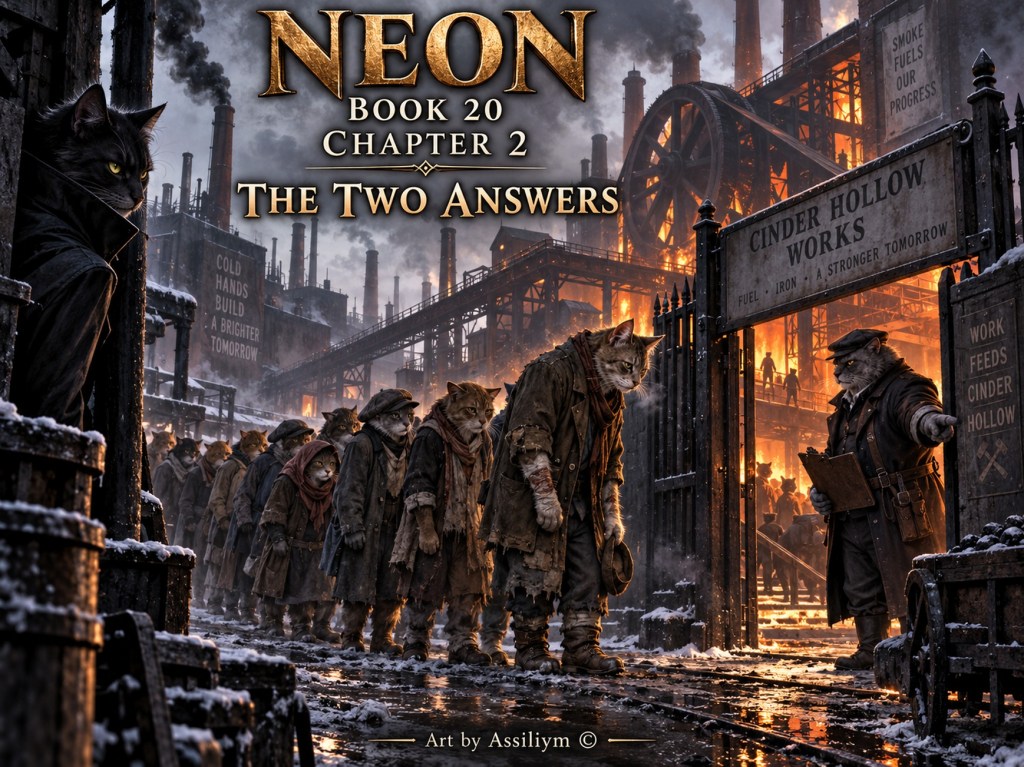
Cinder Hollow did not wake in the morning because, in the strictest sense, Cinder Hollow rarely slept. Its furnaces required paws at hours when respectable Paris-Neon was still dreaming beneath blankets; the belt works changed shifts before dawn; hidden foundries opened their shutters only far enough to release smoke; and carts laden with scrap iron, leather, coal and machine parts ground continuously through streets which had been blackened by so many years of soot that even winter could not make them clean.
Snow occasionally reached the district white. It did not remain so for long. Smoke settled upon roofs, ash drifted from furnace yards, cart wheels churned slush into black paste, and workers returning from one shift passed others already hurrying towards the next. Washing hung from upper windows and came indoors smelling faintly of coal no matter how often it was rinsed. Cats who grew up there learned the factory bells almost as early as church bells. The church might tell a poor cat what hour God believed it to be; the factory bell told him whether there would be bread.
On the eastern factory side of Cinder Hollow, the drinking rooms opened early because a district which worked throughout the night produced cats whose evening began at seven in the morning. One of those rooms stood among the belt works and smoke-dark workshops, close enough to the machinery that glasses trembled whenever some great drive wheel began moving behind the neighbouring walls. It was neither famous nor especially notorious. Cinder Hollow possessed dozens like it: low ceiling, scarred tables, beer cheap enough to become breakfast, spirits strong enough to make hunger temporarily less argumentative, and a landlord who had discovered years ago that asking customers where their wages came from was an excellent way not to receive any.
It was there that Viper had first found Mumble’s father, and it was there that he returned several days after Mumble had refused to go home with him.
He did not return because Mumble had asked him to.
That distinction mattered.
Mumble had already heard the explanations. His father had stood before him and spoken of collectors, drink, gambling, lost wages and the transfer paper he had signed. He had said he had been threatened. He had said he thought Mumble would be fed. He had said the transfer was supposed to be temporary. He had admitted that he had struck the child while drunk, though even then he had weakened the admission with the miserable defence that it had not happened often enough to deserve the full weight of the word.
Mumble had listened.
Then he had said no.
The Clean Ledger had respected the answer. His father was found. Return was refused. Any future contact belonged to the child’s choice.
Old Sable had been quite clear that nobody was to turn the phrase “future contact” into an organised campaign for changing Mumble’s mind.
Viper nevertheless wanted to know whether the father had understood what had happened after leaving that room. A child could refuse a parent and still remain vulnerable to the parent’s hopes, anger, guilt or persistence. The Beggar King’s protection did not end merely because Mumble had spoken one word clearly enough for everyone to understand.
The drinking room was already half full when Viper entered. Some customers had just left the night shift and still carried leather dust and machine grease upon their coats. Others had apparently missed work entirely and were beginning the complicated calculation by which two remaining coppers might be turned into three drinks. A thin tom slept with his head upon his arms. Nearby, another worker removed the bread from beside his untouched beer and slipped it carefully into his coat, saving food for later with the caution of somebody who trusted tomorrow less than alcohol.
At a corner table, a she-cat in a factory apron held a cup between both paws. Her left wrist was wrapped in dirty cloth.
Nobody asked what machine had done it.
In Cinder Hollow, injuries were less conversation than weather.
…
The landlord recognised him and began with the unfortunate sentence, “Not here.”
Viper looked at him.
The landlord reconsidered his relationship with language. “He’s not here.”
“Work?”
“Maybe.”
“You know?”
“I know he hasn’t been drinking here since yesterday.”
“That wasn’t my question.”
The landlord rubbed the counter with a cloth which merely redistributed old beer into a wider area. “Belt works.”
“Still?”
“Yes.”
“How often?”
“When they take him.”
That was the economy of Cinder Hollow reduced to four words. A cat could belong to a factory without the factory accepting any corresponding obligation to belong to him. One week might offer six shifts, another two. A belt could break. An order could vanish. An owner might decide that thirty cats could perform forty cats’ work if sufficiently hungry. Rent did not care. Bread did not care. Old debts certainly did not care.
Viper glanced around the room before asking, “Gambling?”
The landlord hesitated.
Viper waited.
“Not here.”
“That means yes somewhere else.”
“It means not here.”
Another silence.
“Cards twice,” the landlord admitted. “Small.”
“How small?”
“Small enough nobody threatened to cut anything off.”
“Drink?”
“Less.”
“None?”
The landlord gave Viper a look which suggested that miracles should be requested from churches rather than taverns. “Less.”
So the father had not transformed. He had not become sober, virtuous or dependable merely because his son had refused him. Neither had he collapsed completely. He appeared to be what he had been before: a weak cat making an uncertain attempt against habits which had already cost him his household.
That was more troublesome than villainy.
Villains simplified decisions.
Weak cats complicated them.
Viper left the drinking room and crossed farther into the eastern factories of Cinder Hollow. The belt works announced itself before the building appeared. A long mechanical thumping travelled through the walls, punctuated by the scrape of leather belts passing over great wheels. The poorer machinery of Cinder Hollow possessed none of the glamour inventors liked to give machines when displaying them before kings. Here power came from tread, strain, repetition, shoulders and legs. Cats walked mechanisms because water power, clever engines and new inventions were expensive.
Bodies were not.
Outside one gate a line of labourers waited while a forecat decided who would receive work that day. Some wore factory coats. Others had come in whatever clothes remained least damaged. All watched the forecat’s paw.
“You. You. Not you. You.”
One tom stepped forward after being passed over.
“I had one shift this week.”
“Then you’re rested.”
“I have three kittens.”
The forecat looked at him without hostility. “Then you have three reasons to find another shift.”
He moved on.
No cruelty decorated the answer.
That made it worse.
Mumble’s father stood farther down the line.
Viper recognised him despite the work coat. The tom looked older here than he had in the meeting room. There, he had washed himself, straightened his clothes and prepared for the possibility of recovering his son. Cinder Hollow offered no such ceremony. His shoulders sagged beneath a worn coat. One paw carried old belt scars. His boots had been patched with two different kinds of leather, and neither repair looked as though it could survive many more winters.
The forecat reached him.
“You drinking?”
“Not today.”
“That wasn’t the question.”
The father hesitated. “Less.”
The forecat stared at him.
“Inside.”
The gate opened.
Mumble’s father went to work.
Viper did not follow.
There was nothing further to learn which justified turning the boy’s refusal into surveillance. He had wanted to know whether the tom had become dangerous, desperate or vindictive after being rejected.
He had not.
He had simply gone back to Cinder Hollow.
That was almost sadder.
By midday Viper had returned beneath Paris.
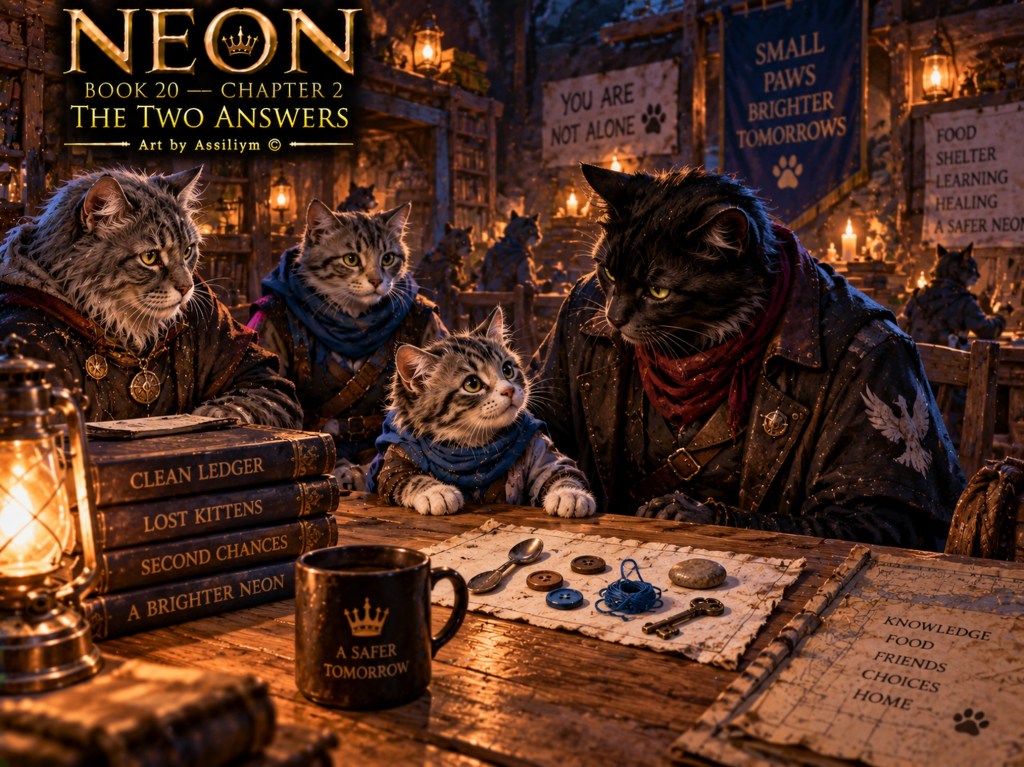
Mumble was at the school table with several other children while Rook conducted a memory exercise involving a spoon, two buttons, a length of string, a cup, a stone, a key and several other objects whose educational purpose had become doubtful once Mumble began noticing more changes than Rook remembered making.
The kitten looked up as Viper entered.
His eyes settled immediately upon the soot at the bottom of Viper’s coat.
Mumble noticed everything.
He spoke.
Rook looked towards Viper. “I assume that concerned you.”
“No.”
Mumble repeated the sentence.
Rook folded his arms. “It very clearly concerned you.”
Viper removed his coat.
Mumble said something else.
This time Viper answered without enthusiasm. “Your spectacles are behind the ink.”
Rook turned.
They were.
Miri laughed from another table.
Rook retrieved them with the dignity of a minister recovering a misplaced province.
Mumble had not stopped watching Viper.
He murmured a longer question.
Old Sable, who had entered carrying the Clean Ledger, paused near the table.
Viper could lie easily. Much of his career depended upon the skill.
He did not lie to Mumble.
“Cinder Hollow.”
Orlo looked towards the passage.
“He said he comes back.”
“Yes.”
“What if he doesn’t?”
Rot looked at him.
The question was larger than Troll.
It contained everyone who had ever disappeared.
“Then we look.”
“Like Raven?”
“Yes.”
“Everywhere?”
“As much as we can.”
Orlo thought about this before asking, “What if dead?”
Rot did not tell him not to say such things. Children who have buried enough of their family do not become safer because adults forbid vocabulary.
“Then we would tell you.”
“You always tell?”
“We try.”
“Old Sable did.”
“Yes.”
“About Grandmother.”
“Yes.”
Orlo rubbed one paw slowly over the stone.
“She died last winter.”
Rot knew.
“Yes.”
“Was she cold?”
That was the kind of question no ledger could answer.
“I don’t know.”
Orlo accepted the uncertainty.
He had become used to truth arriving incomplete.
After a while Rot asked, “Do you remember her?”
“Some.”
“What?”
Orlo folded his paws together and moved them slowly.
“Hands.”
“Her hands?”
“Slow hands.”
“For what?”
“Buttons.”
Rot smiled faintly. “She buttoned your clothes?”
He nodded.
“Soup.”
“She made soup?”
“Yes.”
“What kind?”
“Onion.”
Orlo thought again. “She blew it.”
“To cool it?”
“Yes.”
There she was.
Not DECEASED.
Not NO SURVIVING HOUSEHOLD CLAIM.
A grandmother with slow paws who buttoned a child’s coat and blew upon onion soup before giving him the spoon.
Rot said, “You should tell Raven.”
“Why?”
“She writes things.”
“Crown writes things.”
“Not that book.”
Orlo understood.
Orlo nodded once and returned to his bowl.
That was all.
Old Sable watched him go.
Later she found Basti in the map chamber with the Clean Ledger open to Orlo’s page.
HOME NEEDED remained written there.
“He thinks Troll leaving for half a day means Troll might die,” Basti said.
“He has learned that cats leave.”
“And do not come back.”
“Yes.”
“What do we do?”
Old Sable sat opposite him.
“Keep coming back.”
Basti frowned. He disliked solutions which could not be organised into routes, guards, ledgers and orders.
“That’s all?”
“For now.”
He looked down at Orlo’s entry. “Then he still needs a home.”
“He needs a future home arrangement because no surviving household exists. That does not mean he is homeless tonight.”
Basti looked at her.
Old Sable touched the table.
“He sleeps in the same bed every night. He knows where breakfast is. He knows who will answer if he calls. Troll leaves and returns. Rot knows when he coughs. Raven writes down the things he remembers. That is already more of a home than many cats above us possess.”
Basti looked again at the words.
The refuge had begun as a hiding place. Then it had become a shelter. After that came lessons, games, arguments about blankets, bowls left in the wrong chamber, children who knew where the kitchen cups belonged and kittens who complained if supper was late because they had begun to believe supper was a right rather than luck.
Adults liked categories because categories made administration possible.
Children ruined categories by living inside them.
Orlo had no surviving family.
That did not mean he had nowhere.
Mumble had a surviving father.
That did not mean he had a home to return to.
Blood and home had once been treated as synonyms by Crown clerks filling household columns.
The children were teaching Low Paris another language.
That same evening, Mumble sat beside Viper while the older cat sharpened a knife. Old Sable had forbidden knives from lessons. She had not forbidden Viper from possessing them, chiefly because enforcing such a rule would have required catching him.
Mumble watched the whetstone move along the blade.
After several minutes he spoke.
Viper listened.
“No.”
Mumble repeated himself.
“You said not yet.”
The boy nodded.
“And now?”
Another quiet rush of words.
Viper put the knife down.
“You don’t want another report.”
A nod.
“For how long?”
Mumble shrugged.
“Fine.”
The kitten studied him as though expecting persuasion.
None came.
Viper picked up the whetstone again.
Mumble relaxed.
A minute later he began correcting the sharpening angle.
Viper looked at him. “I was using knives before you were born.”
Mumble answered immediately.
“What?”
The boy repeated it.
Viper stared.
“You are nine.”
Mumble smiled.
Across the chamber Rook asked, “What did he say?”
“Nothing.”
“That was clearly something.”
“It was nothing you need translated.”
In truth, Mumble had informed him that being older had apparently not made him better at sharpening knives.
Orlo was already asleep by then.
Beside Troll’s bed lay the small objects the kitten had collected for him over the previous days: a polished stone, a bent spoon, a piece of blue string, a wooden button and now a brass washer he had found near the schoolroom.
Troll had arranged them carefully as though they were decorations bestowed by foreign princes.
Before sleeping, Orlo had asked, “You here tomorrow?”
“Yes,” Troll had answered.
He had not promised forever.
No living cat could.
He had promised tomorrow.
For Orlo, tomorrow was becoming large enough.
Near midnight Basti returned once more to the Clean Ledger.
He did not alter Mumble’s entry. The father remained found. Return remained refused. Future contact remained the child’s choice.
He did not alter Orlo’s status either. No hidden relative had appeared. No convenient guardian had arrived to turn an uncomfortable question into a neat ending.
HOME NEEDED remained.
Once Basti would have considered both entries unfinished.
Now he was beginning to understand that unfinished did not mean failed.
One child had a father and had chosen not to go with him.
One child had nobody coming and had been told he could stay.
The Crown’s old arithmetic would have found the first case obvious and the second inconvenient. A father possessed a son. An orphan required disposition.
Low Paris had discovered something more difficult.
Mumble was not property to be returned merely because the correct adult had been located.
Orlo was not property to be transferred merely because no adult had been located at all.
Above them, the furnaces of Cinder Hollow continued staining the winter sky. Somewhere among the eastern factories, Mumble’s father worked another belt shift beneath the same smoke which had followed him through years of drink, gambling, debt and regret. Perhaps he would change. Perhaps he would not. His son had decided that, for now, he did not wish to find out.
Below Paris, Troll snored loudly enough to reassure several walls of his continued existence.
Orlo slept near the sound.
Mumble slept farther down the gallery, safely beyond the reach of a father he had refused and within a place where nobody intended to make him repeat the answer simply because an adult disliked hearing it.
The Clean Ledger remained open upon Basti’s table.
One child had answered no.
The other still needed somewhere permanent to belong.
Neither answer required forcing into completion tonight.
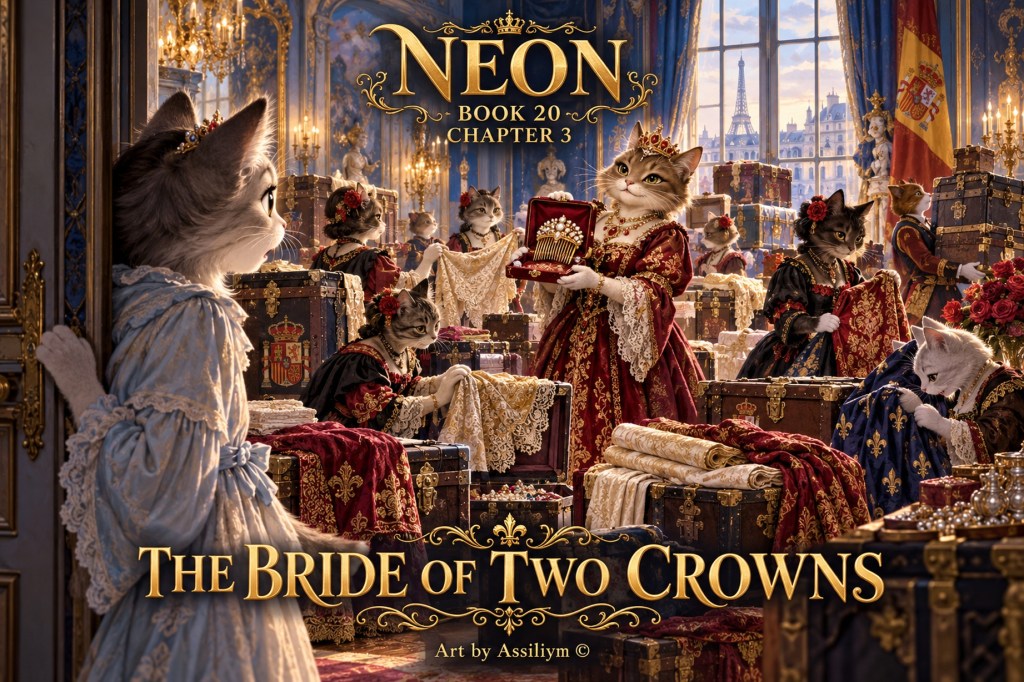
The morning after France and Spain had finally agreed upon the day when their two crowns were to be joined, Princess Anna awoke to discover that Spain had occupied her apartments during the night.
Not militarily; Spain had sufficient experience of Europe to know that conquest by wardrobe was cheaper, quieter and considerably more difficult to reverse. The first indication of invasion came when Anna opened the door of her private chamber and found the adjoining salon filled from wall to wall with trunks: cedarwood trunks banded in brass, dark travelling cases strengthened with iron, narrow jewel boxes covered in Spanish leather, long cases intended for lace and folded silk, and one enormous chest whose lid bore the faded arms of the Montemayor family and appeared old enough to have crossed the Pyrenees before several present ministers had acquired grandfathers. They had travelled from Madrid under guard, through rain, mountain cold and French curiosity; now they stood beneath the painted ceilings of Paris, exhaling the intimate perfumes of another home. Cedarwood mingled with lavender, dried orange peel, rose sachets and the faint sweetness of old silk. The room was French in architecture, but the air had become Spanish.
Queen Beatriz was already in command of the occupation.
She stood near the windows in a dark morning gown, directing three Spanish ladies, two seamstresses and enough servants to transform unpacking into a branch of government. Long sheets of lace were being laid carefully upon linen-covered tables. Rolls of silk leaned against chairs. A maid carried a velvet case towards the sunlight and was stopped by the Queen before she had taken three steps.
“Not there. The sun will fall directly upon it.”
The maid retreated.
Anna remained in the doorway for a moment, still half asleep, watching her mother restore Madrid around her with the serene authority of a woman who considered geography an inconvenience rather than a fact.
“You have brought the whole palace,” Anna said at last.
Beatriz glanced towards her. “Hardly.”
Anna entered. “There is enough luggage here to establish a second Spain.”
“That would require your father’s armour chests. Those are elsewhere.”
There were smiles among the ladies, quickly hidden. Beatriz returned to a cedar case, and Anna came beside her. She had expected jewels; everybody expected jewels from Spain. What she found instead was lace.
The Queen lifted the first layer of scented paper, and beneath it lay broad folds of ivory work so fine that Anna could see the grain of the table through portions of it. Some carried patterns of leaves and pomegranates. Others held tiny flowers made from threads thinner than hair. One length had mellowed almost imperceptibly with age, its ivory warmed by decades of candle smoke, chapel incense and careful storage. Anna recognised the pattern before she understood why.
“This belonged to Grandmother.”
Beatriz’s briskness softened. “Part of it did. She wore a smaller piece at Easter. The rest she kept.”
Anna touched the edge with the tips of her claws, hardly pressing. Childhood returned through texture more quickly than through portraits: an elderly Queen kneeling beneath chapel candles; a black dress; this same pale lace falling from her shoulders; the smell of incense and wax; Anna small enough that the world had seemed composed entirely of enormous adults and unreachable shelves.
“Why was it never used?”
“Your grandmother said she was waiting for the right occasion.”
“And now?”
Beatriz gave the smallest shrug. “Your grandmother is no longer here to argue with me. I have assumed authority.”
Anna laughed, and the ladies resumed their work.
Other trunks followed. There were silks of pearl, warm ivory, cream and pale gold, together with darker Spanish cloths in burgundy, midnight blue and black. Some were untouched lengths brought for possibility rather than design; others had borders already embroidered in old gold. Beatriz had brought enough material for more than one gown, because she trusted neither distance nor tailors sufficiently to wager a royal wedding upon a single piece of fabric. She explained this without humour, which made Anna laugh again. But beneath the extravagance lay something more tender than preparation. These were not simply expensive things delivered from one court to another. They were pieces of a household Anna was about to leave permanently in a way she had never left it before. Until now Madrid had remained behind her like an open door. After the wedding, Paris would become home too.
Beatriz seemed to know what Anna was thinking, for she closed one of the great silk trunks and moved instead to a smaller case covered in deep red leather. This one she unlocked herself.
There were diamonds in Spain capable of changing the mood of a room when their case was opened; emeralds dark as forest pools; rubies which appeared to contain coals beneath their surfaces; strings of pearls whose value would have caused Adrien de Valmire to require both a chair and immediate medical supervision. Beatriz had brought some of these, but the first box held smaller things: family things. A gold bracelet set with cabochon rubies. Pearl earrings Anna remembered from winter feast days. A square emerald pendant worn by Beatriz before she became Queen. A little gold cross smoothed at the back by generations of fur and skin.
Anna touched the cross. “You still wear this.”
“Sometimes.”
“Will I wear it?”
“No. You will already have enough cats trying to hang history around your neck.”
Then Beatriz opened the smallest case.
The bridal comb lay inside.
It was not enormous and did not need to be. Its spine was old gold worked into leaves and tiny flowers, each flower holding a pearl. Three slender golden branches rose from its upper edge, and from them hung five small pearls which trembled whenever the case moved. The piece possessed that peculiar dignity belonging to heirlooms which have survived long enough to become indifferent to fashion.
Anna became quiet.
“My grandmother wore it.”
“Yes.”
“And you.”
Beatriz lifted it from the velvet. “My mother put it into my hair on the morning I married your father.”
Anna smiled faintly. “What did she tell you?”
“That I had chosen a stubborn cat.”
“She was right.”
“Completely.”
The joke passed, but Beatriz continued holding the comb between them. Her expression had changed. For the first time that morning she was no longer organising servants, judging fabric or protecting lace from sunlight. She was remembering another room, another mother, another wedding morning.
“She told me something else,” Beatriz said. “She said that everybody around a royal bride spends the day reminding her what she represents. Her father. Her family. Her kingdom. Her religion. Her future children. Her duties. Her treaty. Her husband. By the time the ceremony begins, there is danger that the bride herself has become the smallest thing in the room.”
Anna looked at the comb.
 Vuk Stribog