
NEON: Silent Paws —Low Paris Gathers
Its Dead- book 3
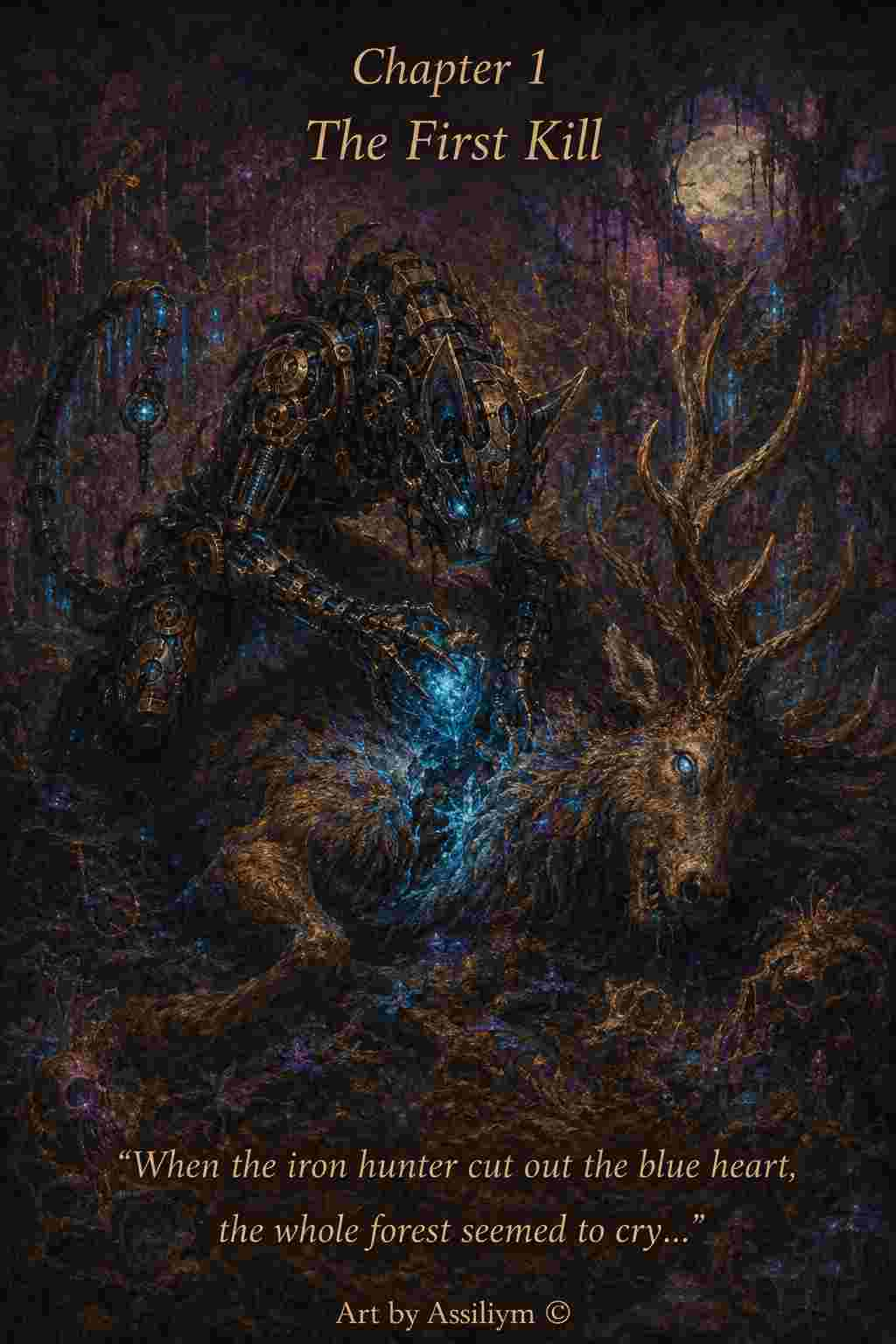
The Elder Stag lay among the black roots of an old whisper-ash, his crown of antlers half-buried in fern and moonlit moss. He had been a prince of the forest for more years than village cats could count, an animal of deep paths and hidden springs, with scars silvered across his flanks and eyes that had seen winters bury whole generations of hunters. Foxes had lowered their heads when he passed. Deer had followed his steps in drought. Even wolves had given him distance when Lucette and Mauve stood full together above the trees.Now he lay open to the night.
No teeth had fed on him.
No belly had been filled.
No prayer had been muttered by a hunter kneeling in shame before taking life. No blood had been covered with leaves. No branch had been bent in thanks. No beast-song had gone up into the dark.
Only a black shape stood above him.
The Tik-Tok Hunter Sentinel lowered its head.
It was not a soldier built for ranks, banners, and open battle. It was not one of the iron things that waited beside gates until commanded to crush whatever crossed. Its body was longer, narrower, more terrible in its purpose. It had the shape of a hunting beast only because the old makers of Tik-Tok had understood that certain crimes require legs, patience, silence, and teeth.
Black armour plates covered its frame, but not completely. In the seams of its neck, under the ribs, inside the shoulders and behind the hooked joints, hundreds of small gears turned in precise obedience. Wheels whispered. Springs tightened. Cogs adjusted with tiny metallic clicks. Blue crystal veins ran through its body like frozen lightning trapped under iron skin. At the centre of its chest a sensor-wheel turned, paused, turned again.
Tik.
Tok.
Tik.
Its head, long and hound-like, lowered towards the Elder Stag’s breast. Thin blue slits opened along the muzzle, scanning, listening, tasting what no living nose could taste.
Blood.
Heat.
Bone.
Fear residue.
Shard-resonance.
There.
Beneath the broken ribs. Behind the mortal heart. Not the heart itself — the heart was only flesh, faithful and finished, dark with its last labour. Behind it, wrapped in nerves of pale blue light and crystal filaments fine as spider-silk, rested the stag’s shard-core.
The blue heart.
It pulsed once.
The Sentinel’s right foreclaw opened.
It did not unsheathe like a cat’s claw. It unfolded in three surgical blades, each one thinner than a thorn and sharper than winter starlight. With one clean movement, the machine cut through blood, membrane, and bone.
The forest heard the sound.
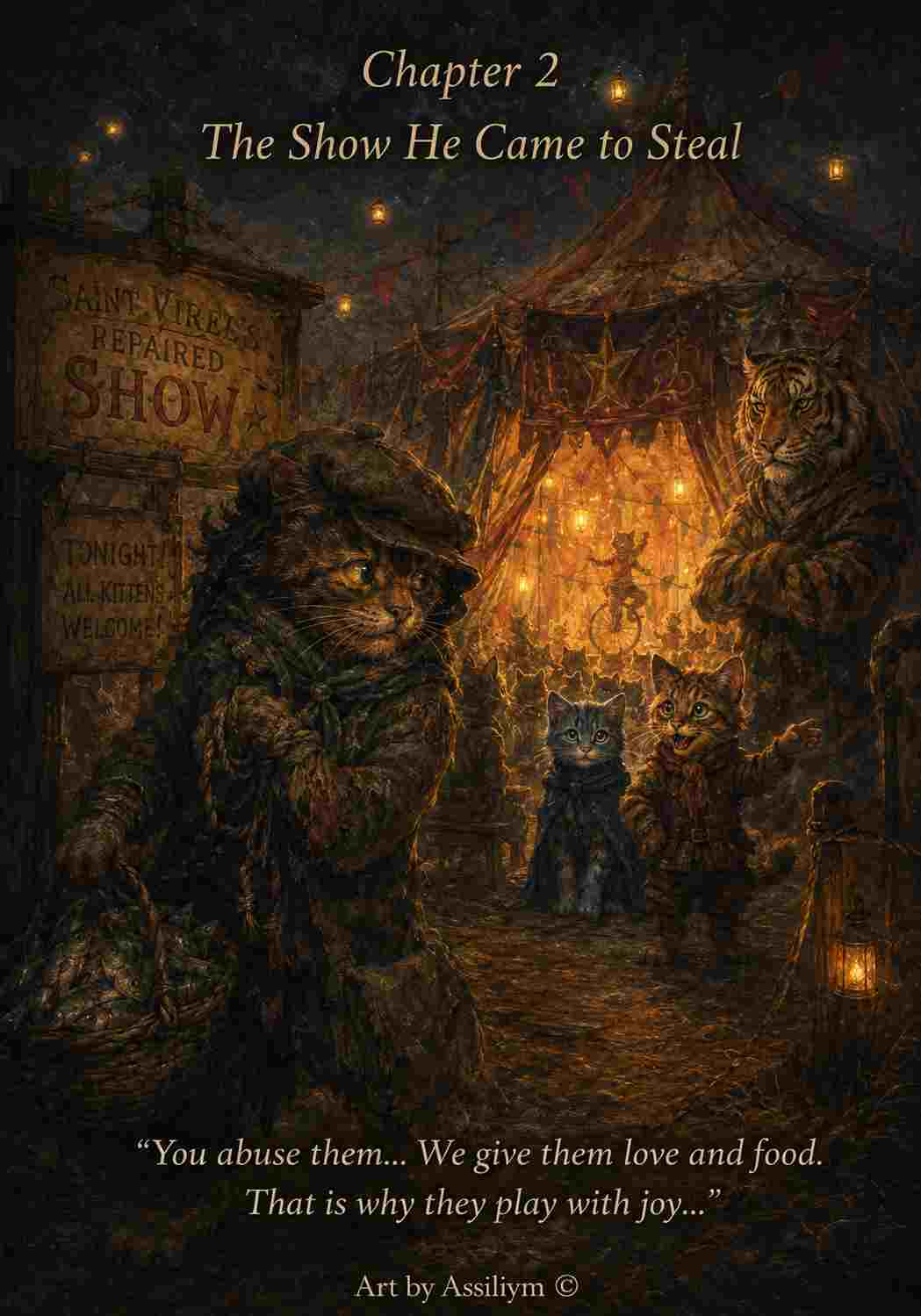
“Inside,” he snapped. “Quickly.”
From the folds of the broken kite came a faint furious squeak.
Céleste heard it.
Her ears lifted.
“What was that?”
“Wind in the mechanism.”
“That mechanism has whiskers.”
“It is a very advanced mechanism.”
He shouldered into the tent before she could answer. Inside, he dropped the flying machine onto a rolled carpet and knelt over it at once. His paws moved quickly now, anger sharpening him. He folded the torn wings, pulled the cracked frame together, detached the little control box from the front harness, and wrapped the blue-shard housing in a cloth.
The shard still gave a weak glow.
Balzak looked at it, and despite the mud, despite the crash, despite Mr Stripe’s promise to eat him should he remain where he was not wanted, his eyes brightened.
A lesser cat might have seen a warning.
Balzak saw tickets.
Another squeak came from the kite’s belly.
Madame Crumbolina, brave little pilot of disastrous heavens, wriggled inside the travelling compartment with the furious dignity of a mouse who had not agreed to become property. Two small mice tumbled beside her, dazed, dusty, and deeply opposed to aviation as a profession.
Balzak opened a small wooden box, swept them in with indecent efficiency, and shut the lid.
“Temporary accommodation,” he told the box.
The box answered with a volley of squeaks that made Céleste raise one eyebrow.
“Temporary imprisonment, you mean.”
“Madame,” Balzak said, pressing the lid down while the box rattled, “in the theatre, language is everything.”
“In theft too, apparently.”
The first smell Balzak encountered was not glory, but fish.
That was because it was himself.
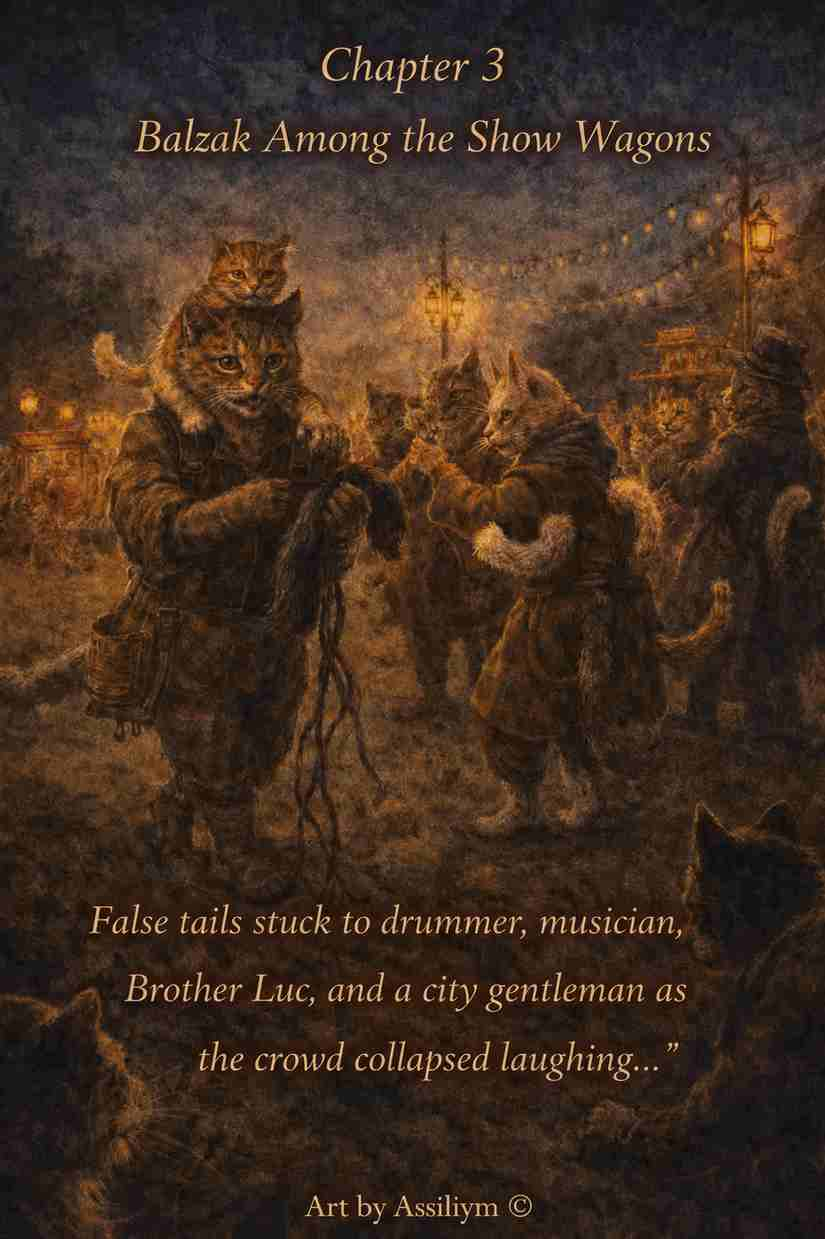
He had gone further in his precautions than vanity would ordinarily permit, for he had not forgotten the tiger’s recognition on the earlier night behind the wagons, and he did not intend to be named again by silence before he had even judged the strength of the field. A hood could mislead the eye. It could do little against memory of scent. So he had dressed not merely as a lesser cat, but as a fishercat from the river roads: patched boots, tar-dark coat, a cap that had known weather and argument, a bit of old net wound round a basket, and over all of it the democratic and inappealable odour of stale fish.
Not clean fish either. Not the brisk silver smell of morning trade and lawful commerce. This was the ripened fragrance of old scales, damp wicker, rope-slime, and one particularly deceased pike whose final service to society had been the abasement of Balzak.
He bought his ticket from a village she-cat who scarcely looked up.
That injured him more deeply than the smell.
He entered under the patched archway with a grunt he despised in himself and took a place on one of the new benches among ordinary paying cats. A broad village tom seated to his right frowned almost at once and shifted half an inch away.
“Merciful saints,” the tom muttered. “Did you sleep in the catch?”
Balzak gave a low fishercat chuckle that nearly cost him a tooth.
“River was generous.”
“The river may be generous,” said the tom, wrinkling his nose, “but you’ve murdered the air.”
A she-cat on Balzak’s left pulled her shawl higher over her face.
“Sit still at least,” she said. “If you wave your forelegs the smell comes in layers.”
Balzak settled into the bench with as much peasant resignation as he could manufacture and thought, with a cold inward sneer, Yes. Recoil. Let all your poor honest noses suffer. Let the striped devil smell fish and river muck tonight. Let him find only a fishercat among the benches.
Then the lamps dimmed a little.
The drum rolled.
It rolled once before the drummer touched it.
 Vuk Stribog