
INSIDE BOOK 4
NEON:
A TALE OF TWO KITTENS-
THE PRICE OF SIN
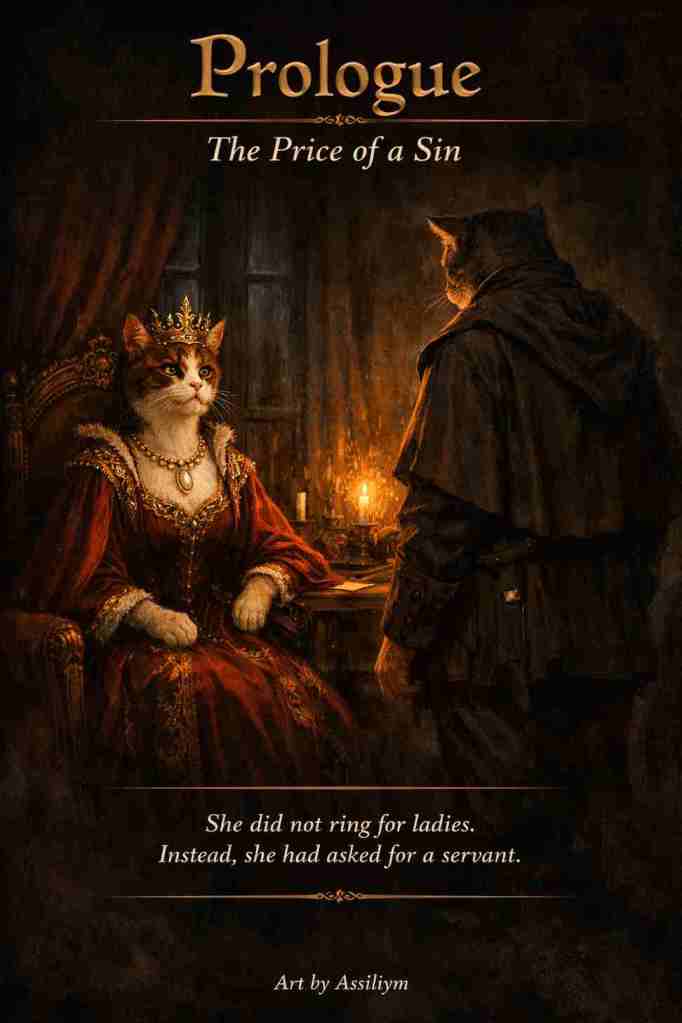
A narrow-shouldered palace cat of no account to history, whose usual work consisted of carrying notes, fetching cloaks, trimming lamps, and becoming so invisible in noble rooms that noble eyes forgot he possessed a name. But Catalina knew more of the palace than any of the palace knew of her. She knew who had once been a hunter. Who had once followed hoof and blood through wet wood. Who had the patience to watch without inventing what had not yet happened.
That was why she chose him.
When he entered, he bowed low enough for obedience and not so low as to become ridiculous. That too pleased her. Ridiculous cats are useless in dangerous work.
For a few moments she did not speak.
She looked at him.
He kept his eyes lowered, but not blindly. A good servant knows where not to look; a better one still knows how to listen with the body.
“You were a hunter once,” she said.
He hesitated only a breath.
“Yes, my lady.”
“Before the palace.”
“Yes.”
“You tracked in bad weather.”
“I did.”
“And in darkness.”
“When needed.”
Catalina let the rain speak for a moment against the shutters.
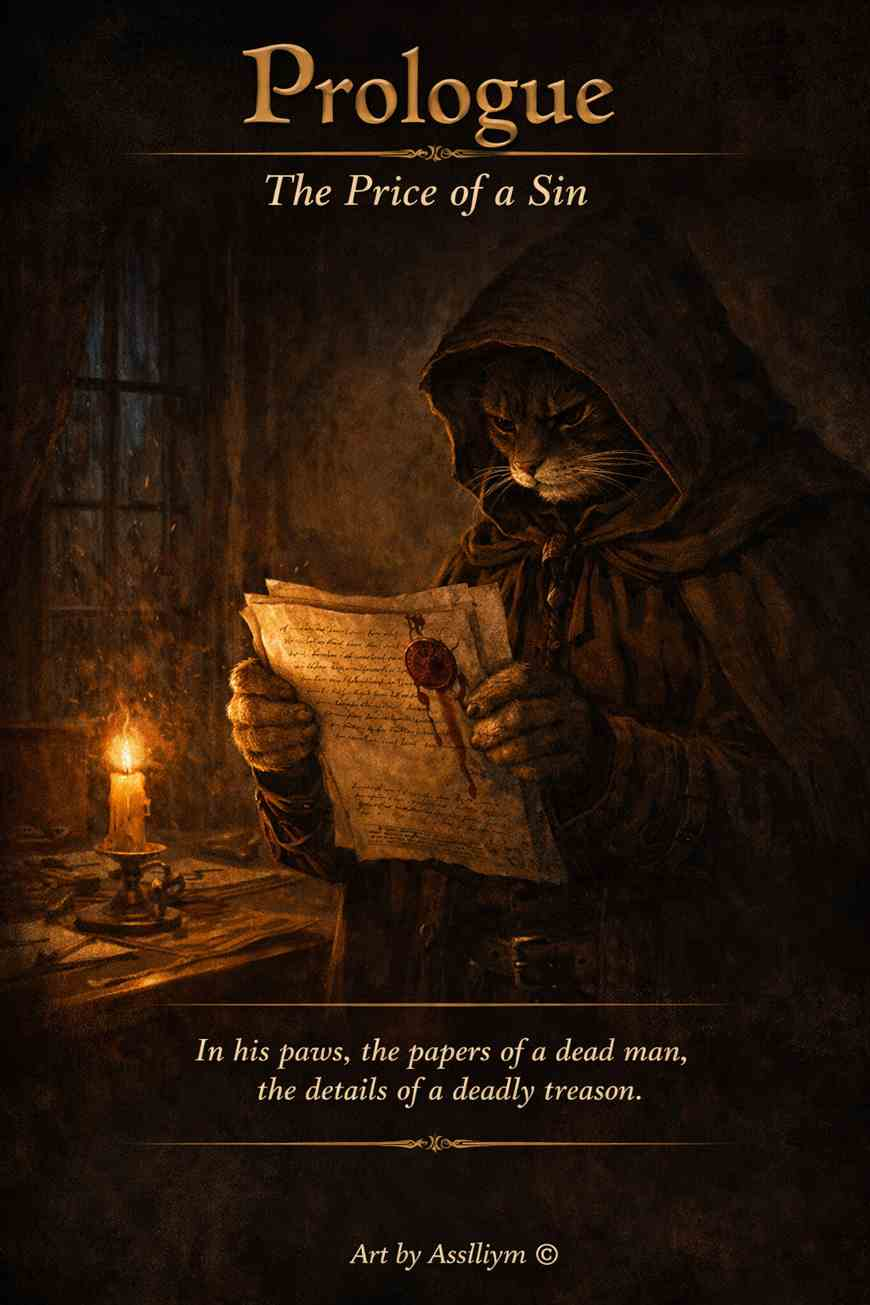
The door shut.
Catalina remained by the dying fire.
For the first time that night, her face altered.
Not much.
Not into tears.
Not into wounded vanity.
Into arithmetic.
If it was what she feared, then this was no passing softness.
No low vice soon cured by shame.
No court flirtation to be crushed with distance and a priest.
If the king had begun making secret roads outside the palace, then those roads led not merely to pleasure, but to consequence.
And consequence in a royal house is another word for danger.
She sat again and waited.
The hours that followed were made of almost nothing.
Rain.
Coals settling.
A lamp guttering once, then recovering.
A single bell somewhere in the palace striking a tired hour.
It struck once too late, or perhaps Catalina only wished it had. Time inside palaces is famous for serving power until the night it changes masters.
At length she rose and went to the writing table.
She did not write.
Étienne Delorme returned sooner than expected.
With him came two cadets.
Not cats.
That altered the room at once.
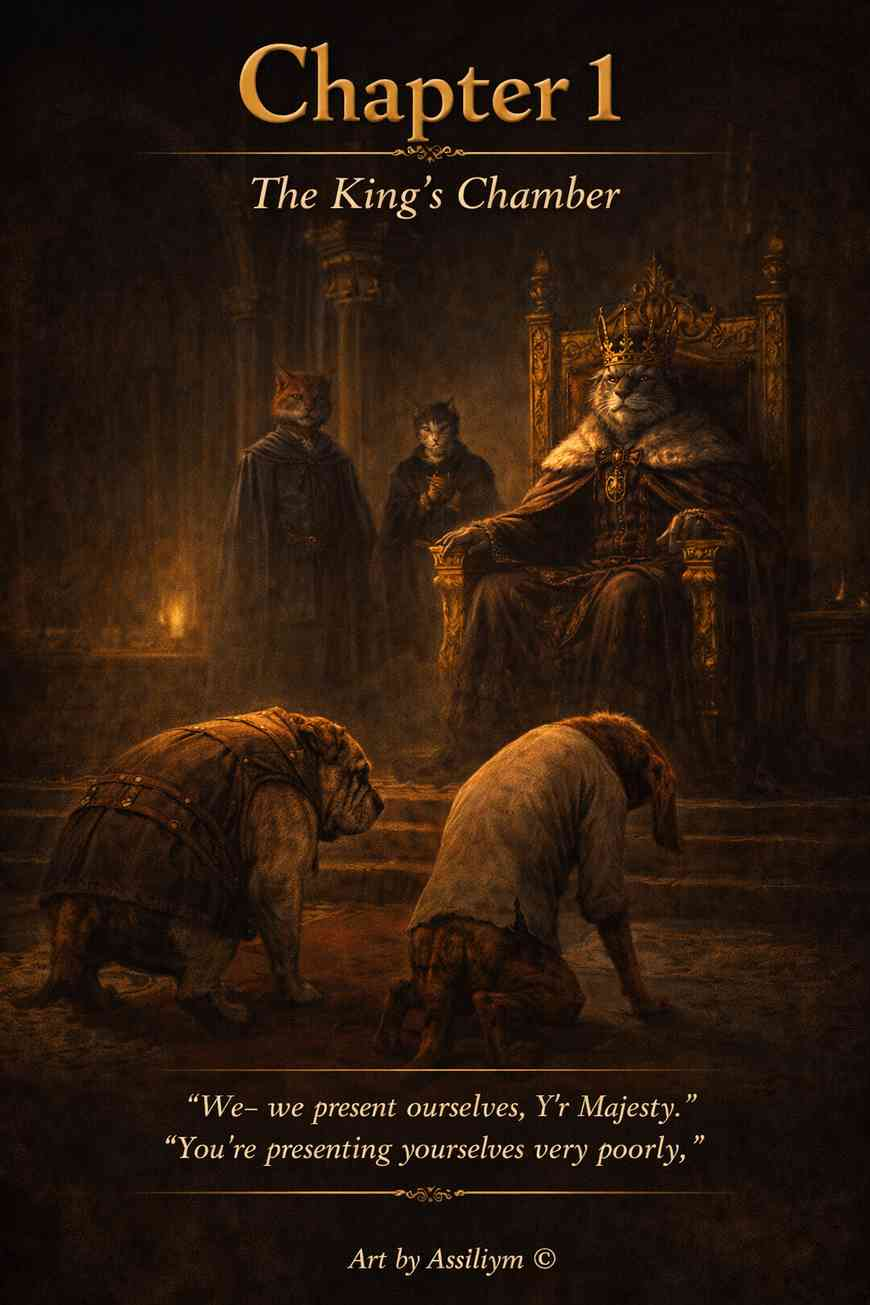
They were dogs—real dogs in a kingdom where even the poorest alley-cat still possessed the consolation of belonging to the ruling blood of the species. These two had no such inheritance. Brick—the broader of the pair—was a bulldog with a chest like a small battering ram, a jaw made for stubbornness, and paws too square for elegance. Stick was a hound, longer in limb, narrower in flank, all anxious ribs and strained obedience, as though nature had built him for pursuit and society had rebuilt him for apology. They were not half-breeds. Not muddies from the provinces. Not some rough but recognisably feline offshoot that could still beg a place somewhere on the great insulting ladder of cat blood. They stood outside it altogether.
And the chamber knew it.
No one spoke. Great courts prefer their cruelties diluted into posture. But Balzak saw the little changes: a secretary’s lids lifting and settling again; the younger clerk drawing his papers a fraction closer to himself, as though dignity required distance; one of the secretaries near the wall wearing the brief, unconscious look with which cats watch a wet dog cross a fine carpet. Dogs in a feline kingdom are never permitted to forget what they are. Half-breeds may be sneered at. Muddies may be mocked for accent, soil, and rough manners. But dogs stand lower still: useful, admitted, and never for a heartbeat mistaken as equals.
Brick and Stick felt it too. Of course they did. Creatures raised beneath the line of ease become weather-readers of contempt.
They had been made as presentable as haste allowed. Their coats had been brushed too fiercely. Their collars sat wrong from over-correction. Brick looked as though he had swallowed the whole outer yard. Stick had the strained, hunted expression of one who knew that a single misstep in such a room would not be forgiven as clumsiness, but remembered as proof of species.
The moment they saw the king, they dropped into a bow so violent and absolute that it was less etiquette than ancestral panic.
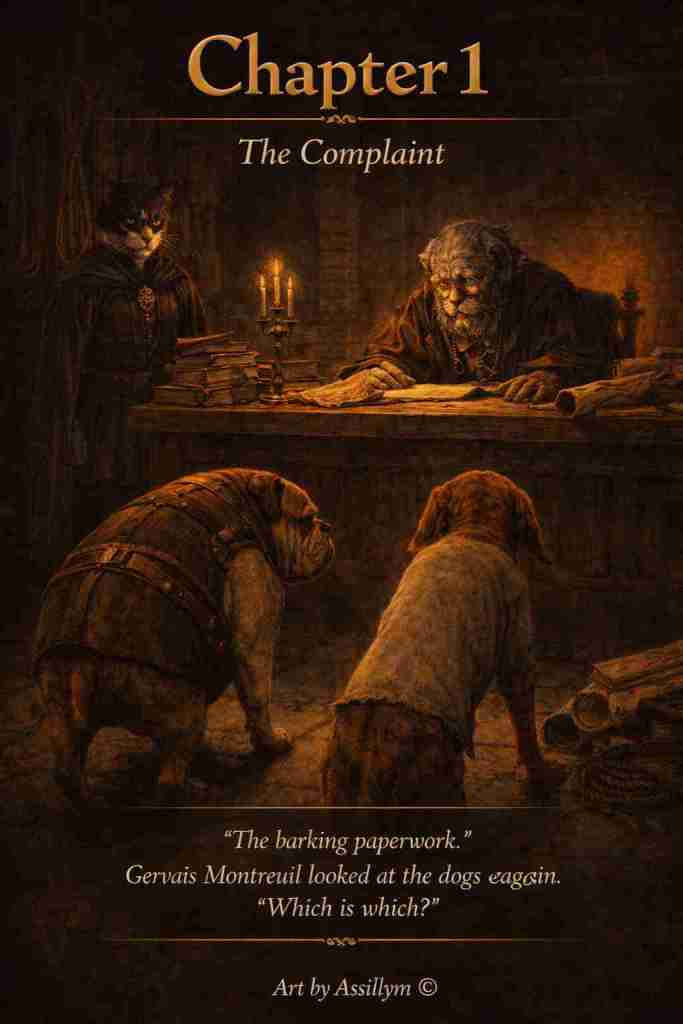
The usher announced him. Balzak bowed.
When he rose, the king was not looking at his face, but at the travelling-case.
“You bring papers,” said His Majesty.
“I have tried to bring order with me, sire.”
Something almost amused flickered at the corner of Luis’s mouth.
“Then you differ from most who come here,” said the king. “Speak.”
Balzak laid the case upon a small inlaid table prepared for petitioners and opened it with deliberate care. He had rehearsed this beginning all the way from Saint Virel. He would not wail. He would not rant. Courts do not move for suffering, only for inconvenience raised to the dignity of precedent.
“Sire,” he began, “I come to place before the Crown a matter of unlawful holding, unauthorised exhibition, irregular possession of trained beasts of value, and the public exploitation of proprietary spectacle without licence.”
That pleased him. One could feel how much more respectable it was than saying they stole my animals and made better stories with them.
Étienne Delorme’s gaze sharpened. The younger clerk dipped his head over a blank page. The king’s lids lifted by a hair’s breadth.
“Where?”
“A village called Saint Virel, sire.”
At that, Étienne Delorme and his clerk exchanged the smallest look. The name had travelled before Balzak had. A good sign, Balzak thought.
“Saint Virel,” said the king softly. “That mud-hole returns to my ears too often of late. Continue.”
Balzak laid down copied route-licences, then the small account-book.
“For years, sire, I lawfully transported and exhibited trained creatures upon licensed roads and under recognised protection where local officers proved either ignorant or inconvenient. I maintained stock, equipment, handlers, feed, veterinary care, travelling warrants, and route permissions. Some months ago, through circumstances which need not burden Your Majesty with unnecessary theatre, a number of animals escaped my train in the Saint Virel district. They were neither reported nor surrendered to any authorised officer. Instead, they were retained.”
“Retained,” repeated the king.
“Yes, sire.”
“By whom?”
“By the village. Or by those who presume to govern compassion there. An old healer. Certain local families. Boys. Peasants. Whoever has chosen to wrap theft in pity.”
He had not intended that last phrase to come out hot, but the king seemed better pleased by anger than by his earlier smoothness.
Étienne Delorme stepped forward.
“What sort of creatures?”
Balzak named them carefully, holding back certain lesser details, enlarging others, and dwelling just enough on the striped forest-cat to ensure that curiosity took root where sympathy might not.
“A striped beast of unusual size and intelligence,” he said. “Smaller trained creatures formerly attached to my exhibitions. Certain exotics which provincial officers are unfit to classify correctly. All valuable. All trained. All unsuited to peasant custody.”
“And these animals are being displayed?” asked the younger clerk.
Balzak drew out another sheet, this one compiled from road-gossip, observation, and the sort of information that can always be bought from innkeepers, hungry boys, and offended neighbours.
“I have every reason to believe so. Publicly. Before assembled crowds. Under a tent of sorts. For coin, gifts, produce, or their country equivalents. Without permit. Without municipal stamp. Without guild clearance. Without safety review. Without posted authority.”
He added the Low Paris sheet last, with a grief so theatrical it nearly became sincere.
“And, sire, worse. Their village miracle has been copied, sold, embroidered, printed, sung, and made into a public nuisance. In Low Paris they now speak of flying mice, sky-commanders, tiger-kites, Saint Virel wonders, and blue-hearted machines as if every stolen marvel were common property. My loss has become entertainment. My trade has been converted into rumour. My discipline, into carnival.”
At the words guild clearance, Étienne Delorme’s ears moved slightly.
At the words blue-hearted machines, Luis looked at the paper.
The king took one of the sheets, glanced across it, and gave a soft, contemptuous breath.
“A village circus.”
Balzak bowed a fraction lower. “An illegal one, sire.”
Augustin, whose pride had always been equal parts vocation and appetite, had decided that if the city wished to worship process, it might do so at a fee.
Thus were born the Lantern Tours.
The first guests had already begun to gather in the outer receiving hall, and they wore the strained brightness of cats determined to seem casual while privately consumed by envy. A collector’s widow from Saint Germen sat on the edge of a chair as if prepared to spring upon any mention of the Moon-Faced Girl in Blue Silk. A rich she-cat in plum silk from the riverside quarter pretended to admire a framed needlework sample while in fact trying to determine whether the black mantle cloth glimpsed through a half-open side door belonged to her commission or another’s. Two court ladies, cousins to somebody whose name had acquired the habit of entering rooms before its owner, spoke in murmurs full of summer politeness and winter hostility. A merchant who had paid too much for everything all his life was now discovering the exquisite pain of paying too much and still not being first.
On a side table, where Augustin had permitted only approved samples and no vulgar amusements, three contraband trifles had nevertheless appeared among the gloves and calling cards: a cheap Captain Whiskerbold scarf, a fake Saint Virel shard-lamp no larger than a walnut, and a tin-legged toy spider that some fool had wound too tightly…
Private Patron’s Contribution for the Lantern Tour of the Twelve
The phrase was infuriating enough to make Étienne wish briefly for civil fire.
Each visitor, after paying, was made to sign the register. Name. House. Commission interest. Number in party. Whether they had previously attended a viewing. Whether they intended, if successful in securing their doll, to acquire a private carrying case or the standard guild casing. There was a surcharge for the carrying case. There was a surcharge for late attendance. There was a surcharge for requesting a second viewing. There was, Étienne had discovered to his horror, even a surcharge for “special concern regarding progress”, a category under which three widows and one magistrate had already willingly humiliated themselves.
And this, he thought bitterly as he blotted another signature, was apparently called art.
At the bottom of the register, beneath the proper lines, some previous paw had scratched a little rhyme in the margin before an apprentice had tried and failed to rub it out:
The Blind One bled, the cloth forgot;
Count twelve dolls, but trust them not.
Étienne stared at it for three seconds, decided that Paris had once again produced superstition with excellent penmanship, and drew a hard line through the words. The ink smudged red before turning black. He disliked that very much.
The room stirred.
Augustin had entered.
He wore black.
Not mourning black, though half the city had become so fond of mourning that the distinction needed stating. This was chosen black, triumphant black, the black of lacquer and authority and expensive cloth cut by a paw with principles. The silver embroidery at his cuffs caught the light like restrained insolence. His fur had been brushed until every line of him declared that no ordinary dust had the right to settle there. He moved through the room with the exact calm of a cat who had already arranged not only the lamps, not only the routes, not only the positions of his artisans and apprentices, but the probable emotional states of every collector present.
“Ladies. Gentlemen,” he said, and because he spoke softly the room was obliged to grow quiet in order to hear him. “You are about to be granted what many have requested and very few have deserved.”
Étienne closed his eyes briefly.
Augustin continued as if there had never been a world in which modesty existed.
“The Lantern Tour is not a public exhibition. It is not a market stroll. It is not an opportunity for pawing, peering, bargaining, advising, or breathing directly upon silk. You are here to witness becoming. If you mistake this privilege for familiarity, you may leave by the same door through which you entered and keep the street.”
No one moved.
He let the sentence settle.
Then he raised one paw slightly, and an apprentice stepped forward with a velvet-covered tray upon which lay the guild seal, a silver pen, and a little bowl of black ink.
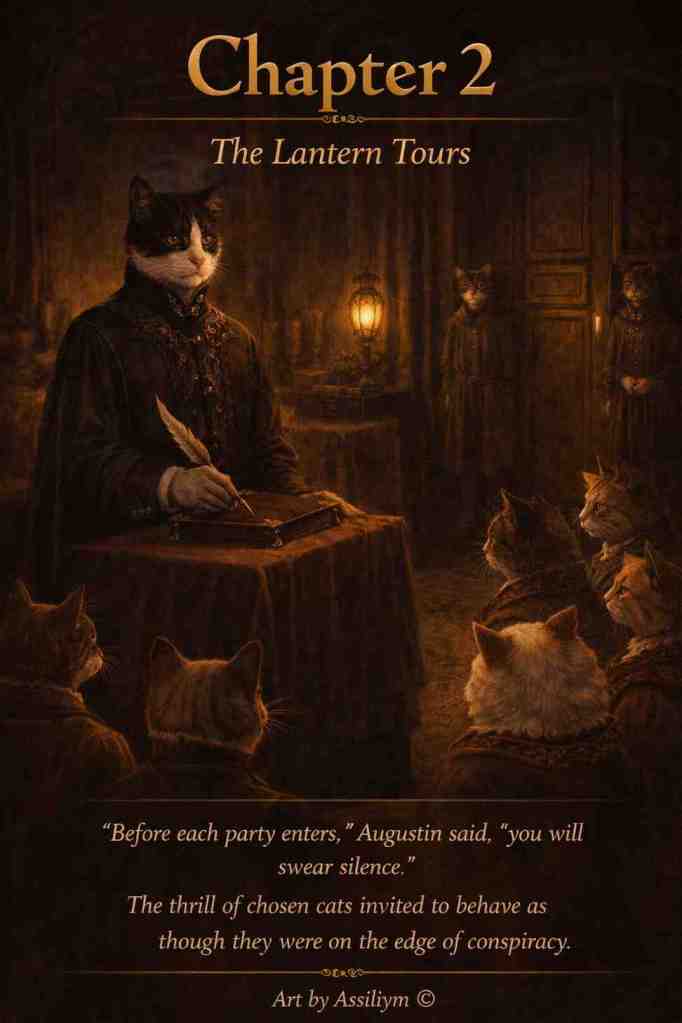
“Before each party enters,” Augustin said, “you will swear silence.”
That produced, as he had known it would, precisely the right little movement in the room. Not fear. Delight disguised as gravity. The thrill of chosen cats invited to behave as though they were on the edge of conspiracy.
“You will not repeat,” he said, “what you have seen of methods, unfinished likenesses, mechanisms, room order, patron placement, artisan hands, private alterations, or the condition of any commission not your own. You will not sketch. You will not question the apprentices. You will not speculate aloud in a manner insulting to the Guild. If you cannot keep silence, you may keep ignorance.”
The widow from Saint Germen nearly glowed…
dsfdsfdsffsdfdsfsfsfsfsdfsdfsdffsdfzsdfxsgfds
 Vuk Stribog