
INSIDE BOOK 5
NEON: The Roads to Paris — The Price of Prudence — Book 5
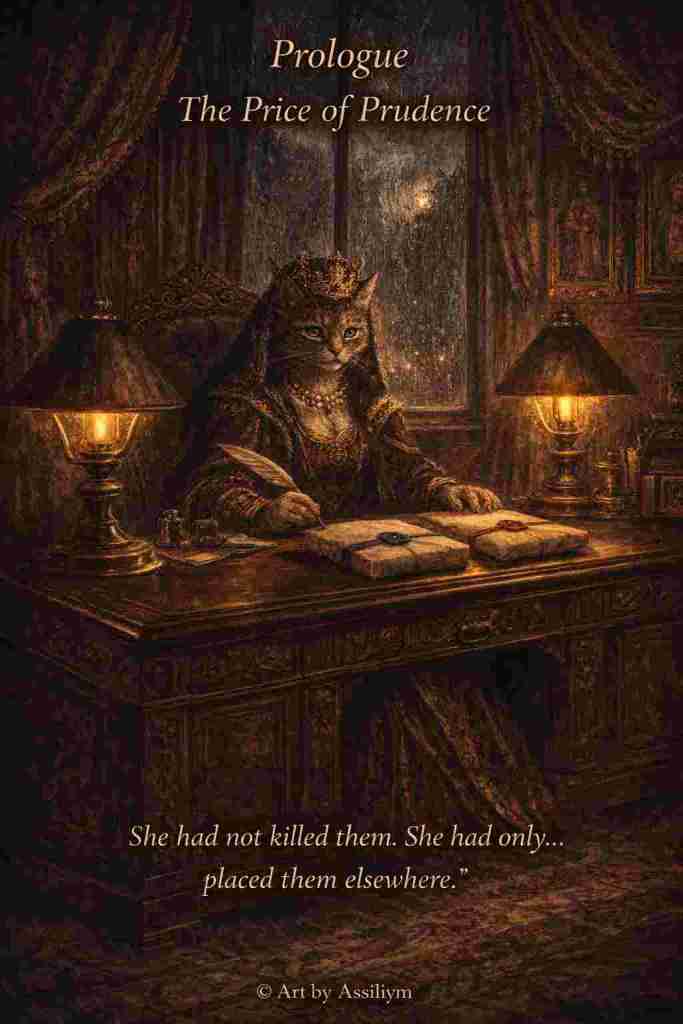
Queen Catalina Inés de Aragon had always believed that the worst crimes in royal houses were committed under the name of prudence.
Not murder in the crude and vulgar sense. Not poison in cups, daggers under cloaks, or cats flung from walls in moonlit towers. Those belonged to songs, taverns, and the vanity of lesser imaginations. No—true royal cruelty preferred cleaner gloves. It signed, sealed, arranged, removed, corrected, transferred, and, above all, preserved appearances. It took the living scandal of blood and converted it into distances, convent walls, changed names, discreet marriages, provincial placements, quiet burials, and records rewritten by obedient paws in rooms where candles burned low and conscience lower.
On the night she divided the children, the palace was so still that one might almost have mistaken it for innocence.
Rain moved softly over the outer roofs. It tapped at the carved gutters and slid from the mouths of stone beasts into the black courtyards below. The long galleries had gone dim. Fires slept low in the greater chambers. Servants passed in muffled haste, each carrying silence as carefully as a tray. Behind one closed door a lute still sounded, because somewhere in every palace there is always one foolish creature singing while fate sharpens its knives. But here, in the queen’s lesser withdrawing room, no music entered. The curtains were drawn. The lamps were hooded. The painted saints on the panelled wall seemed to have withdrawn into themselves, as holy creatures often do when the powerful begin behaving like accountants of damnation.
In the nursery wing, far behind her, some half-asleep maid was humming an old cradle rhyme without knowing she had chosen the wrong night for it:
Two little moons in one small bed,
One was remembered, one was dead.
Lucette kissed the golden hair,
Mauve took the other — no one knew where.
The maid forgot the last line before morning, as most cats forgot uncomfortable songs. But the walls did not forget quite so easily.
Catalina sat upright at the writing table.
Before her lay two packets.
Not letters merely. More than letters. Futures folded and tied with cord.
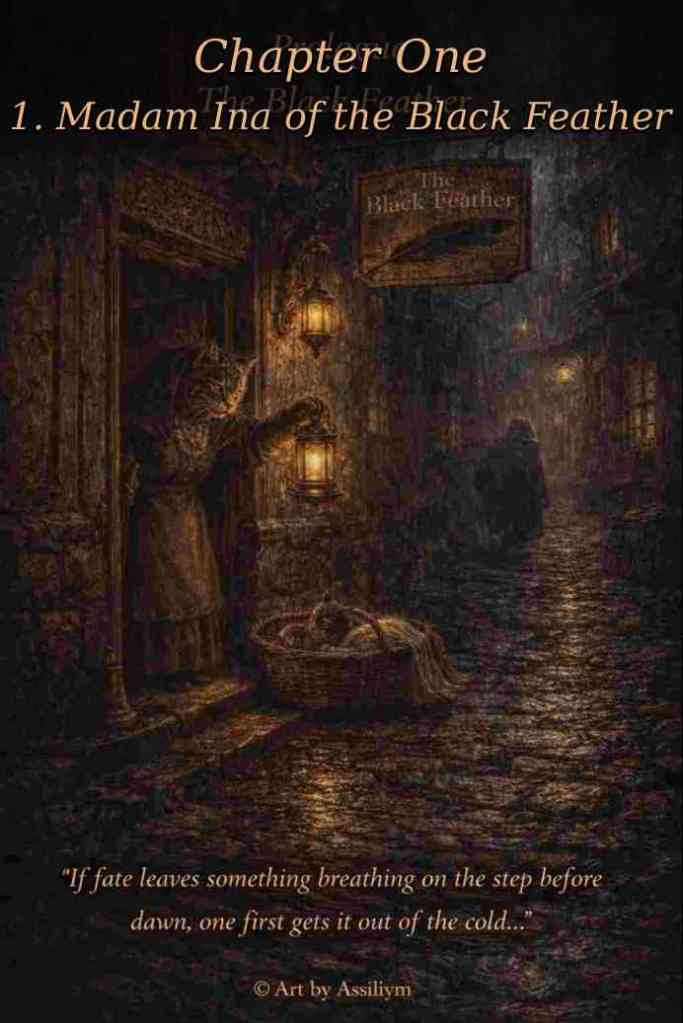
Madam Ina crossed to the bed and stood over her without tenderness but not without attention.
“Well,” she said softly, “you have slept through your own erasure. That is already a professional gift.”
The child opened her eyes.
Not fully. Not dramatically. They merely looked at Madam Ina as if the older cat had not entered the room so much as continued standing there from an earlier thought.
There it was again—that troubling watchfulness.
Madam Ina sat on the edge of the bed.
“You will need a name.”
The child blinked.
Madam Ina had no belief that babies understood such sentences. Yet it pleased her to speak plain truth to them anyway. It saved time later when all of life proved equally unwilling to simplify itself on their account.
She reached for the folded travel papers left beside the washstand. The outer one was only a road-slip, damp at the corners and stained from weather. The handwriting was plain, careful, and meant to survive inspection without inviting memory. She opened it and read the single name written there.
Claire Blanche.
No title.
No lineage.
No story.
Just the name, as if the road itself had dressed the child in whiteness and hoped that would be enough to hide blood.
For one breath, the ink in the name seemed to draw itself thinner, as if the paper were ashamed of carrying a lie but too frightened to refuse employment. Then the letters settled. Paper, like most servants, knew when obedience was safer than honesty.
Madam Ina read it once, then again.
“Claire Blanche,” she said. “That is a great deal of lace for a quarter like this.”
She looked back at the child.
“It will not do whole.”
Her eyes narrowed a little, not in unkindness but in practical editing.
“Claire may satisfy roads, priests, and cats with ledgers. Blanche belongs to laundresses and liars. And both together are too polished for my stairs.”
She folded the paper and tapped it once against her paw.
“Clair, then,” she said at last. “You may keep that much. It is small enough to hide.”
The child did not object.
This, in Madam Ina’s experience, was how most names entered a life.
naming.
Beyond the last proper market town, beyond the better-kept fences and the little farms that still possessed enough grain to look respectable from a distance, the land had thinned into a poorer honesty. The fields lay broad but mean. The soil there could be worked, but only by creatures willing to quarrel with it season after season for rewards too small to impress a landlord and too necessary to refuse. Stone rose through the furrows where wheat ought to have been. Water gathered in the wrong places. Wind crossed the open ground with a cold determination that made weak roofs confess their flaws before winter even arrived. The roads were not roads so much as habits of passage worn into mud.
Pendulum-grass grew in the ditch beyond the lower fence, bowing and lifting with no clockwork neatness, only the slow, tired rhythm of stems too thin for the wind they endured. Under the hedge, a moon-grass vole nosed through last year’s straw and found nothing worth stealing. Even the small thieves of the field were having a poor season.
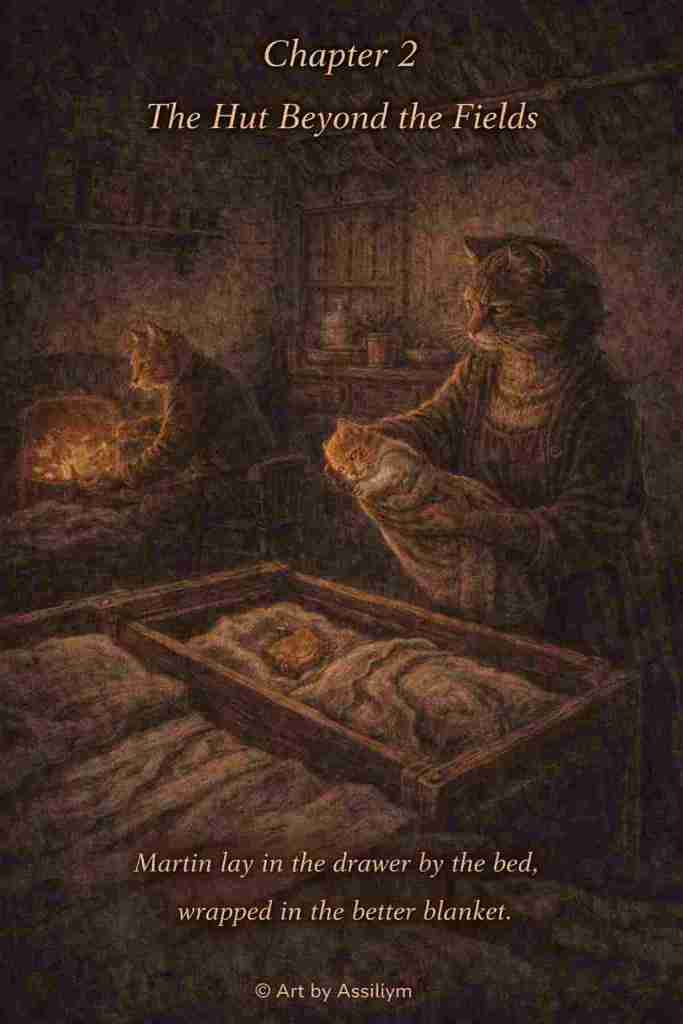
Tom’s holding crouched in that country like a thought too stubborn to die.
There was a patch of grain, a kitchen strip, a low byre, a little fenced yard, and the hut itself under a roof patched too many times by too few hands. The whole place had the look of something held together not by wealth, nor skill, nor luck, but by the daily refusal of two poor cats to let it fall in the exact hour when despair found collapse most convenient.
Near the grain bin, grain-mites had made a pale dust of themselves in the cracks of the lid, and hay-fleas lived in the older straw with the cheerful cruelty of tiny landlords. Tom had beaten the bedding twice that week and cursed both times; the fleas had accepted the exercise as weather.
Martin had been there three days…
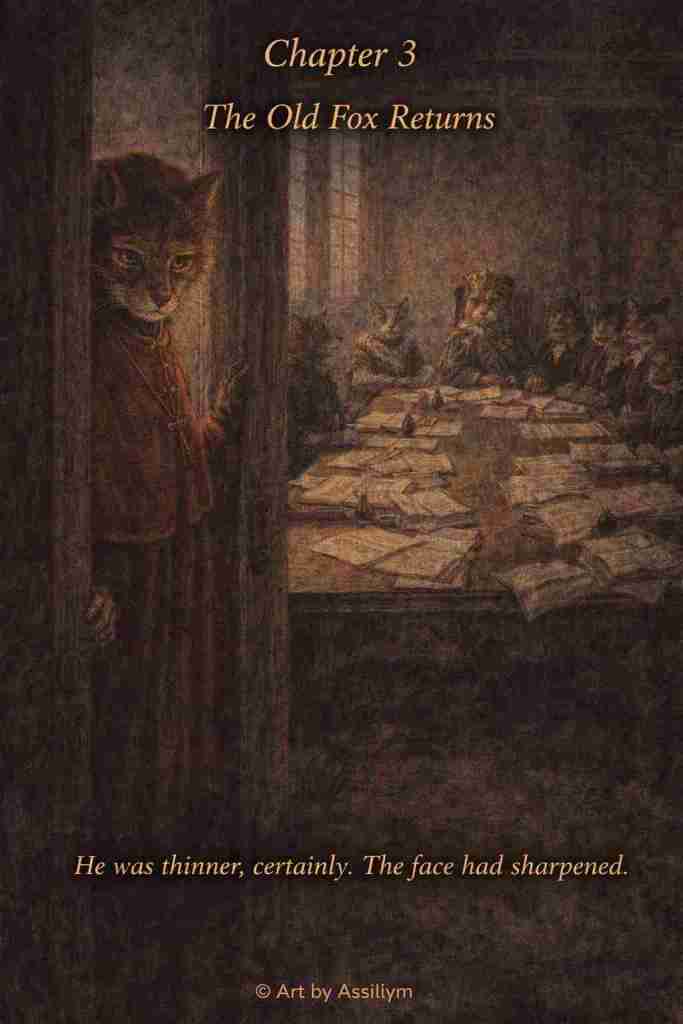
The council chamber smelled of wax, damp parchment, stale velvet, and worry disguised as protocol.
It was not the grandest room in the palace, nor the most ceremonial, but it was one of the most dangerous, because cats entered it believing themselves practical. Wars had been fed there by arithmetic. Villages had been starved there by ink. Monasteries had lost lands there under the language of temporary necessity and never seen them again. The room itself was handsome in the old royal manner: dark panelling, a long table of polished wood, tall windows giving onto a grey morning, and tapestries whose faded victories seemed to suggest that the dead always look more successful from a distance. But what mattered was not the carved lions under the chairs or the gilded trim around the maps. What mattered was that every cat in the room believed he was speaking for order while secretly defending appetite.
Behind the king’s chair hung one old tapestry few courtiers liked to notice for long. It showed a blind judge weighing a crown against a loaf of bread. Servants called the figure Justice. Old clerks called him Prudence. One frightened page had once whispered that it was the Red Listener, who wrote down every law before cats understood whom it would hurt. The palace kept all three stories, because palaces prefer legends that cannot agree with one another.
At the head of the table sat the king.
Age had not yet conquered him, but it had begun writing him in smaller letters. His shoulders were still broad beneath the furred mantle, his face still capable of that leonine force by which older kings silence rooms without raising their voices, yet annoyance had become quicker in him, and patience more expensive. That morning he looked like a cat who had slept, but not peacefully. One paw drummed once against the arm of the chair whenever de Valmire took too long winding up to a point, and once or twice his eyes drifted toward the windows with the expression of a ruler already bored by numbers yet too entangled in them to escape.
At his right sat Princess Sofia, composed, pale, attentive.
At his left sat Prince Luis.
Or rather the creature the palace had, in its private impudence, begun inwardly to call Little Crown.
He wore a small bronze circlet set with pale false stones, the best the treasury could presently excuse as princely adornment without inviting open mockery from foreign eyes. Unfortunately it invited mockery anyway. Even from a distance the stones had the tragic brightness of things pretending to be jewels. The bronze had been polished heroically, but polish is not nobility, and the result gave him the air of a young prince playing kingship with props borrowed from a provincial theatre. Luis himself sat very straight, as cats do when they know they are being looked at and fear the look. The circlet on his head was meant to restore dignity after the recent catastrophe of the lost crown. Instead it made the whole business more visible.
Whenever Luis moved, the pale stones caught the window-light badly, flashing not like jewels but like glass beads in a cheap shrine-lamp. The effect was worse than plainness. Plainness might have looked honest. This looked like rank trying to borrow holiness by the hour.
Around the table sat ministers, noble cats, two senior secretaries, Minister Adrien de Valmire, the Royal Treasurer, and three older councillors who had spent their lives nodding at power until their necks seemed shaped for it. Rolls of account parchment lay in little stacks. Wax tablets crowded with figures had been brought in and rearranged twice already. One silver inkstand stood near de Valmire like a shrine to tedious cruelty.
On one wax tablet, before de Valmire had even spoken, a neat little column of figures had already been pressed into the surface: yield loss, levy increase, expected arrears. The junior clerk frowned, rubbed the wax smooth with his thumb, and stared as the numbers left shallow dents behind. He said nothing. Palace clerks survived by knowing which impossibilities belonged in margins and which belonged nowhere at all.
He was speaking now…
 Vuk Stribog