
INSIDE BOOK 6
NEON: The Black Feather — The Menagerie, the Gallows, and the Marked — Book 6
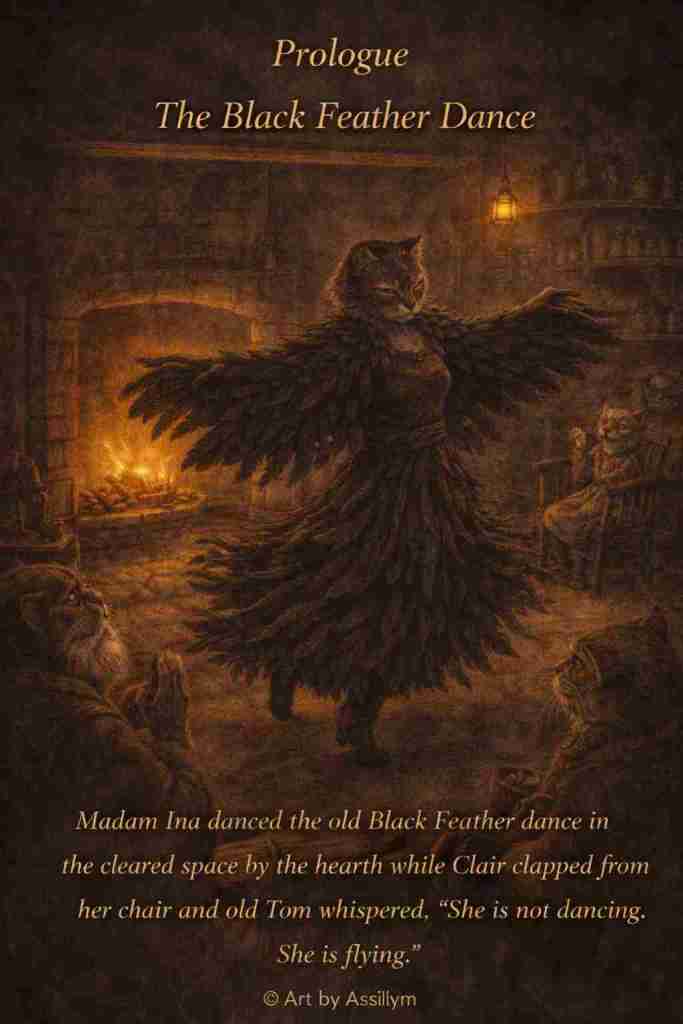
Then Madam Ina, instead of snatching the costume off the child at once, let out one breath through her nose and said:
“Oh, for pity’s sake.”
She crossed the room, bent, caught Clair under the arms, and lifted her high into the smoky lamplight.
The child squealed.
“There,” said Madam Ina. “Flap your wings. Like a bird. Pretend you’re flying.”
Clair threw back her head and laughed — that bright, heedless laugh only kittens possess before the world has taught them what beauty costs — and began flapping the long black sleeves with such utter conviction that, for one heartbeat, it almost seemed possible that air itself might be shamed into obedience.
The room loosened.
A seamstress covered her mouth and smiled.
The carter barked a laugh into his cup.
Old Tom leaned forward so abruptly his spectacles knocked against his chest.
Even Hook Jan’s narrow face shifted at the corners.
“There now,” said Madam Ina, lifting the child a little higher. “A fine bird.”
Again Clair flapped.
Again she laughed.
The black feathers beat the air round her like the broken shadow of a night-bird trying out its first impossible idea of the sky.
“Again,” said the child at once.
“Kittens these days,” said Madam Ina, with the grandeur of a martyr dragged to the scaffold by affection, “are not like in the old times. They are spoiled.”
But she lifted her again.
Clair kicked in the air, flapped the black drapes, and laughed so hard she nearly swallowed her own delight. For one instant there was indeed something magical in it — not grace, not yet, but the strange sweetness of seeing a small creature believe with her whole body that she is flying.
Madam Ina set her down.
“There. Are you happy? Can I go back to work now?”
Clair frowned deeply, as if this represented a failure not merely of kindness but of art.
“Well… again.”
“My dear,” said Madam Ina, “I cannot do this all night.”
The child only looked at her.
Madam Ina sighed with theatrical despair, bent once more, and raised her from the floor. This time Clair flapped even faster, so fiercely that one of the old black feathers snapped loose and drifted down between them.
For a moment it did not fall as a feather ought to fall. It turned once in the smoky air, black against lamplight, and on the white-worn boards beneath it lay two shadows: one small and harmless as down, the other long as a wing spread over a sleeping city. In the corner above old Tom’s chair, a spiderweb trembled though no draught had reached it. Then the feather touched the floor, and everything became ordinary again — which is the oldest trick of omens, and the meanest.
“Oh no,” said Hook Jan, and gave a dry chuckle. “She’ll break your costume. I think you’d better show her how to dance before she destroys the whole legend.”
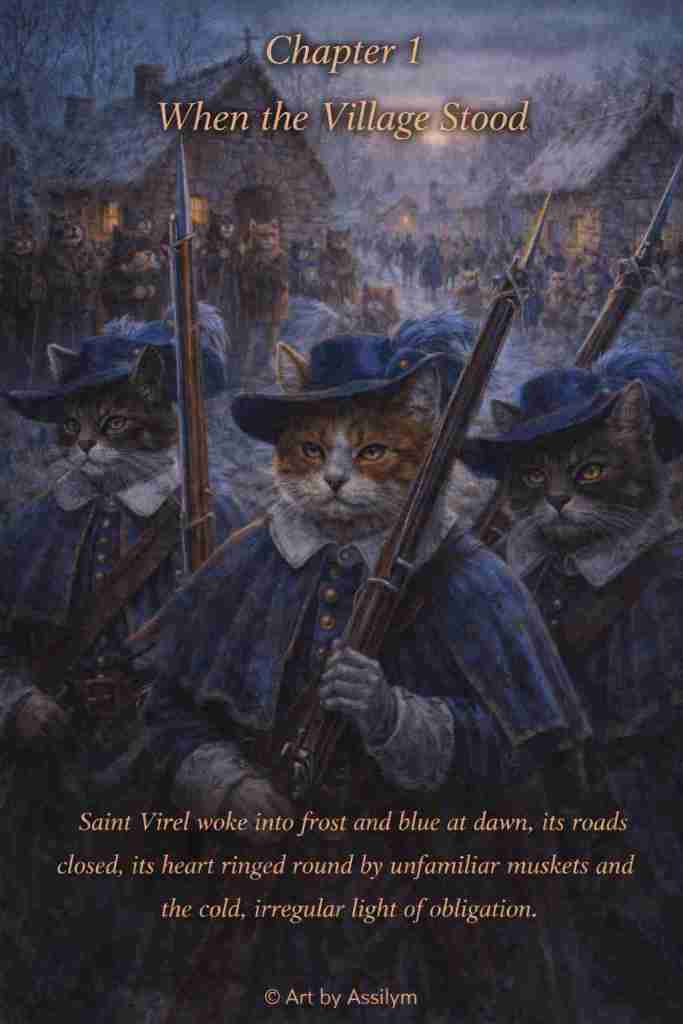
Across the square the blue line had begun to move inward, not marching, not yet, but drawing itself into visible order. Musketeers took the lane-mouths, the bridge, the path by the school, the open side of the meadow. They wore blue coats darkened at the hem with frost and road dirt, and each had a musket with bayonet fixed, a sword at the side, and the look of a cat who has been told that mud is loyalty’s proper witness only when marched over in the king’s name.
Then Lieutenant Vaurin entered the square.
He did not enter alone.
That was the first true mark of him.
Two musketeers came before him.
One sergeant at his shoulder.
A clerk behind with a leather case and a seal-tube.
Vaurin himself only where he could be seen and not touched.
He had grown no kinder since the last time Saint Virel had suffered his attention. He had, if anything, refined the insult. His coat was cut better. His whiskers had been trained to a finer line. The sneer sat on his muzzle now not as temper but as habit. He looked over the square, the poor houses, the chapel, the school-room, the meadow barrack, the animals, and the gathered village with the expression of a cat inspecting a stain on a table linen not his own and deciding how expensive correction must become.
“Saint Virel,” he said.
Nobody answered.
The sergeant barked, “By order of the Crown, stand clear and present no obstruction.”
Father Elric, cassock still half-fastened, stepped into the lane before good sense or heaven could catch him by the tail.
“You begin the morning badly, Lieutenant.”
Vaurin’s eyes touched him and slid away.
“I have not come for theology.”
Father Elric drew himself up. “Then you arrive unequipped for the village.”
One of the musketeers smirked. Vaurin did not. He jerked two fingers at the clerk.
“Read.”
The clerk opened the leather case with all the solemn misery of one whose life has become an instrument by which better-dressed sins are delivered to the poor in complete sentences. He drew out the paper, broke the seal, and read.
The seal was very red in that early light. Too red for wax, perhaps; too bright for anything that had a right to sit so calmly upon paper. Brother Luc, watching it, had the absurd impression that the words were not being read aloud but nailed into the morning one by one.
By authority vested in the Crown and in accordance with laws concerning unlawful holding of trained beasts, irregular public exhibition, undeclared receipts, unstamped performance monies, and unauthorised custody of property subject to royal review—
At that, the first murmur broke through the village.
Not surprise.
Recognition.
Brother Luc swore softly.
Mother Saffron said nothing, but the knuckles on her stick whitened.
The clerk went on, because that is the duty of clerks and sometimes their moral failure.
—the Crown does hereby seize all animals connected to the travelling spectacle presently and unlawfully maintained in Saint Virel, together with all monies raised therefrom, all receipts or takings associated therewith, and any auxiliary materials held in related support of said unlawful enterprise. Resistance shall be construed as disobedience under royal authority and punished accordingly.
The paper shook once in his paw.
Only once.
Toma walked out into the square.
No announcement.
No speech.
He simply moved until he stood before the village and before the blue line, and everyone behind him, friend and foe alike, understood that the thing in front of the musketeers was no longer merely a poor cat in a rough coat. It was Saint Virel’s answer.
He had no armour.
No title.
No proper boots.
Only the body that had cut wood, carried winter, stood in courts, walked roads, and put his own hunger behind others too often to count.
“You’ll not take them.”
Vaurin’s eyes narrowed.
The sergeant shifted.
The first rank of musketeers gripped their muskets more tightly.
The horses snorted white into the dawn.
Toma took another pace.
“They’re under this village’s paw now.”
Vaurin gave a little laugh.
“Your village has very ambitious paws.”
“They fed what others starved.”
At that, Count Baltz came into the square.
He did not hurry.
That was not his way.
But his presence entered like drawn steel. He wore no court finery now, only hard country clothes of good cloth and old cut, and the years sat on him not as frailty but as reserve force. Beside him came Countess Aveline, cloak hastily thrown over her shoulders, one glove half-fastened, her face already alive with the knowledge that this was no scene to be watched politely from a distance.
“Lieutenant,” said Baltz.
Vaurin inclined his head the barest fraction.
“Count.”
“You stand on village ground as though it were battlefield.”
Vaurin gave that mean little smile of cats who feel a superior name near them and are pleased chiefly because the law has dressed them for insolence.
“I stand on the king’s law.”
“No,” said Baltz. “You stand behind it.”
That landed.
The square felt it.
The musketeers felt it.
Vaurin felt it most.
His mouth hardened.
“This matter does not concern a private gentleman.”
“Everything does,” said Aveline, stepping out beside her husband, “when one arrives before dawn with bayonets for children and cages for beasts.”
The clerk looked away.
He should have looked away.
It is difficult to read legal language aloud to a village while its boys stare at your paws and its she-cats stare at your soul.
Vaurin raised one paw slightly.
That was all.
The first rank of musketeers brought their muskets a fraction higher.
Quickpaw made a sound through his teeth and lunged for the rusty sword again, but this time Mer-mer caught him with both paws and held on.
“Don’t.”
“They’ll kill him!”
“Yes,” Mer-mer said, and the sorrow in his voice was so old for such a small cat that Mara nearly turned and broke over it. “If you give them a reason.”
Quickpaw stared at him in hatred, not of his brother, but of the world that forced such speech from him.
Mother Saffron stepped up on Toma’s other side.
Her stick came down once on the frozen mud with a dry crack.
“Try your law here, blue cat.”
Father Elric came too, cassock, sausage-grease, sanctity and all. Brother Luc was beside him with white paws and no wish whatever to die. Joric moved next, which surprised everybody, perhaps most of all himself. Then Mariette. Then the fish seller with both knives in his apron. Then the butcher wiping his palms. Then the old widow, because contempt for death and the Crown had long ago settled into one habit in her. Then Roul. Then the lane cats. Then half Saint Virel, close enough now that the square itself seemed to have grown a spine.
The children were dragged back and would not stay back.
Redcrest screamed above them.
Patch snarled.
Mr Stripe’s tail lashed once in the frost.
The bear rocked his weight forward and the earth looked suddenly less certain of itself.
Vaurin took one step back.
It was very small.
But the square saw it.
That was when he drew the pistol.
Not from the front.
Not stepping out like an officer who means his own danger.
He drew it from behind the first rank, one blue shoulder half hidden by another, the iron black in the morning.
“Move aside, muddy,” he said to Toma, “or I will shoot.”
The word struck like spit.
Quickpaw cried out.
Mara made a sound low and deadly.
Brother Luc went white.
Aveline took one involuntary step forward.
Baltz’s paw went to the weapon at his side.
But Toma did not move.
Behind him, Saint Virel stood.
Beside him, Mother Saffron’s stick remained planted.
Beyond him, the tiger watched the pistol as if memorising the paw that held it.
“You can’t arrest the animals,” said Toma.
Vaurin’s lip moved.
“Oh?”
“They did no crime.”
Vaurin’s eyes flicked toward Mr Stripe, the bear, the dog, the whole living argument of Saint Virel’s mercy. He smiled again, but now the smile had nerves in it.
“Crime,” he said, “is a creature of paperwork.”
“No,” said Toma. “Crime is this.”
There are moments when a coward shoots not because he is brave enough to kill, but because he cannot bear to be answered.
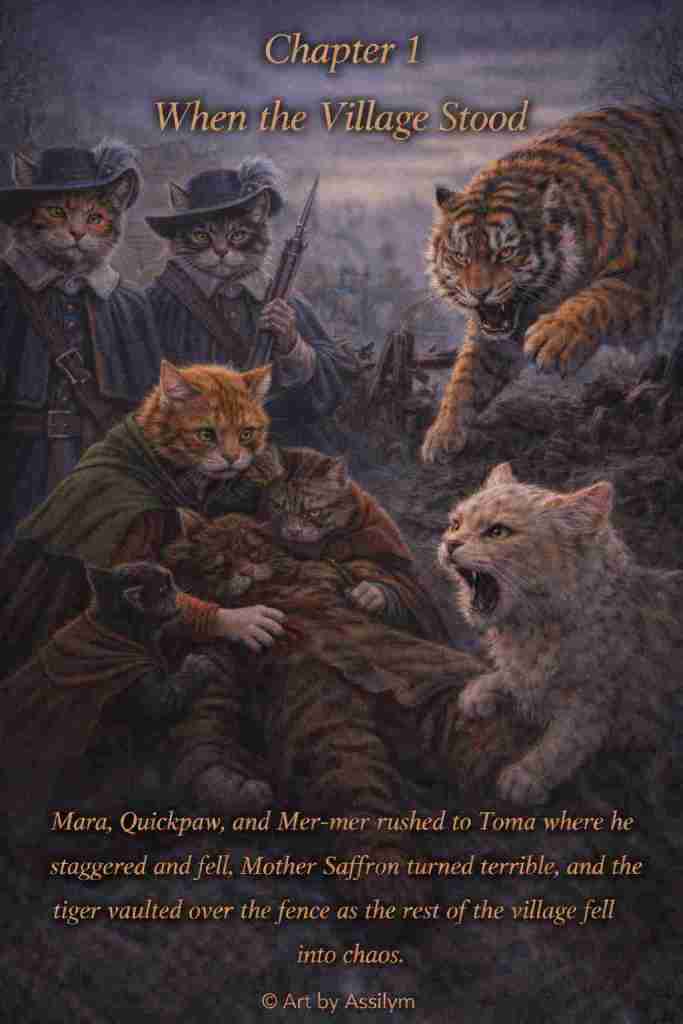
Vaurin fired.
The crack split the square.
For one impossible heartbeat the sound seemed to happen twice. The pistol spoke, and then the morning answered with the same shot from somewhere behind the chapel bell, as if time itself had flinched and repeated the wound by mistake. Smoke hung too long between Vaurin and Toma, a white cloth over a thing no decent world wished to see.
Birds burst from the chapel roof. Children screamed. Horses reared against the reins. Smoke jumped from the muzzle and lay white and vicious for one heartbeat between the line and the village.
Toma staggered…
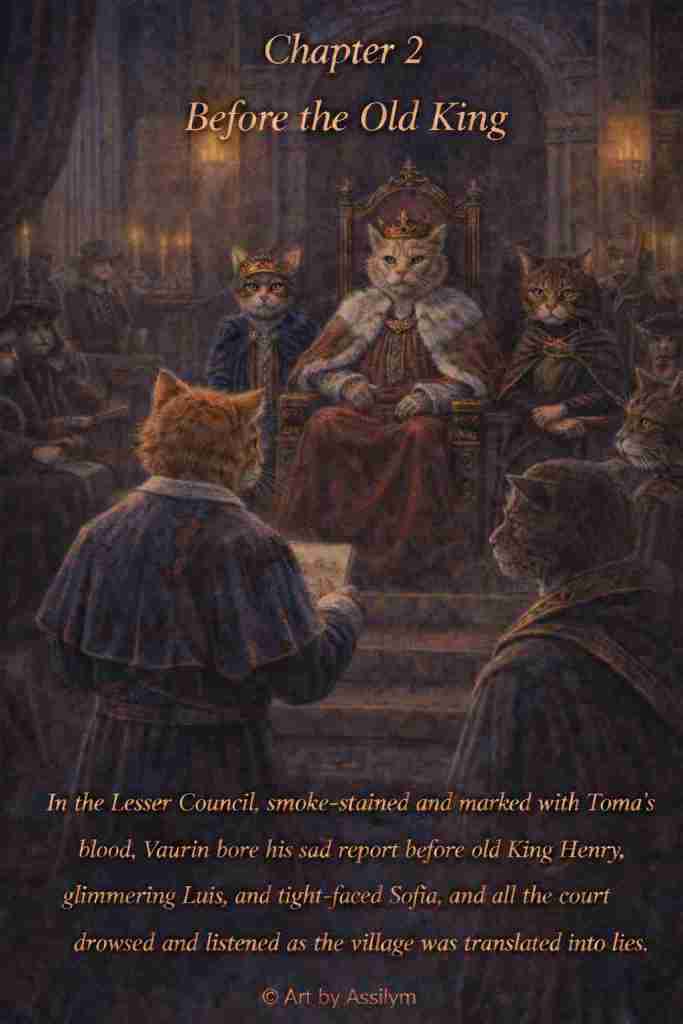
The court was already gathering.
At the far end, under the painted kings of worse centuries, sat Henry.
He looked old that morning.
Not frail.
Never that.
Age had not made him soft. It had made him narrower, meaner in concentration, less willing to pay even lip-service to the tendernesses which younger rulers occasionally perform for vanity. The years had silvered the face and drawn the fur thinner over the cheekbones, but the eyes remained alive with the old leonine appetite for command. He wore no crown. A king who has worn one too long often ceases to require its metal except in public ritual. Here he needed only the chair, the paw on its arm, and the certainty that every cat in the room would measure himself before speaking and still find the measure insufficient.
At his right sat Princess Sofia.
She had come quickly, which meant she had come unwillingly. One still saw in her dress and hair the slight incompletion of a cat summoned before the morning had properly resolved itself. But nothing in her face was incomplete. She had heard already, perhaps in fragments, perhaps only by the speed of the summons, that Saint Virel’s name was once again being carried upward in blue paws. There was no fear in her face. There was anger. Anger and that more dangerous thing beneath it: shame on behalf of a house whose walls one still inhabits.
At Henry’s left sat Prince Luis.
Or, as half the palace had begun privately and irreverently to call him, Little Crown.
The bronze circlet with its false pale stones was upon his head again. It had not improved with familiarity. If anything, it looked cheaper once the eye had time to study it. The bronze had been polished to a devotional shine. The stones answered the window-light with the valiant dead brilliance of things pretending to be jewels. He sat very straight under it, as though posture alone might redeem metallurgy. There was eagerness in him that morning. Not joy, exactly. Something brighter and more adolescently dangerous: the satisfaction of a prince who believes force has moved correctly in the Crown’s name and therefore wishes to look already accustomed to approving it.
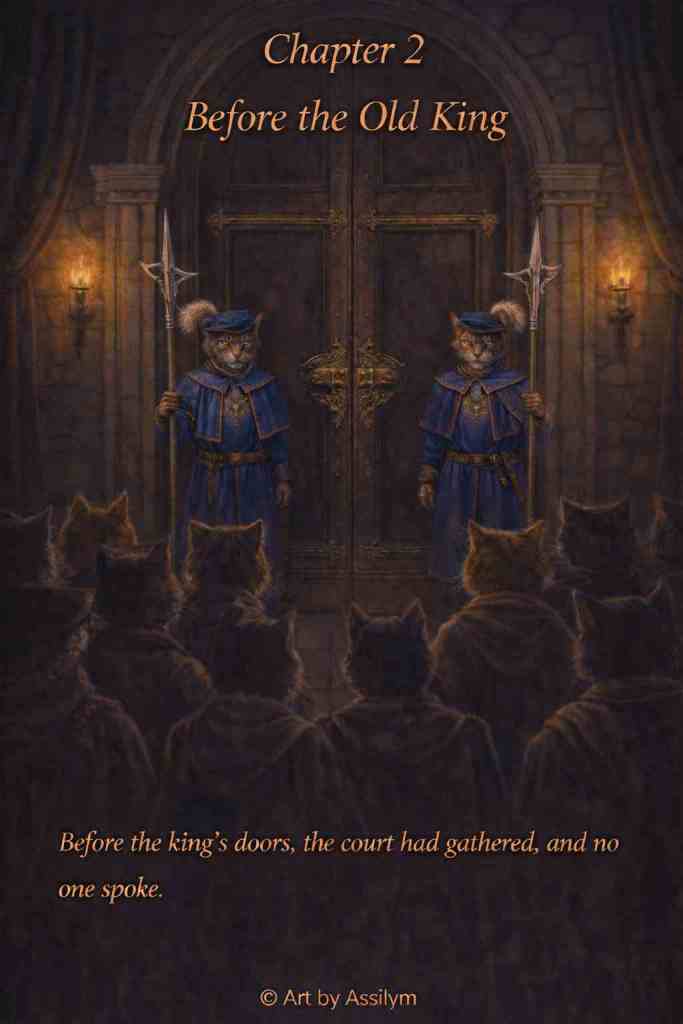
The door opened.
Vaurin entered, bowed, and remained bowed a heartbeat longer than necessity required, allowing the room to inhale his smoke-stained authority.
Henry did not tell him to rise at once.
“What have you brought me?” asked the king.
Vaurin straightened.
“Your Majesty’s order fulfilled.”
That pleased the room before it had even been explained. One saw it in the minute shiftings of posture, the little stir of clerks dipping their pens, the parasites leaning inward by one degree, the almost invisible brightening in Luis beneath his ridiculous metal halo.
Henry rested one claw against the chair arm.
“Report.”
Vaurin did.
He did it well, because cowardly cats often learn the art of arrangement in speech if nowhere else.
He began with the village encircled before dawn.
The animals secured.
The school monies confiscated.
The old healer taken without loss of royal authority.
The crowd resistant.
The line held.
A peasant wounded in the disturbance.
No royal dead.
He did not say he had hidden behind the first rank to fire.
He did not say the tiger had nearly reached his throat.
He did not say Countess Aveline had prevented a bloodbath he himself had set loose.
He did not say children had watched the beasts brought down in nets like condemned princes.
He used the clean words of state handling: restraint, irregularity, secured property, lawful custody, unavoidable injury.
As he spoke, the ink around the written name Saint Virel darkened for one breath on the clerk’s page. Not enough to become a blot. Not enough for any honest record. Only enough for the nearest clerk to glance down, swallow, and continue writing as though the law had not briefly bruised under his paw.
When he finished, the room stood still for a moment under the neatness of his lie.
Then Henry chuckled.
It was not a warm sound.
“If one muddy is wounded,” he said, “that is a price I am willing to pay.”
Sofia’s head turned.
Very slightly.
One might have missed it if one were a poorer reader of disgust.
Her eyes moved to Vaurin’s cuff then. She saw the dark shine of Toma’s blood, saw the lieutenant’s unwounded posture, saw how easily the court accepted another cat’s pain once it had dried into evidence. For one breath she understood that law did not always hide murder. Sometimes it dressed murder, seated it properly, and asked it to give a report.
Luis did not turn at all. He had gone bright in the face with a kind of inward triumph. One paw, against the table edge, had begun tapping an idle little rhythm, and when it stopped it was only because he had become aware of himself doing it and translated the motion into a hum under his breath, as if force, law, and the humbling of villages had placed music in him.
Behind him the little council clock gave one dry tick, paused, and gave the same tick again. Nobody looked at it. Rooms of power forgive clocks many sins so long as they strike for the correct master.
Sofia heard that too.
He turned his head once, only once.
The bolt at the bracket’s side was trembling.
The cracked blue shard in the regulator blinked in answer. Not bright. Not enough to be useful. Only a mean little pulse, like an eye half-opening inside cheap glass. The clock-moss on the damp stone beneath the bracket seemed to tighten its green skin and pulse with it.
It should not have trembled like that.
He saw the older runner Pell hear it too. Pell’s eyes flicked up and away at once. Not fear exactly. Something more used up than fear. Recognition without hope. The younger cat on Tom’s left either had not noticed or had long since learnt the city’s other first lesson: what you cannot afford to stop, you teach yourself not to see.
The forecat passed.
Tom almost spoke.
Then did not.
Because what would he say? The bracket is loose? The machine is unsound? Stop the line? He might as well have suggested they call down one of the moons to turn the wheel kindly by silver light while the workers warmed their paws and discussed justice over broth.
One soot-rat on the beam above the bracket stopped washing its paws. That was all. It froze, whiskers forward, wiser than any overseer in the hall. Then it turned and vanished into the rafters. Tom saw it go and felt a cold, ridiculous envy. The rats knew when to leave.
So he ran.
The rattle worsened.
A beat late.
Then a little sharper.
Then a shiver through the metal housing that passed into the belt itself and came back into their feet.
For one breath the shift bell at the far wall gave a tiny answering tremor though no paw had touched it. Not a ring. Not even a proper note. Only the ghost of a warning, swallowed at once by leather, iron, and the forecat’s refusal to hear anything that might cost production.
The younger cat to his left glanced up at last.
Tom saw the exact moment knowledge reached him.
Too late.
The forecat opened his mouth.
The machine broke first.
It was not a collapse.
Not a grand tearing explosion such as children imagine when they hear the word factory and think of devils forging weather. It was smaller, cleaner, more hateful. The bracket gave with one iron shriek. The wheel lurched. Something black and bright shot loose from the side assembly with the speed of bad judgement.
The lantern roaches burst from the wall in a scatter of crawling amber sparks. Drain gnats rose in a filthy little cloud. The blue shard regulator flashed once, too late and too pleased with itself.
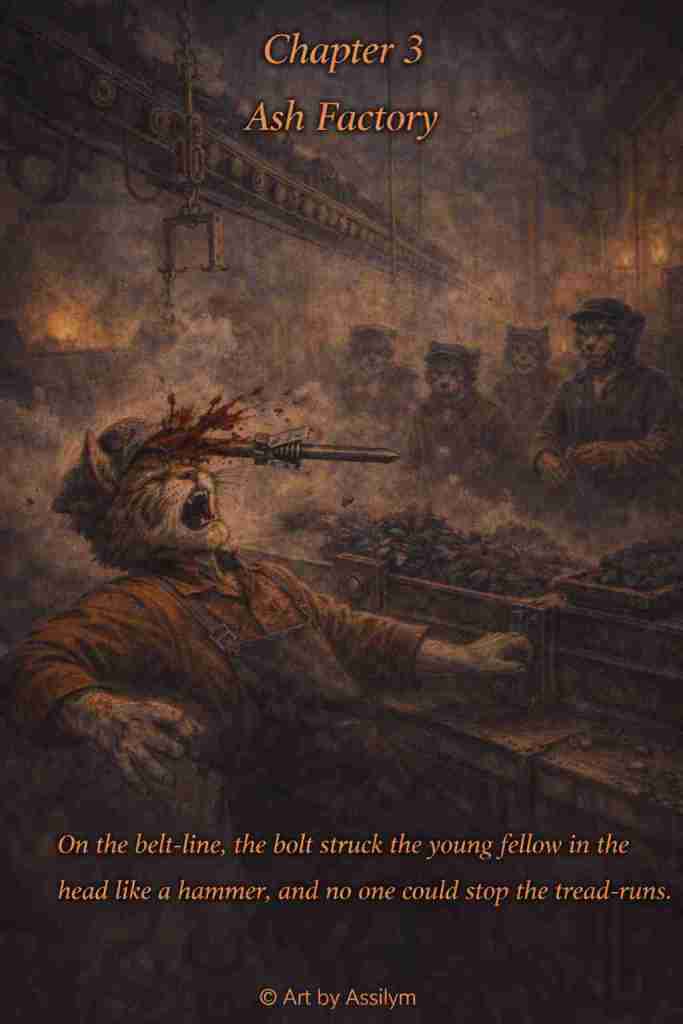
The bolt struck the young runner in the head.
No speech.
No cry.
No noble warning to the others.
One instant he was there, stride holding, breath harsh, muscles working like every other cat’s.
The next he was broken.
The iron hit above the eye and tore through bone as though the skull had been made only to flatter the body with one last false sense of enclosure. Blood went out in a sheet against the side-frame and the cat dropped at once, not folding, not trying to save himself, but simply falling sideways into the rail as though life had been cut with a knife too sharp to feel.
Tom saw the face hit the slats.
Saw one paw still move twice without ownership.
Saw the blood come under the body in a red widening burst that the running belt immediately began dragging into streaks.
And he could not stop.
That was the true horror.
The line jolted.
Three cats shouted.
One behind nearly lost his feet.
The forecat screamed something.
But the tread-runs did not cease.
The belt still demanded stride, because one broken body, however persuasive in its blood, was not enough to stop the whole mechanical appetite of the hall.
For a heartbeat — one wrong, stretched heartbeat — the whole line seemed to repeat itself. The shout came twice. Pell’s paw struck the same slat twice. The dead cat’s loose paw twitched once, then again, as if the second had been caught in the teeth of some invisible wheel and dragged back over the same piece of horror. Then time spat them forward, and the belt went on.
Tom’s chest seized.
His feet kept count.
Left.
Right.
Breathe.
Blood.
Left.
Right.
Breathe.
Tick.
Tock.
The dead cat lay half on the run, half against the rail, and the line worked beside him as if labour itself had gone mad and begun denying what the eye saw in order to protect the engine from delay.
“Keep it!” roared the forecat. “Keep it, keep it, keep it!”
One worker at the far end started to break stride in panic. The stick cracked against iron inches from his knuckles.
“Keep it!”
Tom did.
He did because the belt behind him was still full.
Because if he stopped the row might tangle.
Because if the row tangled the next machine would seize.
Because the city had arranged the work so that revulsion itself became a luxury item and no cat on the line possessed enough coin to buy it.
By the time the shift bell finally struck, Tom’s whole body had become one great trembling refusal.
The bell rang late. Or early. Or perhaps Tom had lost the shape of hours entirely. In the Ash Factory, time belonged to the belt first and to clocks only if there was any left over.
He stepped off the slats and nearly fell because stillness was now a thing his legs no longer trusted. Around him other workers bent double, spat, coughed, wiped sweat from faces gone grey under soot, and took their breath like thieves. No one looked toward the blood first. They knew it was there. That was enough.
Then the hall began turning its head.
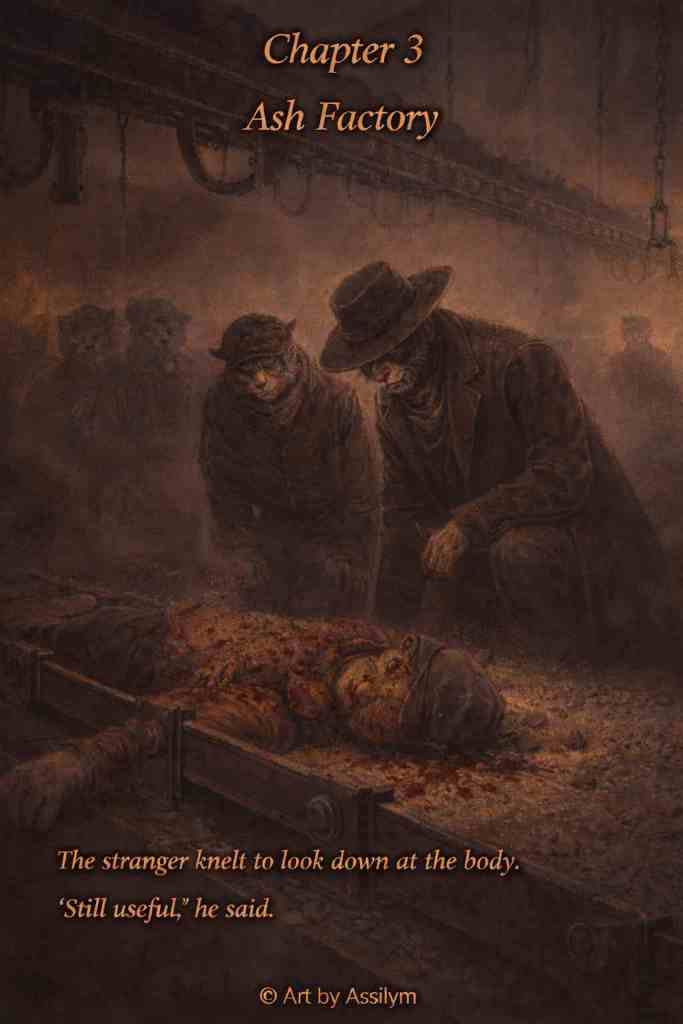
The body had been pulled to the side under a hanging belt where the ash sweepers kept broken crates and waste sacks. Somebody had thrown sawdust over the worst of the floor. It had gone pink in clots immediately. The young runner lay on his back now, eyes open, bolt still in the skull, the blood already dulling from scarlet to a thicker darker red more difficult for decent rooms to admit. One arm had fallen out from the shoulder strangely, paw up, as if still asking the machine a question.
Tom stared.
“Don’t,” said Pell beside him.
Tom did not look away. “He’s dead.”
“Yes.”
“That’s all?”
Pell spat black and wiped his mouth with the back of his wrist.
“In this hall? That’s all.”
There was no bitterness left in him while saying it.
That was the worse thing.
A blind tunnel rat nosed from the drainage gap beneath the waste sacks, pale whiskers trembling in the stink. It did not come for the body. Not yet. It only listened, eyeless and patient, while living cats decided how little of death could be allowed to interrupt a shift.
Tom’s paws were shaking now.
Not with grief first.
With the body’s belated rebellion.
He felt the whole day rush back into him at once: the blood on the slats, the bolt in the skull, the impossibility of stopping, the understanding that if he had fallen too the hall would merely have dragged him aside in turn and reset the line for the next crew.
He might have crossed himself.
Might have gone to the dead cat.
Might have done some decent provincial thing by which the living confess that a body has just become former.
The forecat prevented it by clapping twice for attention.
“Shift’s done. Evening line on in ten.”
Some workers laughed.
Not because it was funny.
Because the factory had outdone even their own expectations of indecency and there remained nothing else to give the moment except that little cracked bark of disbelief cats use when civilisation proves itself not worth the invention.
Then the murmur at the door began.
Not loud.
A change in the hall’s weather more than a sound.
Tom turned.
She had come back.
The Cat With No Name entered from the inner passage, baton resting on one shoulder, coat dark as wet soot, eyes already taking measure before the workers had decided what faces to wear. Tom knew her now as one knows the shape of cold before it reaches the skin. There are cats whom the city uses to count bodies. She was one of them. Not a forecat merely. Not a floor mistress merely. Something more exact and less forgivable.
Behind her walked a cat Tom had never seen before.
That was not what frightened him.
What frightened him was his body’s answer.
Before the stranger had fully crossed the threshold, Tom’s breath went wrong. Not the good wrong of labour, which at least contains method, but the older animal wrong by which a creature knows the grass is hiding something with teeth before the mind has had time to make a story of it. The hair rose along his spine. His paws, still shaking from the shift, changed their shake. Every instinct that belonged not to city, factory, law, or wages, but to older mud, older winter, older prey-fear, began speaking in him at once.
Run.
He did not run.
He could not have said why.
Perhaps because no one else moved.
Perhaps because the hall itself, for all its belts and filth and murder, had suddenly become very still around the newcomer, and some cats grow quieter than prayer when the thing they have feared in stories steps into a room and looks disappointingly real.
Even the lantern roaches stopped moving on the wall. An ash-wing bat opened one black eye above the furnace vent and did not click. Somewhere below, the sewer eel broke the surface of the drain-water with a soft wet kiss and sank again. The factory had many kinds of life in it. For once, all of them behaved as if life were a condition best kept secret.
The stranger was not large.
Tom had expected, had he ever let himself expect at all, some gigantic furnace-cat from Cinder Hollow, scarred, blazing, all ash-saint myth and iron-clawed damnation. This one was worse. A moderate figure. Plain dark coat. Muzzle not old, not young, merely used. Paws ungloved. Eyes unreadable at first because they seemed not fixed upon the hall so much as passing through it, making silent little inventories the way winter inventories weak roofs. There was nothing theatrical in the gait. Nothing put on. Only a terrible calm, the calm of a cat who enters death as other creatures enter trade.
Tom knew at once he had heard the old runner’s story properly after all.
The Cat With No Name stopped by the body.
The stranger came to stand beside her.
For a moment neither spoke.
The factory held its breath.
Then the unknown cat said, in a voice so quiet Tom nearly thought he had imagined it:
“He was a strong worker.”
Not pity.
Not mockery.
Something worse.
A cool appraisal, as one might speak of a beam that had held longer than expected before finally splitting.
The Cat With No Name gave the smallest little sound of agreement.
“Yes,” she said. “I know.”
The stranger looked down at the broken head, the bolt, the spread of blood under the sawdust.
“What a shame.”
Again the tone did not rise above conversation. It was the calm that made Tom’s stomach turn. A cat may scream over a corpse and still seem morally alive. A cat who speaks thus, at that volume, before that red ruin, belongs to another grammar.
The Cat With No Name tilted her head.
“You could use the body,” said the stranger.
She giggled…
 Vuk Stribog