
INSIDE BOOK 7
NEON: Beneath the Dying Crown — The Road Below — Book 7
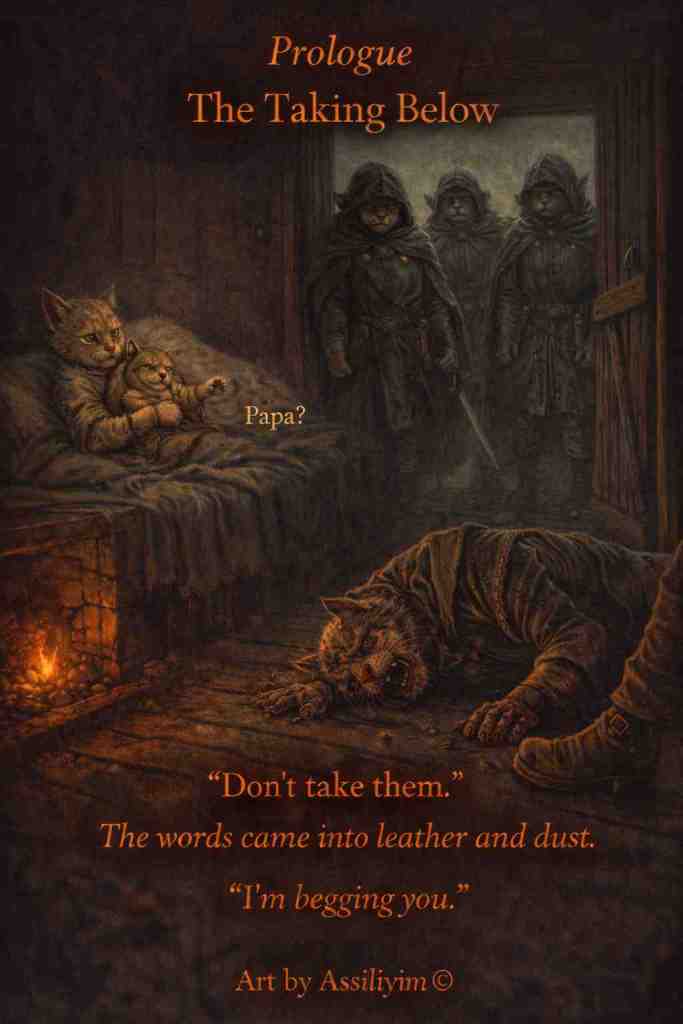
Voices now. Muffled at first. Then one voice he knew too well.
“Matthieu! Open!”
Not a stranger, then. Worse. A fellow guard.
He went to the door but did not lift the bar at once.
“What do you want?” he called through the wood.
A pause answered him.
He could hear breathing beyond it. More than one cat. Boots shifting on the threshold. The faint jingle of harness or belt fittings. Shame, trying not to sound like shame.
Then the voice came again, rougher now for being forced to remain official.
“Open, Matthieu.”
“What do you want?”
Another pause. Longer. Someone outside muttered something too low to catch. Then:
“We’ve come for your wife and the kitten.”
The house seemed to shrink.
Behind him Élise let out one small breath through her nose, not a cry, not yet, but the sound of a creature who has just heard sentence pronounced in a language she already understood.
Beneath the floor, something settled. No board moved. No stone cracked. Yet Matthieu felt it through his knees before he understood he had felt anything at all: a low answering heaviness, as if the buried parts of the city had heard the words wife and kitten and made room.
Matthieu lifted the bar and tore the door inward.
Four guards stood outside in the pale, dirty dawn.
They looked exactly as city guards always looked: cloaks damp at the hem, boots dark with street wet, belts strapped square, cudgels hanging at the hip, the old city badge sewn on the breast. Cats one sees every day until suddenly one does not see cats at all anymore, only the office they have come to perform.
At their front stood Arnaud Bellier, broad-shouldered, scar across one eyebrow, a cat who had once shared bread and sour wine with Matthieu under a watch arch during rain. His face now was the face of a cat holding a task that had already shamed him before sunrise.
In Bellier’s paw was the folded order. The red seal upon it had darkened in the wet, and though the paper was no larger than any other paper, it seemed to pull his arm down, as though the law had found weight at last and chosen to become cruel about it.
Matthieu looked at him and for a moment something almost like relief flared in him. Familiarity. Memory. Comradeship. Surely those things still weighed something.
“There’s been a mistake,” he said at once.
No one replied.
“You hear me? A mistake.”
Bellier’s eyes went not to Matthieu first, but past him, into the room.
“You were reported.”
“By whom?”
“It doesn’t matter.”
“It matters to me.”
Bellier swallowed. “Matthieu—”
“My wife is unwell. That is all. The child has fever. That is all.”
From the bed Luc coughed.
It was not a loud cough. Barely more than a broken little sound in the back of the throat.
But it was enough.
The guard standing second from the left looked away toward the street as though there might yet be dignity somewhere in the dawn if he refused the doorway. Another shifted his stance and tightened both paws on the strap across his chest. Bellier did not move.
“We have orders,” he said.
The word orders entered the room more cleanly than the guards had done. It passed over the threshold, crossed the poor boards, touched the bed, and settled there. There are words that do not need claws because cats have already agreed to bleed for them.
Matthieu laughed then, and there was madness already in the sound.
“Orders? From which clean desk? From which dry room? You know me.”
“Yes.”
“You know her.”
Bellier said nothing.
“You’ve held him.”
This time Bellier flinched.
That gave Matthieu hope where none should have lived. It was a terrible hope, because it was made not of reason but of the raw superstition that one known face may still halt the whole machine.
He stepped into the doorway and filled it.
“No.”
Bellier closed his eyes for one heartbeat.
“Stand aside.”
“No.”
The word came from the whole body. Not loud. Not dramatic. Absolute.
Bellier drew breath.
“Do not make this worse.”
Matthieu’s lip pulled back from his teeth.
“Worse?”
One of the other guards moved then, perhaps meaning only to place a paw on his arm and ease him aside. Matthieu struck first.
The baton caught the cat high on the shoulder with a crack that spun him half round and drove him into the wall. In the same motion Matthieu rammed his forearm into Bellier’s throat and shoved him backward off the step. Another guard lunged. The doorway exploded into claws, cloth, breath, curses, the crash of one body into the jamb.
Élise cried out behind him.
Luc began screaming.
That scream was what broke the fight.
Not because it weakened Matthieu, but because it made him more dangerous than strength could manage. He drove forward like a cornered beast, striking blind and hard, no longer a guard, no longer even a husband in any civil sense, but merely a father between a bed and the uniformed paws coming toward it. He landed one blow. Then another. Then three of them were on him at once.
A cudgel hit the side of his ribs.
Another smashed across his forearm.
Bellier got both paws into his chest and threw all his weight forward. Matthieu slammed back against the inner wall, the baton flew from his grip, and one of the guards wrenched his right arm behind him so viciously he thought for an instant the shoulder had come out.
He dropped to one knee.
Luc was still crying.
Matthieu twisted, tried to rise, caught a boot in the stomach, and went down on both knees on the worn boards of his own floor.
Matthieu remained on his knees until the cold from the floor climbed into his bones. At last he sat back on his heels and looked round the room.
The stool.
The cup by the hearth.
Luc’s little cloth ball under the bench.
Élise’s shawl where it had slid from the bed.
The blanket dragged half down.
The door-bar lying on the boards where he had thrown it aside himself to let the city in.
He thought then—quite clearly, almost calmly—that a cat may survive the instant his family is taken and still not remain wholly alive afterward.
When he rose, he did not cry. There are griefs that come first as labour. He went to the bed. Straightened the blanket. Picked up the shawl. Set the little cloth ball on the shelf. Put the fallen bar back into its brackets. Performed, in the wrecked silence, the last dumb rituals of a house that had ceased to be a house.
Only when he came to Luc’s cup and saw the tiny tooth-marks along the rim did his body betray him.
He bent over the table and made no sound at all, but shook so violently that the cup rolled from his paws and broke on the floor.
The broken pieces lay among the floor-dust like little white moons. One shard slid into the crack by the hearth and lodged beside the thread of clock-moss. For a moment, absurdly, Matthieu thought of reaching down to save it. Then the thought passed. There are fragments even grief cannot trouble to collect.
Weeks passed.
Or days.
Or only one long corridor of time down which he walked without company.
He did not return to duty. No one came to summon him. No one needed to. The house grew meaner around him. He slept badly, ate when hunger forced him, and made, more than once, the journey toward the tunnel quarter only to turn back before the last gate because courage is not a river and does not always flow when called.
Each time he went near the lower gates, the city changed smell. Above, Paris-Neon smelt of bread, gutter-water, smoke, horse sweat, fish, wool, candle-fat, ambition and lies. Near the tunnel quarter another odour rose through the grates: wet stone, old iron, mould, sickness, and under all of it a faint sweet rot, like flowers left too long in a locked room. Once a whisper-crow perched above the gate and watched him with one black eye. It did not caw. That was worse.
Then one morning he found the pale numb patch on his own flesh.
He stared at it for a long time.
Not in disbelief. In recognition.
By then the city no longer needed a report.
The sentence had written itself.
When at last they came for him, the knocking was lighter.
That was the final obscenity.
He opened before they struck the second time.
Not Bellier now. Different guards. Younger. Less ashamed. One looked at him and saw not a colleague but a marked cat already halfway to the underworld.
Matthieu took his cloak.
He looked once round the room.
The house did not seem watched now. It seemed already emptied from below, as if some unseen root had drunk its warmth through the foundations and left the boards, the hearth, the bed, and the little shelf standing only because wood and stone are slower than hearts to understand abandonment.
Then, without a word, he followed them.
The streets were wet. Dawn had not yet fully risen. The city yawned itself awake around him with the same old indifference: carts, smoke, shutters, distant bells, a baker’s apprentice running, a dog nosing refuse in the gutter. How strange, he thought, that the world can remain so ordinary while one life is lowered out of it like a bucket into a well.
At the corner, three sewer lilies had opened in a crack where no decent flower should have grown. Their petals were pale, almost translucent, and each held a bead of black water at its heart. A child might have called them pretty. Matthieu knew better now. Some flowers bloom only where the city has begun to rot in earnest.
At the mouth of the leper tunnels, the air changed.
Stone. Wet. Rot. Echo.
And that other smell again, faint but waiting: sweet-sick, root-deep, almost floral, as though some buried garden had learned to grow without sun and had become resentful of the living.
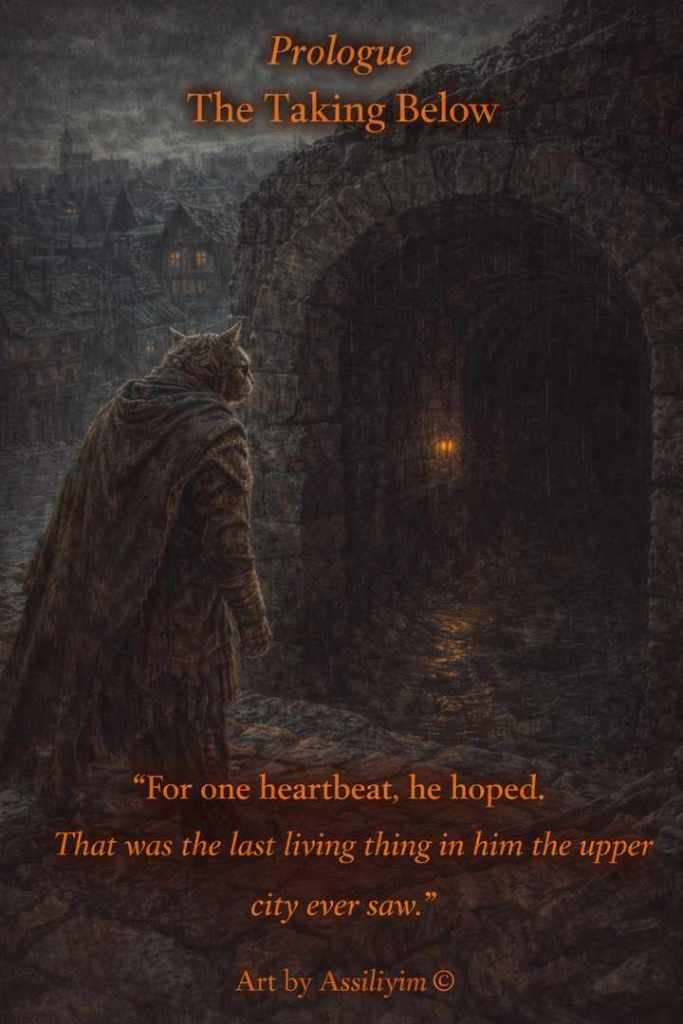
He stopped there at the threshold and looked down into the dark where they had taken Élise and Luc before him.
For one heartbeat, he hoped.
That was the last living thing in him the upper city ever saw.
Far below, where water crawled under stone and roots pressed through forgotten brick, something received his hope the way earth receives rain: without pity, but not without memory.
Then they led him below.
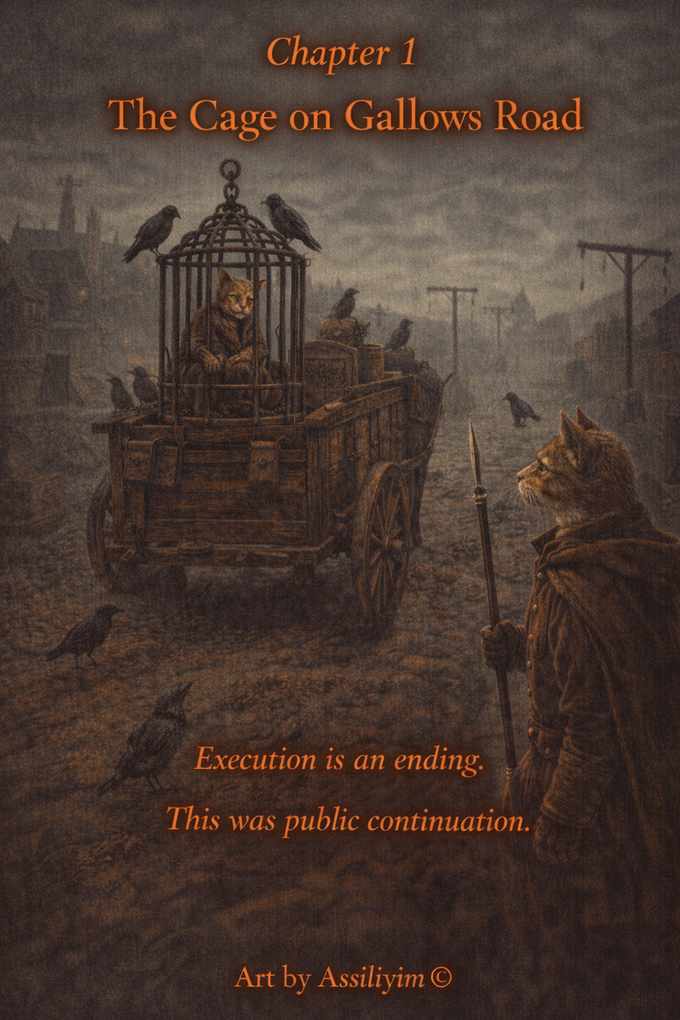
By the following morning Bastian was on Gallows Road.
Near the corner, where Gallows Road bent down towards the older stones of Iron Ward, two dock-workers had taken shelter beneath the striped awning of a shuttered ale-stall. They were supposed to be waiting for the rain to soften. Instead, they had clearly spent the time persuading a jug of beer to lose an argument.
One was a broad, red-nosed tom with river-mud on his boots and the solemn expression of a cat entrusted with terrible truths by heaven, hell, and perhaps a dishonest brewer. The other was thinner, sharper, and less drunk, though only in the technical sense that one rotten plank may be less drowned than another.
“You hear them when the storm comes,” muttered the broad one.
The thin one looked at him over the rim of his cup. “Hear what?”
“The hanged cats.”
The other stared. Then he barked a laugh so harsh that two whisper-crows on the gallows wall lifted their heads and considered him with professional disapproval.
“You’ve had enough beer to baptise a barrel.”
“No.” The broad tom slammed his paw on the table so hard the cups jumped. “I swear by God and by Old Nik of the Dock Paw. He heard them.”
“Old Nik hears his own teeth after midnight.”
“He heard them,” insisted the first. “Whispering round the gallows. Crying too. Not like cats crying now. Like cats crying in their last moment. They come back when the wind is black. Back to the rope. Back to the boards. Back to the place where the law dropped them.”
The thin dock-cat’s grin weakened, though he was brave enough to keep most of it. “And I suppose they asked Old Nik for directions?”
“Laugh then.” The broad tom lowered his voice. “But he said the rain was running wrong on the gallows post.”
“Wrong?”
“Up.”
For a moment even the thin one said nothing. The rain came down around them, ordinary enough in the street, dark on the stones, silver on the awning edge. Beyond them Gallows Road waited with its black posts, its wet boards, its cages, its old ropes, and the long patience of places where mercy had been outvoted too often to keep count.
“You’re drunk,” said the thin tom at last.
“Aye,” said the broad one. “But not enough to walk that road in a storm.”
Then he looked past his companion towards the gallows and added, very softly, “You won’t laugh if Gallows Road remembers your name.”
If the training yard of de Treville had smelt of order, sweat, and sharpened purpose, Gallows Road smelt of the kingdom’s underside. Tar. Iron. Wet timber. Rope fibres. Cheap broth gone stale in a bucket. Fear—the sour, metallic scent of cats who have spent too long near cages and no longer notice it because noticing has become a luxury.
The road itself sloped unevenly. On one side rose the prison structures: low stone, heavier gate, iron-bound doors, narrow slots rather than windows. On the other side the ground opened toward the display posts and the hanging works farther on, where timber beams, crossbars, and old weathered uprights stood against the pale sky with the patient ugliness of a craft well practised. Crows had already taken morning positions. Somewhere chain struck chain. Somewhere a cat shouted for water. Somewhere another laughed at nothing worth laughing at.
Bone-willows leaned along the far ditch, bare though the season had no right to leave them so naked. Their white twigs clicked faintly whenever the wind moved through them, not like branches, but like little dry bones disagreeing with one another. Under the holding wall, sewer lilies opened where dead water ran from an iron mouth into the gutter, their pale petals bruised at the edges and their centres black as sealed ink.
Old cats said Gallows Road had been laid over an older path, one that went down before kings had learned to call descent justice. Bastian had laughed at such village rot when he first heard it. Standing there now, with the stones dark under his boots and the prison wall breathing damp against his face, he was less certain.
The chain behind her shifted again. Tik. Tok. Tik. Tok. For a few breaths the sound was almost lost under the wheels, voices, and rain, yet it kept its place beneath them, too regular to be weather and too soft to be command. Bastian found, to his irritation, that his own paw had begun to mark the interval against his thigh.
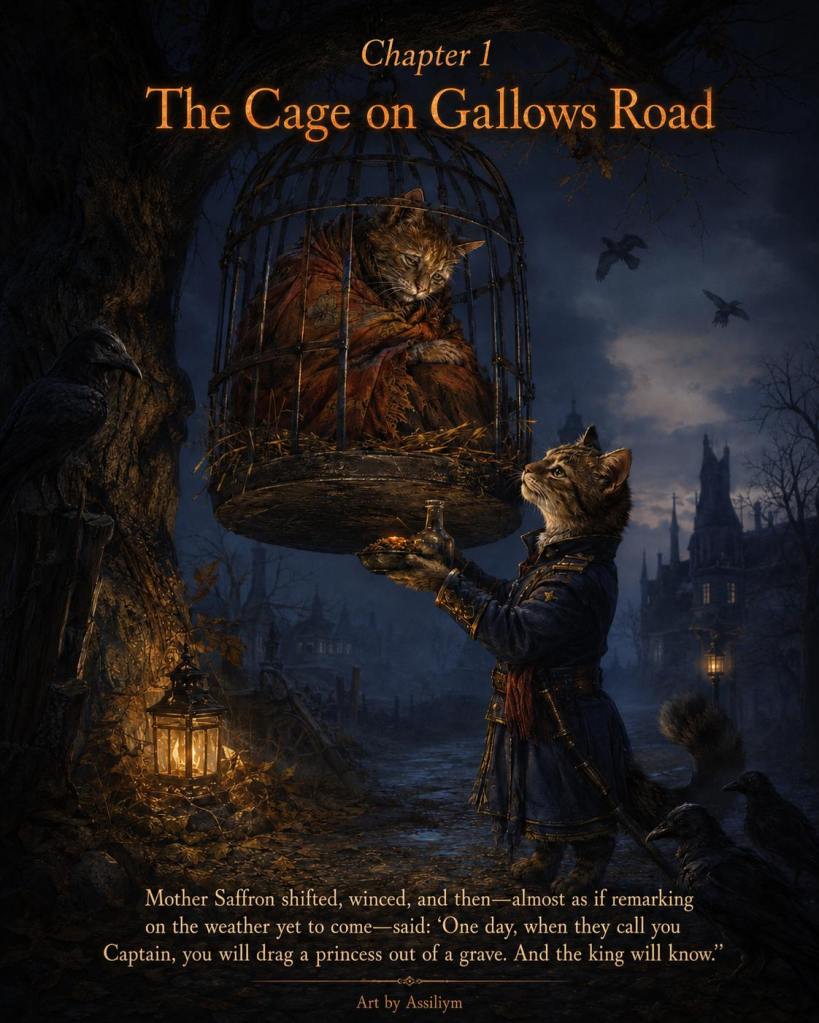
Mother Saffron heard it. Of course she heard it. Her ears moved once. Then, without looking away from him, she tapped one claw against the cage floor: not in rhythm, but across it. Once. Twice. A third time late. The little order broke. The chain swung on, stupid and harmless again, though Bastian did not know why the air felt easier.
Mother Saffron shifted, winced, and then—almost as if remarking on the weather yet to come—said:
“One day, when they call you Captain, you will drag a princess out of a grave. And the king will know.”
Bastian stared at her.
The words were absurd.
The words were insolent.
The words were, for one short unwelcome instant, chilling.
Then the city returned around him in all its iron commonness, and he found anger more comfortable than unease.
“You’ll have stale bread before noon and frost in your bowl by evening,” he said. “Spend your gift on something useful.”
Mother Saffron gave the smallest shrug that the cage allowed.
“I did.”
She lowered her paw after that and brushed the bowl with one claw. The tiny sound came wrong, deliberately wrong, refusing the road’s measure as a singer refuses a tune she knows was written by an enemy.
He turned away then because looking at her had become intolerable in some fashion he did not care to name.
Below on the road, carts were beginning to multiply. Paris-Neon was waking into its market day. Hoofs, wheels, voices, bells, distant smoke. The kingdom was moving. Behind him the prison gate opened and shut. Ahead of him the slope ran down toward the city’s deeper hungers. Above him, in the cage, an old village she-cat sat under the King’s law with bread enough not to die and not enough to call survival mercy.
Bastian stood at his post in his father’s coat and the city’s borrowed buttons and understood that René had indeed opened him a door.
Only not the one he had imagined.
Behind him the cage chain settled once more. Tik. Tok. Tik. Tok. Bastian looked down and found his paw moving with it again against his belt. He stopped at once, hot with anger though no cat had accused him. Above, Mother Saffron said nothing.
That was worse…
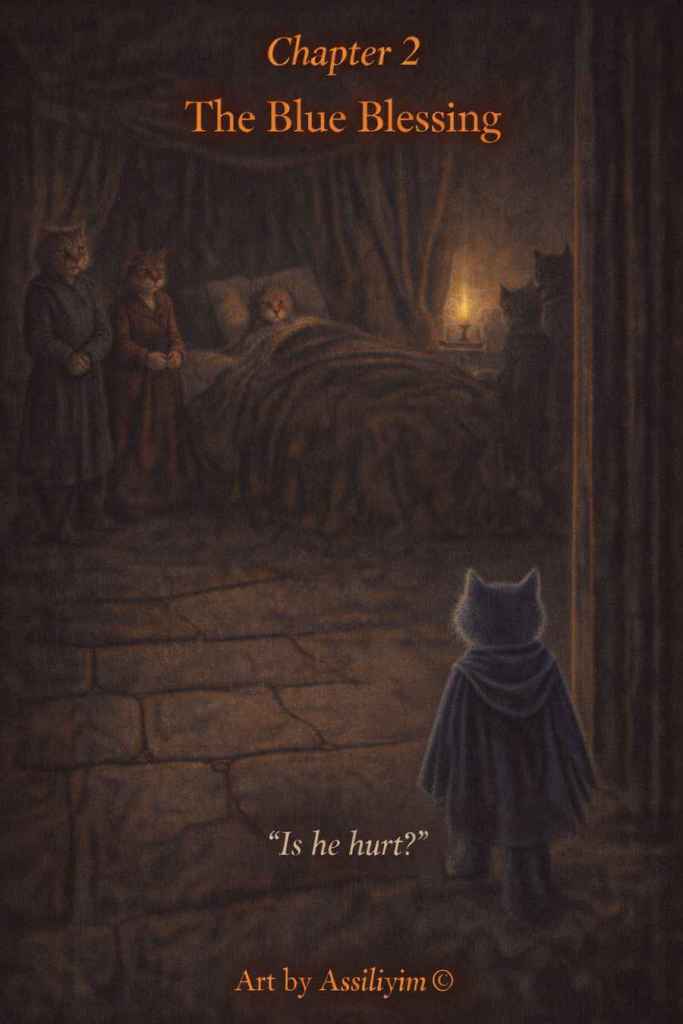
The king’s chamber had begun to smell less like power and more like waiting.
There are odours which belong to authority as naturally as velvet, ink, or gold-headed sticks belong to cats who have worn command too long to distinguish it from their own posture. Wax. Leather. The faint dust of parchments opened and closed by other paws. Good wool aired by servants. The resinous breath of polished furniture. Steel kept clean not for battle, but for the spectacle of preparedness. All those scents still lived in the great room where Henry of France lay. Yet over them, and through them, and at last ruling them with the patience of a stronger monarchy, had come other presences: cooling broth left untasted, physic steeped too long in covered cups, cloths changed in silence, vinegar, lamp smoke kept low at all hours, and that indefinable thinness by which a room confesses that the body at its centre no longer governs the atmosphere, but is being governed by it.
In the silver basin by the bed, the water had taken a faint blue skin from the half-light, though no blue glass stood near it and no servant had poured anything into it but clean water. Once, when the physician crossed too close, the surface trembled without being touched. The old chamber cat who saw it crossed herself so quickly that her sleeve struck the tray and made the spoons whisper together like frightened teeth.
The shutters were not fully opened.
No cat had ordered them kept half-closed. No written order existed. No master of household had composed a doctrine on the subject. It was one of those decisions made by fear in instalments. Someone, on the first morning after the fall, had left one panel only partly drawn back so the light would not strike the king too fiercely. A second servant, entering later, had found the dimness appropriate and preserved it. A third had judged the room better thus. Before noon the whole chamber had learned half-light, and from then on the day itself entered only under restraint, as though sunshine were a rude relation who must be admitted on sufferance to the bedside of a dying sovereign.
The clocks had also learnt caution, though less successfully. The little ormolu clock near the mantel ran two breaths ahead of the travel clock on the secretary’s table. The wall clock over the inner door dragged behind both. No one mentioned this. Sickrooms are full of conspiracies of silence, and the first conspiracy is always against noticing what cannot be repaired.
Henry lay beneath the canopied bedclothes as under a subdued siege.
Once he had filled rooms merely by entering them. Even seated, even silent, he had possessed that old leonine craft by which certain rulers occupy not space but proportion, making lesser cats seem arranged around them by natural law. Now the bed occupied the room for him. The long lines of the curtains, the piles of folded linen, the trays, the little tables, the silver basin, the clustered lamps, the attendants posted at intervals with that peculiar formal misery of old households forced to serve mortality under ceremony — all had organised themselves about his body and become, by degrees, the architecture of decline.
Beside the far window stood a little porcelain bowl in which three palace moon-fish had once moved with ornamental stupidity through clear water and floating silverweed. They did not move now. They hung in the basin like three pale commas waiting for a sentence no clerk dared write. Whenever Henry’s breath hitched, their fins tightened, and the silverweed sank lower as if the water itself had grown tired of pretending to be decorative.
He was awake.
That was both the comfort and the terror.
Comfort, because death had not yet fully crossed the threshold and settled on the pillow.
Terror, because the cats in the room knew now that consciousness can remain long after speech has gone and command become a thing of the eyes alone.
He could open them.
Close them.
Turn them.
Sometimes, with a cost visible even to the least observant chamber servant, he could move one paw by an inch or two against the coverlet. But the tongue — that old royal instrument by which sentences had once marched, mocked, pardoned, condemned, and altered the appetites of whole rooms — had retreated into silence. When physicians spoke of hope they did so in tones so measured that even the curtains seemed to disbelieve them. When priests spoke of grace they lowered their voices not from reverence alone, but because one does not shout over a kingdom discovering that it may soon require another throat.
Near the bed stood a table laid not with state papers now, but with draughts, spoons, folded cloths, and the little glass measures by which learned cats attempt to persuade death to observe arithmetic.
Morel delivered him at last to the menagerie walk.
The smell met them first:
straw,
meat,
animal heat,
cages,
the sad old iron smell by which captivity advertises itself even when the bars are polished.
Mer-mer ran then.
Not wildly.
Not with the shrill foolishness of indulged children set free from velvet rooms.
He ran with relief.
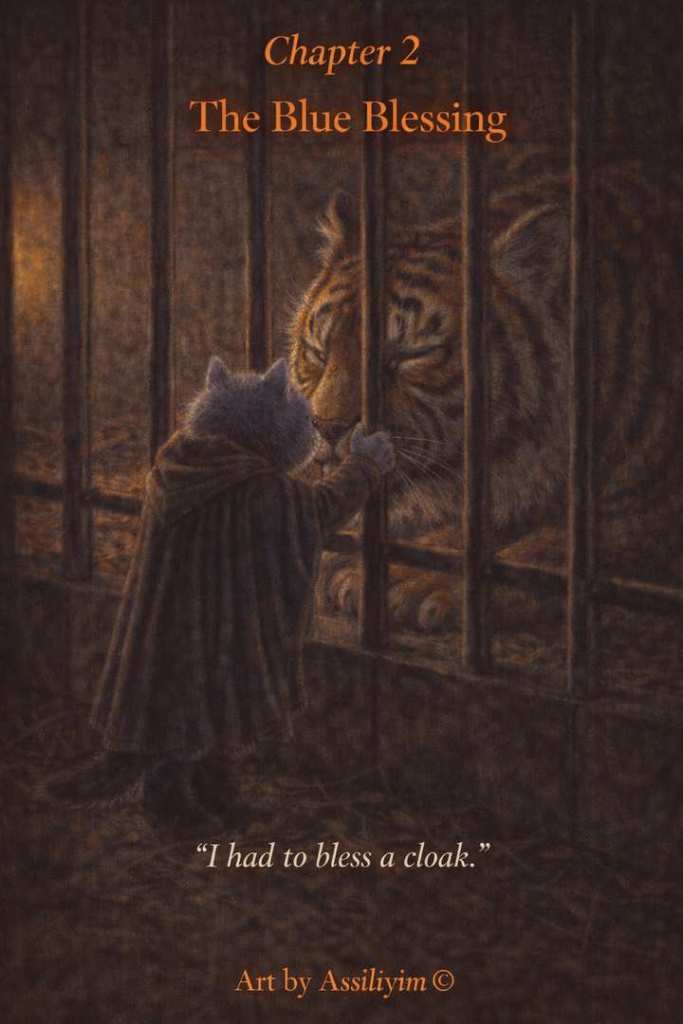
When he reached Mr Stripe’s cage the tiger was already up, already coming to the bars, already searching the child’s face with that deep wounded beast-attention which asks first not for food, not for freedom, but whether the known beloved creature has returned whole.
Mer-mer put both paws through the bars at once.
“I had to bless a cloak.”
The tiger huffed warm breath over his paws.
“It was stupid.”
Mr Stripe blinked once.
Slowly.
“Yes,” said Mer-mer. “I know.”
Then the great tiger’s nostrils widened. He lowered his head, not to the child’s paws, but toward the side of Mer-mer’s neck. For one breath the bars between them seemed too thin for the amount of silence that entered the walk. Mr Stripe did not growl. He did not pull away. But the gold in his eyes sharpened, and somewhere behind that gaze an older beast-law looked at the hidden Mark and did not like what it found warming there.
Mer-mer touched the bars more tightly.
“I didn’t do anything,” he whispered.
Mr Stripe breathed over his paws again, slower this time, as if answering not with denial but with loyalty.
And because beasts often give better absolution than priests, the child leaned his forehead against the iron and let the cage, the tiger, the smell of straw, and the plain honesty of captivity steady him after the perfumed rottenness of the king’s chamber.
Above them, in the palace, the old king still laboured for breath.
Around him the parasites turned.
Beside him the prince practised stillness.
Beyond him the kingdom waited.
But down in the menagerie walk, where the Great Royal Protector was merely a blue kitten with cold paws and a tired heart, the truth remained simpler.
The bars were honest.
The tiger was honest.
And soon, in the palace, meant no.
The next night Leonardo set a trap.
It was not a cruel trap. Leonardo was not that kind of cat, though he occasionally threatened to become one while dealing with palace accounts. It was a little hinged box with a cheese bait, a weighted door, and a spring so delicate he had once considered using it in a measuring device before deciding it had too much personality.
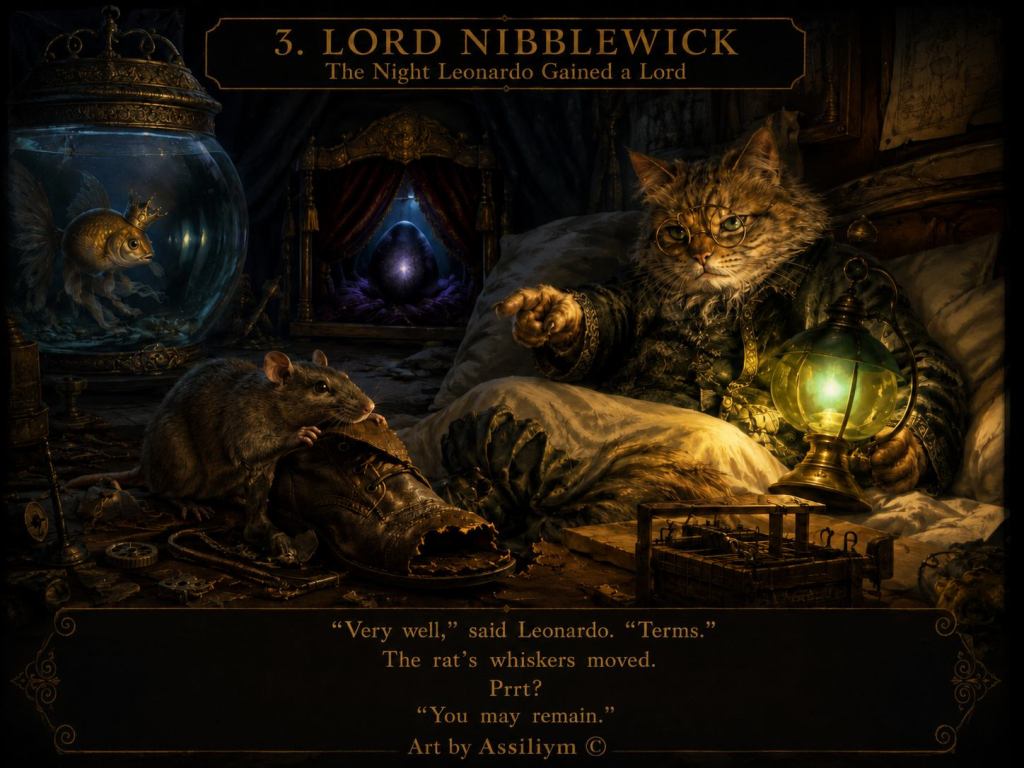
In the morning the cheese was gone, the trap was closed, and the rat was sitting on top of it eating a crumb of bread with the meditative calm of a retired judge.
Leonardo looked at the trap.
Then at the rat.
Then at the trap again.
“I see,” he said. “You have studied law.”
The rat chewed, swallowed, and gave a grave chrrp, as though accepting professional recognition.
The third night Leonardo improved the trap.
The fourth night he improved it again.
By the fifth night the trap had acquired two doors, a counterweight, a bell, a sliding panel, a little balanced spoon, and a philosophical grievance. The rat entered it, ate the bait, somehow rang the bell from outside, and escaped with the spoon.
Leonardo found the spoon in the morning inside his slipper.
That was when surrender became the only dignified position left.
He stood in the middle of the villa with one chewed boot in his paw, one bent trap on the table, and the rat watching him from beneath the aquarium stand. The Duchess floated above, fins trembling with what Leonardo chose not to call amusement.
“Very well,” said Leonardo. “Terms.”
The rat’s whiskers moved.
Prrt?
“You may remain.”
The Duchess turned one slow circle.
“Do not encourage him, Madam. This is diplomacy.”
The rat sat up on his hind legs. It was a fatal gesture. No creature that small had any right to look as if it were accepting a treaty between equal powers.
Leonardo narrowed his eyes.
“There will be conditions. No chewing boots. No entering the egg corner. No nesting inside the Blue Spark Machine. No stealing screws I have not finished misplacing myself. No judging me while I work. I have a fish for that.”
The Duchess flicked her tail against the glass.
“Yes, you.”
The rat lowered himself and sniffed the toe of the damaged boot.
Snff-snff… prrt?
“No,” said Leonardo sharply.
The rat stopped.
Leonardo stared.
The rat stared back.
“Ah,” said Leonardo. “So you do understand civilisation. You merely oppose it.”
The rat made a soft tchik, turned slightly, and washed one paw.
“Yes,” said Leonardo. “That is exactly what an enemy of civilisation would say.”
 Vuk Stribog