
INSIDE BOOK 8
Book 8 — NEON: The Empty Red Chair — When the Crown Began to Bite
— PROLOGUE —
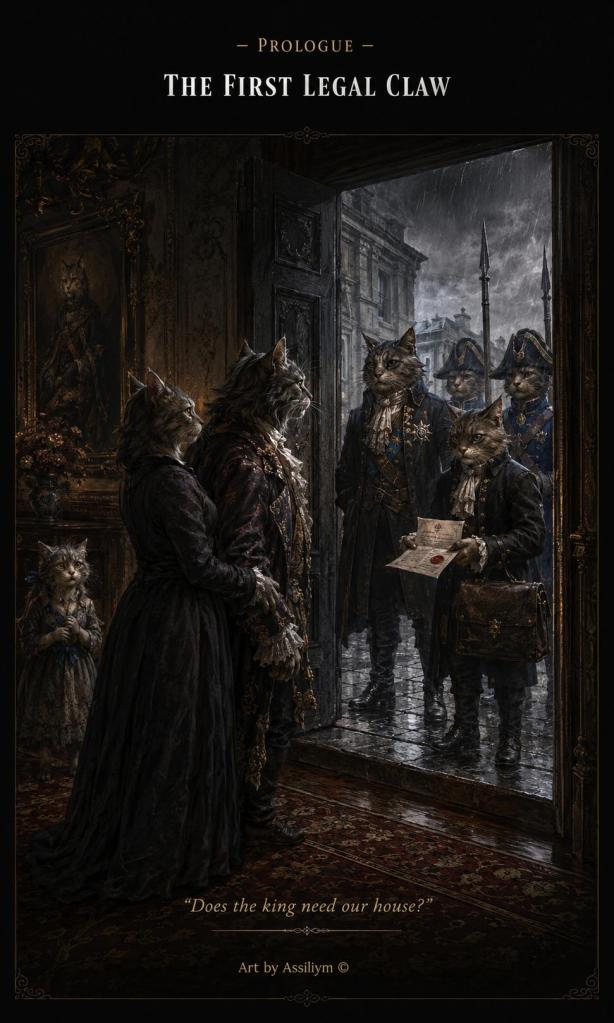
The clerk’s ink darkened on the word suspended. No one but Ina noticed. She had seen ink darken before on debts, death warrants, and tavern bills that would end in knives. It was not magic, she told herself. It was merely paper enjoying cruelty.
Severin held out his paw.
The steward gave him the order.
He read it once.
Read it again.
Then looked up, and for the first time the old cat’s face showed not grief, not even anger, but that rarer and more ruinous thing: comprehension.
“So,” he said. “He keeps the shell and eats the house.”
The steward remained properly blank.
“There is no accusation, Your Grace,” he said.
“No,” said Severin. “That is what gives it style.”
From the morning room came Little Crow’s voice, too bright in the silence.
“Why are there guards?”
Ina did not turn.
The steward lowered his paper. “We are instructed to proceed at once.”
“Proceed with what?” asked Severin.
“With reversion, suspension, and inventory.”
The clerk was already taking notes.
“Under whose seal?” said Severin.
“The King’s own.”
“Am I granted time?”
“The instruction is immediate.”
“Am I turned out?”
“The residence no longer stands under your command.”
A pause.
Then, because cruelty sometimes achieves its final polish only in the last sentence, the steward added gently, “You retain your person, Your Grace. The rest is not mine to discuss.”
Little Crow had come into the hall after all.
No one had heard her. She stood in her half-fastened ribbon and morning stockings with the solemn shock of a young she-cat who has walked into a room where all the grown cats have suddenly become old.
“Does the king need our house?” she asked.
The clerk’s pen stopped.
Severin turned.
No cat there would ever afterward have forgotten the look on his face at that moment. It was not the look of a duke. Nor of a court uncle. Nor of a man insulted by a nephew upon the throne. It was the naked look of a creature who has just discovered that a young she-cat’s question can make paperwork obscene.
Ina crossed the hall in three strides and drew Little Crow to her side.
“Hush.”
But Little Crow was still looking at the paper, the guards, the faces, the steward’s gloves.
“Why are they taking the carriage?”
The steward bowed his head slightly, as if to the room at large.
“The carriage is attached to the grant,” he said. “It belongs to the Crown.”
There it was.
The phrase.
It had the exact clean bite she had expected.
It belongs to the Crown.
The house? The Crown.
The carriage? The Crown.
The servants’ livery? The Crown.
The silver? The Crown.
The winter garden and the glass pavilion where Little Crow had once tried to appoint a hedgehog minister of flowers? The Crown.
It belongs to the Crown.
A kingdom can do much with a sentence when the sentence has clerks behind it.
On the sill, a strip of frost-moss that had crept in under the shutter gave one dull blue blink and then went grey again. In other winters, Quickpaw would have poked it with a spoon and declared it lazy. This morning no one laughed at the moss, and so even that little piece of Neon seemed to know it had entered the wrong house.
Mara was already awake because grief in poor houses seldom permits the luxury of sleeping late.
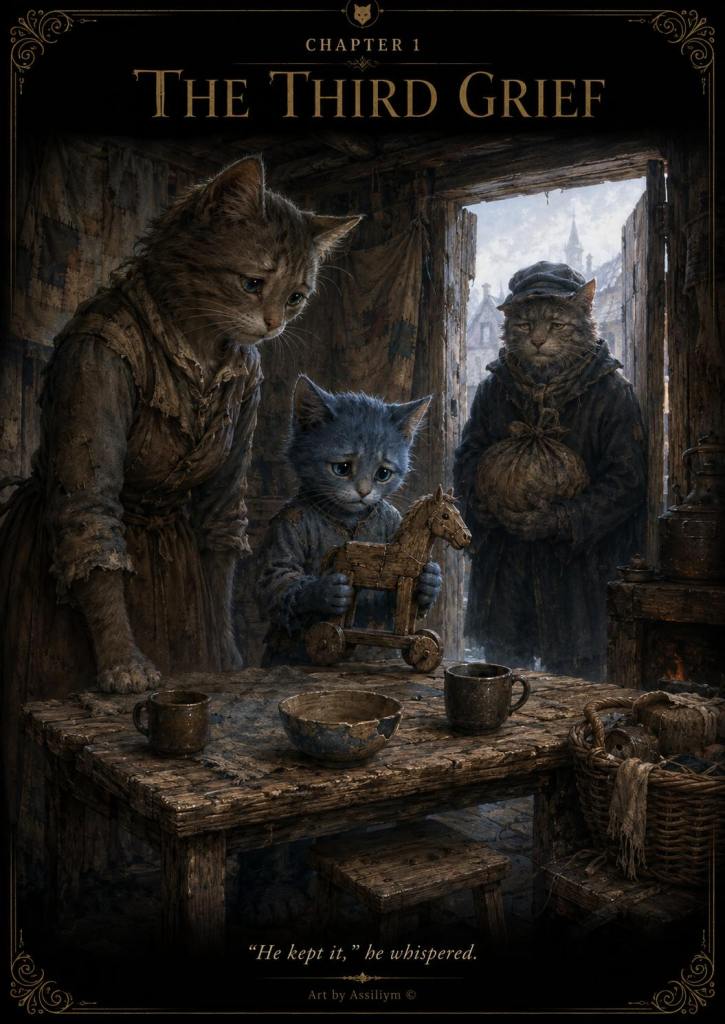
She moved with the old practical care of a she-cat who had spent too many winters learning how to draw one more meal out of bones already twice persuaded, how to keep flame alive in damp weather, how to make labour stand in for certainty where certainty had failed. She had tied back her sleeves. The kettle muttered over a weak fire. Yesterday’s crust had been cut and laid out. A heel of cheese, a little broth thickened with barley, two cups and one chipped bowl waited on the boards with all the mute, embarrassed thrift of things that know they are not enough and come anyway. There was a patching basket by her foot. A half-mended cuff lay over one knee. She worked because her paws knew how, and because stillness in the hut had become too articulate to be borne for long.
Mer-mer sat opposite her and watched.
He had slept in his own place for the first time since the capital, yet home had not folded itself round him as he had imagined on the road. A kitten, when torn too long from the shape of his own life, believes at first that return will operate like magic: one enters the old doorway and all missing things take their proper places again; the voice from the hearth speaks; the brother thunders in from outside; the father’s boots stand by the door; grief, having made its little mistake, withdraws with apologies. But houses are not magicians. They are witnesses. They keep what they can and show what remains.
The blue kitten’s eyes moved again to the table.
At Toma’s place there stood no cup.
At Quickpaw’s, there stood a cup, because Mara had put one there by habit and had not yet learnt how to stop. The sight of it hurt more than if she had not. An empty place made sense to sorrow. A prepared place mocked it.
The cup trembled once. Not enough to spill. Not enough for any sensible cat to call it an omen. Only enough for Mer-mer to see the pale broth shiver round the rim, as though some part of the hut had remembered Quickpaw’s paw before the rest of the world allowed him back.
He lowered his gaze.
“It is too quiet,” he said.
The words did not rise loudly. They simply entered the room and stayed there.
Mara kept her eyes on the bread while she cut it.
“Morning is often quiet,” she answered.
“No.” He looked up. “Not like this.”
She did not correct him. There are times when mothers lie to kittens out of mercy, and times when truth has already walked so far into the room that lying would only insult the one who must hear it. She set the knife down.
No wind came through the chinks this morning. The thatch held. The fire, though poor, did its work. Nothing in the hut moved except the little steam from the kettle, and even that seemed to rise carefully, as if unwilling to make itself heard where too much else already was.
The stable tom looked down at him, and some mixture of pity and surprise passed through his old face—for though the whole valley knew of the blue kitten’s return, seeing him there in the poor doorway, alive and narrow and much more kitten than palace talk ever made him sound, was another matter.
“He said you’d know.”
Mara took the bundle inside and set it on the table. The cloth came away.
On the boards lay Quickpaw’s old wooden horse.
One ear had broken long ago and been mended badly with string. The paint, such as there had ever been, was mostly rubbed off. One wheel turned crooked. It was the sort of toy a rich kitten would have forgotten under a chair and a poor kitten could love until the wood itself seemed to answer by remaining in one piece out of loyalty.
The little horse smelt faintly of Count Baltz’s clean linen, strange soap, and new firewood. Under that, Mer-mer found the older smell: smoke from this hut, old bread, winter paws, Quickpaw’s fur, and the sour-sweet dust of a toy dragged through too many poor mornings to be ashamed of itself.
For a moment Mer-mer did not touch it.
Then he reached with both paws and drew it close.
“He kept it,” he whispered.
The stable tom, still at the threshold, nodded.
“He kept it by the bed all night, so they told me. Then this morning he said it must be sent up here because ‘Mer-mer is the one who knows where it runs fastest.’”
The blue kitten pressed his paw-pad into the cracked wheel.
The wheel turned once with its old uneven little sound. Clack-clack… clack. Not a clock. Not a machine. Only a poor toy remembering the rhythm of two brothers racing it along floorboards while Toma pretended not to smile and Mara pretended not to hear them quarrel.
Mara stood very still.
Mara’s breath stopped.
Then she saw the thing that would remain with her longer than the shape.
From the dark centre there came, very faintly, a little thread of ash-grey vapour.
Not steam.
Not smoke from fire.
Not breath as any living neck should breathe.
It rose thinly, coiling no higher than a claw’s breadth before dissolving into the pale hut-light, as if the mark itself had begun to exhale some older weather through her kitten’s flesh.
“No,” she whispered.
Mer-mer’s paws had gone flat against the table. The horse sat crooked before him. The cup of broth might have been a hundred miles away. The sounds of the hut—kettle, fire, Mara’s breathing, the old messenger shifting by the threshold—began slipping from him one by one, as coins dropped into black water are lost not by violence but by depth.
The whisper came first.
Not through the ear.
Through the mark.
Vel’kaal, ul-vhar.
Mer-mer froze.
He did not know the words. He knew that at once. No cat in Saint Virel had ever spoken them. No monk had taught them. No mother had sung them over fever. They were not French, not Latin, not any church muttering, not any peasant charm against winter, toothache, or bad kings.
And yet the sound found a place inside him that answered.
Not happily.
Not willingly.
But as an old locked room answers when the correct key enters after many years of dust.
Vel’kaal, ul-vhar.
Wake, old friend.
The meaning did not arrive as translation. It unfolded behind the pain, slow and dreadful, like writing appearing on the inside of his skull.
Old friend.
That was worse than threat.
A threat might have belonged to an enemy. This had the terrible gentleness of recognition.
Mara’s paws closed on his shoulders.
“Mer-mer.”
He tried to answer her, but his tongue had gone small in his mouth.
The ash-grey vapour breathed again from the mark.
Then the voice came nearer — not louder, nearer.
Zha’reth az’kael.
Mer-mer’s claws caught the edge of the table.
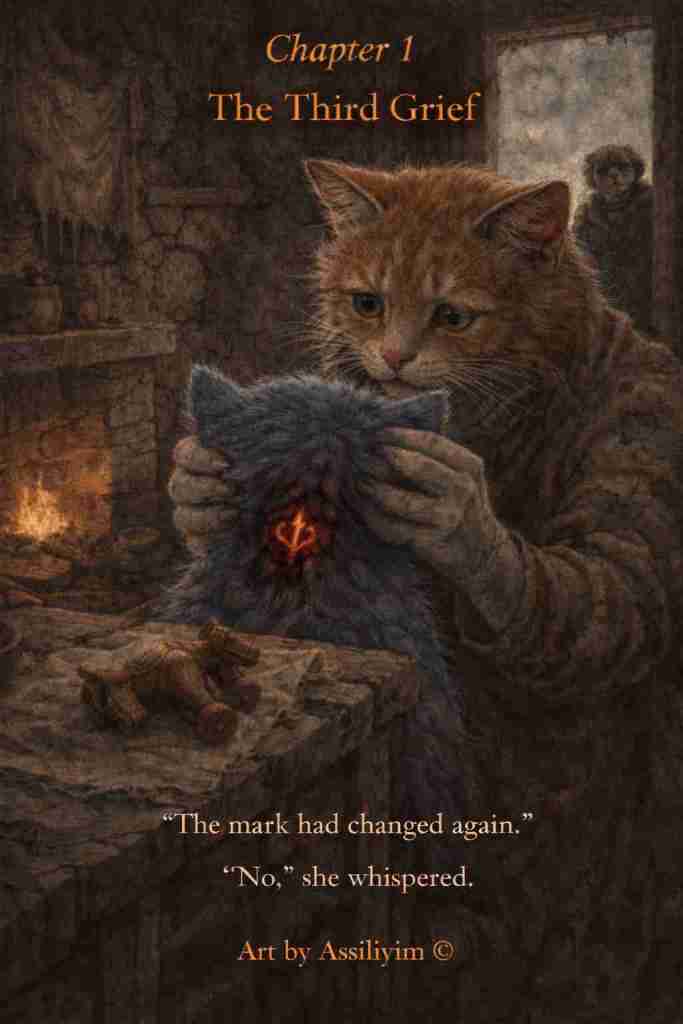
No shape stood in the doorway.
No face leaned from the smoke.
Yet all at once Mer-mer knew, in the marrow and under the mark and somewhere older than Mer-mer himself, that something immeasurably greater than a village, greater than a king, greater even than the frightened scale by which kittens rank their own sorrows, had turned its will upon him.
Words entered him then in a tongue not meant for air.
Thren-esh vel kael.
He did not understand them as one understands a lesson. He suffered them. Completion. Rule. Inevitability. The sense of a sentence that had no room in it for refusal because refusal had not been admitted into its grammar.
The black root in his neck burned.
Azh’Vel-Korrath zul-naeth.
The mark widened under Mara’s parted claws.
The ash-grey thread trembled.
Something buried was being addressed, named, summoned by a sovereignty older than his kittenhood and contemptuous of it.
Mara felt him go stiffer in her paws.
“Mer-mer!”
Ul ven’korr.
Open what was buried.
No—worse than that.
Not the meaning itself, but the pressure of meaning. Opening. Yielding. Unfastening at the centre. The appalling sensation that the body might be no more than a latch if the right authority found the proper word for it.
Naer-zul.
Withdraw.
Not from the hut.
Not from the pain.
From himself.
Mer-mer made a little sound then—small, strangled, more terrible than crying because it was the sound of a kitten trying not to surrender where he could not yet even see the thing demanding surrender. His claws bit the table. The wooden horse rocked and fell on its side.
Its crooked wheel turned once more. Clack. Then stopped against Mara’s cup, as if the poor toy had spent all the force Quickpaw had given it and could go no farther alone.
The old stable tom crossed himself and then, seeing neither priest nor doctrine in the room equal to this business, backed clear out into the yard without another word. Whatever happened next belonged to the hut, the mother, and the invisible.
Mara did not know what was speaking to him.
She did not know what had touched the black mark at his neck. She knew this only:
Toma lay in wet earth behind the church.
Quickpaw slept under another roof.
And now something she could not see had laid claim to the third grief while he still breathed in her paws.
The thought struck her with the full animal simplicity of motherhood. Not idea. Not theology. Instinct.
No.
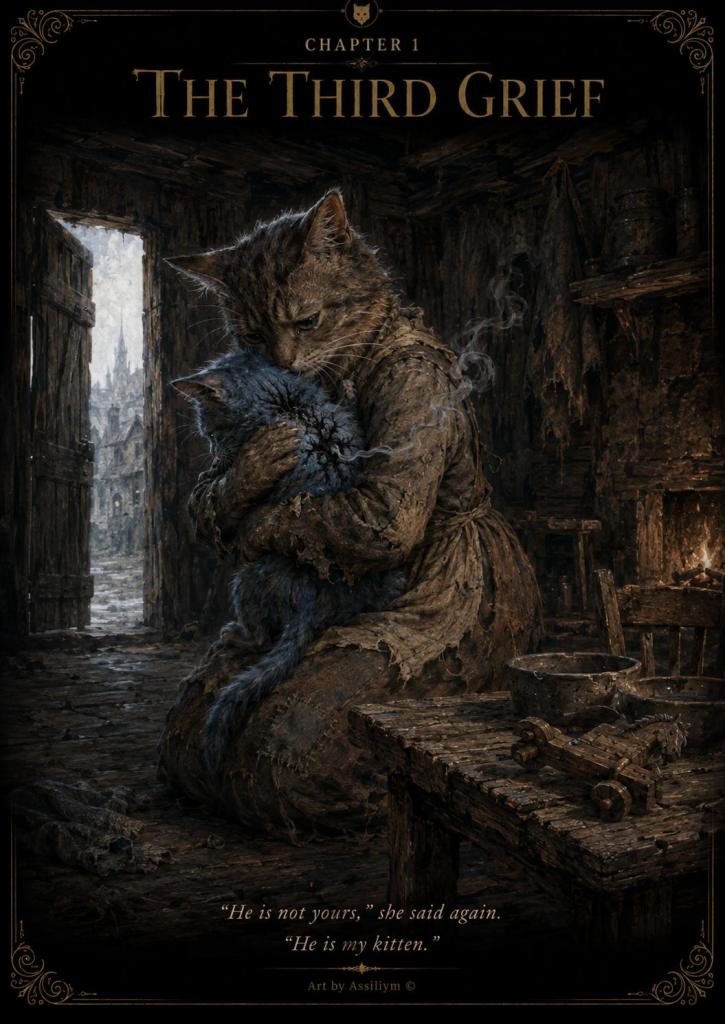
She turned Mer-mer toward her and pulled him bodily against her chest. He came because some part of him was still kitten enough to come when lifted. The mark burned against her wrist through his fur. The ash-grey breath touched her sleeve and vanished there.
“My dear kitten,” she whispered, and then the whisper broke. “My poor dear kitten.”
His head fell against her shoulder.
She kissed him once above the eye, then again, as if kisses still possessed legal force in the universe and could be laid down like seals where greater powers might read them and retreat.
“I won’t give you to anyone.”
The mark pulsed.
Inside him the pressure gathered again, not impatient, not wrathful—worse. Patient. Certain. As if whatever had named him had all of time and all of right and found the interruption of a mother’s paws no more than weather passing over stone.
Mer-mer’s lips moved.
For one instant Mara thought the other voice would answer through him.
Instead he said, very faintly, as he had when fever was small and the world still made sense:
“Maman…”
It nearly killed her.
She crushed him closer, one paw over the back of his head, the other spread protectively over the burning nape as though her own flesh might still stand between his and whatever unseen mouth had begun to breathe through it.
“You hear me,” she said then.
Not to the room.
Not to the mark.
Not even to fear itself.
To the thing.
The words came out low at first, then stronger because terror, once it has spent the first coin of trembling, often purchases fury with what remains.
“You hear me.”
The pressure did not retreat.
The hut seemed to lean inward around them.
Somewhere in the fire a knot snapped.
“Leave my kitten.”
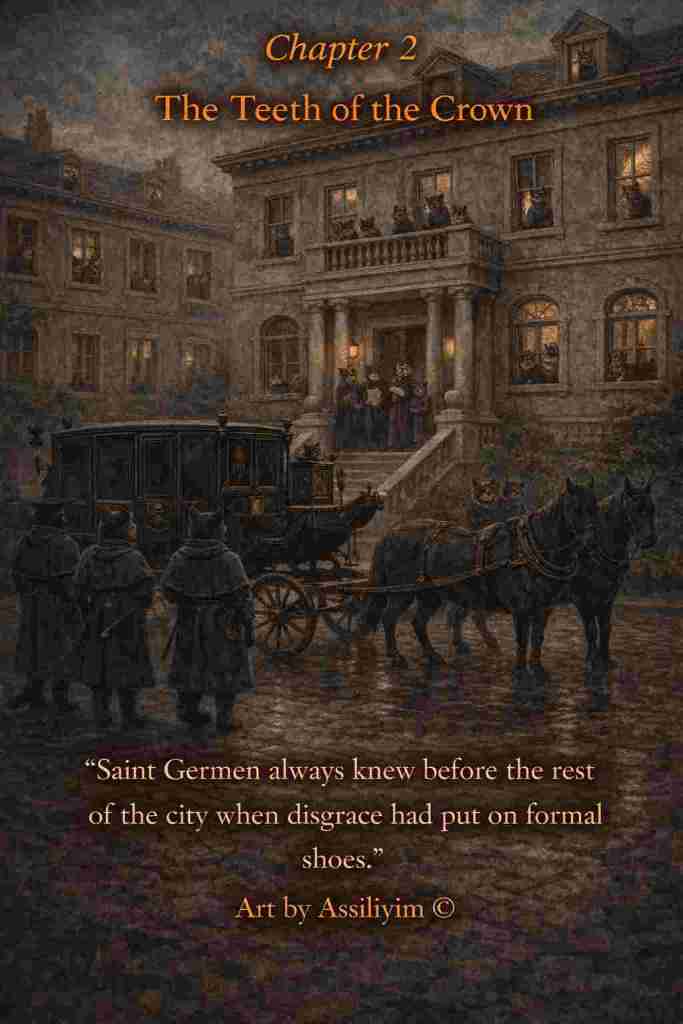
Saint Germen always knew before the rest of the city when disgrace had put on formal shoes.
It was one of the district’s oldest accomplishments. Long before papers were read aloud, before servants carried whispers into kitchens, before clerks unlocked their boxes and drew out seals with the little pious faces of cats pretending not to enjoy power, Saint Germen had already scented the change in weather. Curtains moved. Shutters opened a claw’s width. Noble cats, who would have sworn in chapel that curiosity was a vice fit only for merchants and actresses, somehow discovered reasons to stand at upper windows with cups in their paws and prayer-books in their laps whenever another noble house was about to be corrected by the world.
In one upper window, a blue-shard lamp flickered though the sun had already risen. Its owner turned the shade at once, not because the light offended her, but because Saint Germen never liked being caught watching too brightly.
That morning correction came in black.
The carriage of Lord Justice Malvoisin climbed the long street beneath a sky of thin, exhausted silver, its lacquered sides dark as mourning glass, its wheels grave and slow, as if even the axles knew they served not transport but sentence. Before it rode blue guards with polished breastplates and hard indifferent eyes. Behind it came more: a second wagon with leather cases and rolled inventories; three clerks in sober caps; two court justices wrapped in black-trimmed law-cloths; and, most visible of all to Saint Germen’s more enthusiastic observers, Senior Inspector Étienne Delorme riding with the dry erect patience of a cat who had long ago taught his ambitions to sit still in public and gnaw only inward. At his side rode Captain Vaurin, newly elevated under the new king’s favour and wearing that promotion as lesser cats wear perfume—too heavily, too early, and with far more pleasure than decency permitted.
The four black carriage horses did not like the hill. They climbed it, because harness and training are old tyrannies, but their ears lay flat and their breath smoked sharper than the morning required. Somewhere under the polished wheels, the old trees of Saint Germen held their leaves too still, as if Beast-Law had scented paperwork and found it unnatural.
The procession moved uphill with no trumpet and all the more authority for it.
At the first corner an old noble she-cat in pearl mourning ribbons touched the glass with two claws and said to no one she would have acknowledged later, “That is Malvoisin’s justice carriage.”
At the second house, where a younger tom still believed history concerned itself personally with his breakfast, another voice answered, “Then God help whoever is to be instructed.”
A third, drier voice came from a neighbouring balcony where a cat in dark velvet had abandoned all pretence of not watching.
“Poor Duke Severin,” she said. “The new king has sent all his teeth to bite him.”
That line travelled down the street faster than the carriage itself.
By the time the black wheels rolled beneath the trees before the House of Mireval, Saint Germen had already arranged itself into an audience. Not openly. Never vulgarly. But one does not need a crowd when one has windows.
No tavern bell rang here, no market cat shouted it, no sailor embroidered the tale with three impossible miracles. Saint Germen preferred cleaner gossip: a curtain’s twitch, a servant’s lowered voice, a prayer-book opened upside down by a she-cat too delighted to notice.
The carriage stopped.
The guards spread with that cold efficient spacing by which power announces it has no wish for drama and every preparation for it. Vaurin dismounted first. He had the look of a cat who had dreamt for years of being obeyed in visible places and had at last been given a street noble enough for his vanity. Étienne dismounted after, no flourish in him at all, which made him worse. His gloves were grey. His boots were clean. The faintest suggestion of satisfaction lived somewhere behind the eyes, but only a seasoned enemy would have known where to look for it. Malvoisin descended last.
Severin stood beside the drawing-room door.
He had not sat.
Cats of his kind are rarely granted the vulgar mercy of collapse at the proper time. He remained upright, one paw resting upon the back of a chair as though furniture might remember allegiance when kings did not.
His eyes fell upon the costume.
A strange expression crossed his face—pain, affection, shame and amusement at fate’s taste bound too tightly for clean separation.
“So,” he said quietly. “That is what survives me.”
Ina came to him.
“No. That is what survives them.”
A clerk, hearing only enough to remain irritating, turned a page.
“The carriage remains.”
Severin’s eyes moved towards the front door.
For one childish, exhausted instant he had perhaps imagined—not hoped exactly, for old noble cats survive by rationing hope—that the carriage might at least carry them away. Some remnant of propriety. Some old servant’s courtesy. Some final scrap of rank to protect Little Crow from the street.
But there are mornings when a kingdom is determined to make its lesson visible.
“The carriage remains,” the clerk repeated. “It is attached to the grant.”
There was the last small hope killed.
Severin looked at Ina.
Few moments are sadder than the instant an old cat chooses the dignity in which he will be ashamed.
“There is nothing here now that I may offer you.”
No one moved.
“No house. No carriage. No household. No income fit even for pretence.” His mouth tightened. “I would understand if this is where you leave me.”
Little Crow looked from one to the other.
Ina stared at Severin for one long second, and through that second passed the whole strange road which had brought a Duke and Fire Ina to one breakfast table beneath Saint Germain silk: suspicion, amusement, danger, hunger, battle, tenderness, Little Crow, the chapel and the ridiculous splendour of happiness arriving late.
Then she spoke with the ancient contempt of loving she-cats for male stupidity.
“You silly old cat.”
His head lowered.
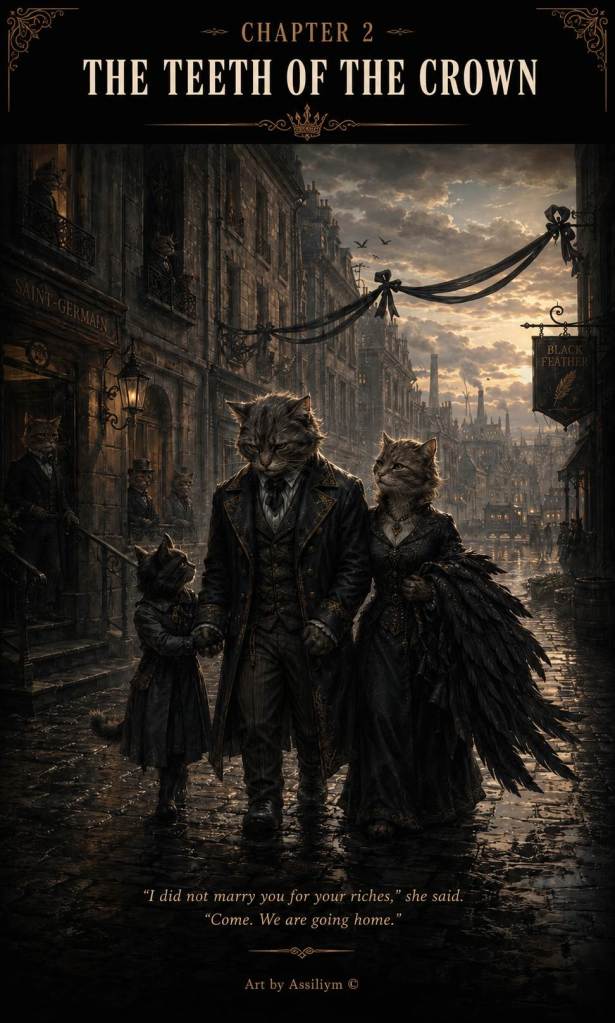
“I did not marry you for your riches.”
She shifted the black wings beneath her arm.
“Come. We are going home.”
Little Crow considered this a sufficient diplomatic resolution and immediately reached for Severin’s paw.
He gave it to her.
That was how the little procession formed.
No carriage.
No footcats.
No outriders.
No convenient fiction that Saint Germain would not notice.
Only Severin de Mireval, still wearing his fine coat because dispossession comes faster than wardrobe, descending the front steps between his wife and Little Crow while behind them Malvoisin’s clerks continued converting his life into columns.
At the gate Severin turned once.
Not towards the whole house.
Not the high windows, the winter garden or the little iron pavilion which Little Crow had transformed into her summer kingdom and which Severin had used as an excuse to purchase sugared cakes under the pretext of weather.
He looked at something smaller.
Upon the window seat of the blue drawing room, visible through the lace, lay one black feather.
A plume overlooked from Little Crow’s triumph on the night of the bells.
That, more than the warrant, almost undid him.
The feather stirred although no window stood open.
It moved once, not towards the clerk or the royal seal, but towards the street.
A little thing choosing exile over inventory.
Ina touched Severin’s arm.
The moment passed.
They walked down through Saint Germain.
The district saw.
How could it not?
 Vuk Stribog