
BOOK ONE — NEON ART
NEON — Before the Kingdom Broke
Once upon a time—
No. Cross that out.
That opening was too tired, too neat, and far too polite for Neon.
Instead, our tale begins in the gentle murmur of twilight, beneath the pale light of Neon’s two moons, Lucette and Mauve, who whispered the lost tales of old gods and stranger machines.
And long before those machines learned to dream, there was a poor village under the winter sky.
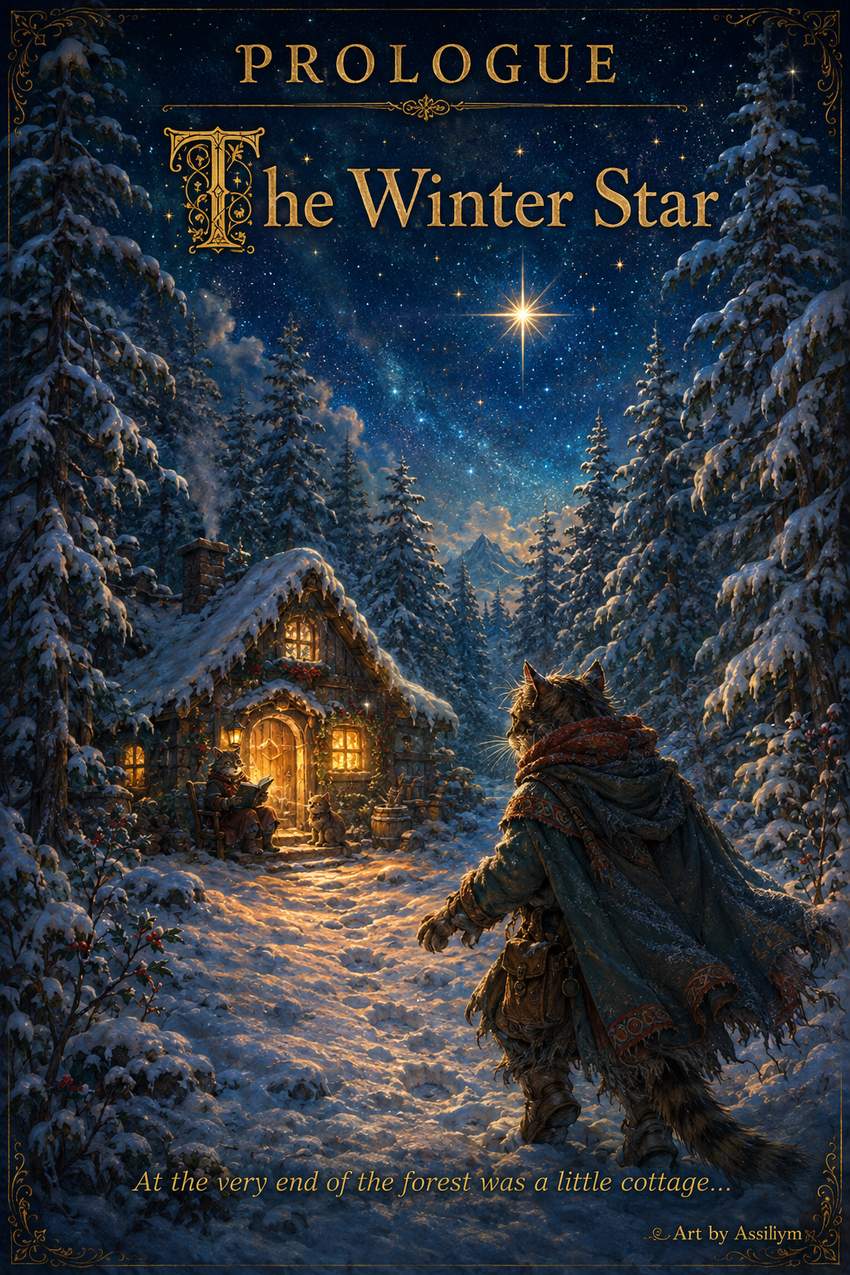
At the very end of the forest, where the trees stood so close together that even moonlight had to plead for passage, there was a little cottage which the snow had nearly forgotten how to spare.
It leaned under the winter like an old beggar under a sack of stones. The roof had bowed in the middle. Frost had grown thick in the corners of the windowpanes, not in pretty silver feathers, but in hard white crusts, as if the cold itself had bitten the glass and stayed there. In one corner of the pane, the frost had drawn a strange little circle around another circle, with tiny white teeth between them, like the ghost of a wheel no carpenter had made. It had appeared in the night. By morning it would be gone.
Near the lower edge of the same pane, where a kitten’s breath might have misted the glass had any kitten stood there, the frost showed two tiny stars joined by a crooked bridge. One star was clear. The other had been scratched away by some careless claw of cold. Mara would not notice it until dawn, and by then she would tell herself it had been only ice. Poor mothers are often wiser than priests; they know which signs must be ignored if breakfast is to be survived.
Yet there was something sorrowful in it too, as though it were not falling in triumph but descending in exile.
For one instant, the clouds behind it opened.
Toma saw the two moons.
Lucette, pale and round.
Mauve, darker and watchful.
And between them, where no moon should have been, there trembled the thinnest ghost of a third light: not a full moon, not even a proper shape, but a pale broken ring like a wound in the sky trying to remember itself.
For one breath, that broken ring seemed not to shine, but to look.
It was not the look of an eye exactly. Eyes belonged to beasts, priests, mothers, creditors, and other creatures with inconvenient opinions. This was colder than sight and older than witness: a hollow blue remembering-place, as if some lost jewel of heaven had once opened there and the sky had never fully healed around its absence.
Had an old Blue-Hood monk stood in that clearing, he might have fallen to his knees or run until his sandals forgot him. Toma, having no monastery education and no sandals worth heroic flight, merely stared and shivered.
Inside that broken ring, for less than the length of a blink, there moved other colours. Gold too bright to be moonlight. Black water rising against stone. A red desert under a dead sun. A city of metal turning upon itself like the inside of a clock. Then all of it folded shut.
Toma saw none of it clearly. Later, if anyone had asked him, he would have sworn he had seen only a falling star. A poor cat with frost in his whiskers does not volunteer to have seen worlds. Such confessions bring priests, doctors, or laughter, and all three are expensive in their own ways.
That was mercy. Clear sight is not always a gift. Some things, when properly seen, begin seeing back.
Then it vanished.
The blue-white fire continued downward.
The whole forest seemed to hold its breath.
The ticking in the pendulum-grass stopped.
Every branch, every needle, every frozen root waited. Even the cold seemed to pause in its work, offended perhaps that some greater power had entered the night without first applying to winter for permission.
The light passed over the black branches, staining them for an instant in silver-blue, and then fell beyond the clearing, somewhere deeper among the pines.
There came no crash.
No burst of flame.
Only silence.
Then, a moment later, a sound so small that he almost mistrusted it.
A cry.
Not the cry of a night-bird. Not the thin shriek of a hunted thing.
A kitten’s cry.
He stood frozen.
Again it came, faint and wavering through the snowbound dark.
He turned at once and stumbled toward it, plunging between drifts, catching his cloak on thorns, scraping his shins on hidden roots. The cry came again, weaker now, and in it there was that dreadful helplessness which no creature with a heart can hear without haste.
He reached a little hollow between two bent firs where the snow had gathered thickly.
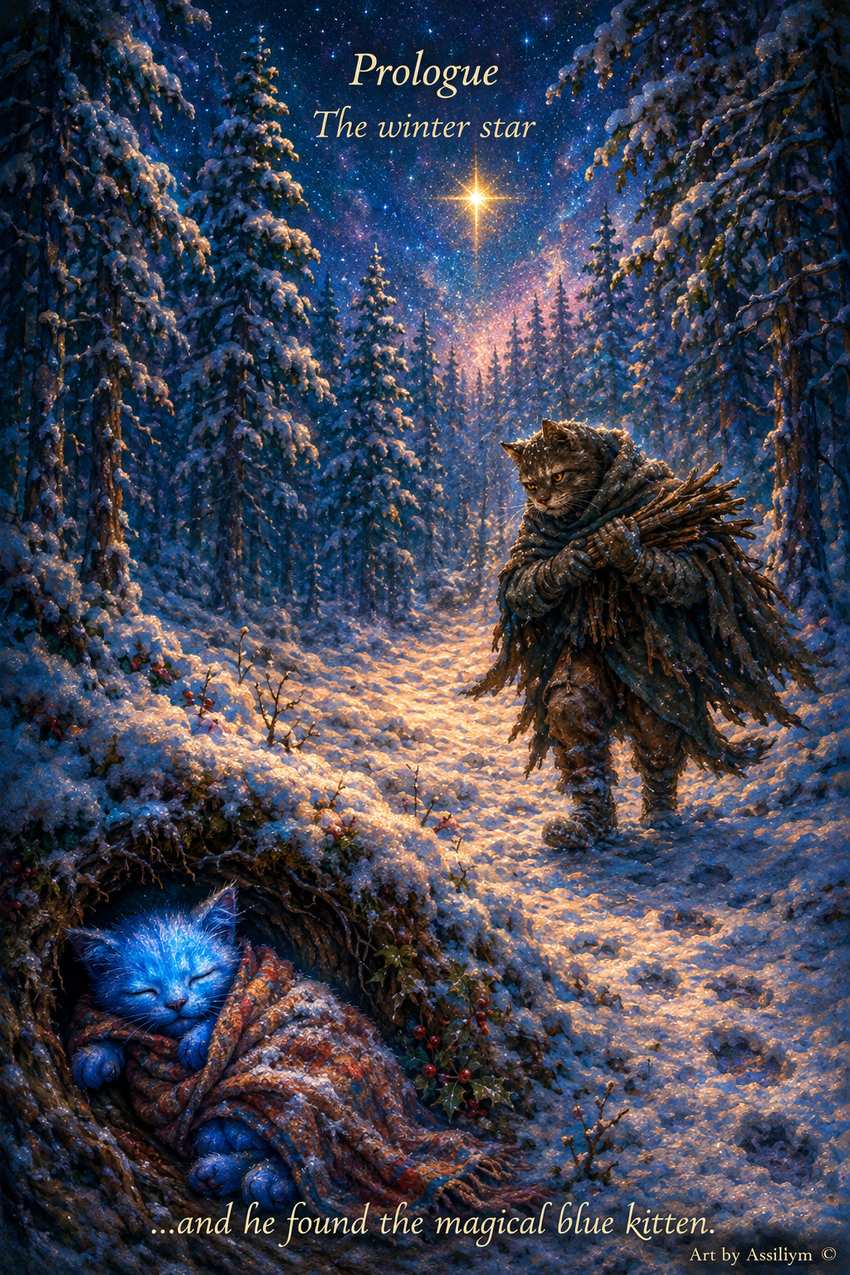
There, in the white, lay a kitten.
For one dazed instant the father could only stare.
It was very small. Too small to have been alone in such a place and still belong to life.
The blanket wrapped around it was no blanket of any house he had ever seen—light as mist, fine as milkweed silk, half-frozen already and sparkling with frost. One tiny paw had slipped free. The face was pinched with cold. The kitten’s eyes were shut.
But the fur—
The fur was blue.
Not bright as a painted toy, not gaudy or unnatural, but a deep soft blue, like evening caught in wool. Snowflakes had settled upon it and had not yet melted. Against that terrible white, the kitten looked like a fallen piece of twilight.
Around the hollow, the snow had melted in a perfect circle, though no heat rose from it. At the edge of that circle, frost had drawn little white lines in the shape of tiny roads running outward and then breaking off suddenly, as if the ground had tried to remember a map from another world and failed halfway through the lesson.
At the very centre of the circle, beneath the kitten’s small body, the snow had not melted at all. It had hardened into a thin blue glaze, smooth as old glass. In it, for less than a heartbeat, there appeared a mark like a page folded into an eye. Then the glaze cracked, whitened, and became only snow again.
No cat in Saint Virel would have known the sign. No priest would have admitted knowing it. No king, had he found it, would have left the forest alive without ordering three clerks, seven soldiers, and one frightened scholar to scrape the whole hollow into boxes.
One line curled like a wave. One bent like a horn. One ended in a little star. One was only a black scratch where the snow had refused to whiten at all. Had a scholar from Oraclia seen it, he might have crossed himself and spoken of broken layers. Had a sailor seen it, he might have spat and muttered of stolen tides. Toma saw only a freezing kitten, and that was already more mystery than his heart could carry.
Toma did not see all of that at once.
The she-cat looked at the fur then, and even through all her weariness she could not hide her astonishment.
“Blue,” she murmured.
The father nodded.
“As if the evening sky had lost a piece of itself.”
She gave him a tired side-glance.
“Hush. We cannot feed poetry either.”
Yet there was no hardness in it now.
She looked toward the cradle.
“Our lad is Quickpaw,” she said after a silence. “Always kicking, always dreaming he is already running somewhere.”
The father smiled faintly.
“And this one?”
She looked down at the strange little foundling in her arms.
The blue fur caught the low light of the coals and held it softly, like dusk on snow.
Outside, beyond the cottage walls, the forest gave one low shudder. Snow slipped from a branch. Somewhere the pendulum-grass ticked again, though no wind had moved.
Tick.
Tick.
Tick.
The sound came faintly through the night, too distant for certainty, too even for comfort.
The blue kitten opened his eyes for one instant.
They were too dark to see properly in the poor light, but Mara had the sudden foolish impression that he was not looking at the hearth, nor at her, nor at the cradle, but past all these things — past roof and forest and winter — toward some broken height from which he had fallen.
And for that same instant, the cradle charm trembled. The dry seeds clicked together: one, two, one — then stopped.
Then he closed them again.
“Bluepaw,” she said.
So he became Bluepaw.
No bells rang. No star returned to claim him. No voice spoke from the chimney. Only a poor mother, with too little food and too much heart, gave a name to a freezing kitten and made a place where there had been none.
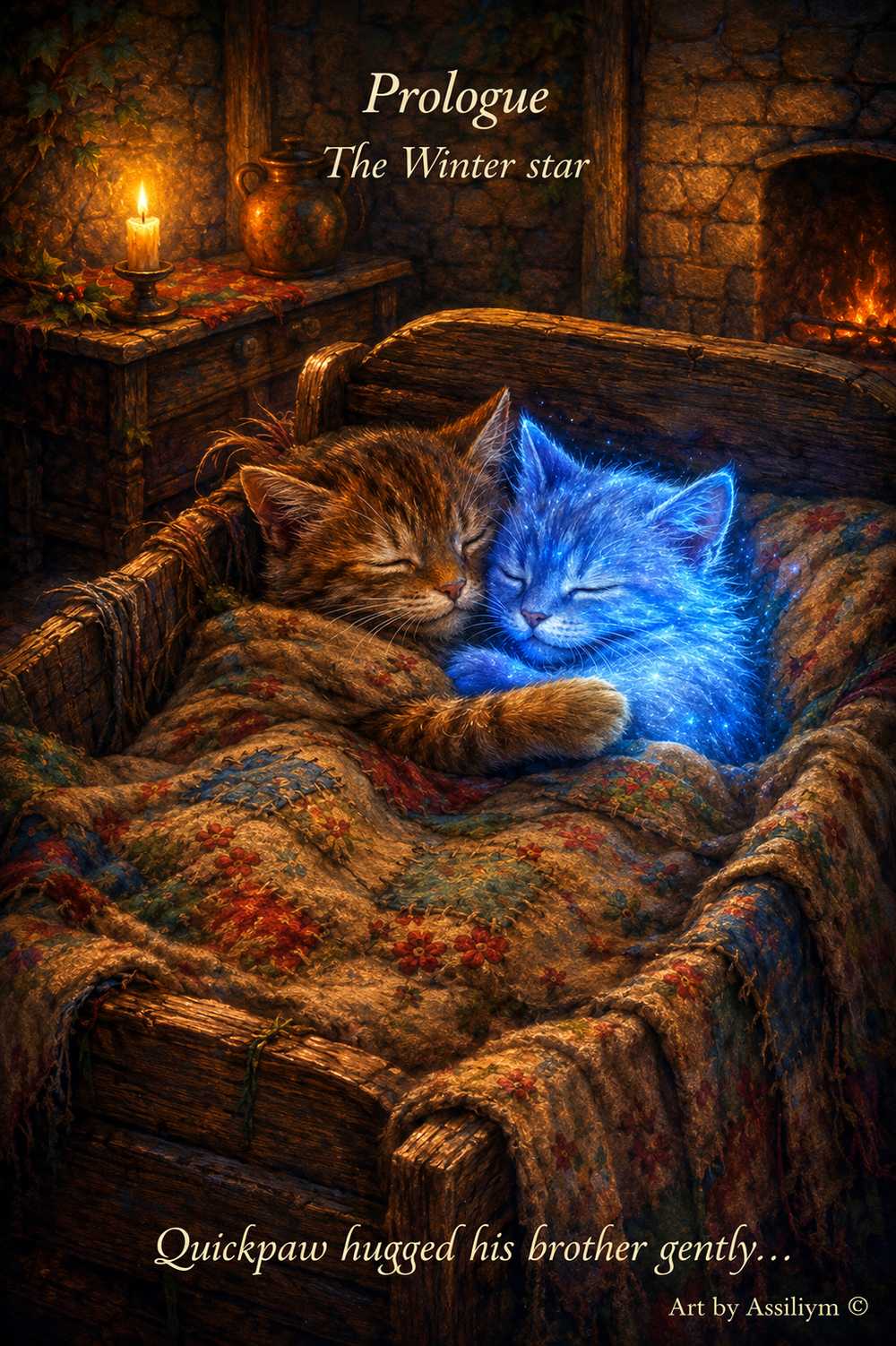
They laid him beside Quickpaw.
The cradle was small, the blanket thin, and the world outside pitiless. Yet under that patched wool there were now two tiny bodies instead of one, breathing in uneven little sighs as the last warmth of the room gathered around them like a blessing too humble to call itself such.
Quickpaw turned in his sleep and pressed one paw against Bluepaw’s side.
Bluepaw, still half-lost to cold and mystery, made a soft sound and curled closer.
The mother stood over them for a long time, saying nothing.
When it was done, Toma stood with the coins in his paw and looked at them.
They were not enough for pride.
But perhaps they were enough for soup.
He went first, without letting himself think too much, to the butcher’s stall. The butcher, a broad red-faced tom with arms like hams and mercy only in accidental moments, was hacking at a joint of meat when Toma approached.
“Scraps?” Toma asked.
The butcher glanced at him, at his patched coat, at the coins.
“Bones.”
“If there’s a little fat on them.”
“There’s always a little fat if one loves imagining.”
Toma laid down two coins. The butcher sighed as though charity had personally offended him, then swept into a paper twist a handful of bones, a strip of gristle, and, by grace or inattention, one small piece of meat clinging red at the edge.
Toma took them as reverently as another cat might receive relics.
The butcher’s apprentice, a narrow little tom named Lio, leaned closer and whispered, “Was it true, Master Toma?”
Toma paused. “Was what true?”
“That you found a blue kitten fallen from a star.”
The butcher grunted. “Lio, if you must gossip, at least do it while cutting something.”
“I heard Mother Brindle say one moon lost him and the other refused to admit it,” Lio insisted.
“That is because Mother Brindle sells onions,” said the butcher. “A cat who sells onions must perfume them with lies.”
Toma tucked the parcel more securely under his arm.
“He is a kitten,” he said.
Lio’s ears lowered, not with disappointment, but with the stubborn awe of kittens who are not easily rescued from wonder.
“Still,” he said, “a blue one.”
Toma had no answer to that.
From there he went to a vegetable stall and bought one carrot, two turnips no one else had wanted, and half a cabbage whose outer leaves had frozen brown. He turned the coins in his paw.
There were enough left for one more thing.
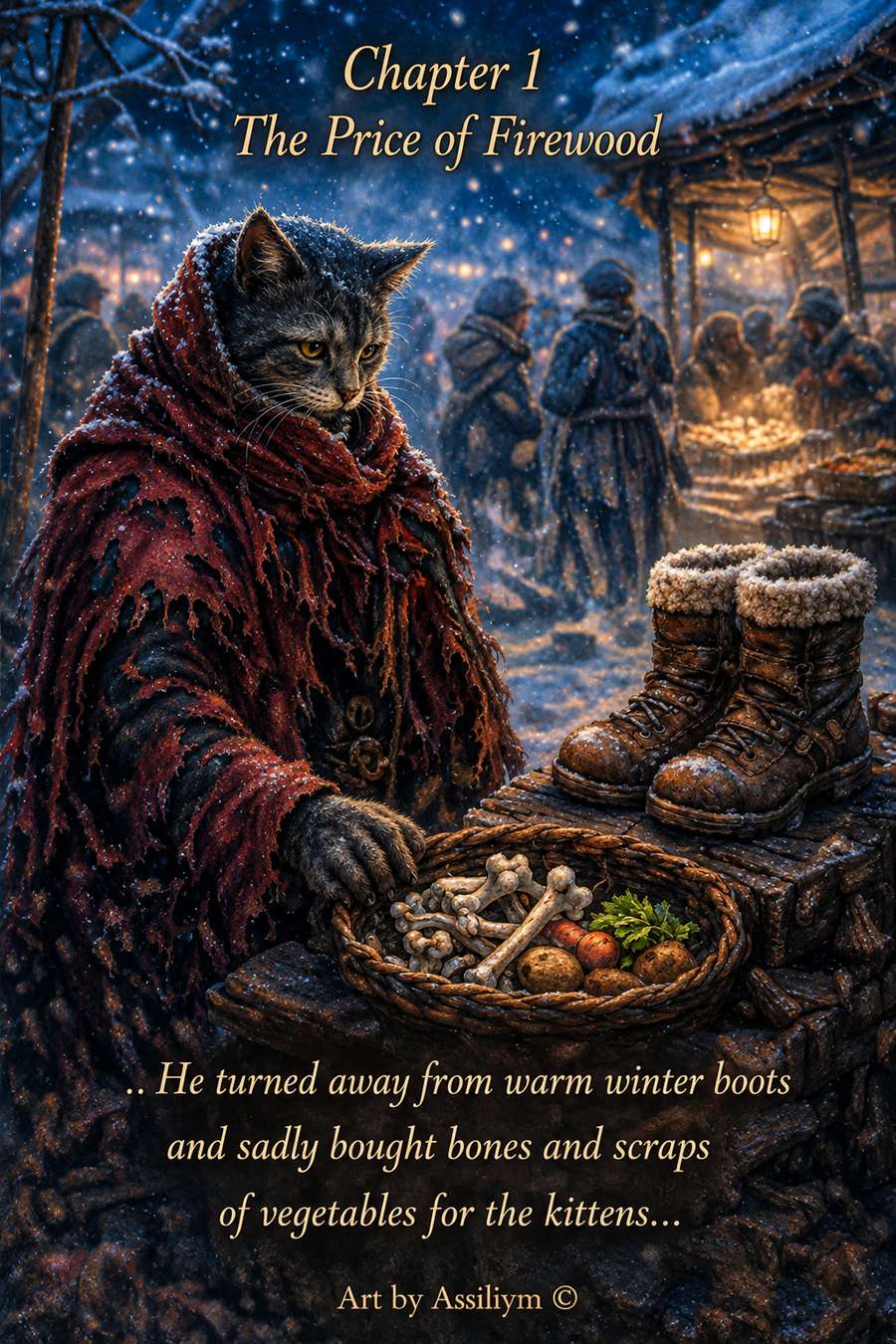
And there, across the lane, hung from a cobbler’s peg a pair of plain winter shoes. Not fine ones. Not soft. But whole. Whole soles. Whole stitching. Leather that had not yet given up its argument with the world.
Toma stopped.
For a long moment he looked at them.
He did not touch them. A poor cat learns not to insult necessities by handling them as though they were luxuries. He only stood and looked while the cold crept through the wrappings around his feet.
Whole shoes.
He imagined the walk home without wet seeping through.
He imagined the forest path not cutting him at every hidden edge.
He imagined Mara not wincing when she saw his feet.
Then he looked down at the paper parcel in his arms.
Bones.
Turnips.
The little piece of meat.
Enough for broth thickened into something nearly celebratory.
In his mind he saw Quickpaw waking to the smell.
Bluepaw making those strange soft sounds he made when warmth reached him.
Mara standing over the pot, stirring with that serious concentration she brought to every miracle of poverty.
Toma let out a breath and turned away from the shoes.
When he reached home, dusk had already begun to gather in the trees.
The cottage door opened before he could knock properly. Mara had been listening for him.
When she saw the paper parcel in his arms, real light came into her tired face for the first time that day.
“Toma.”
He held up the vegetables a little awkwardly, as if embarrassed by their smallness.
“For the pot,” he said. “And bones.”
Mara took the parcel from him as though it were treasure.
“To the saints with kings,” she whispered. “Tonight we dine.”
He laughed then—quietly, so as not to wake the kittens—and stepped inside. The room smelled of cold wool and waiting. Quickpaw and Bluepaw were awake in the cradle, two tiny faces turned towards the sound of the door, as solemn as magistrates and much hungrier.
Mara was already half across the room to the hearth when she stopped.
She turned back.
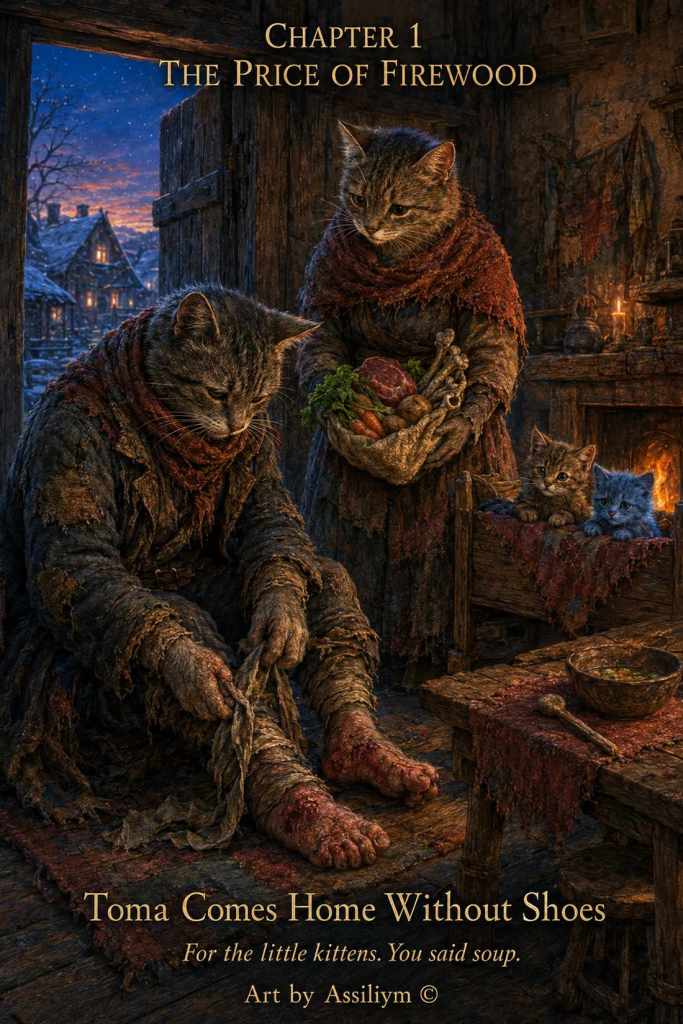
Toma had bent to untie the wrappings from his feet.
There were no shoes.
Only strips of old leather and cloth wound round his paws and lower legs, damp through, dark with melt, and frayed to threads at the edges.
Mara stood quite still.
“You didn’t buy them,” she said.
Toma glanced up, still busy with the knots. “Buy what?”
“Shoes.”
He shrugged lightly. “I am still acquainted with the ground. We remain on speaking terms.”
Mara set the parcel down slowly.
“Toma.”
“It is all right.”
“It is not.”
He unwound the last strip. The skin beneath was reddened and raw in places where cold and rubbing had done their work together.
“I bought meat,” he said, in the practical tone of one explaining a sum too obvious to dispute. “And vegetables. For the little kittens. You said soup.”
Mara looked at his feet, then at the cradle.
Quickpaw had begun to paw at the blanket, sensing excitement without understanding it. Bluepaw watched with his grave blue silence, as though he already knew that joy in poor houses often arrived leaning on pain.
“You should have bought them for yourself,” Mara said, and her voice broke a little on the last word, not from anger, but because tenderness and misery are near relations.
Toma shook his head.
“I am all right.”
He held up the strips of leather and cloth with a smile that was too gentle to be called brave.
“I’ll dry them by the fire,” he said. “And tomorrow they will pretend to be shoes again.”
At last the soup was ready.
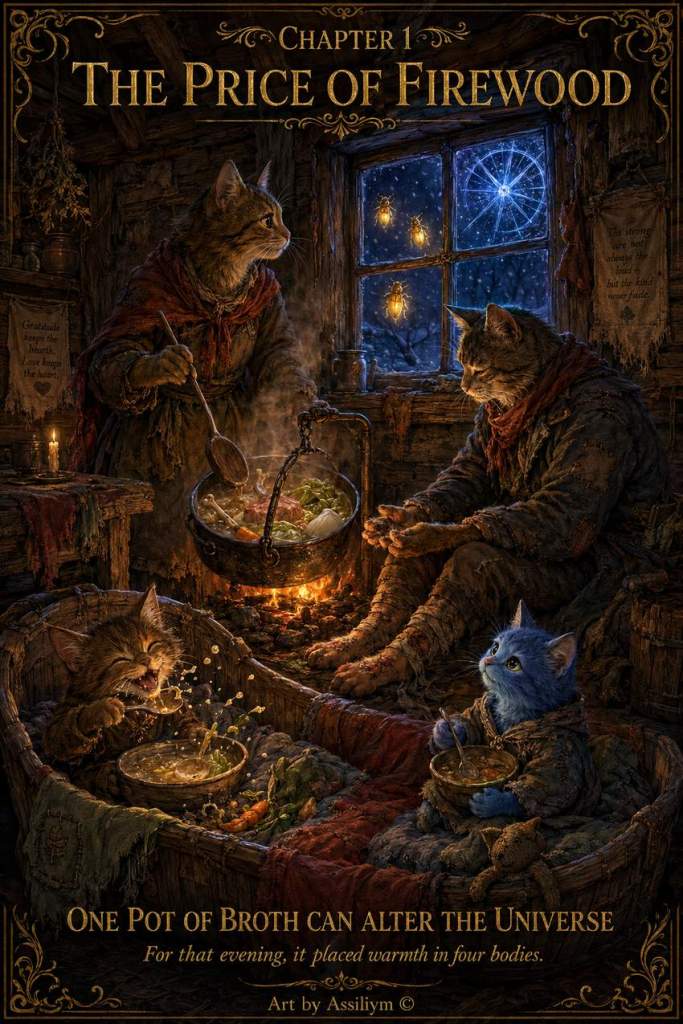
Mara poured a little into a cup to cool for herself and Toma, and a smaller portion, thinned further, for what could be safely given to the kittens. They ate slowly because there was not enough to eat quickly. Toma drank as if each mouthful apologised to his body for arriving late. Mara pretended not to watch him. He pretended not to know.
Quickpaw made a glorious mess of his share, accepting nourishment as a battlefield victory.
Bluepaw took his more quietly.
Yet when warmth reached him, he gave that small strange sound again: not quite a purr, not quite a sigh, but something deep and contented, absurdly solemn for so tiny a chest.
Toma smiled despite his pain.
“There,” he murmured. “He approves of your disgraceful pot.”
“My pot has survived worse critics than blue stars,” Mara said.
But she smiled too.
The beetle-lamps at the window shifted. Their little lights made three trembling dots on the glass. For a moment they stood in a line. Then one crawled higher, and the shape became almost like a cradle, or a bridge, or two small stars joined by a thread.
Mara, spoon in paw, stared at it.
She remembered Mother Brindle’s nonsense from the market, though she had not meant to remember it:
One moon watches, one moon weeps,
one lost kitten never sleeps.
No. That was not how it went. Was it one lost kitten, or two? Had the old she-cat said one? Had she said two?
The rhyme slipped away before Mara could catch it properly, as old rhymes do when they are not yet ready to become evidence.
The soup did not make them rich.
It did not mend Toma’s feet.
It did not fill the shelf, or patch the roof, or persuade winter to pass by their cottage with a more merciful face.
But for that evening, it placed warmth in four bodies.
— CHAPTER 2 —
The night drew itself more closely about the little cottage.
The poor fire had done what it could. It had taken Toma’s precious scraps of wood and Mara’s patience and made, for one brief hour, a room that no longer felt like the inside of a frozen grave. But winter is a creditor that does not forget. Already the warmth was thinning. The corners of the cottage had begun to fill again with that pale, stealthy cold which enters without sound and sits down wherever it pleases.
Still, after the soup, after the little comfort of seeing both kittens fed and warm, the house felt richer than it had that morning.
The pot hung empty, its thin broth reduced to a memory on the iron.
The leather strips near the fire had begun to dry.
Quickpaw and Bluepaw lay together in the cradle, though “lay” was a courtesy granted mostly to Bluepaw. Quickpaw had once more waged war upon his blanket and won. One hind leg stuck out at a heroic angle, and his tail twitched now and then with the solemn ferocity of someone fighting dragons in his sleep.
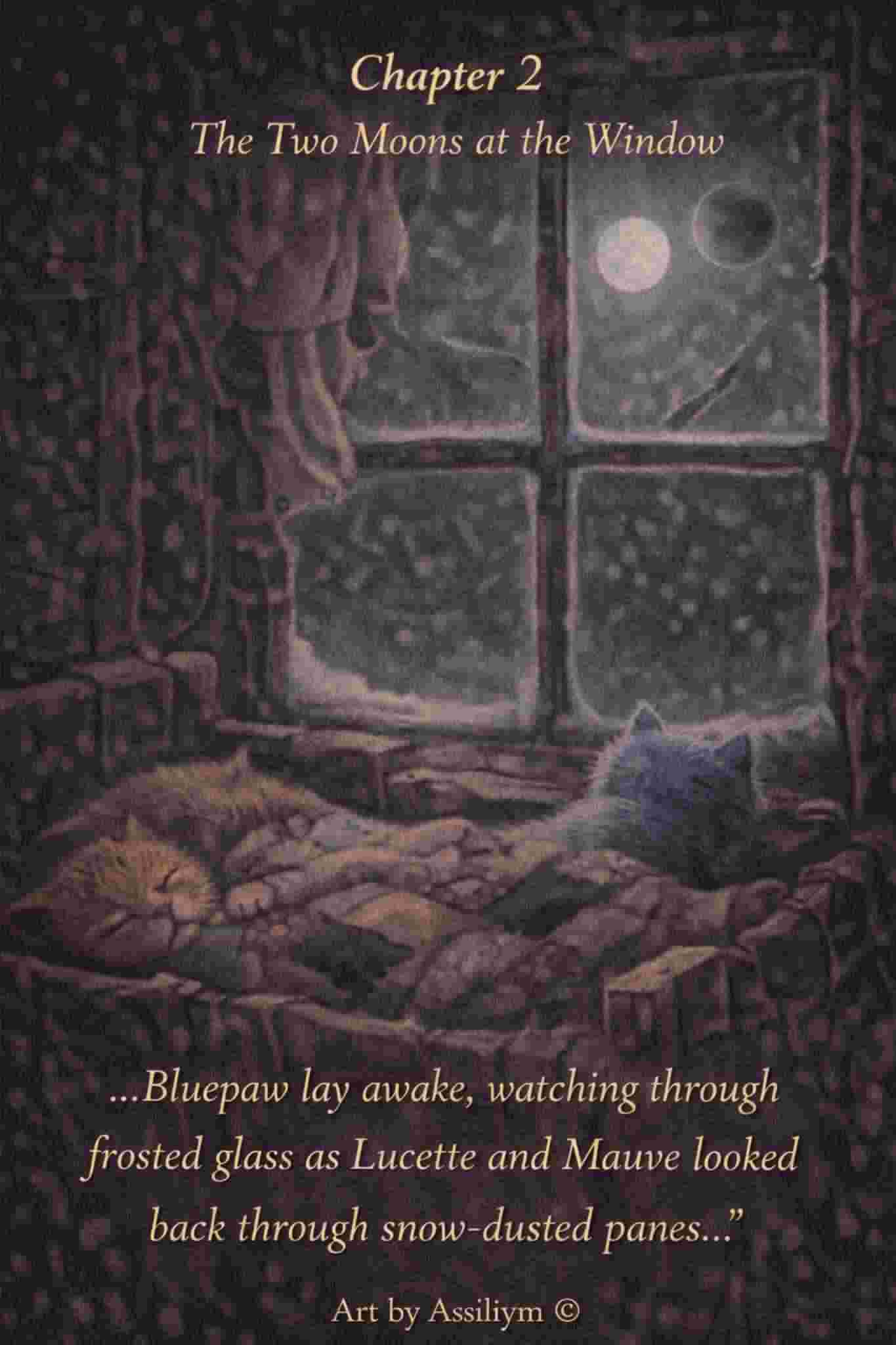
Bluepaw was awake.
Mara noticed it first.
She had been mending by the fire, though mending was too hopeful a word for persuading rags to remain on speaking terms with one another. Her needle moved in and out of an old sleeve while her eyes, as mothers’ eyes do, kept straying always back to the cradle. Quickpaw kicked. Quickpaw sighed. Quickpaw attacked the air with one small paw. Bluepaw did none of these things.
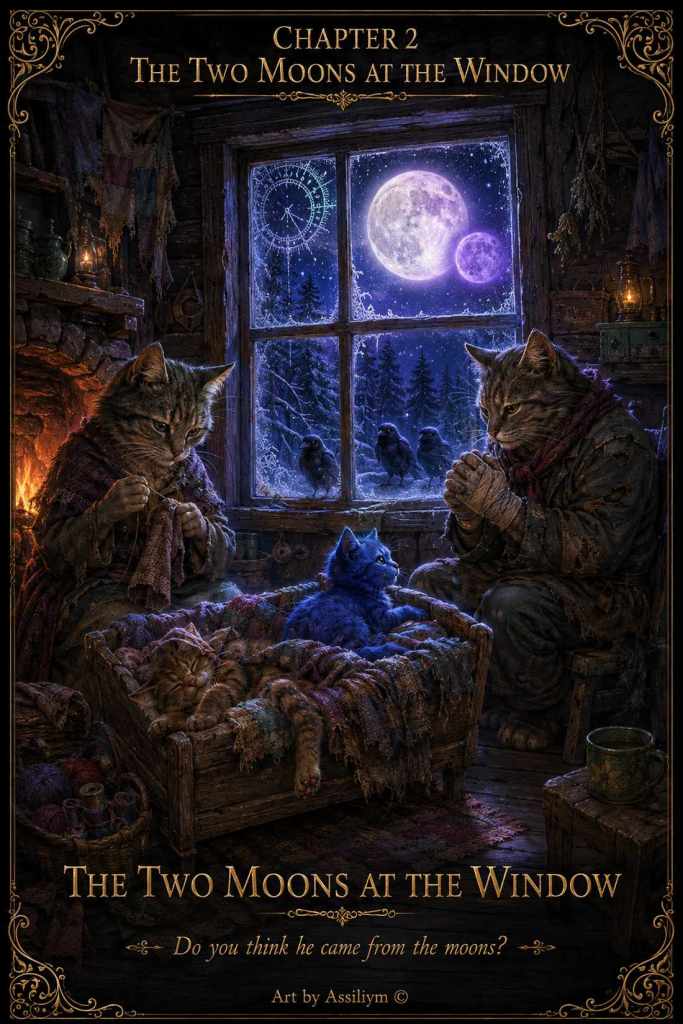
He was looking at the window.
Not merely turning his head towards it, as any kitten might turn towards light. He was watching it with that strange, still seriousness that had already begun to make Mara’s heart ache in ways she could not explain.
The frost on the pane had grown thick again, veining the glass in white branches and silver feathers. Beyond it there was, at first, only the dim blur of snow and night. Then the clouds shifted.
A pale light entered the room.
Softly at first, like milk poured into dark water.
Lucette had risen.
On Neon, the poor and the rich alike knew her. She was the milk moon, round and pale and tender-eyed, though poor cats often said she looked tender only because she watched them from too great a distance to hear what winter said indoors. Her light spread over the drifts outside the cottage and turned them to silver fleece. The black line of the forest softened. Somewhere beyond the trees the frozen stream shone like a knife laid down in prayer.
Then, a little later, as if she disliked arriving unannounced, came Mauve.
Not so bright as Lucette.
Not so wide.
Not so gentle.
Mauve was the ink moon, darkened as though some giant paw had brushed her with the end of a writing quill. Even when full, she always seemed marked by thought. Old village cats said that Lucette looked down to pity the world, but Mauve looked down to remember it. Her dimmer, stranger light mingled with Lucette’s through the frosted pane and laid a second colour over the snow—a bruised violet hush, faint as old sorrow.
Under the two moons, the whole edge of the forest seemed changed.
The snow beyond the window was no longer merely white. It had taken on both lights at once, pale and shadowed, as if the world could not decide whether to sleep or confess.
In the upper corner of the pane, the frost-wheel from the night before had returned.
It was smaller now, almost shy. A ring of white. A second ring inside it. Tiny teeth between them, delicate as lace and wrong as bone. When Lucette touched it, the little wheel glimmered. When Mauve touched it, a shadow appeared in its hollow centre — not the shadow of anything in the room, but a darkness that seemed to be looking out.
Mara’s needle paused.
The mark was only frost. Of course it was only frost. Poor mothers had no time for haunted windows. If one began fearing every pattern winter made on glass, one would never mend a sleeve, boil a pot, or survive until thaw.
Yet the tiny white teeth of the wheel seemed almost to turn.
Bluepaw did not blink.
He stared at Lucette and Mauve with such deep and speechless attention that even Toma, who had been rubbing warmth back into his sore paws, lowered his paws and followed the line of the kitten’s gaze.
For a while neither he nor Mara spoke.
Quickpaw, after one mighty squirm of his whole small body, managed somehow to wedge both hind feet against the cradle’s side and make a face of such profound concentration that Toma nearly laughed aloud. But even Quickpaw’s efforts could not disturb the hush entirely. The room had gone quiet in a different way now, as if the two moons themselves had leaned close to listen.
Mara set aside her mending.
“Toma,” she said softly.
He looked at her.
She did not look at him at first. Her eyes remained on Bluepaw.
“Do you think…” she began, then stopped, as if ashamed of the thought.
Toma waited.
At last she said, in almost a whisper, “Do you think he came from the moons?”
Toma frowned.
“Did you hear that?”
“The wind,” Mara said too quickly.
“The wind has become opinionated.”
“Then perhaps it has been listening to you.”
He leaned over the cradle, looked at the little blue kitten under the double moonlight, listened to the tiny rumbling engine of contentment in his chest, and repeated softly, with sleepy mockery,
“Purr-purr…”
Then, because tiredness blurs sounds and tenderness softens them, the word changed a little in her mouth.
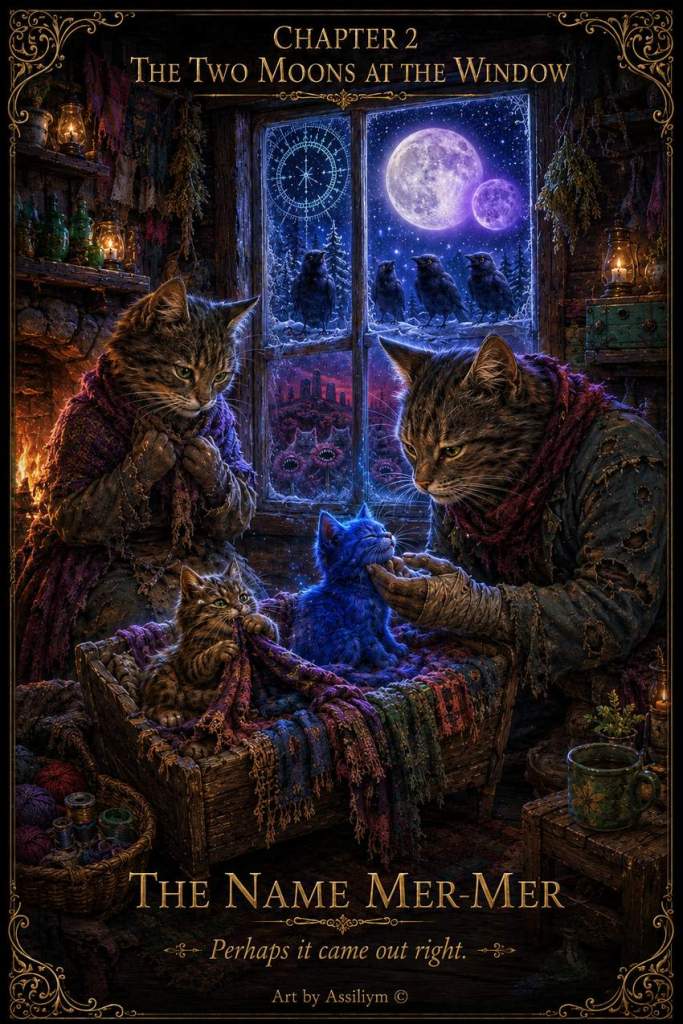
“Mer-mer,” she said.
Toma looked up.
Mara herself blinked, as if surprised by what she had just heard.
Quickpaw, excited by the sound of voices, squeaked and flailed one paw in support of confusion.
Toma smiled slowly.
“Mer-mer?”
Mara gave a helpless little shrug.
“It came out wrong.”
“No,” said Toma, still stroking the blue kitten’s chest until the purr went on and on in happy shivers. “Perhaps it came out right.”
Outside, Lucette and Mauve climbed higher.
The milk moon laid a pale road over the snow.
The ink moon darkened the edges of the forest, turning every tree into a line of script no cat could read.
The bone-willows by the frozen stream shone faintly.
The pendulum-grass ticked once more beneath the wind.
Far away, somewhere beyond the reach of the clearing, a night-creature called and was answered by none.
Then, across the whitened stream, the ice gave one sound like a page being turned.
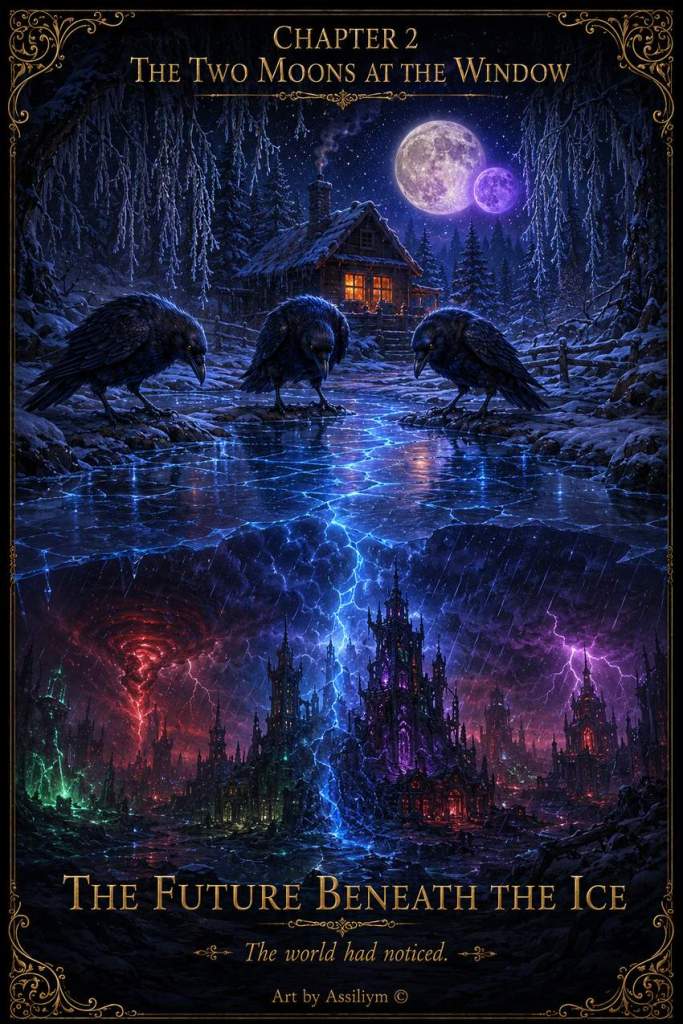
A thin crack opened from bank to bank. Not wide enough to break. Not deep enough to matter. Only a hairline fracture through which blue light briefly breathed.
In that blue breath, something appeared beneath the ice: not fish, not water, but a sky filled with storm. Towers stood in the distance, crooked and black against clouds that moved like armies. For one dreadful instant, the frozen stream reflected not the present forest, but some future Neon where rain came sideways and the world seemed to have forgotten how to stop dying.
Six rolls of thunder shuddered in silence behind the glass of the vision.
Then came one still blue pause.
A lull.
Mercy, perhaps. Or only exhaustion.
Then the crack sealed.
The stream became ice again.
No one in the cottage saw it.
Only the whisper-crows saw. And crows, being wise, told no one until much later, and then only in a language cats mistook for bad weather.
Inside the cottage, Mara and Toma fell quiet again.
Quickpaw, exhausted by his own rebellion, at last surrendered to sleep, one paw flung over toward his brother as though even unconsciousness must be shared. Mer-mer remained awake for a little while longer.
He looked past the room.
Past the cracked pane.
Past the frost.
He looked at Lucette, the milk moon, and Mauve, the ink moon, with a stillness too old for infancy and too innocent for fear.
For one moment, reflected in his dark kitten eyes, the two moons did not look like two.
Behind Lucette there was a pale bridge of light. Behind Mauve there was a smaller shadow, almost hidden, almost erased. Mara would later remember nothing of it, because she had been too tired and too full of love to study reflections in a kitten’s eyes.
But somewhere, in a story not yet ready to become true, an old rhyme stirred and turned over in its sleep:
Two moon-kits in one cradle lay,
one dawn-bright, one stolen away.
Name the first and lose the other;
forget the sister, bless the brother.
— CHAPTER 3 —
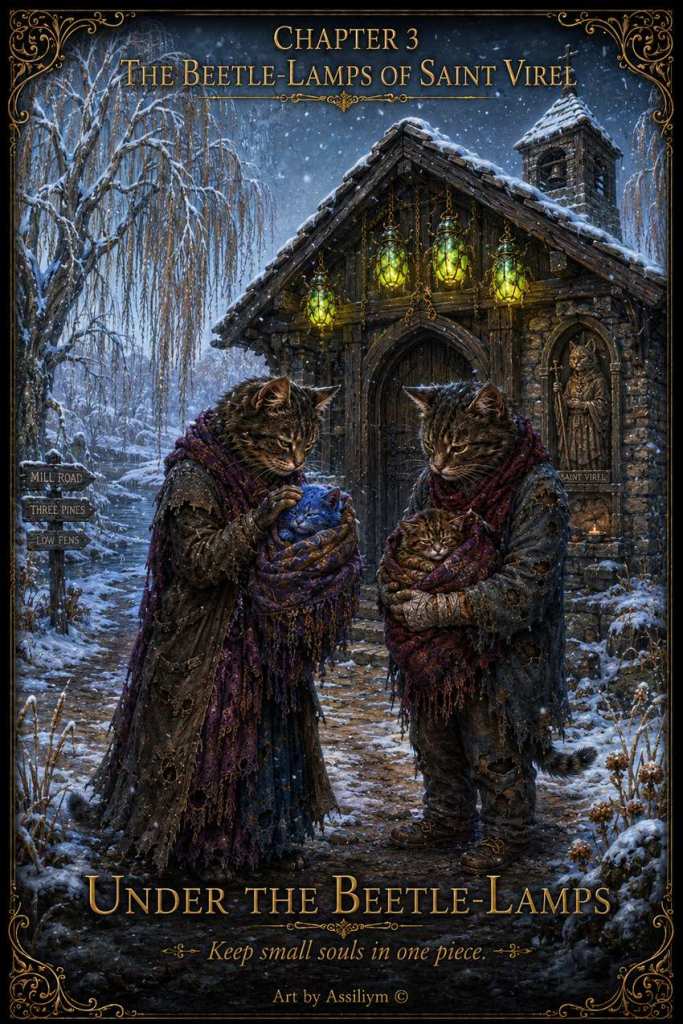
At the bend in the road the frozen stream appeared, black beneath its crust of ice, with the bone-willows leaning over it in pale, rigid clusters. Their branches gleamed faintly, as though the winter sun had forgotten bits of old glass upon them.
Saint Virel’s chapel stood beyond that, where three roads met.
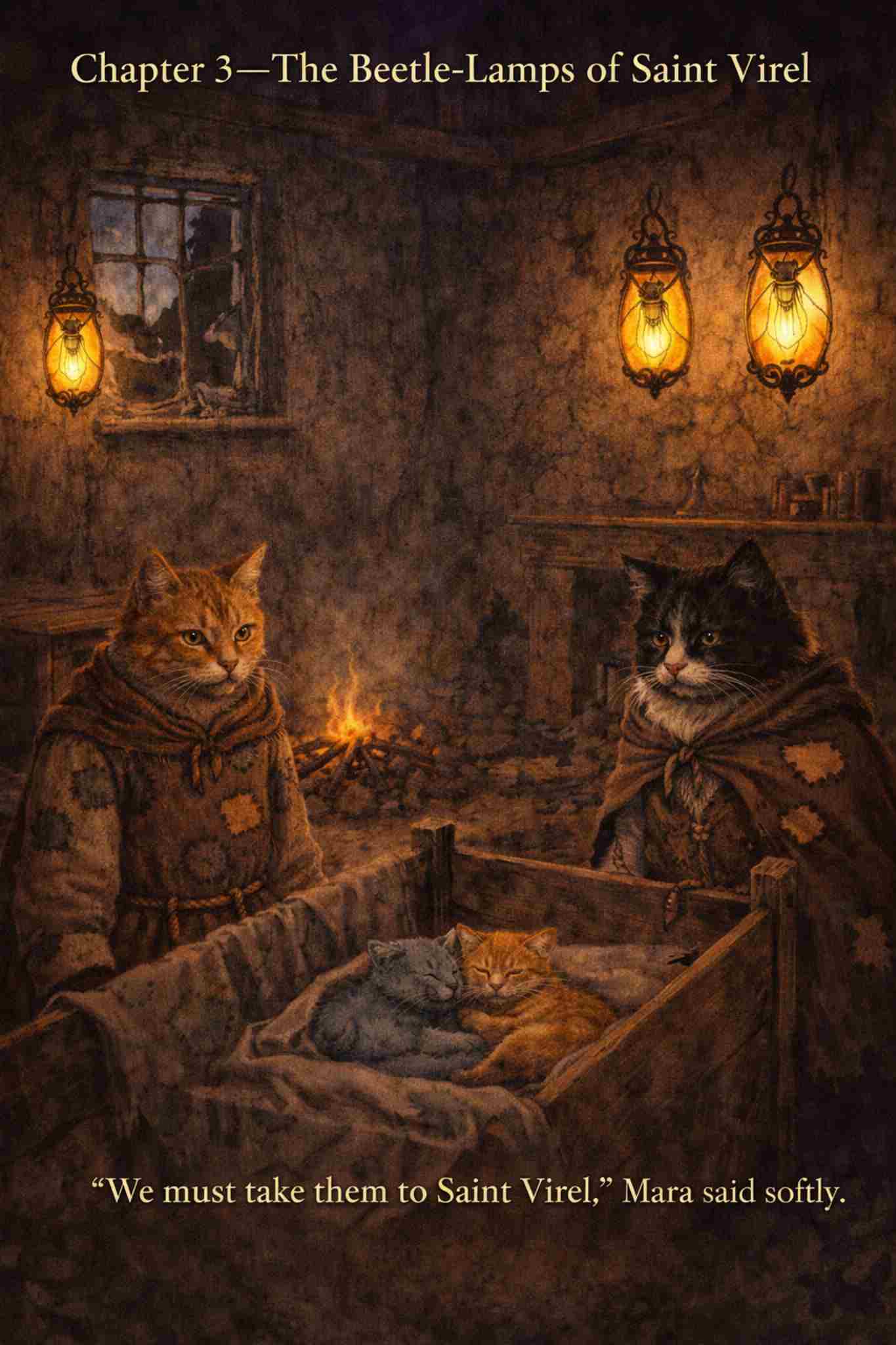
It was a small place, built long ago of dark wood and rough fieldstone, with a bell no larger than a soup pot and a little porch under whose eaves hung four beetle-lamps. Even by day they glowed with soft, living pulses of green-gold light, their folded shells shining like polished beads. Richer churches had stained glass, silver chalices, and polished saints with calm painted eyes. Saint Virel had beetles, weather, and devotion worn thin by many poor paws. Yet under the lamps the little porch looked almost holy enough to warm itself.
The beetle-lamps were old — older than Father Elric, older than his predecessor, older perhaps than the chapel register with its worm-bitten cover and badly spelled baptisms. Village kittens were told that Saint Virel himself had carried the first beetle through a snowstorm in his mouth, because his paws were full of orphans and his tail was busy keeping wolves away.
This was almost certainly false.
In another version, told by old Mother Brindle when she had drunk warm cider and wished to be impressive, the beetles had once been stars fallen into insects after the Great Clock sneezed.
This was also probably false.
In Father Elric’s preferred version, beetle-lamps were beetles, and cats who made theology out of bugs deserved sermons of punitive length.
That version was dull enough to be widely respected.
The village kittens, naturally, preferred a fourth version, because any story approved by Father Elric had already suffered a fatal wound to its entertainment. They sang it near the well when no adult seemed close enough to correct them:
Blue monk, blue monk, hide your book,
King comes knocking, do not look.
Page goes under, bell goes dumb,
Read one line and lose your thumb.
“That is disgusting,” Lysa had declared, which meant she admired it and intended to improve it before supper.
Father Elric had forbidden the rhyme twice. That had been a mistake. Forbidden things travel among kittens faster than fleas in a blanket, and with considerably more confidence.
A carved image of the saint stood in a niche by the door: a travel-worn cat in a patched cloak, one paw raised in blessing, the other holding a little lamp. His muzzle had been rubbed half smooth by years of paws and kisses. Someone had tucked a dried sprig of winter-thyme behind one wooden ear.
Mara stopped beneath the lamps and touched two claws to the beam, then to Quickpaw’s blanket, then to Mer-mer’s.
“Keep small souls in one piece,” she whispered.
Toma touched the beam too.
“And spare them their father’s luck,” he added.
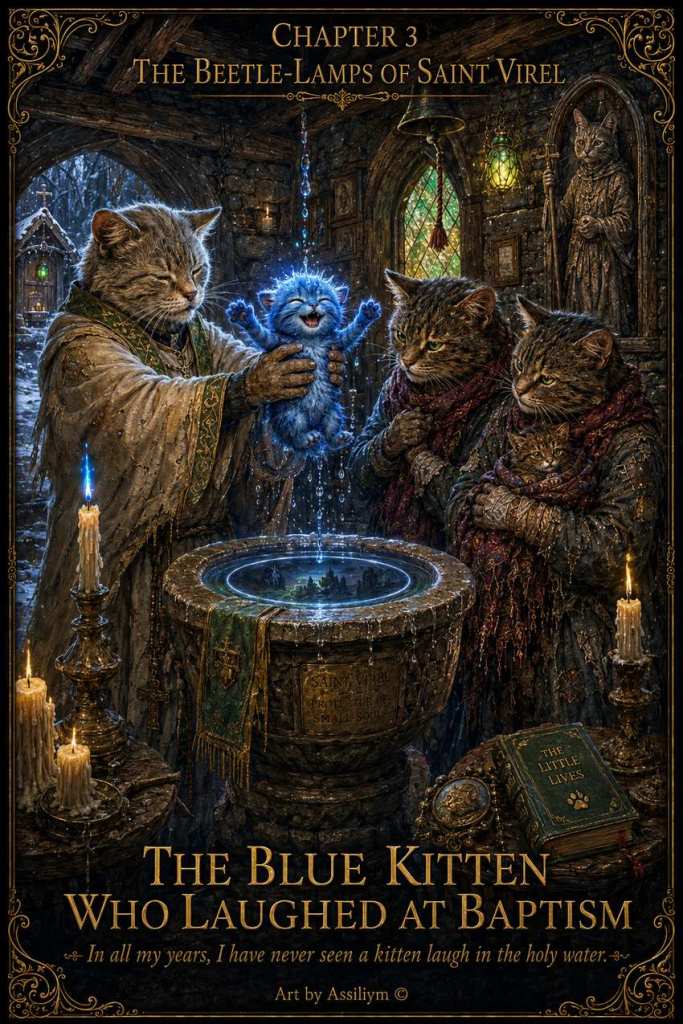
The priest saw the fur.
Blue.
Not dyed blue, not stained, not made theatrical by market trickery. A deep quiet blue, soft as dusk, lying there in the arms of a poor mother as naturally as if the world had always contained such kittens and he alone had been too inattentive to notice.
The priest’s expression changed.
His brows rose. He blinked once. The impatience drained out of his face like water from a basin with a crack in it.
He stepped forward.
“What is this?”
“A kitten,” said Toma, with the bland courage of the poor, who sometimes defend themselves best by pretending not to understand the wonder in other cats’ voices.
The priest stared a moment longer.
Then, recovering himself, he straightened his stole, drew his dignity back around him like a cloak, and said in a voice much altered from the one before:
“All right. Come to the font.”
Mara obeyed at once.
The font at Saint Virel was made of old stone veined like river ice. The holy water inside it was colder than any water had a right to be indoors. The priest took up the small silver shell used for pouring and opened the register upon the lectern.
The chapel beetle-lamps outside dimmed.
Inside, the candle-flames narrowed, not as if blown by wind, but as if the air itself had leaned sideways. The water in the font, perfectly still a moment before, tightened into one small circle. Not a ripple. Not a splash. A circle, drawn from within.
Father Elric did not see it at first. His eyes were on the register.
Mara saw it.
In the round dark surface of the holy water, she saw not the chapel roof reflected, but a cliff of black stone under green lightning. Then a sea — impossibly high, rising like a wall with stars drowned inside it. Then nothing.
The vision lasted so briefly that it might have been the shadow of the priest’s sleeve.
Mara almost stepped back.
But Quickpaw kicked inside his bundle, Mer-mer breathed against her wrist, and the water became water again.
“The names,” he said.
Mara and Toma looked at one another.
“Quickpaw,” said Mara.
The priest’s pen paused, but only briefly. Village clergy have heard worse.
“And the other?”
Mara hesitated the width of a heartbeat. Bluepaw belonged to the snow, to the hearth, to the secret of the cottage. But the village now knew another name, and names given under moonlight have a way of following a creature farther than the ones chosen in daylight.
“Mer-mer,” she said.
The priest wrote.
His pen scratched once, twice, and then stopped.
The wet ink on the page seemed, for half a second, darker than ordinary ink. It gathered itself too neatly around the name, as though the letters had weight. Father Elric frowned, tapped the nib, and watched the ink settle into harmless black.
Mer-mer.
He looked at the word and, for reasons he could not defend, suddenly remembered a nonsense line from his grandmother’s hearth:
Blue kitten, brown kitten, one house door;
one came hungry, one came before.
That was all he remembered. He disliked it immediately. Priests prefer complete prayers and authorised hymns. Fragments behave like mice in doctrine.
“Very well. Quickpaw first.”
Toma took Quickpaw from Mara’s arms. Quickpaw had been dozing with the complacency of the recently fed, but the moment he found himself in a stranger’s paws beneath a cold church light, suspicion overtook him. He frowned with all the concentrated offense a kitten can summon.
The priest dipped the silver shell, raised the water, and let it fall upon the little brow.
Quickpaw reacted as though all theology had conspired personally against him.
He let out a cry of such pure indignation that the candles themselves seemed to tremble. His paws flew. His tail stiffened. His whole body declared war upon sanctity, weather, and moisture alike.
Mara’s heart lurched toward him, but Toma held him gently and murmured, “There now, there now,” while the priest, who had baptized enough village infants to be unmoved by outrage, finished the blessing with professional speed.
“Quickpaw,” he said, “I receive you into the keeping of Saint Virel and the mercy of the Highest—”
Quickpaw screamed louder.
The priest glanced up.
“A spirited kitten,” he said dryly.
“Spirited?” murmured Toma. “Father, he has denounced the Church.”
Mara would have laughed if her own nerves had not been wound so tight.
At the very moment Quickpaw shouted his outrage, the chapel bell outside answered him.
Not loudly.
Only one small iron note.
Bong.
Father Elric stiffened.
He looked toward the door.
“That bell is not to be rung until vespers.”
Quickpaw hiccupped, deeply satisfied with this institutional damage.
Toma murmured, “He has allies.”
The priest ignored him.
Then came Mer-mer.
The priest took him more carefully.
Not reverently, not yet; but with the curious caution one uses for strange glass or foreign fruit. Mer-mer did not cry. He looked up at the priest’s face, then at the shell, then at the candlelight on the stone ceiling.
The water fell.
It touched the blue kitten’s brow and ran in a clear bright line between his little ears.
Mer-mer blinked.
His mouth opened.
And instead of crying, he laughed.
Not a full laugh, for he was too small yet for that. But a delighted little bubbling sound, a kitten’s giggle, startled and pleased, as though the holy water had not offended him at all but had whispered some private joke too soft for others to hear.
The chapel went still.
Even Quickpaw, in the brief pause between protests, seemed taken aback.
The priest stared.
Mer-mer laughed again. His little paws flexed in the air. The sound echoed faintly under the stone roof, absurd and pure and entirely out of place in that cold solemn room.
The echo did not end correctly.
It touched the stone, returned once as laughter, returned twice as a soft tick, and returned a third time as something that might have been a very distant chant.
Tik—
No.
Only the drip of water from the shell.
Father Elric’s ears flattened. He told himself at once that cold chapels make poor acoustics. This was true. It was also insufficient.
The priest lowered the shell very slowly.
“In all my years,” he said, and his voice had lost every shred of impatience now, “I have never seen a kitten laugh in the holy water.”
Toma swallowed.
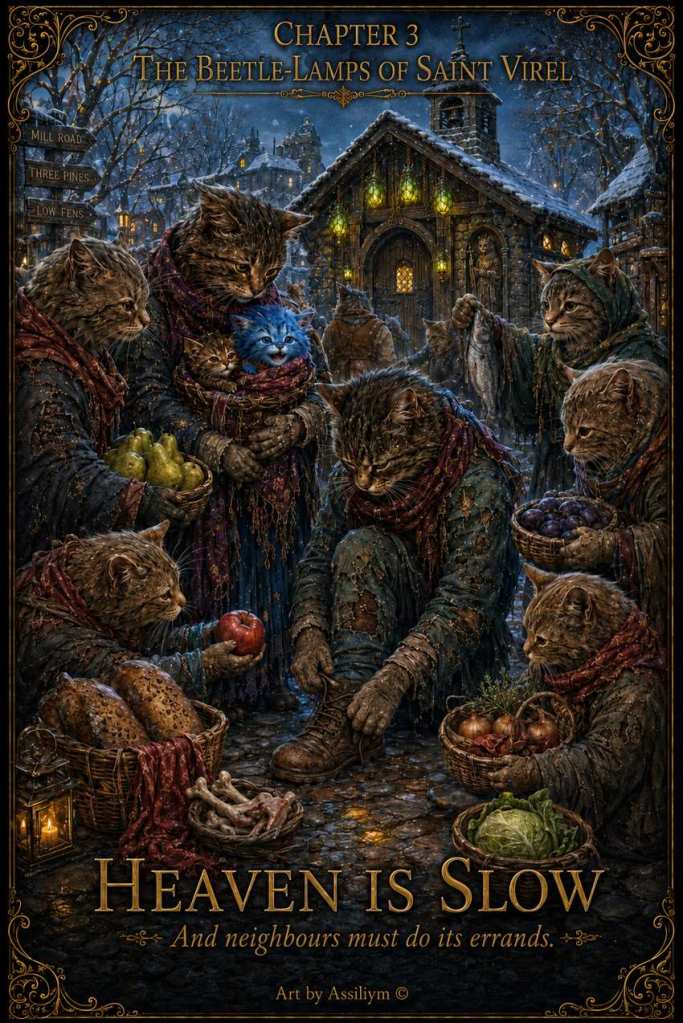
Near the fish cart, a shallow tub of moon-fish flashed silver. They had been dull a moment before, resigned to commerce and death. Now they turned all at once, every little body facing Mara’s bundle.
The fish seller saw it and slapped the tub with her wet paw.
“Stop looking religious,” she hissed at them. “You are three coins a string.”
The moon-fish ignored her, which fish do well.
Then the first of them came near: not the servant she-cat this time, but an old fruit seller with one blind eye and paws red from winter. He kept a little stall of late pears, bruised apples, sour plums, and those few stubborn fruits which refuse either to rot properly or to thrive.
He looked at Mer-mer for a long moment.
“Well,” he said at last. “Would you look at that.”
Mara drew the blanket closer. Toma, however, had the practical instinct of one who knows admiration sometimes opens into trade.
“We brought them for the blessing,” he said.
The fruit seller grunted.
“I heard.” He scratched his chin. “Laughed in the water, they say.”
Quickpaw, as if unwilling to be left out of village legend, made a sudden fierce squeak.
The old fruit seller nodded toward him. “And that one cursed the priest?”
“Vigorously,” said Toma.
The old cat chuckled.
Then, with no more ceremony than that, he reached down into his stall and came up with two pears a little softer than they ought to have been, one apple bruised on one side but still red as a saint’s holiday, and three wrinkled winter plums.
“Here,” he said.
Mara blinked. “We cannot—”
“They’re not my best.”
To Mara’s eyes they were splendid.
The pears looked like golden lamps.
The apple might as well have been a jewel.
Even the wrinkled plums had the dusky richness of things too good for ordinary days.
“I have no money for fruit,” Toma said, and already his voice was rougher than before.
The old seller snorted. “Then it’s fortunate I’m not selling. Take them. A laughing blue kitten doesn’t pass my stall twice in one winter.”
He looked at Mer-mer again, softer now.
“May he bring a better season than the last.”
He tucked the fruit into Mara’s paws before she could refuse again.
That opened the flood.
A cobbler’s widow, who had been standing at her doorway listening with half a shoe in one paw, came forward next. She looked first at Toma’s feet, at the wet wrappings, the rubbed-through leather, the poor stubbornness of them. Then she vanished into her shop and emerged carrying a pair of old shoes.
They were not handsome.
They had once belonged to a fuller, richer paw.
One strap had been mended twice. The left sole was worn thin at the heel.
To Toma, they looked like something a king might wear to step into mercy.
“Take these,” she said.
He stared.
“I cannot pay.”
“I did not ask if you could.”
She thrust them toward him. “They’re old, but still good. Better than freezing like a fool in rags.”
He opened his mouth, closed it again, and took the shoes with such care one might have thought they were made of spun sugar.
A little lad beside the cobbler’s door stared at the shoes, then at Toma, then at Mer-mer.
“Does the blue kitten make shoes?”
“No,” said the widow.
“Does he make feet?”
“No.”
“Then why did he get shoes?”
The widow looked at Toma’s torn wrappings.
“Because sometimes heaven is slow, and neighbours must do its errands.”
 Vuk Stribog